Blessed John Forest, Franciscan Friar and Martyr
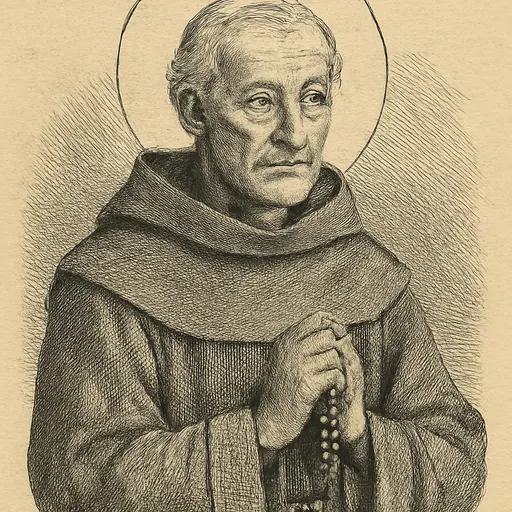
Blessed John Forest was an English Franciscan friar of the Observant reform, a preacher at Paul's Cross and confessor to Queen Catherine of Aragon. Arrested for telling penitents that King Henry VIII was not head of the Church, he was hung in chains over a fire at Smithfield on May 22, 1538. Pope Leo XIII beatified him in 1886.
Who was Blessed John Forest?
Blessed John Forest was an English Franciscan friar who was burned at Smithfield in London on May 22, 1538, for refusing to accept King Henry VIII as head of the Church. He belonged to the Observant Friars at Greenwich, the strictest branch of the Franciscans in England, and he was confessor to Queen Catherine of Aragon. We keep his feast on May 22.
He was born about 1471, probably at Oxford, and lived more than forty years as a son of St. Francis. His death was staged as a public spectacle, with a sermon, a crowd of thousands, and a wooden statue of a Welsh saint thrown into the fire beneath him. It became one of the bravest confessions of faith of the English Reformation.
The life of John Forest
Friar, preacher and confessor to the queen
Forest received the Franciscan habit as a young man at the friary church in Greenwich, beside the royal palace. Some years later the friars sent him to Oxford to study theology, and he was later known as "Doctor" Forest.
The first date in his life that his biographers trust is January 22, 1525, when he preached at Paul's Cross, the great open-air pulpit of London, at the command of Cardinal Wolsey. He became a regular preacher there.
He was also confessor to Queen Catherine of Aragon, and when Henry set out to put her aside, the Greenwich friars took her part openly. In 1532, as warden of the Greenwich house, Forest talked the king out of suppressing the whole order, for a while. Two members of his own community who opposed him reported every word to Thomas Cromwell, and in 1533 he was deposed and sent to a convent in the north.

Prison and the letters
In 1534 the king suppressed the Observants altogether. About two hundred friars were imprisoned, and by one early account fifty died in their chains. A government report of the time lists Forest as "in London, in prison there."
From these years come letters said to have passed between the imprisoned friar and the queen. They survive only in Latin and Spanish versions printed decades later, and their wording may be free. In his reply to Catherine he wrote:
Doubt not of me that by any inconstancy I should disgrace my grey hairs.
He told her he had spent forty-four years in the Order of St. Francis and was in his sixty-fourth year, and he sent her his rosary.
Greyfriars and the trap of the confessional
By early 1538 Forest was free again and living with the Franciscans at Greyfriars, near Newgate. A sworn statement by Lord Mordaunt, made to clear himself, shows how he lived there. The porter told Mordaunt's chaplain that the friar heard confessions and could be found after nine o'clock, "for he saith our Lady Mass." After confession Mordaunt said, "I perceive ye take no money," and offered forty pence. Forest asked him to give it to the porter to buy coal for the house.
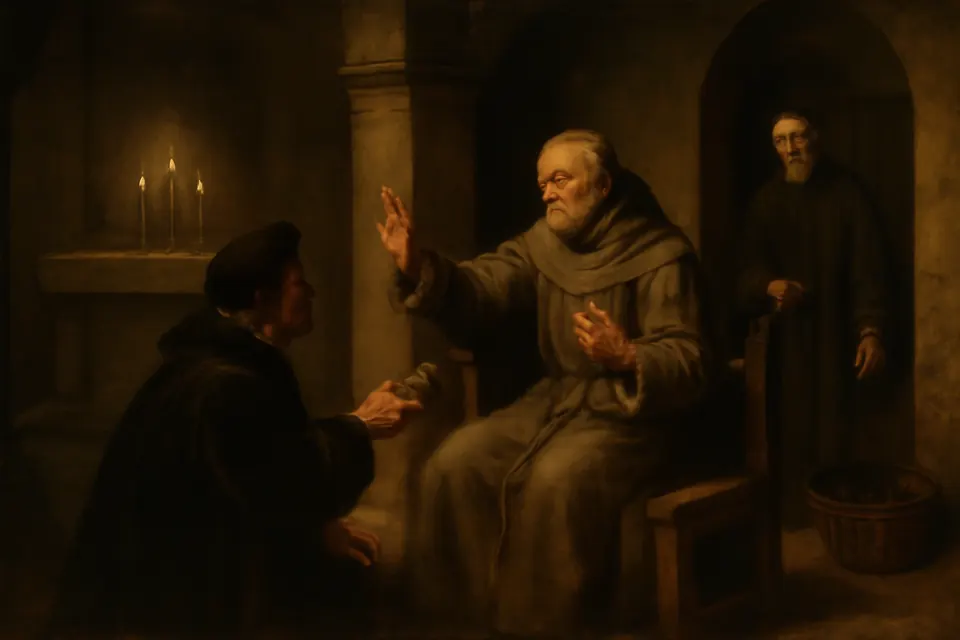
The government was looking for penitents who would testify against him, and it found one. He was arrested around the end of March 1538 because, in the words of the charge, "in secret confession he had declared to many of the King's subjects that the King was not Supreme Head of the Church."
Trial before Cranmer
On May 8, 1538, Forest stood before Archbishop Cranmer at Lambeth, charged with heresy on four articles. Three were plain Catholic belief, and the fourth twisted the Church's teaching on penance.
Two London chroniclers, both hostile to him, say he signed the articles and submitted that day. Father John Hungerford Pollen, who studied every document, thought the old friar, weakened by prison and confused by the trick in the fourth article, may have given way in some form. Whatever happened, it did not last. When his abjuration was brought to him to read, he refused it. On May 12 Bishop Hugh Latimer preached at Paul's Cross, where Forest was supposed to carry a faggot and recant in public. He did not come. Latimer could only ask the crowd to pray that the friar "might be converted from his said obstinacy."
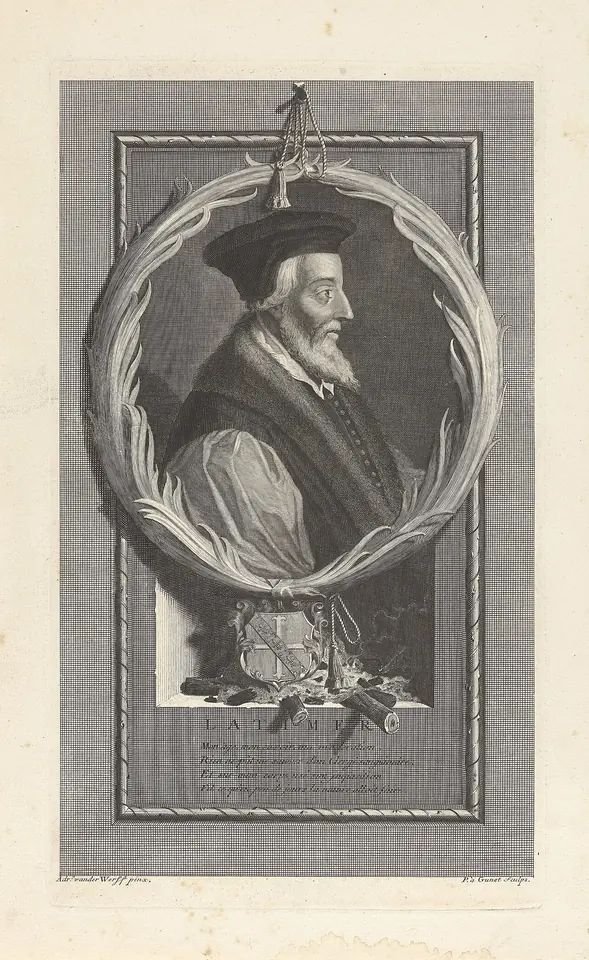
Forest was condemned as a relapsed heretic. Latimer complained to Cromwell that in Newgate the friar was "rather comforted in his way than discouraged" and might even be hearing Mass there.
The martyrdom at Smithfield
On Wednesday, May 22, 1538, a scaffold, a pulpit and a gallows were built at Smithfield beside the gate of St. Bartholomew's Hospital. The Dukes of Norfolk and Suffolk, the Bishop of London, the Lord Mayor and, by the chronicler's guess, ten thousand people came to watch. Forest was dragged from Newgate on a hurdle in his ragged habit.
Latimer preached for about an hour. Then he asked the friar in what state he would die. Charles Wriothesley, a herald and no friend of the friar's cause, wrote down the answer:
That if an angel should come down from Heaven and show him any other thing than he had believed all his lifetime past he would not believe him, and that if his body should be cut joint after joint or member after member, brent hanged, or what pain soever might be done to his body, he would never turn from his old sect of this Bishop of Rome.
Cromwell had sent for a huge wooden statue of St. Derfel Gadarn, a warrior saint, from the church of Llandderfel in Wales, and it was hoisted onto the platform beside the friar. A Spanish eyewitness, whom Pollen calls Garzias, says Forest reminded Latimer of the bishop of Rochester and Thomas More, "who renounced the goods of this world, and chose rather to die than to lose their immortal souls."
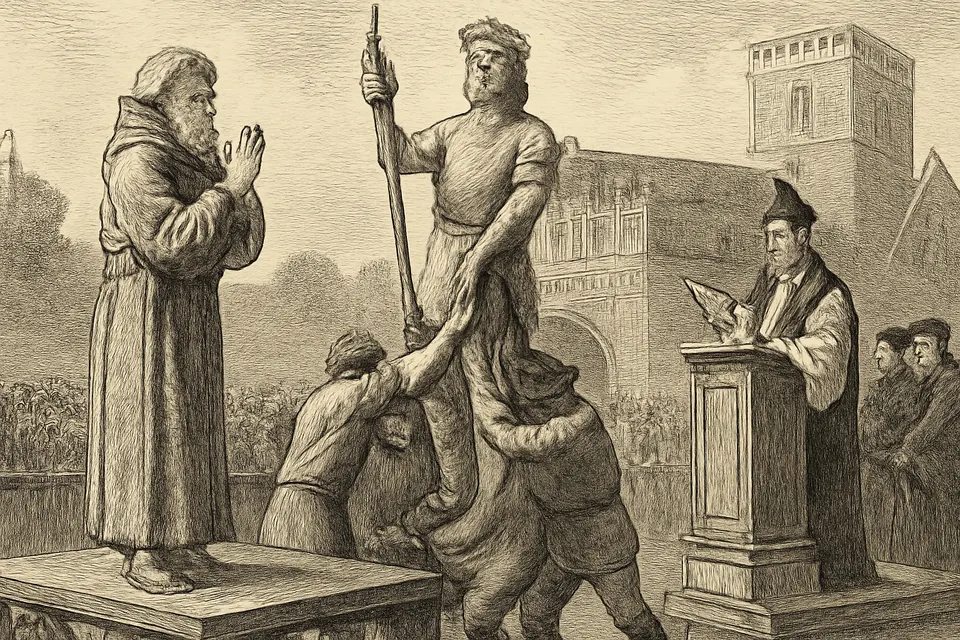
He was hung by a chain around his waist from a gibbet over the fire, and the statue was thrown into the flames beneath him. The Franciscan writer Bourchier says he prayed, "Neither fire, nor faggot, nor scaffold shall separate me from Thee, O Lord." Garzias says his last words were Domine, miserere mei, "Lord, have mercy on me."

Miracles and beatification
- Reported: Garzias wrote that after the fire, a dove as white as snow was seen over the martyr's head at midday, "a long time seen by many people." No other source confirms it.
- Approved: none. As a martyr he was beatified without a miracle. Pope Leo XIII confirmed the honor given him and fifty-three other English martyrs in 1886.
Symbols of Blessed John Forest in art
No portrait from his lifetime is known. In the few modern pictures of him he wears the gray-brown Franciscan habit and knotted cord. The chain recalls how he was hung over the fire, and the flames his death at Smithfield. Some add a rosary, for the one he is said to have sent the queen, and the martyr's palm. A large wooden figure of a mounted warrior beside him points to the statue of St. Derfel that was burned with him.
Feast day, relics and prayer
We keep his feast on May 22, and with all the English martyrs on May 4. See the feast day calendar.
The Catholic Encyclopedia judged that his remains most likely still lie unmarked at Smithfield.
We know of no traditional prayer to him that we can quote. Let us ask him to pray for confessors and preachers, for all who keep the secrets of the confessional, and for anyone who has once wavered and needs the grace to stand firm. Blessed John Forest, pray for us.
Where the relics of Blessed John Forest are kept: see them on the relics map →
Frequently asked questions
Who was Blessed John Forest?
An English Observant Franciscan from Greenwich, a doctor of theology from Oxford and confessor to Queen Catherine of Aragon. He opposed Henry VIII's divorce and royal supremacy and was burned at Smithfield on May 22, 1538, the only Franciscan among the English martyrs beatified in 1886.
Why was John Forest executed?
The charge was that "in secret confession he had declared to many of the King's subjects that the King was not Supreme Head of the Church." He was tried for heresy before Archbishop Cranmer, refused to stand by a submission his accusers claimed he had made, and was condemned as a relapsed heretic.
What did John Forest say before he died?
Asked in what state he would die, he declared that if an angel came down from heaven and showed him anything other than what he had believed all his life, he would not believe him, and that whatever was done to his body he would never turn from the faith of the Bishop of Rome. The account comes from the London chronicler Charles Wriothesley, who was no friend of his cause.
What was the statue burned with John Forest?
A large wooden image of St. Derfel Gadarn, a warrior saint, taken from the church of Llandderfel in Wales. Thomas Cromwell had it brought to London and thrown into the fire under the friar.
When is the feast of Blessed John Forest?
May 22, the day of his martyrdom.
Keep exploring
Sources
- Catholic Encyclopedia (1910): Blessed John Forest. Birth about 1471, Paul's Cross sermon of 1532, Lambeth on April 8, 1538, beatification in 1886, the fate of his remains
- Bede Camm, ed., Lives of the English Martyrs Declared Blessed by Pope Leo XIII in 1886 and 1895, vol. 1 (1904): The Blessed John Forest, by John Morris and John Hungerford Pollen. The Mordaunt deposition, the letters to Queen Catherine and Elizabeth Hammon, Wriothesley's and Hall's account of the Lambeth trial, Latimer's letter of May 18, 1538, and the eyewitness narratives of the martyrdom by Garzias, Fra Marcos da Lisboa and Bourchier