St. Pancras of Rome
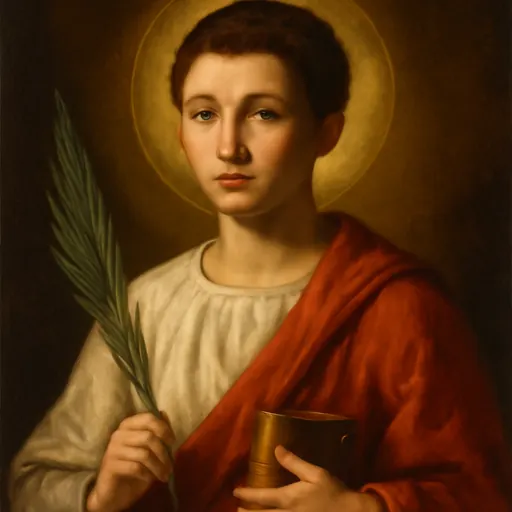
St. Pancras of Rome was a boy martyr of about fourteen, beheaded for Christ in the early fourth century and buried on the Via Aurelia, where a basilica still stands over his grave. Since the sixth century Christians have honored him as the guardian of true oaths, and he is a patron of children and of oaths. We keep his feast on May 12.
Who was St. Pancras of Rome?
St. Pancras of Rome was a boy martyr of the Roman persecutions, killed for Christ at about fourteen and buried in a catacomb on the Via Aurelia, the road that runs west from the Janiculum hill. He is the saint behind the many churches called St. Pancras, and behind London's St. Pancras, whose old parish church bore his name long before the railway station did.
His name is in the oldest Roman calendars, and a church has stood over his grave since the fourth century. The story of his life is later and, as the Catholic Encyclopedia says plainly, "not reliable historically." What is certain is his martyrdom, his grave and the love of Christians for him for some seventeen hundred years. We keep his feast on May 12.

The life of St. Pancras
What history tells us
The Roman lists of martyrs from the fifth century record "the natal day of St. Pancratius, on the Aurelian Way at the second milestone" on May 12. In the fourth century a church was built over his grave, and pilgrims' guides of the seventh century all point to it. He probably died in the persecution of Valerian (257–258) or of Diocletian (303–305).
The legend
The later Passion of St. Pancras, retold in the thirteenth-century Golden Legend, fills in the story. Pancras was born to a noble family in Phrygia. When his parents died, his uncle Dionysius brought him to Rome, where both became Christians. Then the boy was brought before the emperor Diocletian, who spoke to him gently: he was young, noble, the son of a friend, and could be like a son to the emperor himself if he would sacrifice to the gods. Pancras answered, in Caxton's old English:
If I be a child of body yet mine heart is old, and by the virtue of my lord Jesu Christ your threatening and menaces make me no more to move than doth the painting that I see upon the wall.
The emperor ordered him beheaded. A noble Roman lady, whom Caxton calls Cocovilla, buried him with honor.

Miracles of St. Pancras
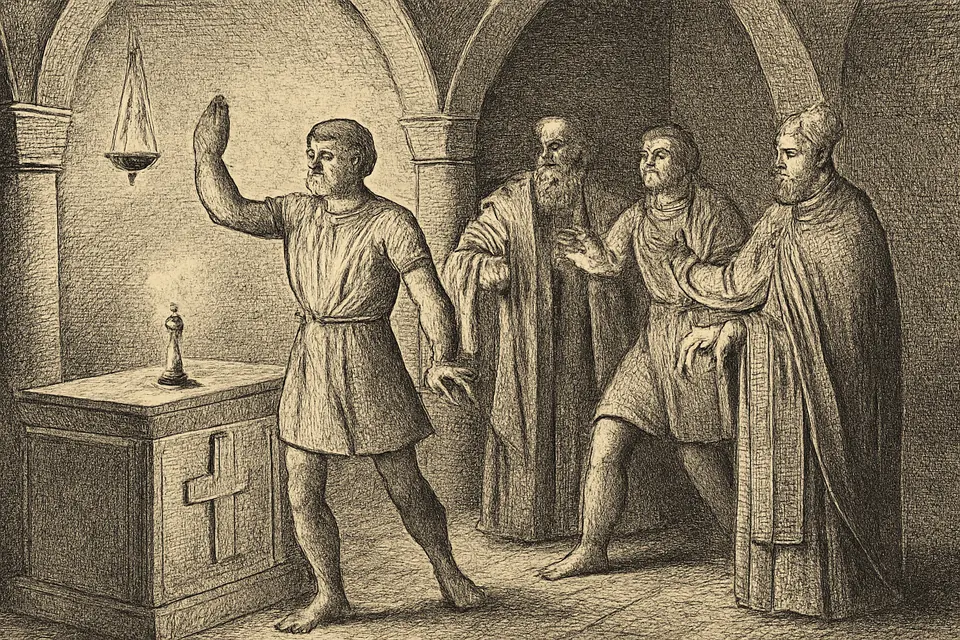
- The punishment of false oaths at his tomb: traditional. St. Gregory of Tours, writing in the sixth century, said that anyone who swore falsely at the grave of St. Pancras would be seized by an evil spirit or fall dead before he reached the choir. The Golden Legend tells of a judge who sent two men to swear first at the altar of St. Peter, where the guilty man came to no harm, and then at the tomb of St. Pancras, where the liar could not lower his raised hand and died on the spot.
Because of these stories, people in Rome came to swear solemn oaths at his tomb, and he became the patron of oaths and the protector against perjury.
Why St. Pancras is the patron saint of children and oaths
- Oaths and against perjury: from the tradition of the oaths sworn at his tomb, told by Gregory of Tours.
- Children: because he gave his life for Christ when he was only a boy.
In German-speaking lands he is also one of the Ice Saints, with St. Servatius, whose feasts in mid-May were long watched as the last days of frost.
St. Pancras in England
The English loved St. Pancras from the beginning of their Christian history. When St. Augustine of Canterbury and his monks came from Rome in 597, they brought the cult of the Roman martyrs with them, and tradition links his name to one of the first churches at Canterbury. Later, in the 660s, Pope Vitalian sent King Oswy of Northumbria "the relics of the blessed apostles, Peter and Paul, and of the holy martyrs, Laurentius, John, and Paul, and Gregory, and Pancratius," as St. Bede records.
Symbols of St. Pancras of Rome in art
Painters show St. Pancras as a beardless youth. Look for:
- A palm branch: the sign of a martyr.
- A sword: the instrument of his death by beheading.
- Youthful dress: a rich Roman tunic and cloak, or, especially in German and Spanish art, the armor of a young knight.
- A book: sometimes, for the Gospel he confessed.
In Spain, as San Pancracio, he is often shown pointing upward with one finger and holding a palm, and his image is kept in shops and homes as a patron of work and good fortune. Read the name in the inscription to tell him from other young martyrs such as St. Vitus or St. Sebastian.
Where St. Pancras is honored
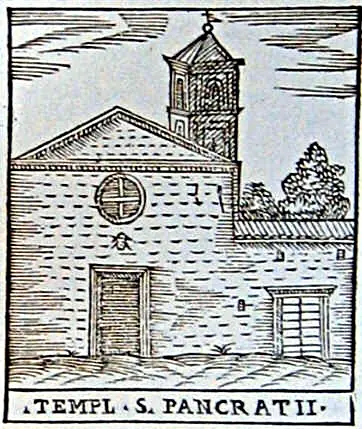
His basilica on the Janiculum, San Pancrazio, still stands over the catacomb where he was buried, rebuilt and altered over the centuries. A woodcut in a pilgrims' guide of 1588 shows it as the plain church that pilgrims visited on their rounds of Rome.

Feast day and prayer
We keep the feast of St. Pancras on May 12, together with Sts. Nereus and Achilleus. Find other saints of May on our feast days page and other patrons on our patron saints page.
No single traditional prayer to St. Pancras is known to us from a source we can cite, though devotional prayers to San Pancracio are common in Spain and Latin America. Let us ask St. Pancras to pray for children and young people who are pressed to give up their faith, for all who must give testimony under oath, and for honesty in our courts. St. Pancras, pray for us.
Frequently asked questions
When is the feast day of St. Pancras of Rome?
May 12. On the General Roman Calendar it is an optional memorial, kept on the same day as Sts. Nereus and Achilleus.
How old was St. Pancras when he died?
About fourteen, according to his legend. The later Passion of St. Pancras and the Golden Legend both give that age.
Why is St. Pancras the patron saint of oaths?
Because St. Gregory of Tours, writing in the sixth century, said that anyone who swore a false oath at his tomb was struck down before he could leave the church. People in Rome came to his tomb to settle disputes under oath.
Is St. Pancras station in London named after him?
Yes, indirectly. The station takes its name from the London district of St. Pancras, which grew up around the old parish church dedicated to this Roman martyr.
Is St. Pancras one of the Ice Saints?
Yes. In German, Austrian and Dutch weather lore, St. Pancras (May 12), St. Servatius (May 13) and St. Boniface of Tarsus (May 14) are the Ice Saints, whose days were long the last when farmers feared frost.
Keep exploring
Sources
- Catholic Encyclopedia (1911): Sts. Nereus and Achilleus, Domitilla and Pancratius. His grave at the second milestone of the Via Aurelia, the fourth-century church, the late and unreliable legend, and the likely date of death
- The Golden Legend, vol. 3 (Caxton translation, Medieval Sourcebook). The legend of his trial, and Gregory of Tours on false oaths at his tomb
- Bede, Ecclesiastical History of the English People, Book III (Medieval Sourcebook). Pope Vitalian's letter sending relics of Pancratius to King Oswy of Northumbria