St. Andrew Fournet (André-Hubert Fournet), the "Good Father" of Poitou
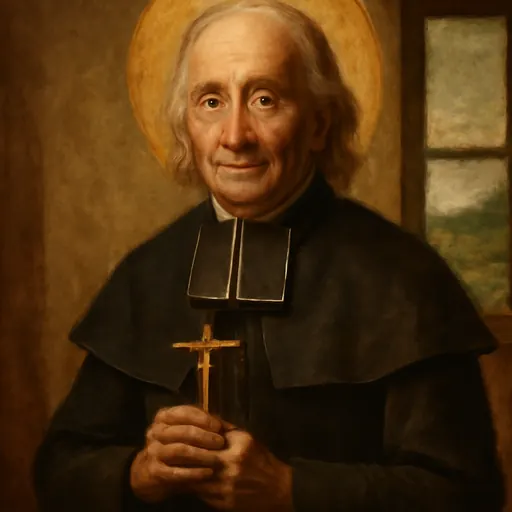
St. Andrew Fournet (André-Hubert Fournet, 1752–1834) was a French parish priest of Poitou who refused the Revolution's oath, said Mass in hiding, and afterward founded the Daughters of the Cross with St. Elizabeth Bichier des Ages. His people called him the "Good Father." He was canonized in 1933, and his feast is May 13.
Who was St. Andrew Fournet?
St. Andrew Fournet, in French André-Hubert Fournet, was a country priest of Poitou, in western France, who went from a comfortable, half-hearted priesthood to heroic holiness, kept the faith alive in his parish through the French Revolution, and then helped found a religious congregation that spread across France and beyond. His people simply called him le Bon Père, the Good Father. We keep his feast on May 13.
A boy who did not want to be a priest
He was born on December 6, 1752, in Saint-Pierre-de-Maillé, a village near Poitiers, to well-off and devout parents. By every account he was a restless child who preferred games to books. The Italian hagiographical encyclopedia Santi e Beati says he did not know what he wanted to be, except that it was certainly not a priest. His parents sent him to study at Poitiers, but the books did not hold him. He dressed in the latest fashion, rode horses and went to parties.
His mother, worried, sent him to stay with an uncle who was a country priest. There, to everyone's surprise, the young man decided to give his life to the Church. He was ordained, served as curate to an uncle at Haims and then at Saint-Phèle-de-Maillé, and before long succeeded another uncle as pastor of his home parish of Saint-Pierre-de-Maillé.
The beggar at the door
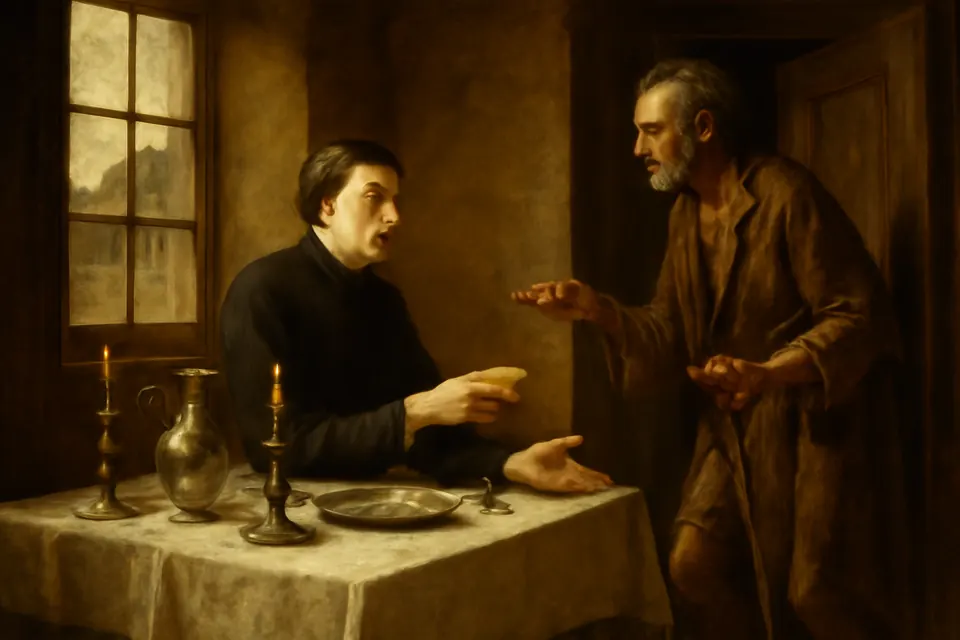
He was a dutiful priest, but a comfortable one, living with his mother and sister and treating the priesthood, as Santi e Beati puts it, more as a job than a mission. Then one day a beggar came to his dining room and asked for alms. Fournet handed him a piece of bread and apologized that he had nothing more. The poor man answered, in effect, "How can that be, when your table is covered with silver?"
The rebuke went straight to his heart. He sold what he owned and gave it to the poor; when he had nothing left, the story goes, he cut up his curtains to make handkerchiefs for them. He slept on a straw mattress, prayed through the night, ate bread and vegetables and fasted often. His sermons, once polished and learned, became simple enough for every farmer to follow.
Priest in hiding
When the Revolution imposed the Civil Constitution of the Clergy, Fournet refused the oath, which would have bound the Church in France to the state against the Pope. He was stripped of his parish and came close to death several times. Driven out of France, he took refuge in Spain, where he cared for the sick and the imprisoned.
He could not stay away from his people. He came back secretly while the persecution was still raging and lived in hiding, disguised as a peasant, saying Mass in the woods, baptizing, hearing confessions, marrying couples and teaching children, always one step ahead of arrest and the guillotine.

The Daughters of the Cross
When peace returned to the Church, he went back to a parish where everything had to be rebuilt. Around this time he met a young noblewoman of Poitou, St. Elizabeth (Jeanne-Élisabeth) Bichier des Ages, who placed herself under his direction. Together they founded the Daughters of the Cross, a congregation of sisters for the Christian education of girls, especially poor girls, and for the care of the sick, the orphaned and the old. Fournet wrote their rule.
In 1820 he resigned his parish and moved to La Puye, where the congregation had its motherhouse, to give himself entirely to forming the sisters. He died there on May 13, 1834. Elizabeth Bichier was canonized in 1947.

The miracles of St. Andrew Fournet
- Reported: the multiplication of bread. Santi e Beati says that at least twice, when the community at La Puye had nothing left to eat, the Good Father's prayer multiplied the bread.
- Reported: ecstasy in prayer. Witnesses said they saw him rapt in contemplation, raised a few hands' breadth from the ground.
- Reported: at the hour of his death, some sisters said they heard three knocks on a wall and a voice saying, "I am going to heaven."
- Approved: the miracles accepted for his beatification by Pope Pius XI on May 16, 1926, and for his canonization on June 4, 1933. The cause had been opened in 1877, and his heroic virtues were declared in 1921.
Symbols of St. Andrew Fournet in art
He is shown as he lived, without symbols borrowed from legend:
- A black cassock and stole: the parish priest, faithful through persecution.
- Loaves of bread: his charity to the poor and the multiplication of bread at La Puye.
- A crucifix: the Cross that gave his congregation its name.
In the churches of Poitou, statues show him as an old priest in a cassock, often holding a crucifix.
Prayer to St. Andrew Fournet
There is no widely known traditional prayer to St. Andrew Fournet in English. Let us ask the Good Father, who was converted by a beggar's question, to pray for parish priests, for all who teach poor children, and for each of us, that we may hear Christ's voice in the poor who knock at our door. See also St. John Vianney, another French country priest of the same troubled age, and the feast day calendar.
Frequently asked questions
Who was St. Andrew Fournet?
A French priest (1752–1834), pastor of his home village of Saint-Pierre-de-Maillé in Poitou. He refused the Civil Constitution of the Clergy, ministered in secret during the Revolution, and with St. Elizabeth Bichier des Ages founded the Daughters of the Cross to teach poor girls and care for the sick.
When is the feast of St. Andrew Fournet?
May 13, the day he died at La Puye in 1834.
When was St. Andrew Fournet canonized?
Pope Pius XI beatified him on May 16, 1926, and canonized him on June 4, 1933.
What miracles are told of St. Andrew Fournet?
The best known is the multiplication of bread or grain for the hungry community at La Puye, told at least twice. It is a reported miracle from his life. Separate miracles, investigated by the Church, were approved for his beatification in 1926 and his canonization in 1933.
Keep exploring
Sources
- Santi e Beati: Sant' Andrea Uberto Fournet. The beggar at his table, his ministry in hiding, the title "Good Father", the move to La Puye, the multiplication of bread
- Hagiography Circle: Saints and Blesseds who died in 1834. Birth date, introduction of the cause (1877), heroic virtues (1921), beatification (May 16, 1926) and canonization (June 4, 1933)