St. Servatius, Bishop of Tongeren and Patron of Maastricht

St. Servatius (Sint Servaas) was a 4th-century bishop of Tongeren, in present-day Belgium, who defended the Nicene faith against the Arians at the councils of Sardica and Rimini. He died at Maastricht, traditionally on May 13, 384, and his relics lie in the city's Basilica of St. Servatius. He is the patron of Maastricht and one of the "Ice Saints" of mid-May.
Who was St. Servatius?
St. Servatius, called Sint Servaas in Dutch and Saint Servais in French, was a bishop of Tongeren in the 300s and is the patron saint of Maastricht. He is not a later Dutch saint or a place name: he was a bishop of the late Roman Empire who stood with St. Athanasius when much of the Church was bending toward Arianism, the teaching that the Son of God is less than the Father.
Tongeren was then the chief town of the Tungri, a Roman people in what is now Belgian Limburg. Servatius governed the Church there for many years, and he died at Maastricht, a day's journey away on the Roman road. We keep his feast on May 13, the date the Bollandists and Butler's Lives of the Saints give for his death in 384.
A bishop against the Arians
The most reliable facts about Servatius come from the councils. Butler records that he welcomed Athanasius in his exile, defended his cause and stood for the Catholic faith at the Council of Sardica (343). We have a nearly contemporary witness for the next test. Sulpicius Severus, writing around the year 400, describes the Council of Rimini in 359, where the emperor's men kept the Western bishops shut up in the city until they signed a creed written to suit the Arians. One by one they gave way until about twenty were left, and the most steadfast, Sulpicius says, were "our friend Fœgadius, and Servatio, bishop of the Tungri."

The prefect Taurus pleaded with them in tears. In the end the two drew up their own confessions condemning Arius, and an Arian bishop slipped an ambiguous line into the final text that, Sulpicius says, "escaped the notice of the hearers." Servatius was not a man who won every fight. He was a man who did not bend when most did.
The journey to Rome
Gregory of Tours, writing in the late 500s, tells of a bishop of Tongeren he calls Aravatius, whom most scholars take to be Servatius. Fearing that the Huns would overrun Gaul, the bishop fasted, prayed and went to Rome to beg the help of the apostles at the tomb of St. Peter. There he learned that "it was sanctioned in the council of the Lord that the Huns must come into the Gauls." He returned home, died, and was buried at Maastricht beside the Roman road.

Gregory's dates do not fit: Attila came some seventy years after 384. Butler accepts the story of the pilgrimage and dates it to 382. It is honest to say we cannot be sure how much of Gregory's account is history.
The miracles and legends of St. Servatius
Gregory says that miracles drew many people to the bishop's tomb and that a church was built over it. These healings at the grave are reported in the oldest source we have. Over the centuries, more legends grew around him:
- Traditional: that he was born in Armenia and was a distant kinsman of Jesus. The basilica itself notes that the oldest mention of his Armenian birth dates from the 11th century.
- Traditional: that St. Peter gave him a silver key in Rome, the sign of the power to forgive sins.
- Traditional: many more wonders added by later medieval lives, above all the 12th-century Legend of St. Servatius that Hendrik van Veldeke wrote in the Limburg dialect, one of the first works of Dutch literature. Among them is an eagle that shaded the sleeping bishop with its wings.
Why St. Servatius is patron of Maastricht
His tomb made Maastricht a holy city. The present Basilica of St. Servatius, built in stages over his grave, is considered the oldest standing church in the Netherlands, and the basilica says pilgrims have come to the grave since the 400s. His body was later raised from the ground and placed in the gilded shrine the people call the Noodkist, the "chest of need," because it was carried through the streets in times of danger. The last such procession was in 1991, at the start of the Gulf War.

His place among the Ice Saints comes from the calendar. May 11 to 15 were long the last days when farmers in Germany and the Low Countries feared a killing frost, and his feast falls in the middle, so people called on him against late frost.
Symbols of St. Servatius in art
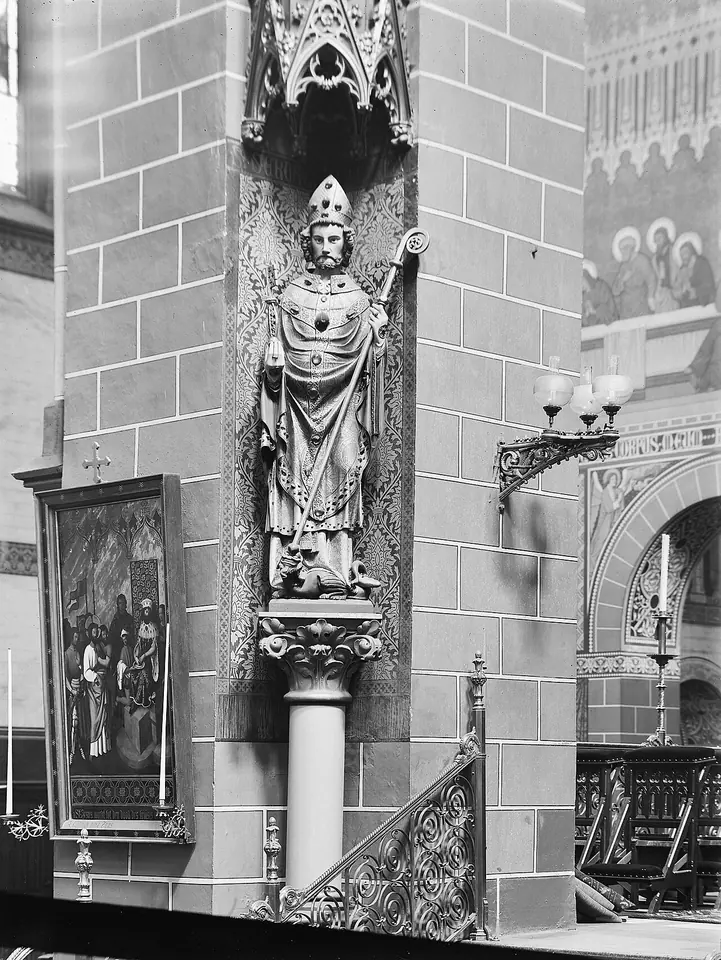
Servatius is shown as a bishop in miter and vestments with a crozier. Look for these signs to tell him apart:
- A key, the gift of St. Peter in legend. This is his surest mark.
- A dragon under his feet, for the evil he overcame.
- An eagle above or beside him, from the legend of the bird that shaded him.
- In the Low Countries, a reliquary bust or the shrine itself often stands for him.
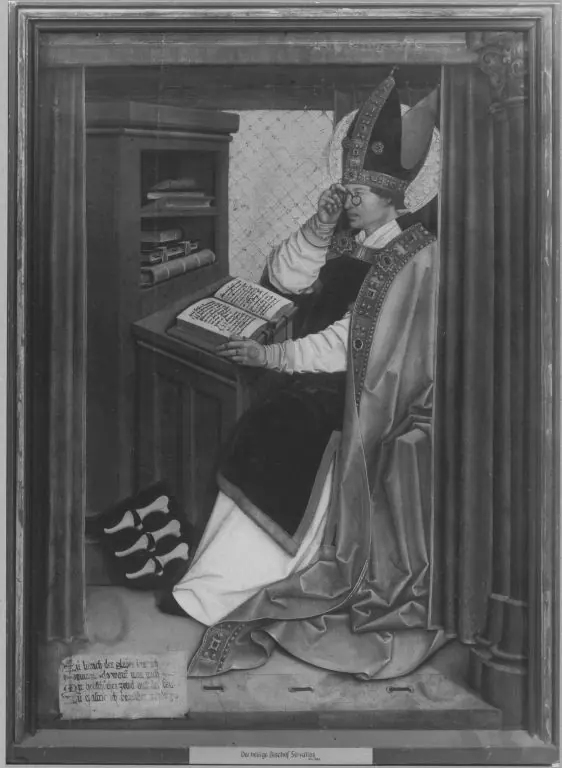
Strigel's panel on this page shows him simply, as a scholarly bishop. The silver bust in the treasury is the best-known image of him in Maastricht. It has held most of his skull since 1403; Spanish troops damaged it in the sack of 1579, and Alessandro Farnese, Duke of Parma, paid for new shoulders and a new miter in 1580.

Feast day and the Heiligdomsvaart
Maastricht keeps his feast on May 13. Every seven years the city holds the Heiligdomsvaart, first recorded in 1391, when the relics of Servatius and the other saints of the basilica are carried in procession through the streets. The basilica gives the next date as 2032.

Prayer to St. Servatius
We have found no traditional English prayer to St. Servatius with a clear origin. We ask his help in our own words:
St. Servatius, faithful bishop, you held to the truth about Christ when others gave way. Pray for us and for our bishops, that we may confess the Son of God with courage, and pray for all who live in fear of what is coming. Amen.
See the feast days calendar and the patron saints index for more.
Frequently asked questions
Who was St. Servatius?
A bishop of Tongeren in the 300s who stood with St. Athanasius against Arianism. Sulpicius Severus, writing about 400, names him as one of the last bishops to hold out at the Council of Rimini in 359. He died at Maastricht, where his tomb became one of the great pilgrim shrines of the Low Countries.
When is the feast of St. Servatius?
May 13, the traditional date of his death in 384. In German and Dutch weather lore he is one of the "Ice Saints" whose days in mid-May are the last when frost is feared.
Where are the relics of St. Servatius?
In the Basilica of St. Servatius in Maastricht. His body is in a gilded 12th-century shrine called the Noodkist, and most of his skull has been kept in a silver reliquary bust since 1403. Every seven years the relics are carried through the city in the Heiligdomsvaart pilgrimage.
Why is St. Servatius shown with a key?
Gregory of Tours tells how Servatius prayed at St. Peter's tomb in Rome, and later legend says Peter gave him a key as a sign of the power to bind and loose. The key is his best-known emblem in art.
Sources
- Sulpicius Severus, Sacred History, Book II, ch. 44 (New Advent). Servatio, bishop of the Tungri, among the last holdouts at Rimini
- Gregory of Tours, History of the Franks, Book II, ch. 5 (Internet Medieval Sourcebook). Bishop Aravatius of Tongeren, his journey to Rome and death
- Alban Butler, The Lives of the Fathers, Martyrs, and Other Principal Saints, vol. 5 (May 13), St. Servatius
- Basilica of St. Servatius, Maastricht: Sint Servaas (treasury). The bust (skull since 1403, rebuilt 1580), the Noodkist and its processions, the Armenian legend
- Basilica of St. Servatius, Maastricht: Heiligdomsvaart