St. Constantius of Perugia, First Bishop and Martyr

St. Constantius of Perugia (San Costanzo) was, by an ancient tradition, the first bishop of Perugia, beheaded for Christ near Foligno about the year 170. His relics rest in the Basilica of San Costanzo, and he is one of the city's three patron saints. We keep his feast on January 29, when Perugians bake the ring-shaped torcolo di San Costanzo.
Who was St. Constantius of Perugia?
St. Constantius of Perugia, San Costanzo in Italian, is the bishop-martyr whom the people of Perugia honor as the first shepherd of their church. He is one of the city's three patrons, with St. Lawrence, to whom the cathedral is dedicated, and St. Herculanus, a later bishop. We keep his feast on January 29.
What we know for certain is short. His name stands on January 29 in the Martyrology of St. Jerome, one of the oldest lists of martyrs in the Western Church, and the Roman Martyrology repeats it: "At Perugia, in the time of Marcus Aurelius, St. Constantius, bishop and martyr, who together with his companions, received the crown of martyrdom for the defense of the faith." The Italian scholars who studied the early bishops of Italy, Francesco Lanzoni and the Bollandist Hippolyte Delehaye, judged that his episcopate rests on an ancient and serious tradition, so it is very likely that he was Perugia's first bishop.
The fuller story comes from his passio, a legend that survives in four versions. We tell it as traditional.
The life and martyrdom of St. Constantius
Before the consul
During a persecution, under Antoninus in some versions of the legend and Marcus Aurelius in others, soldiers brought him before a consul named Lucius. He was scourged and then shut with his companions in a burning furnace, the hot room of a bath. They came out unharmed.
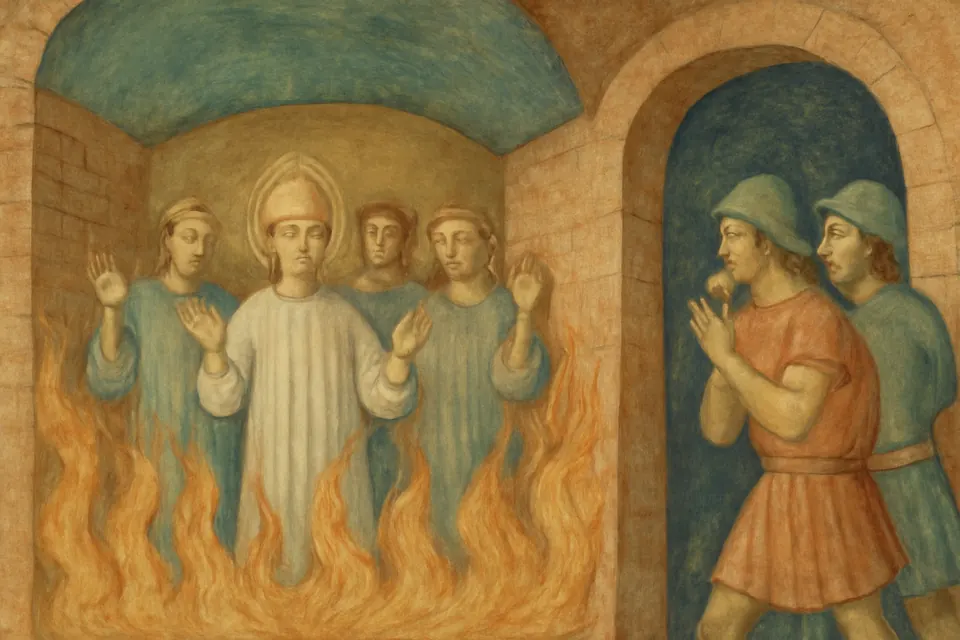
The converted jailers
Taken back to prison, he spoke to his guards of Christ, and they believed and helped him escape. He hid in the house of a Christian named Anastasius, but both were found and arrested. The legend leads him through the prisons of Assisi and Spello, and every version agrees that he was beheaded near Foligno, at a place called "il Trivio." Foligno once had a church of San Costanzo near its Porta Romana; the seventeenth-century historian Ludovico Jacobilli says it was torn down in 1527, and that the fields there were still called the "countryside of San Costanzo" in his day.

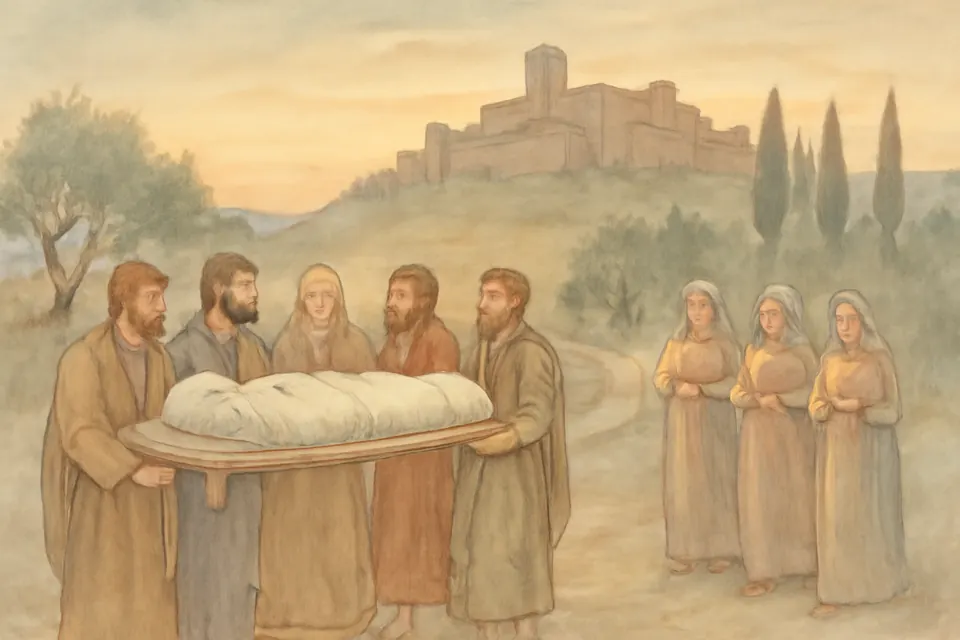
Carried home to Perugia
All versions of the passio say his body was brought back to Perugia and buried just outside the city, at a place called Areola outside the Porta San Pietro. Perugia's first cathedral was built there, dedicated to St. Peter.
Miracles of St. Constantius
The furnace he survived and the jailers he converted belong to the traditional legend. Local accounts also tell of a blind woman who regained her sight and a nobleman named Crescentius, paralyzed for years, who walked again after the saint's blessing. These too are traditional stories; they have never been formally investigated.
Why St. Constantius is the patron of Perugia
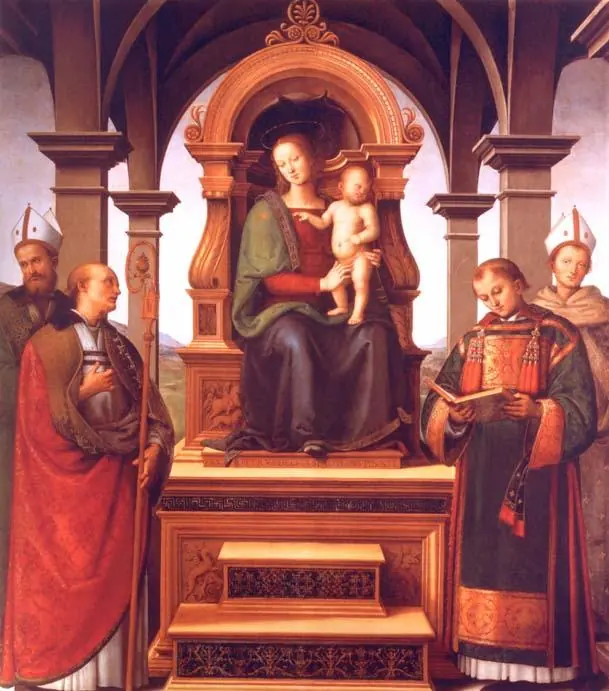
He is honored as the founder of Perugia's church and the first of its martyrs, and his tomb has been the center of his cult since ancient times. The city's government honored him in its own art: in the 1490s the Decemviri, the priors of Perugia, commissioned Pietro Perugino to paint the Virgin with the city's patrons for the chapel of their palace, and Constantius stands among them.
Symbols of St. Constantius in art
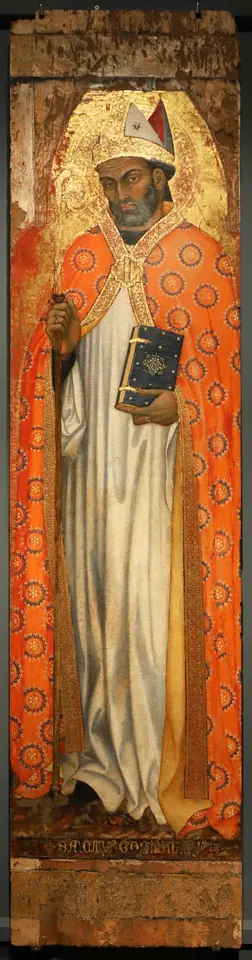
Painters show him as a bishop: miter, crosier and often a book, the Gospel he preached. The Renaissance painters of Umbria made him young and beardless, a gentle bishop reading. He often appears beside Herculanus, the other bishop-patron of the city, and the two can be hard to tell apart without a label. Some images add the martyr's palm.
In Perugia you will find him in Taddeo di Bartolo's polyptych of 1403, now in the National Gallery of Umbria and in the panels Perugino painted for San Pietro. See also St. Louis of Toulouse, who stands with him in the Decemviri altarpiece.
Where St. Constantius is honored
The Basilica of San Costanzo stands just outside the gate that bears his name, on the site of his tomb. An inscription on the old altar records that Bishop Vivianus consecrated the church in 1205; it was largely rebuilt in the nineteenth century. In 1781 his relics were examined, and in 1825 they were solemnly placed in the new altar, where they rest today.

On the days of his feast Perugia holds the Fiera Grande di San Costanzo, a torchlight procession, the luminaria, to the cathedral of San Lorenzo, and Mass with the bishop. Bakeries sell the torcolo di San Costanzo, a ring-shaped sweet bread that Perugians call a sign of union for engaged couples. A gentle local legend says engaged girls go to his church on the feast and watch the play of light on his image: if the saint seems to wink, the wedding will come within the year, and if he does not, the fiancé consoles his girl with a torcolo. Find the saints around his feast on our feast days calendar.
Prayer to St. Constantius
We have not found a traditional prayer to St. Constantius in a source we could verify, so we do not print one. Let us ask him to pray for the Church in Perugia and all of Umbria, for bishops and those who preach the Gospel, for engaged couples preparing for marriage, and for everyone who is afraid to bear witness to Christ.
St. Constantius, pray for us.
Frequently asked questions
Who was St. Constantius of Perugia?
The first bishop of Perugia, in Umbria, according to a tradition the scholars Lanzoni and Delehaye considered ancient and serious. His legend says he was arrested under the emperor of his day, survived a burning furnace, converted his jailers, and was finally beheaded near Foligno about 170.
When is the feast of St. Constantius of Perugia?
January 29. He is listed on that date in the Martyrology of St. Jerome, one of the oldest calendars of martyrs, and in the Roman Martyrology.
What is the torcolo di San Costanzo?
A ring-shaped sweet bread that Perugians bake for his feast. Local legend says engaged girls look at his image in his church on the feast; if the saint seems to wink, they will marry within the year, and if not, the fiancé consoles his girl with a torcolo.
Where are the relics of St. Constantius?
In the Basilica of San Costanzo, just outside the Porta San Costanzo in Perugia, built where he was buried. His relics were examined in 1781 and solemnly placed in the new altar in 1825.
Keep exploring
Sources
- San Costanzo di Perugia, vescovo e martire, Santi e Beati. The four versions of the passio, the furnace, Anastasius, Assisi and Spello, the church at Foligno demolished in 1527, the consecration of 1205, Lanzoni and Delehaye, and the relics in 1781 and 1825
- The Roman Martyrology (English translation, Baltimore: John Murphy, 1916), January 29
- Perugia: Fiera Grande di San Costanzo, Perugia OnLine. The fair, the luminaria to the cathedral, the torcolo and the legend of the wink