Blessed Peter Wright, Jesuit Martyr of Tyburn

Blessed Peter Wright (1603–1651) was an English Jesuit priest from Northamptonshire who served as chaplain to English soldiers and then to the Marquis of Winchester. Arrested on Candlemas Day 1651, he was condemned for his priesthood and hanged at Tyburn on Whit Monday, May 19, 1651, before a vast crowd. Pope Pius XI beatified him in 1929.
Who was Blessed Peter Wright?
Blessed Peter Wright was an English Jesuit priest who was hanged at Tyburn on Whit Monday, May 19, 1651, during the Commonwealth, when England had no king. A poor boy from Northamptonshire who had drifted from the faith and found it again, he spent years as chaplain to English soldiers in Flanders and in the civil war, then lived as chaplain to the Marquis of Winchester. He was seized in the Marquis's house as he was going to say Mass on Candlemas Day, condemned on the word of an apostate priest, and died before a crowd said to number twenty thousand.
Nearly everything we know of him comes from a Life printed at Antwerp in the very year he died by a man who watched his execution. Bishop Richard Challoner retold it in his Memoirs of Missionary Priests.
The life of Blessed Peter Wright
A servant who lost his faith and found it
Peter Wright was born at Slipton in Northamptonshire in 1603 to "poor but virtuous parents." His father died when he was young, and his mother, left with a large family, sent him into service. For several years he worked for a country lawyer, and living among Protestants he forgot what his dying father had taught him and gave up his religion.
As a grown man he came back to it by degrees. Setting out for a pilgrimage to Rome, he reached the English Jesuit college at Liège, where the Jesuits fully reconciled him to the Church. He studied for two years at the Flemish Jesuits' college in Ghent, and in 1629, when he was chosen to be sent to the seminary in Rome, he asked instead to join the Society of Jesus. He was received as a novice at Watten. Challoner says that he was "by nature hasty and passionate," but that from his novitiate on he was "remarkably calm and sedate." He liked to slip out to nearby villages to teach the children their catechism.

Chaplain to soldiers and to a noble household
After his studies he served for a time as prefect of the boys at St. Omer, a task he disliked and offered to keep for life if his superiors wished. He was then sent as chaplain to the English soldiers in Flanders. Their colonel, Sir Henry Gage, kept him as his companion for seven years in Flanders and in England. When Gage, the royalist governor of Oxford, was killed in 1644, the Marquis of Winchester and his wife took Fr. Wright into their household.
Arrest on Candlemas Day
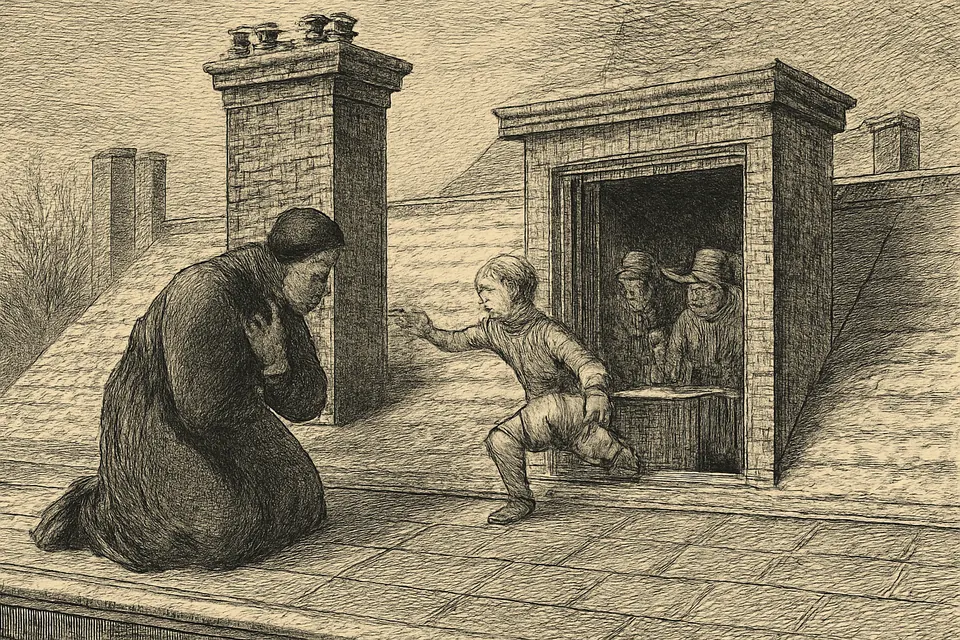
On the morning of Candlemas, February 2, 1651, priest-catchers rushed the Marquis's London house just as Fr. Wright was going to Mass. The Marquis held them on the stairs long enough for the priest to climb out of a window onto the lead roof. But in the chapel the searchers found the altar dressed and everything laid out for Mass. Seeing the open window, they sent a boy out after him, and he was found.
He was committed to Newgate. At his trial the chief witness was Thomas Gage, a priest who had abandoned the Church and was the brother of Fr. Wright's old friend Sir Henry. He swore that Wright was a priest and a Jesuit and that he had often seen him say Mass. Asked for his answer, Fr. Wright said: "My Lord, I give Almighty God thanks, from the bottom of my heart that He has been pleased I should be here arraigned (to use the words of St. Peter), not as a murderer, nor as a thief, nor as a reviler, nor as guilty of any other crime but my religion." When the jury found him guilty, he bowed and said, "God Almighty's holy name be blessed now, and for evermore."
Tyburn, Whit Monday 1651
He was sentenced on the eve of Pentecost. Catholics crowded to his cell for confession and his blessing. On Whit Monday morning he said Mass, and when the knocking came at the iron grate he cried, "I come, sweet Jesus, I come." On the way to Tyburn on the hurdle he passed the house where the Marquis of Winchester and his family waited on a balcony; he raised himself as far as his bonds allowed and blessed them with the sign of the cross.

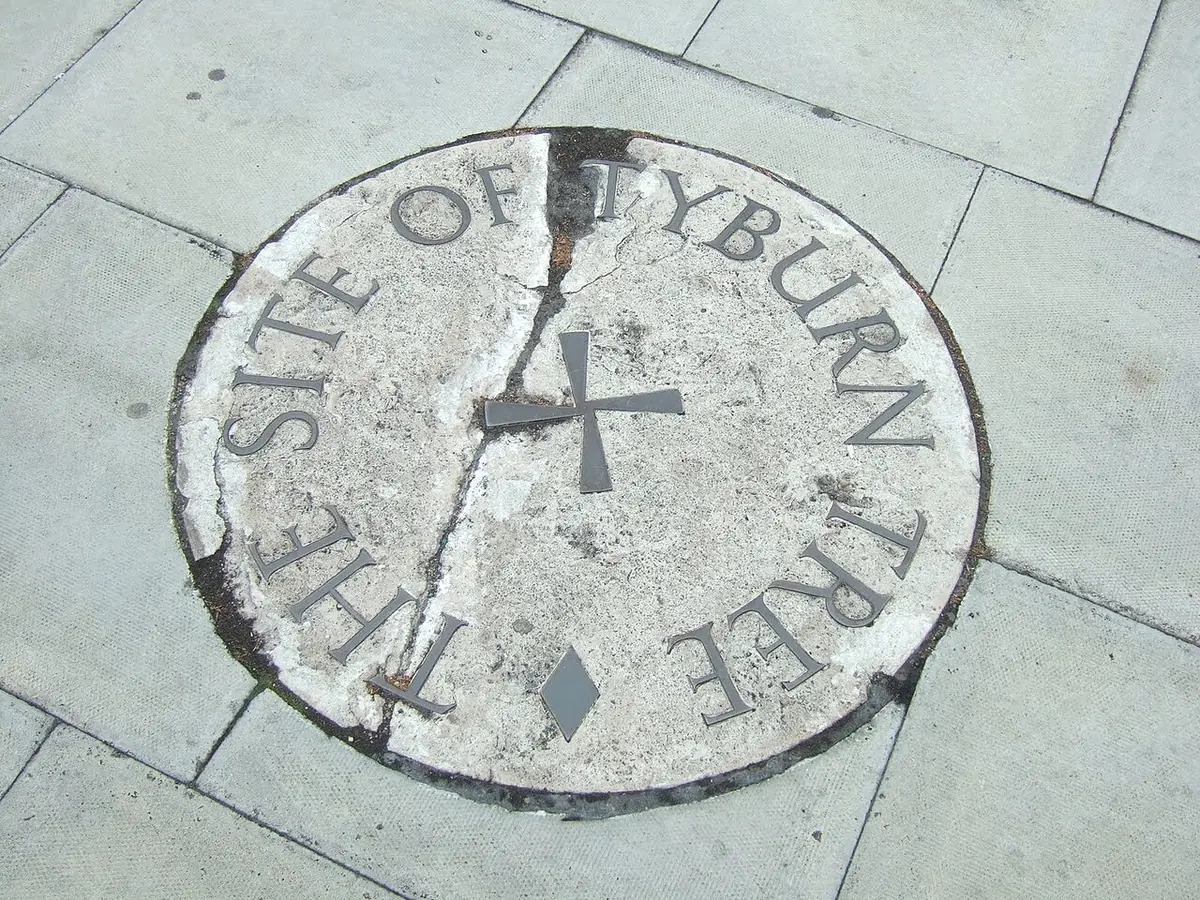
At Tyburn, Challoner's source counts some twenty thousand people. With the rope around his neck Fr. Wright spoke: "I was brought hither charged with no other crime but being a priest. I willingly confess I am a priest; I confess I am a Catholic; I confess I am a religious man of the Society of Jesus." He asked the Catholics present to "join in prayer for me and with me till my last moment; and when I shall come to heaven I will do as much for you. God bless you all; I forgive all men." He was allowed to hang until he died before his body was quartered. His friends carried his head and quarters to the English Jesuit college at Liège.
Beatification
Pope Pius XI beatified Peter Wright in 1929 with a large group of martyrs of England and Wales. As a martyr he was beatified without a miracle. Challoner notes that his death led several Protestant onlookers to the Catholic faith; no miracles, approved or reported, are recorded for him.
Symbols of Blessed Peter Wright in art
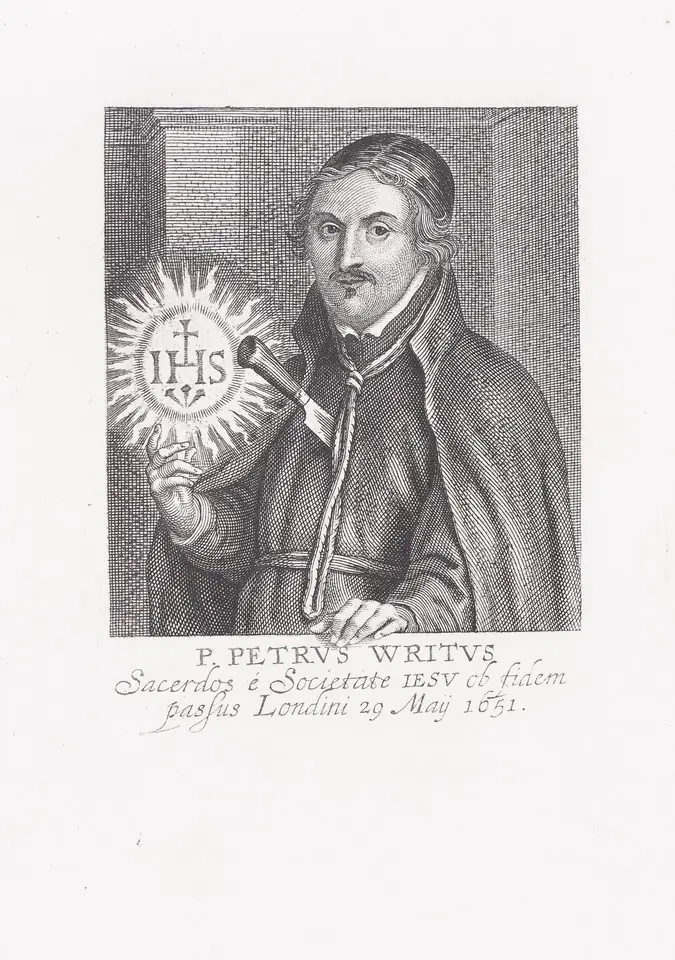
The best-known image of him is the old engraved portrait on this page, in which he wears the Jesuit cassock and holds the IHS emblem of the Society of Jesus, its letters standing for the name of Jesus. Seventeenth-century Jesuit martyr books also show him at the gallows with the noose. The palm marks him as a martyr.
Feast day and where he is honored
We keep his feast on May 19, the day he died. In England and Wales he is also honored on May 4 with all the English Martyrs. Pilgrims remember the martyrs of Tyburn near Marble Arch in London, where the Tyburn Convent keeps their memory. See our feast days calendar for other saints of May.
Praying with Blessed Peter Wright
We know of no traditional prayer to Blessed Peter Wright, so we do not print one. His own last request is a fitting way to pray with him: he asked those who loved him to pray for him and with him, and promised to do as much for them in heaven.
Let us ask Blessed Peter Wright to pray for army chaplains, for priests who serve in hiding, and for all who have drifted from the faith of their childhood and are finding their way home.
Frequently asked questions
Who was Blessed Peter Wright?
An English Jesuit born at Slipton in Northamptonshire in 1603. He lost his faith as a young servant, returned to it, entered the Society of Jesus, served as chaplain to English troops and to Catholic families, and was executed at Tyburn for being a priest.
When is the feast of Blessed Peter Wright?
May 19, the day he died, as the Roman Martyrology lists it. In England and Wales he is also remembered on May 4 with all the English Martyrs.
What were Peter Wright's last words?
At Tyburn he told the crowd he was dying for no other crime than being a priest and a Jesuit, asked the Catholics to pray with him to the end, promised to pray for them in heaven, and said, "God bless you all; I forgive all men."
Where are his relics?
His friends were allowed to take his head and quarters, which were carried to the English Jesuit college at Liège. That college was later closed, and we have not found a source for where the relics are today.
Keep exploring
Sources
- Richard Challoner, Memoirs of Missionary Priests, ed. J. H. Pollen (1924), pp. 499–504. His whole life, from the eyewitness Life printed at Antwerp in 1651: Slipton, Liège, Watten, Sir Henry Gage, the Candlemas arrest, the trial, the hurdle, the crowd of 20,000 and his speech; quotations from this text
- John Hungerford Pollen, "English Confessors and Martyrs (1534–1729)," The Catholic Encyclopedia, vol. 5 (1909). Listed for May 19, 1651, at Tyburn
- Roman Martyrology 2004, May (GCatholic). May 19 entry for Blessed Peter Wright
- Beato Pietro Wright, Santi e Beati (Italian). Beatification by Pius XI in 1929