Blessed William Tirry, Augustinian Priest and Martyr of Clonmel

Blessed William Tirry (1608–1654) was an Augustinian friar from Cork who ministered in secret after Cromwell's conquest of Ireland. Betrayed on Holy Saturday 1654, he refused to give up his faith to save his life and was hanged at Clonmel on May 12, 1654, wearing his habit and forgiving his betrayers. Pope John Paul II beatified him in 1992.
Who was Blessed William Tirry?
Blessed William Tirry was an Irish Augustinian friar who kept bringing the sacraments to his people after Oliver Cromwell's government made it a capital crime to be a Catholic priest in Ireland. He was arrested on Holy Saturday 1654, tried at Clonmel and hanged there on May 12, 1654. Pope John Paul II beatified him in 1992 with sixteen other Irish martyrs.
Many people search for him as "St. William Tirry." The Church has declared him Blessed; he has not been canonized.
The life of William Tirry
A Cork family
He was born in Cork in 1608 into one of the city's leading families. His uncle and namesake, William Tirry, was Bishop of Cork. An old Augustinian account, which Fr. Denis Murphy translated in his Our Martyrs (1896), says that even as a boy he "preferred to pass his time in prayer in the churches," and that he turned his back on the rank his family held to "hide the nobility of his birth" among the Hermits of St. Augustine.
He entered the Order at eighteen and was sent abroad for his studies, to Valladolid in Spain, to Paris and to Brussels. He came home with a name for learning and virtue. His uncle the bishop made him his adviser, and Viscount Sarsfield entrusted him with the education of his two sons.
Priest in hiding
Cromwell landed in Ireland in August 1649. In the years that followed, priests were outlawed, hunted for bounty, hanged or shipped abroad. Fr. Tirry stayed. Murphy's account says that for three years he lived hidden, "leaving his cell only to administer the sacraments."
He was betrayed on Holy Saturday 1654 while he was preparing to celebrate the Easter Vigil, and was taken to the jail at Clonmel. Later accounts place his hiding place and arrest at Fethard, in County Tipperary.

Prison and trial at Clonmel
In prison he kept saying the Divine Office every day. His companion, a fellow Augustinian named Walter, was able at times to bring him the Holy Eucharist. The charge, as the Augustinian Order puts it today, was simply "being a priest in Ireland." He was offered his freedom if he would renounce the Catholic faith. He refused, and a court under military pressure found him guilty of treason.

The martyrdom of William Tirry
He spent the whole night before his death in prayer, "to strengthen himself," he said, "for the fight." At dawn he received Viaticum. When the soldiers burst into his cell, Murphy's source says, he greeted them "with joy as if they were his friends."
On May 12, 1654, he walked to the scaffold in his Augustinian habit, followed by a large crowd who grieved that an innocent man was to die. There he publicly forgave those who had betrayed him. He asked for absolution in case a priest was in the crowd, hoping that Fr. Dennis O'Driscoll was there. Then he spoke to the people about faith, about keeping the passions under control and about the practice of virtue, until the executioner cut him short. The old account says his words converted several Protestants who heard them.

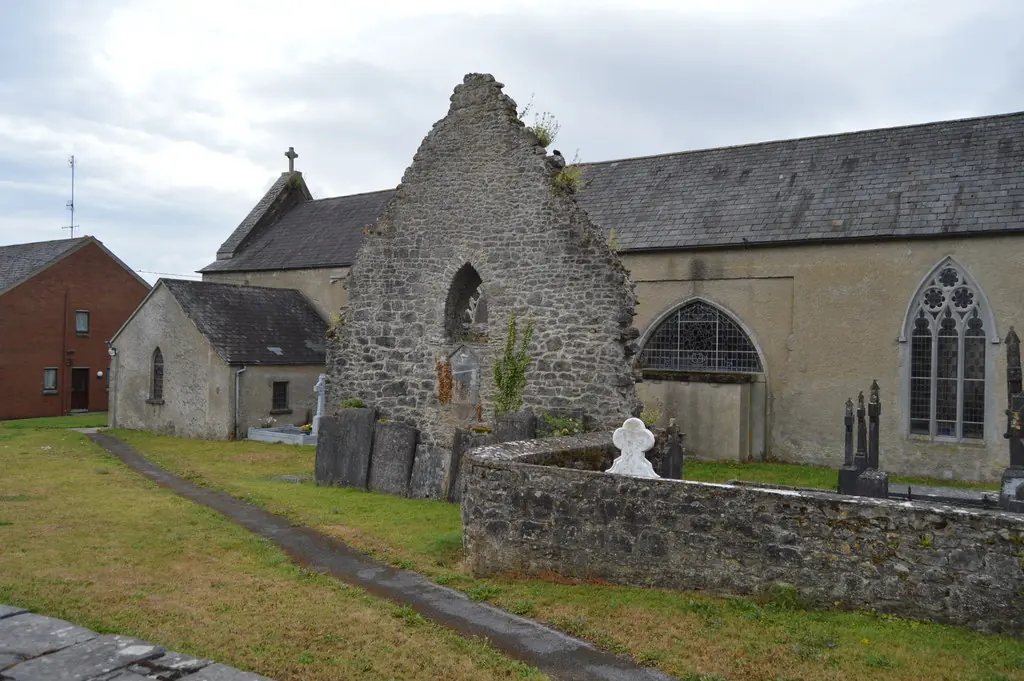
His body was buried at the Augustinian friary in Fethard. The exact place of the grave is not known today.
Miracles of Blessed William Tirry
The Augustinian account that Murphy translated tells of two wonders. Both are reported miracles, recorded by his Order, not examined or approved by the Church:
- The crowd gathered up drops of his blood, and "a blind woman got back her sight by touching his habit."
- When his companion Walter was sailing to Belgium and a storm overtook the ship, he "calmed the sea by casting into it a small piece of the holy man's habit."
As a martyr, he was beatified without a miracle.
Beatification
On September 27, 1992, Pope John Paul II beatified seventeen Irish martyrs of the penal times, among them William Tirry. "Their victory lay precisely in going to death with no hatred in their hearts," the Pope said. "They lived and died for Love. Many of them publicly forgave all those who had contributed in any way to their martyrdom." Fr. Tirry was one of those.
Symbols of Blessed William Tirry in art
No portrait from his lifetime is known. Modern images show him with:
- The black habit and leather belt of the Augustinians, which he wore to his death.
- The martyr's palm.
- A rope, for the gallows at Clonmel.
- A book, for the learning his Order remembered.
Feast day and prayer
We keep the memory of Blessed William Tirry on May 12, the day the Augustinians celebrate him, and with the other Irish martyrs on June 20. You can find other saints of mid-May on our feast days page.
There is no traditional prayer to him. We can pray in the words John Paul II used: "Blessed Irish Martyrs, intercede for the beloved Irish people!" And let us ask Blessed William Tirry for the grace he showed on the scaffold, to forgive from the heart those who have wronged us.
Frequently asked questions
Who was William Tirry?
An Irish priest of the Order of St. Augustine, born in Cork in 1608 into a leading family, nephew of the Bishop of Cork. Trained in Spain, France and Belgium, he served in hiding after priests were outlawed and was hanged at Clonmel in 1654.
When is the feast of Blessed William Tirry?
May 12, the day of his death, kept by the Augustinians. The Irish martyrs beatified in 1992 are also honored together on June 20.
Where is Blessed William Tirry buried?
His body was buried at the Augustinian friary in Fethard, County Tipperary. The exact grave has never been found.
What miracles are told of William Tirry?
An old Augustinian account, translated by Fr. Denis Murphy in 1896, reports that a blind woman recovered her sight by touching his habit, and that his companion calmed a storm at sea by casting in a piece of it. These are reported, not approved, miracles.
Keep exploring
Sources
- Blessed William Tirry, Priest and Martyr, Order of St. Augustine. His birth in Cork in 1608, studies, the Holy Saturday arrest, the offer of freedom, his execution on May 12, 1654, his pardon of his betrayers, the request for absolution, burial at Fethard, and beatification
- Denis Murphy, Our Martyrs: A Record of Those Who Suffered for the Catholic Faith under the Penal Laws in Ireland (Dublin, 1896), Internet Archive. The older Augustinian account: Viscount Sarsfield's sons, the hiding, the Eucharist brought by his companion Walter, his last night, the scaffold speech, and the reported miracles
- John Paul II, Homily at the beatification of twenty-one new Blesseds, including seventeen Irish martyrs, September 27, 1992, Vatican. Quoted on this page