St. Thecla of Iconium: Disciple of St. Paul and First Woman Martyr
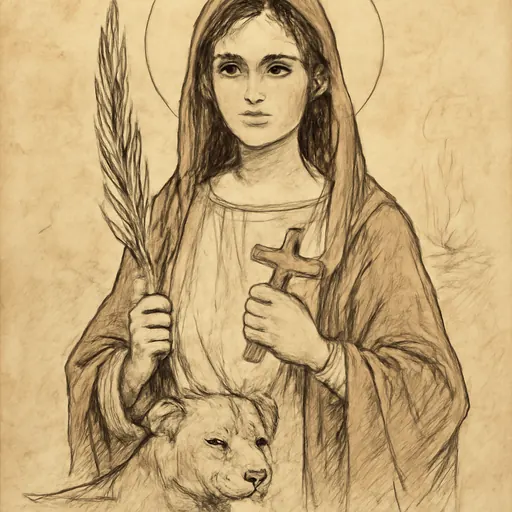
St. Thecla of Iconium was a young woman of the first century who, according to the second-century Acts of Paul and Thecla, heard St. Paul preach, gave up her marriage to follow Christ, and survived fire and wild beasts. The Eastern churches honor her as protomartyr among women and equal to the apostles. Her feast day is September 24 in the East (September 23 in the older Roman calendar).
Who was St. Thecla?
St. Thecla of Iconium is the young woman who, in an old Christian story, heard St. Paul preach from her window, left her fiancé and her family to follow Christ, and walked out of a fire and a den of lions unharmed. The Eastern churches call her protomartyr among women and equal to the apostles, the first woman to suffer for Christ and a preacher of the Gospel in her own right. In the West her name was spoken for centuries at the bedside of the dying.
Nearly everything we know about her comes from one book, the Acts of Paul and Thecla, written in Asia Minor around the year 180. The Church never received it as Scripture. Tertullian, around 200, said a priest in Asia wrote it "from love of Paul" and was removed from office when he confessed. The Catholic Encyclopedia calls the story legendary throughout, but adds that "it is not impossible" a real virgin of Iconium was converted by Paul and worked in the missions like many women of the apostolic age. Her veneration is ancient and real, so we honor her as the Church always has, and tell her story as the legend it is.
She should not be confused with St. Thecla of Kitzingen, an 8th-century English abbess in Germany, or with Thecla of Gaza, a martyr of 304.
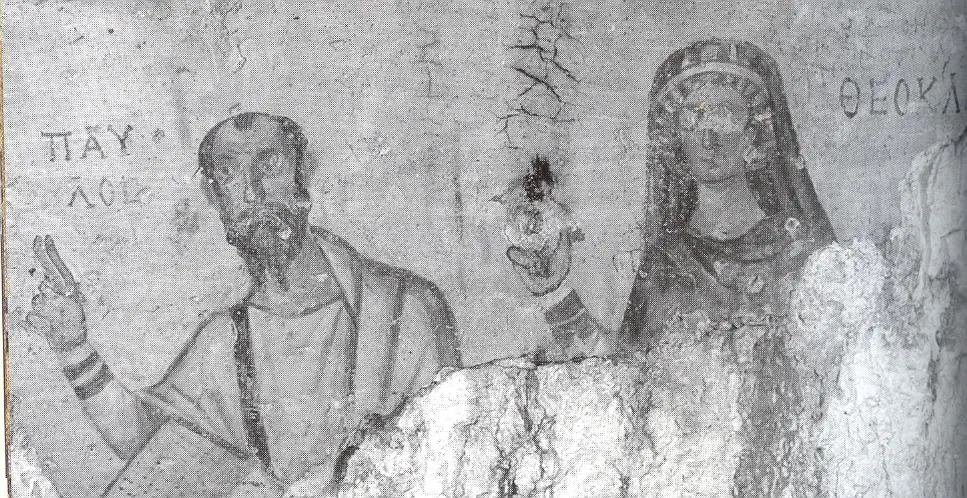
The story of St. Thecla
What follows is the account in the Acts of Paul and Thecla, as translated in the Ante-Nicene Fathers. All of it is traditional.
The girl at the window
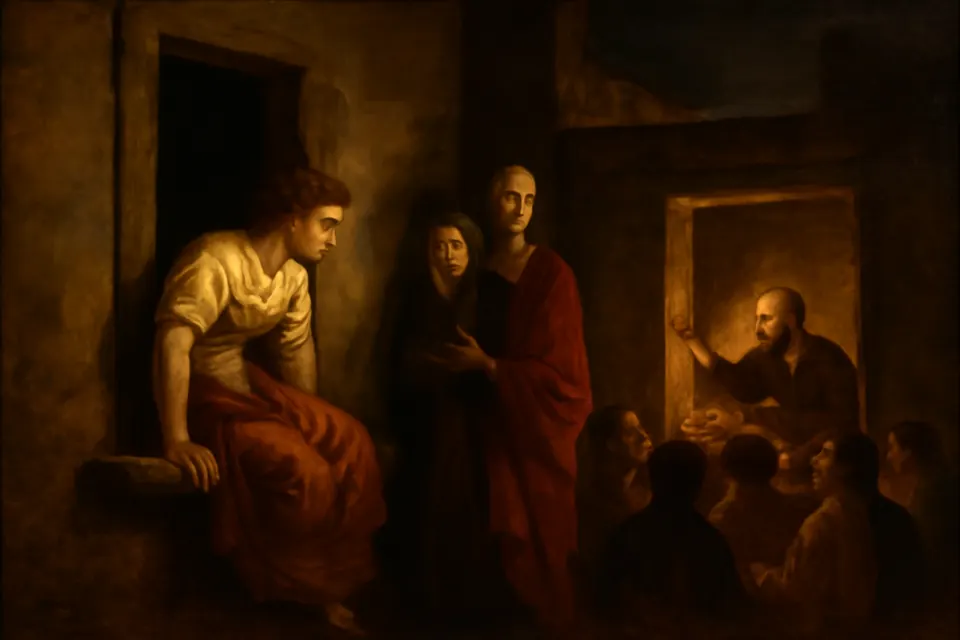
Paul came to Iconium, today's Konya in Turkey, and preached in the house of a man named Onesiphorus about purity, self-control and the resurrection. Next door, a young woman named Thecla, engaged to a leading citizen named Thamyris, sat at her window and listened "night and day," for three days without eating. Her mother, Theocleia, complained that she clung to the window "like a spider."
Thamyris had Paul arrested. That night Thecla bribed the gatekeeper with her bracelets and the jailer with a silver mirror, and sat at Paul's feet in prison. When they found her there, the governor had Paul whipped and driven out of the city. Thecla's own mother cried out to the court, "Burn her." The governor condemned her to the stake.
The fire
In the theater Thecla made the sign of the cross and climbed onto the pyre. The fire was lit, but it never touched her. The ground rumbled, a storm cloud burst over the theater with rain and hail, and the fire went out. She found Paul hiding with Onesiphorus's family in a tomb on the road, praying for her, and they shared five loaves, herbs and water. She asked to cut her hair and follow him. Paul, worried for her, told her to be patient and she would receive baptism.
The lioness and the bulls
In Antioch of Pisidia a powerful man named Alexander tried to take her by force in the street. She fought him off, tore his cloak and knocked off his crown, and he had her condemned to the beasts. A rich widow, Queen Tryphaena, sheltered her until the day of the games and came to love her like her own dead daughter.
In the arena they let loose a lioness, and it lay down and licked her feet. When a bear came at her, the lioness tore it apart; when a lion attacked, the lioness fought it and both died. Then Thecla saw a pit full of water and threw herself in, saying, "In the name of Jesus Christ I am baptized on my last day." A flash of fire surrounded her, and the beasts would not touch her. They tied her between two maddened bulls; the flames burned the ropes away. Tryphaena fainted, the governor stopped the games, and when he asked Thecla what was in her that no beast would touch her, she answered: "I indeed am a servant of the living God."
The women of the city shouted, "There is one God, the God of Thecla," so loudly, the Acts say, that the foundations of the theater shook.
Preacher and hermit
Thecla dressed in a man's cloak and found Paul at Myra in Lycia. He sent her out with the words "Go, and teach the word of God." She went home to Iconium, found Thamyris dead and her mother alive, and tried to win her mother for Christ. Then she went to Seleucia in Isauria, on the south coast of Asia Minor, and lived in a cave for seventy-two years, the Acts say, "and she enlightened many by the word of God."
One manuscript adds a last chapter. The sick came to her cave and were healed, and the physicians of Seleucia, who were losing their trade, sent drunken young men to violate her. She prayed, a voice from heaven said, "Fear not, Thecla, my true servant, for I am with you," and the rock opened. She walked into it and it closed behind her, leaving her attackers holding a scrap of her veil. She was ninety years old, and the Acts give the day of her death as September 24.

The miracles of St. Thecla
None of these stories has been examined in the way modern canonizations require, and all of them come from an apocryphal book.
- Saved from the fire by a sudden storm (traditional).
- The lioness that defended her, and the beasts that would not touch her (traditional). St. Ambrose wrote of the lioness "licking her feet, showing without a sound that it could not injure the sacred body of the virgin."
- The bulls whose ropes burned away (traditional).
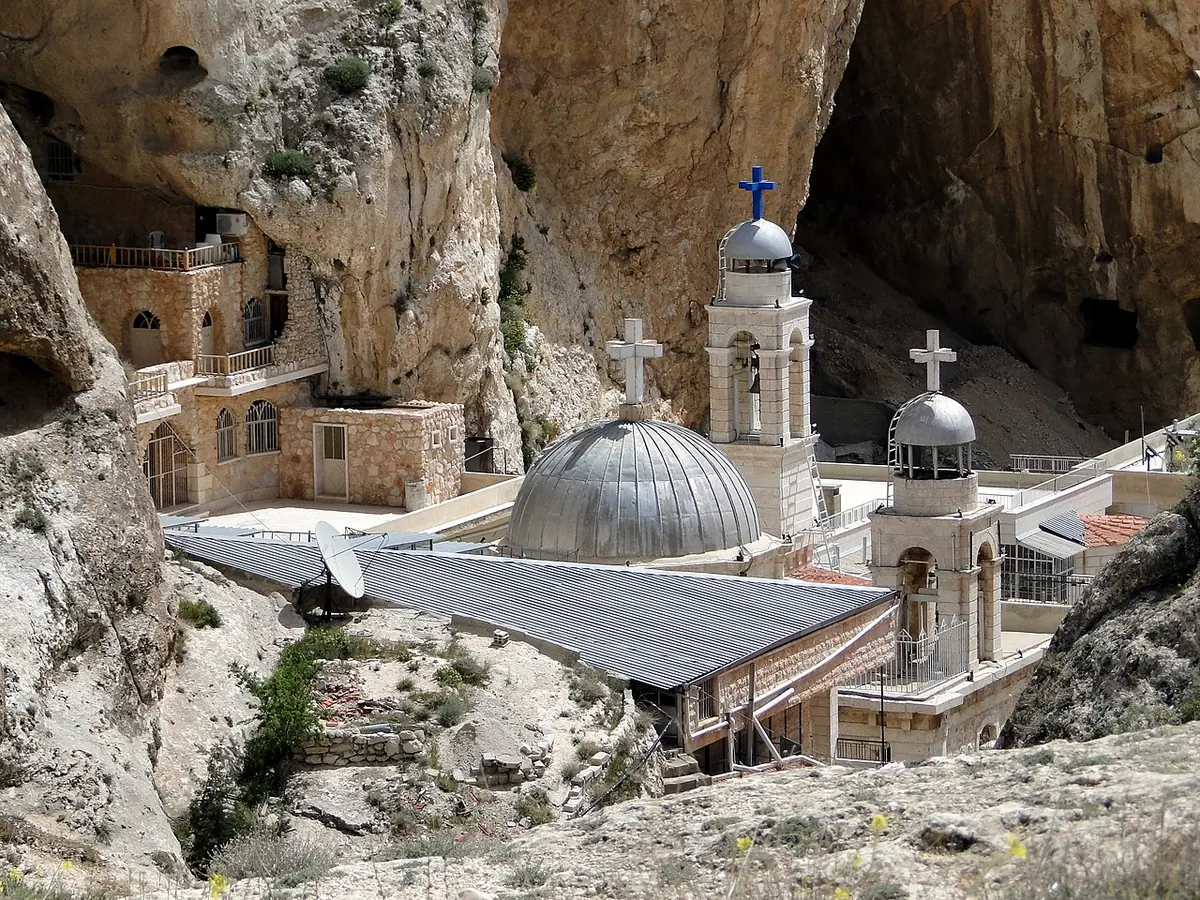
- The rock that opened to shelter her (traditional). Maaloula in Syria tells its own version: fleeing her pursuers, Thecla found the way blocked by a cliff, and it split to let her through.
- Healings at her shrines (reported). Healings were reported at Seleucia from early times, and the Patriarchate of Antioch says people still come to her grotto at Maaloula for cures, including childless couples, Muslim as well as Christian.
Why St. Thecla is a patron of the dying
For centuries the Roman Ritual's prayers for a soul leaving this world, the Commendation of a departing soul, ended with a litany of God's rescues: Noah from the flood, Daniel from the lions, Susanna from false witness. Its last line names Thecla. As translated by Gregory DiPippo:
And as Thou didst deliver Thy most blessed Virgin and Martyr Thecla from three most cruel torments, so may Thou deign to deliver the soul of this Thy servant, and cause him to rejoice with Thee in the goods of heaven.
So the Church asked that the dying be rescued as she was, which is why we still call on her for a good death. St. Ambrose had said much the same, telling consecrated virgins to let Mary teach them how to live, and "Thecla teach you how to be offered." She is also the patron of Tarragona in Spain and Este in Italy, for reasons told below. See more on our patron saints page.

Symbols of St. Thecla in art
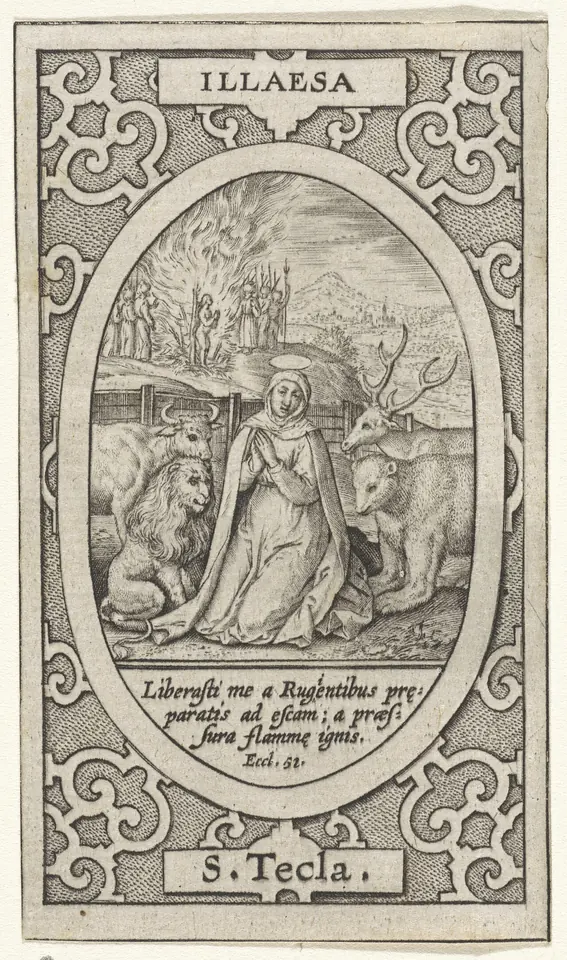
You will usually find Thecla as a young woman, sometimes crowned, with one or more of these:
- A lion or lioness at her feet, peaceful and even tender, for the arena at Antioch.
- Flames or a pyre, for the fire in Iconium.
- Bulls, for the last torment she escaped.
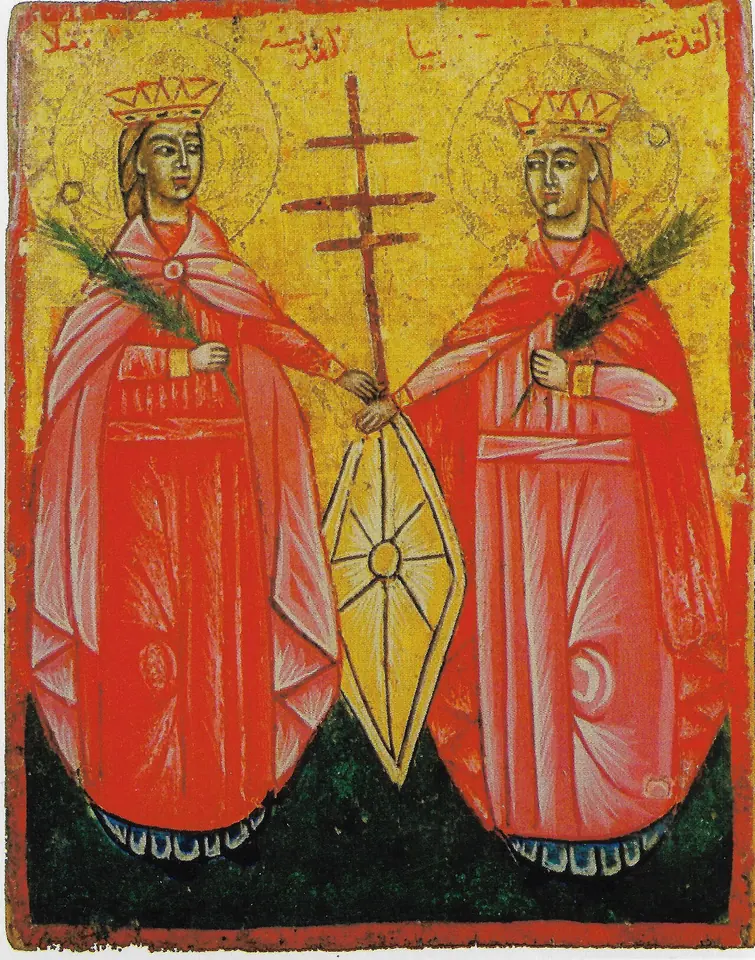
- A martyr's palm, though she was not killed, because the Church honors her as a martyr.
- A book, scroll or cross, for her preaching. In Eastern icons she often holds a cross, the sign of an apostle and martyr, and wears a red maphorion.
The 1563 engraving above gathers nearly all the beasts at once. Western Renaissance painters often placed her beside St. Paul or among virgin martyrs like St. Catherine of Alexandria, St. Agnes and St. Barbara. An 18th-century Syrian icon below pairs her with St. Catherine as two royal virgins with palms.
Feast day and where St. Thecla is honored
The Orthodox and Eastern Catholic churches keep her feast on September 24, and the Orthodox Church in America notes that she is invoked when women are tonsured as nuns. In the West, Pope St. Pius V added a commemoration of St. Thecla on September 23 to the breviary of 1568 and the missal of 1570; she is no longer on the General Roman Calendar. Neighbors on the calendar are on our feast days page.
Seleucia
Her greatest ancient shrine stood outside Seleucia, near today's Silifke in southern Turkey, where the Acts say she lived and died. Pilgrims crowded there in the 4th century. The pilgrim nun Egeria visited, and St. Gregory of Nazianzus retreated there for several years. The Emperor Zeno built a great church over her cave around 475. Today the site, called Ayatekla, is a ruin, but the cave church beneath it can still be visited.

Maaloula
In the Syrian mountain village of Maaloula, the Greek Orthodox Patriarchate of Antioch keeps the Convent of St. Thecla, built around a rock grotto that local tradition holds was her refuge and her tomb. Its spring is said to heal, and the convent is one of the great places of pilgrimage in Syria.
Tarragona and Este
Tarragona, on the Catalan coast, has had a relic of her arm since 1321, when it arrived from Armenia Minor through the efforts of King James II of Aragon. The cathedral is dedicated to her, and its alabaster high altarpiece, carved by Pere Johan between 1426 and 1434, shows her life in six scenes. The city's great festival, the Festes de Santa Tecla, fills the streets every September around her feast. In Milan, a relic of her head was placed in the old summer cathedral, which took her name. And at Este, near Padua, the people asked her help during the plague of 1630; Tiepolo's great altarpiece of her praying for the town, finished in 1759, still hangs in Este Cathedral.
Prayer to St. Thecla
The Orthodox Church sings this troparion on her feast, in the Orthodox Church in America's translation (Tone 4):
You were enlightened by the words of Paul, O Bride of God, Thekla, / and your faith was confirmed by Peter, O Chosen One of God. / You became the first sufferer and martyr among women, / by entering into the flames as into a place of gladness. / For when you accepted the Cross of Christ, / the demonic powers were frightened away. / O all-praised One, intercede before Christ God that our souls may be saved.
We ask her prayers for those near death, for young people who give their lives to Christ against the wishes of others, and for courage to speak of Him. St. Thecla, who listened to the Gospel and never let go of it, pray for us.
Frequently asked questions
Who was St. Thecla?
A young woman of Iconium (now Konya, Turkey) who, in the Acts of Paul and Thecla, was converted by St. Paul's preaching, broke off her engagement, was condemned to be burned and then thrown to wild beasts, and was saved both times. She later preached and lived as a hermit near Seleucia, dying at about ninety. Almost everything about her comes from those Acts, written around 180, so the details are legend, though the Catholic Encyclopedia allows that a real disciple of Paul may lie behind them.
When is St. Thecla's feast day?
September 24 in the Orthodox and Eastern Catholic churches, which is also the day her Acts give for her death. The Roman calendar used to commemorate her on September 23, and Tarragona in Spain still keeps its great festival of Santa Tecla on that day. She is not on today's General Roman Calendar.
Why is St. Thecla called a martyr if she was not killed?
Because she suffered for Christ and was ready to die: she went to the stake and into the arena. The Eastern churches call her protomartyr among women, the first woman to suffer for the faith, and equal to the apostles, because she preached the Gospel.
Is the Acts of Paul and Thecla in the Bible?
No. It is an apocryphal work of the late second century. Tertullian, writing about the year 200, said a priest in Asia had written it out of love for Paul and had been removed from office for it. Still, the Church Fathers, among them St. Ambrose and St. Gregory of Nazianzus, honored Thecla herself.
What is St. Thecla the patron saint of?
She is the patron of Tarragona in Spain, which has had a relic of her arm since 1321, and of Este in Italy. Because the Church's ancient prayers for the dying name her, she is also invoked for a good death.
Sources
- Catholic Encyclopedia (1912): Sts. Thecla
- The Acts of Paul and Thecla (Ante-Nicene Fathers, vol. 8)
- Tertullian, On Baptism, chapter 17
- St. Ambrose, Concerning Virgins, Book II, chapter 3
- Orthodox Church in America: Protomartyr and Equal of the Apostles Thekla
- Gregory DiPippo, The Feast of St. Thecla, First-Martyr Among Women (New Liturgical Movement, 2020). The Commendation of a soul, her Roman commemoration of 1568, Seleucia and Milan
- Greek Orthodox Patriarchate of Antioch: The Convent of St Thecla, Ma'lula
- Tarragona Cathedral: Main altarpiece (the arm relic of 1321)