St. Galla of Rome: Young Widow, Servant of the Poor and Friend of St. Peter

St. Galla of Rome (died about 550) was the daughter of the Roman consul Symmachus. Widowed before her first wedding anniversary, she refused to remarry, entered a convent beside St. Peter's Basilica, and spent her life in prayer and generous almsgiving. Pope St. Gregory the Great tells how St. Peter appeared at her deathbed. Her feast is October 5.
Who was St. Galla of Rome?
St. Galla of Rome was a young Roman noblewoman of the sixth century who lost her husband within a year of their wedding and then gave the rest of her life to God, living in a convent beside St. Peter's Basilica and pouring out her wealth on the poor. Pope St. Gregory the Great wrote the story of her holy death, and the Church has remembered her ever since. We keep her feast on October 5.
A daughter of Symmachus
Galla was the daughter of Symmachus the Younger, consul and patrician, one of the most learned and respected men in Rome. Her family was at the very top of Roman society. The 1911 editor of Gregory's Dialogues notes that Symmachus was also the father-in-law of the philosopher Boethius, so Galla was the sister of Boethius's wife, Rusticiana.
Those were dangerous years. Rome was ruled by the Gothic king Theodoric, who in his last years turned against the Roman senators he suspected of plotting with Constantinople. He had Boethius executed, and then Symmachus, whom the Catholic Encyclopedia says he "unjustly condemned to death" in 525. The same storm took Pope St. John I, who died in Theodoric's prison in 526.
Widowed in her first year
Galla married young. Before the first year of the marriage had passed, her husband died. St. Gregory tells what came next:
though both plenty of wealth and her young years were great allurements to a second marriage, yet she made choice rather to be married spiritually to God
Gregory adds an unusual detail, and tells it with tenderness. Her doctors warned her that unless she married again, her strong constitution would make her grow a beard like a man. It happened, Gregory says, "but the holy woman little regarded outward deformity, which inwardly in her soul was enamoured with the beauty of the heavenly spouse."
She laid aside her fine clothes and gave herself to the service of God in the convent "which is by the church of the blessed Apostle St. Peter." There she lived "for the space of many years in prayer and simplicity of heart, and bestowed alms plentifully upon needy and poor people."

Butler says the revenues of her great estates "were made the patrimony of the poor." The Catholic Encyclopedia adds that she founded a hospital as well as a convent near St. Peter's. Tradition holds that the bishop and theologian St. Fulgentius of Ruspe addressed his letter on the state of widowhood to her.
Her death: St. Peter at the bedside
At the end of her life Galla suffered from cancer of the breast. She kept two candles burning beside her bed through the night, because, Gregory says, "loving light, she did not only hate spiritual darkness, but also corporal."
One night St. Peter stood before her bed, between the two candlesticks. She was not afraid. She asked him:
How is it, my Lord? what? are my sins forgiven me?
Peter bowed his head and answered, "Thy sins are forgiven thee; come and follow me." Galla then begged that her dearest sister in the convent, Benedicta, might come with her. Peter said that another sister would come with her now, and that Benedicta would follow thirty days later. Galla told the abbess what she had seen. On the third day she died, together with the other nun, and on the thirtieth day Benedicta followed them.
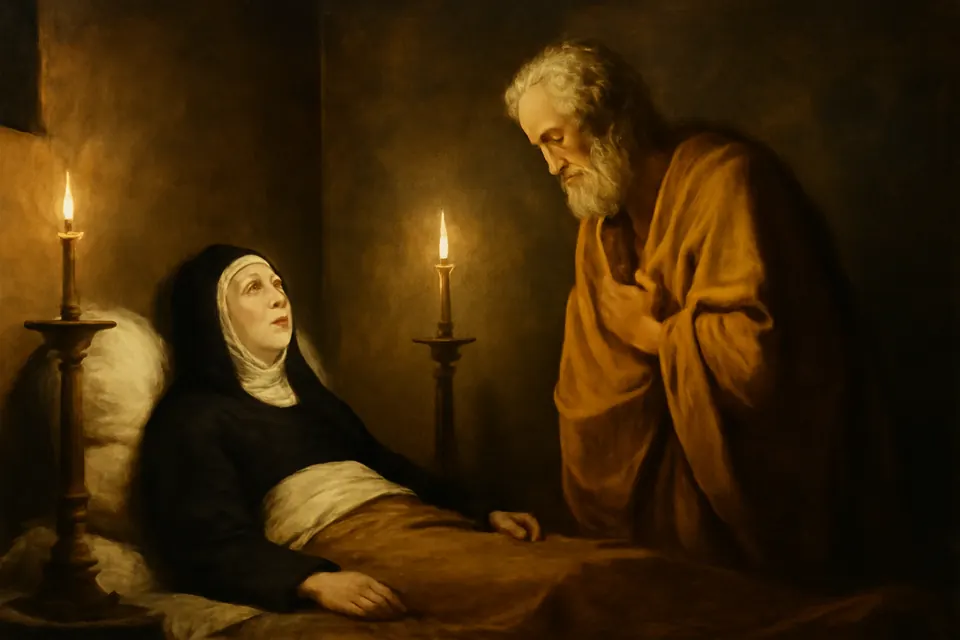
We count this a reported miracle: Gregory wrote it down within living memory, from witnesses he calls "grave and of good credit," and he says the nuns of the convent still knew every detail. It was never examined by any formal process.
The icon of Santa Maria in Portico
Galla's name lived on in a Roman church, Santa Galla, near the old Piazza Montanara, which also housed a hospice for the poor in later centuries.
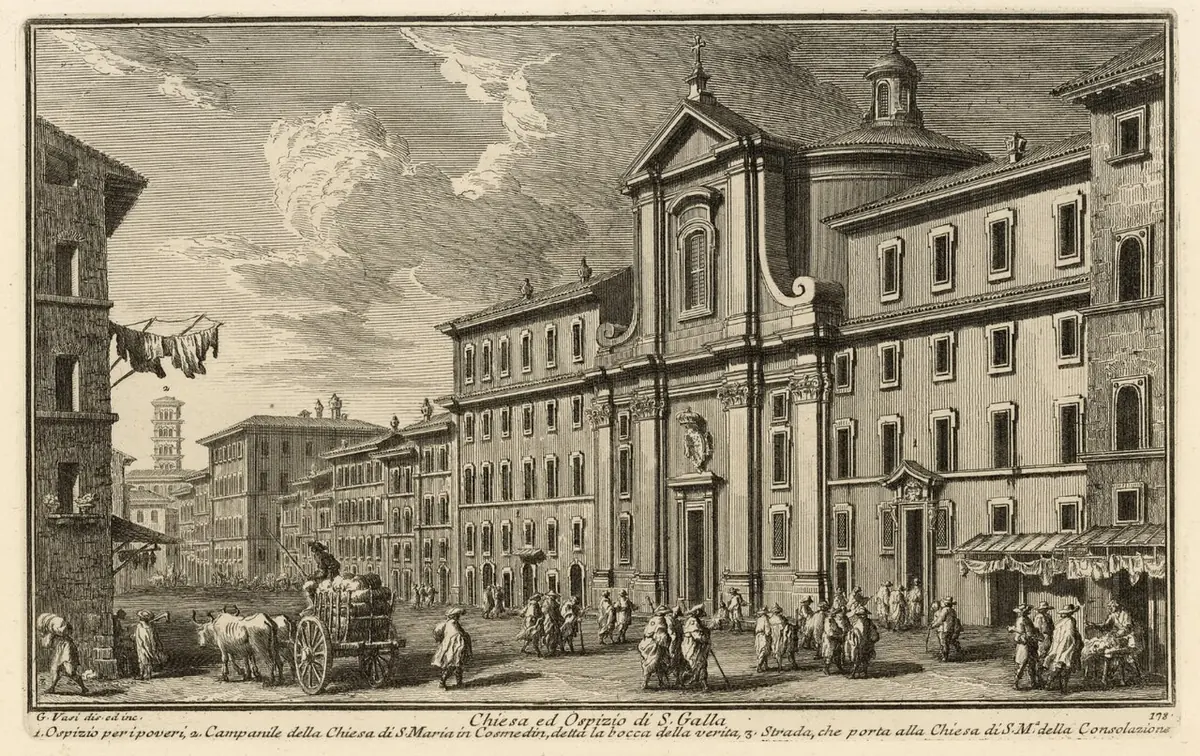
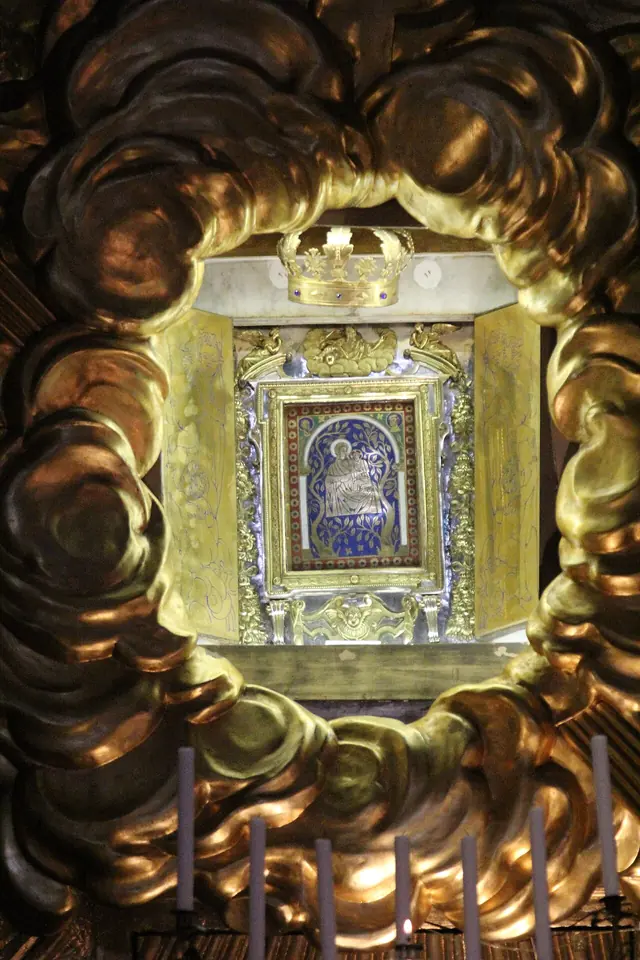
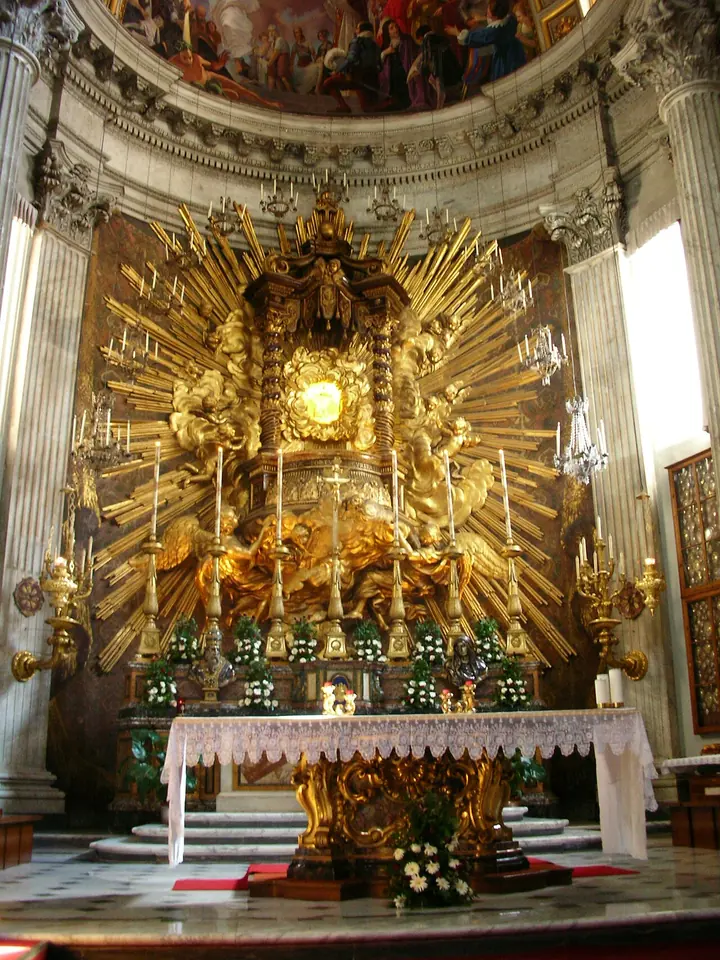
That church once held a small image of the Virgin and Child, known as Santa Maria in Portico. The Catholic Encyclopedia reports that "according to tradition" it represents a vision granted to St. Galla. The image was held to be miraculous and was carried in procession through Rome in times of plague. This is a traditional story, not one Gregory tells. The image now stands over the high altar of Santa Maria in Campitelli.
Symbols of St. Galla in art
St. Galla is rarely painted, and she has no fixed emblem. When she appears, she is a young widow in a dark veil, often giving bread or alms to the poor. Scenes of her death show St. Peter between two candlesticks at her bed. In Rome she is linked with the image of Santa Maria in Portico.
Feast day and prayer
We keep her feast on October 5; see our feast day calendar. There is no traditional English prayer to her. Let us ask her prayers for all widows and for the sick: St. Galla of Rome, who turned grief into prayer and wealth into bread for the poor, pray for those who mourn, for those who suffer long illness, and for us at the hour of our death.
Frequently asked questions
Who was St. Galla of Rome?
A sixth-century Roman noblewoman, daughter of the consul and patrician Symmachus, whom King Theodoric put to death in 525 or 526. Her husband died within the first year of their marriage, and she gave herself to God in a convent by St. Peter's, where she lived for many years in prayer and works of mercy.
What happened at St. Galla's death?
According to St. Gregory the Great, she was dying of cancer when St. Peter appeared at her bed between two candlesticks and told her, "Thy sins are forgiven thee; come and follow me." She asked that her friend Benedicta might come too; he answered that Benedicta would follow thirty days later. Galla died three days after, and Benedicta on the thirtieth day.
When is the feast of St. Galla of Rome?
October 5.
Is St. Galla connected with the icon of Santa Maria in Portico?
Yes, by tradition. The Catholic Encyclopedia says her church in Rome once held an image of Our Lady that tradition connects with a vision granted to St. Galla. It was carried in procession in times of plague and now hangs over the high altar of Santa Maria in Campitelli.
Keep exploring
Sources
- St. Gregory the Great, Dialogues, Book IV, ch. 13 (1911 translation, tertullian.org). The account of her widowhood, illness and death, quoted here; the editor's note on her family and Boethius
- Catholic Encyclopedia (1909): St. Galla. Her father's execution, the letter of St. Fulgentius, and the image of Santa Maria in Portico
- Alban Butler, Lives of the Saints (1866), vol. X: St. Galla, Widow (Bartleby, archived)
- The Roman Martyrology (English edition, 1916), Internet Archive. October 5