St. Pelagia the Penitent of Antioch
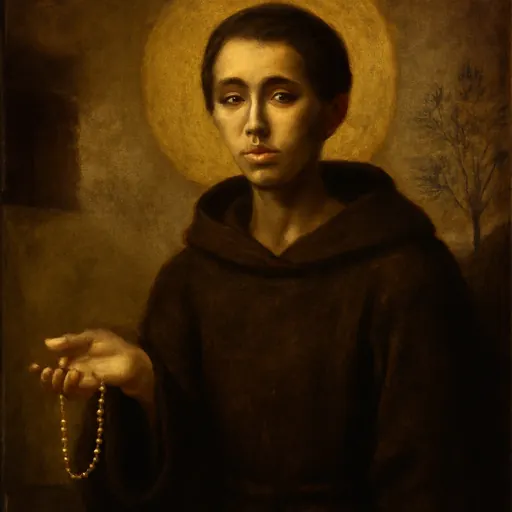
St. Pelagia the Penitent was the most celebrated actress and dancer of Antioch who, converted by the preaching of Bishop Nonnus, gave away her fortune and lived out her days as a hermit on the Mount of Olives, disguised as a monk named Pelagius. Her feast day is October 8. She is not St. Pelagia of Antioch, the virgin martyr.
Which St. Pelagia? The penitent and the virgin martyr
When people speak of St. Pelagia, they usually mean St. Pelagia the Penitent, the dazzling actress of Antioch who was converted in a single sermon and ended her days as a hidden hermit on the Mount of Olives. Her feast is October 8, and her story, told by an eyewitness called James the Deacon, was one of the most widely read saints' lives of the Middle Ages.
Antioch gave the Church a second St. Pelagia, and the two are easily confused. St. Pelagia the virgin martyr was a girl of about fifteen who died in the persecution of about 300, more than a century before the penitent; she has her own section near the end of this page. A third, Pelagia of Tarsus, was another martyr. Alban Butler warned his readers in the 18th century not to mix them up.
Who was St. Pelagia the Penitent?
Pelagia was the leading actress and dancer of Antioch, then one of the great cities of the Roman East. Her life on the stage made her rich and famous, and she was not yet baptized. The people of Antioch called her Margarita, "the pearl," for the jewels she wore. After hearing a sermon by Nonnus, a holy bishop visiting the city, she wept, begged for baptism, gave everything she owned to the poor, freed her slaves and vanished. Years later she was found again in Jerusalem, as an unknown monk living in a sealed cell on the Mount of Olives.
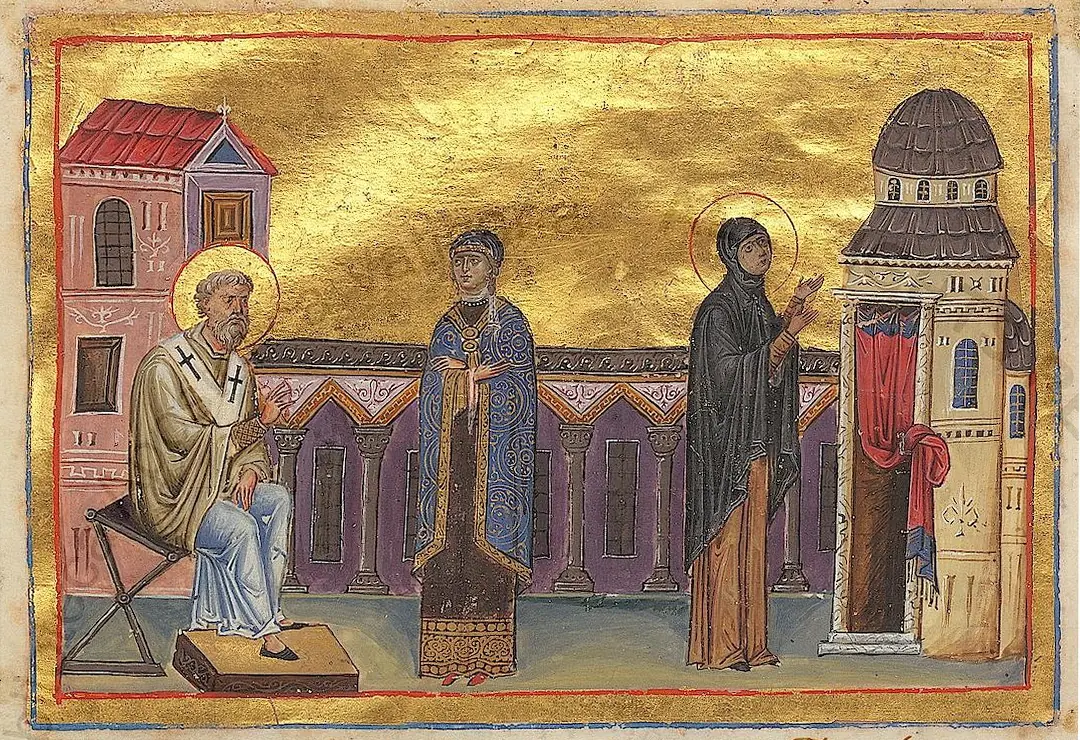
Our main source is the Life written by James, deacon to Bishop Nonnus, who says he saw these things himself. Its Latin version was copied into the Lives of the Fathers that monks read for centuries. Butler identifies Nonnus with a bishop of the mid-5th century who succeeded Ibas at Edessa and later served at Heliopolis in Syria (modern Baalbek, in Lebanon), which would place Pelagia's conversion in that century. The Orthodox Church calls him Nonnus of Edessa.
The life of St. Pelagia
The bishops and the actress
The bishop of Antioch had called eight bishops to a council. They sat outside the basilica of St. Julian the Martyr, and the others asked Nonnus to teach them. While he was speaking, the first actress of Antioch rode past on a donkey, with a train of young men and girls in costly robes, covered in gold and pearls, her head and shoulders bare. In Helen Waddell's translation of the Latin Life, the bishops "groaned, and in silence turned away their heads as from great and grievous sin."
Nonnus did not look away. He watched her until she was gone, then wept, and told the bishops that her beauty had delighted him, and that God would set her before His judgment seat to judge them all: she spent hours adorning her body to please the men of Antioch, while they did not even wash their souls for their immortal Bridegroom.
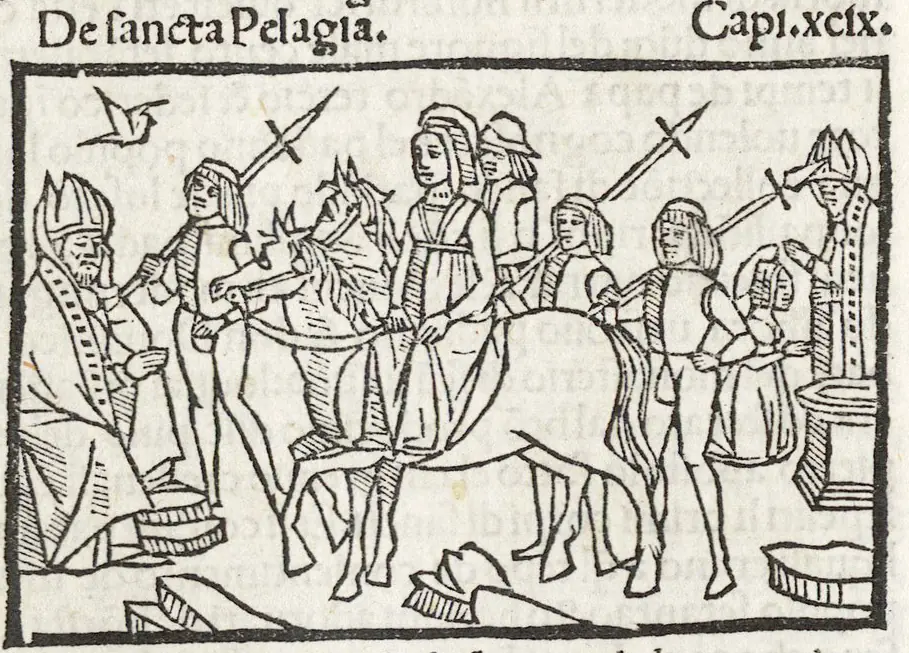
That night Nonnus lay face down on the floor of his cell and prayed, "Lord Christ, have mercy on a sinful man and an unworthy, for a single day's adorning of a harlot is far beyond the adorning of my soul."
The sermon and the letter
The next day was Sunday, and the bishop of Antioch asked Nonnus to preach in the great church. He spoke of the judgment to come, and the people wept. Pelagia, who James says had never been inside a church, had come in, and she was overcome. She sent two servants to follow Nonnus to his lodging and then sent him a wax tablet. "To Christ's holy disciple," she wrote, "the devil's disciple and a woman that is a sinner." She had heard that Christ came "not for the good men's sake, but that He might save sinners," and she begged to see him. Nonnus answered that she could come, but would see him only with the other bishops present.
Baptism
She came at once, threw herself at his feet, washed them with her tears and wiped them with her hair, and asked to be baptized. Nonnus said the canons required a sponsor for a woman of her life. She refused to wait. "I am a sea of wickedness and an abyss of evil," she said, and she warned him that he would answer to God for her soul if he delayed. The bishops had never seen such faith.
They sent for a deaconess of Antioch, Romana, who became her godmother. When Nonnus asked her name, she said that her parents had called her Pelagia, but the city called her Margarita because of her pearls. Nonnus baptized her and gave her Holy Communion, and that evening told his deacon to rejoice with the angels and to take oil and wine with their meal for the salvation of the girl.
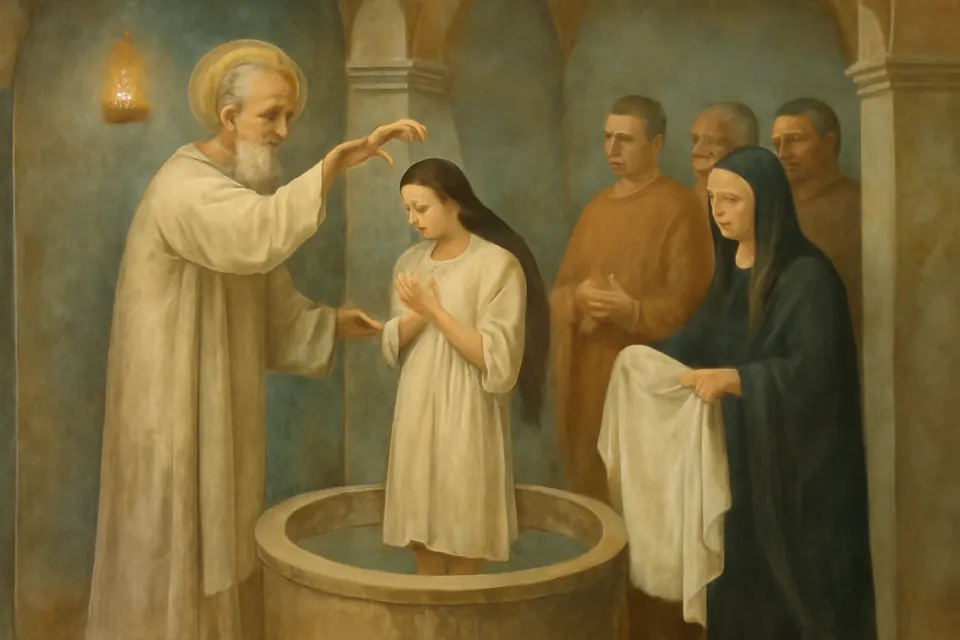
James reports that the devil came twice to tempt her back, and each time vanished when she made the sign of the cross. Three days later she had her steward bring every piece of gold, silver and jewelry she owned and gave it all to Nonnus. He handed it to the church treasurer with an oath that none of it should go to the church, but all to "the widows and orphans and the poor." She freed her slaves and gave each a gold torque.
Brother Pelagius on the Mount of Olives
On the eighth day, when the newly baptized lay aside their white robes, Pelagia rose by night, put on a tunic and cloak of Nonnus, and was never seen in Antioch again. Romana wept for her. Nonnus told her not to grieve, for Pelagia had chosen the better part, like Mary of Bethany.
Three or four years later James went on pilgrimage to Jerusalem. Nonnus told him to ask for "a certain brother Pelagius, a monk and a eunuch," who lived shut up alone. James found the cell on the Mount of Olives, closed on every side with one small window. The hermit opened it and knew him, but James did not recognize her: the face he had seen in such beauty was "wasted and haggard with fasting." She asked him to tell Nonnus to pray for her, closed the shutter, and began to sing the office of Terce.
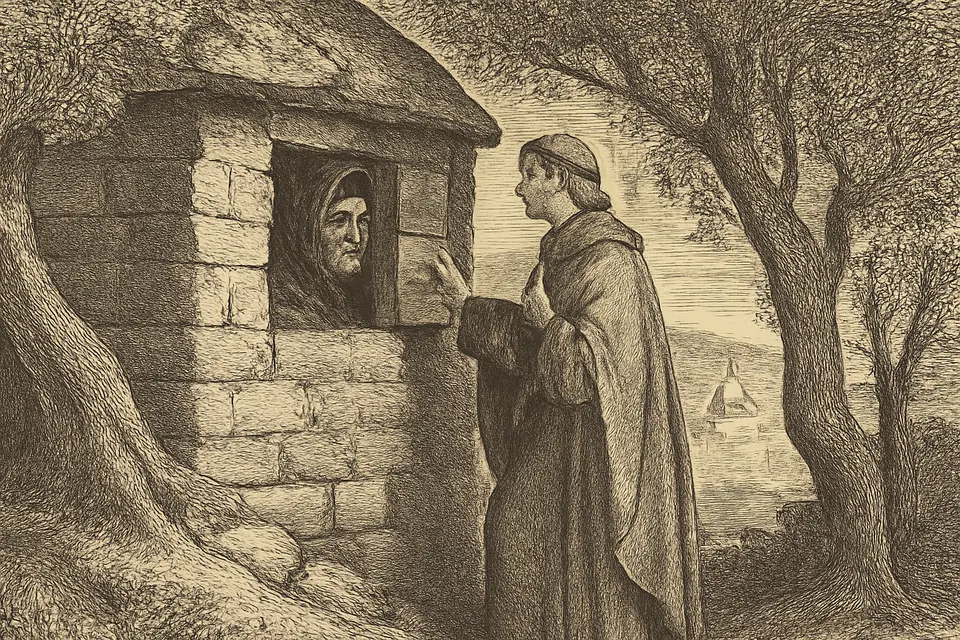
When James came back, no one answered for three days. He opened the shutter and saw the monk lying dead. When the monks of Jerusalem prepared the body for burial, they discovered that "brother Pelagius" was a woman. Nuns came from Jericho and the Jordan with candles and hymns, and she was buried on the Mount of Olives.
The miracles of St. Pelagia
No miracle of St. Pelagia has been formally investigated by the Church. In her Life, Nonnus's dream of a filthy dove washed white in holy water and the devil's vanishing at the sign of the cross are traditional. So is the discovery at her burial, which James presents as a wonder God revealed: the monks cried out, "Glory to Thee, Lord Christ, who hast many treasures hidden on the earth, and not men only, but women also."
St. John Chrysostom, preaching in Antioch around 390, told his people about an actress from Phoenicia who had held "the first honors on the stage" and was famous as far as Cilicia and Cappadocia, who was converted, baptized and lived for years shut up "as it were, in a prison," refusing even to let her old lovers see her. He gives no name, but Thomas Craughwell counts the sermon among the sources for Pelagia's story.
Why St. Pelagia is a patron of penitents and actresses
Pelagia's whole story is about repentance, the bishop's as well as her own. The Orthodox hymn for her feast says she showed "us the way to repentance." We ask her prayers when we feel too far gone to come back to God, and for those whose work keeps them in the public eye. The Church has given her no formal patronage, but because she began on the stage she is often called a patron of actresses. See more on our patron saints page.
Symbols of St. Pelagia in art
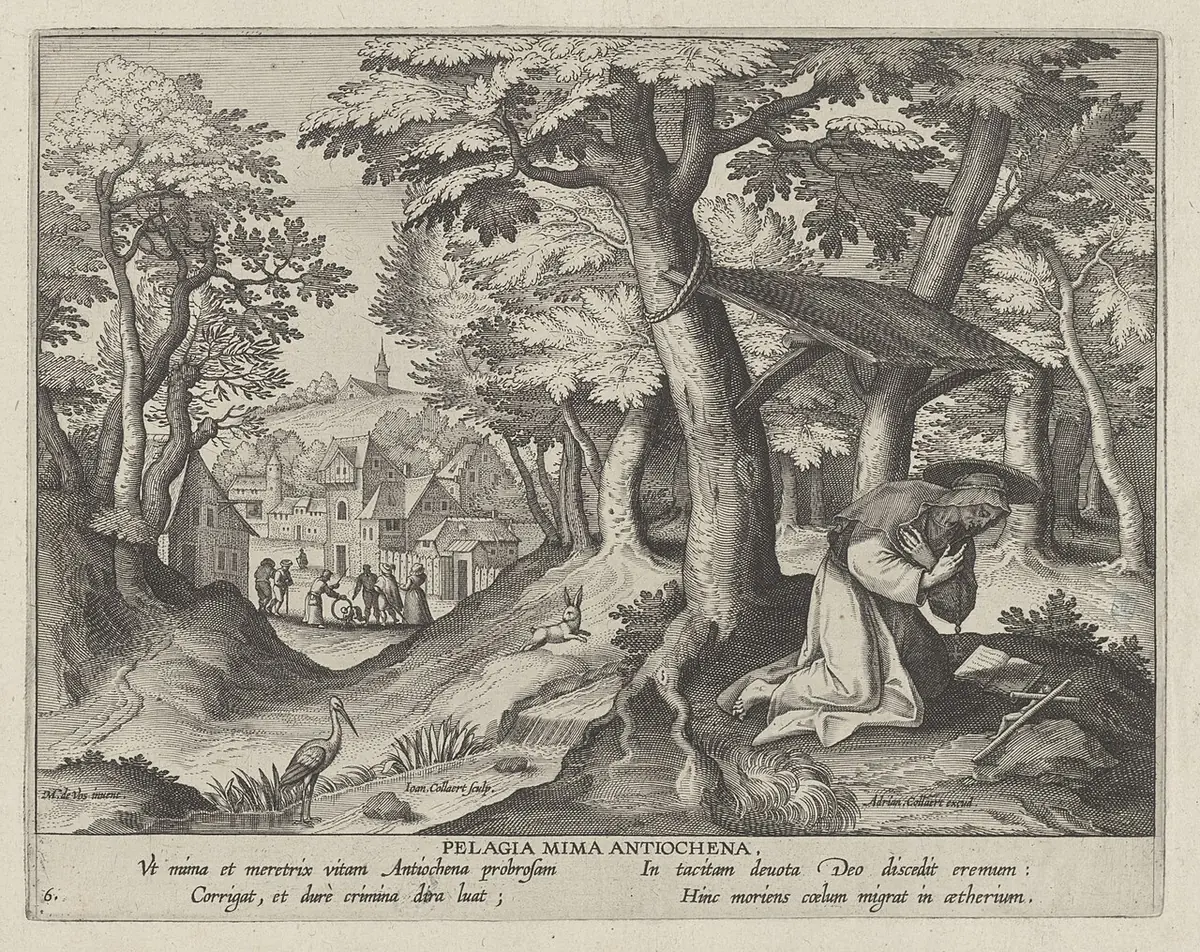
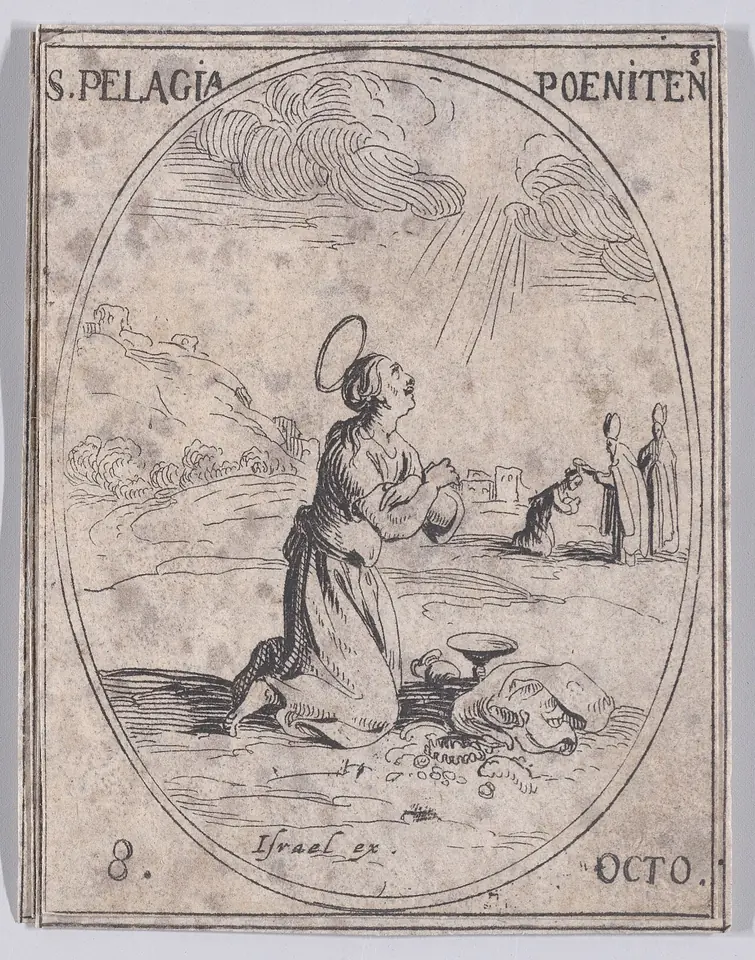
There are two Pelagias in her pictures, the actress and the hermit, and artists often show both. Look for:
- Rich clothes, pearls and jewels: her life as Margarita, sometimes shown riding in procession or with her jewelry thrown on the ground.
- A monk's habit or hood: her years as "brother Pelagius."
- A small cell or window: the cell on the Mount of Olives where James found her.
- Kneeling in prayer, rays from heaven: the penitent at prayer, as in Callot's etching.
- Bishop Nonnus: often beside her, preaching, praying or baptizing.
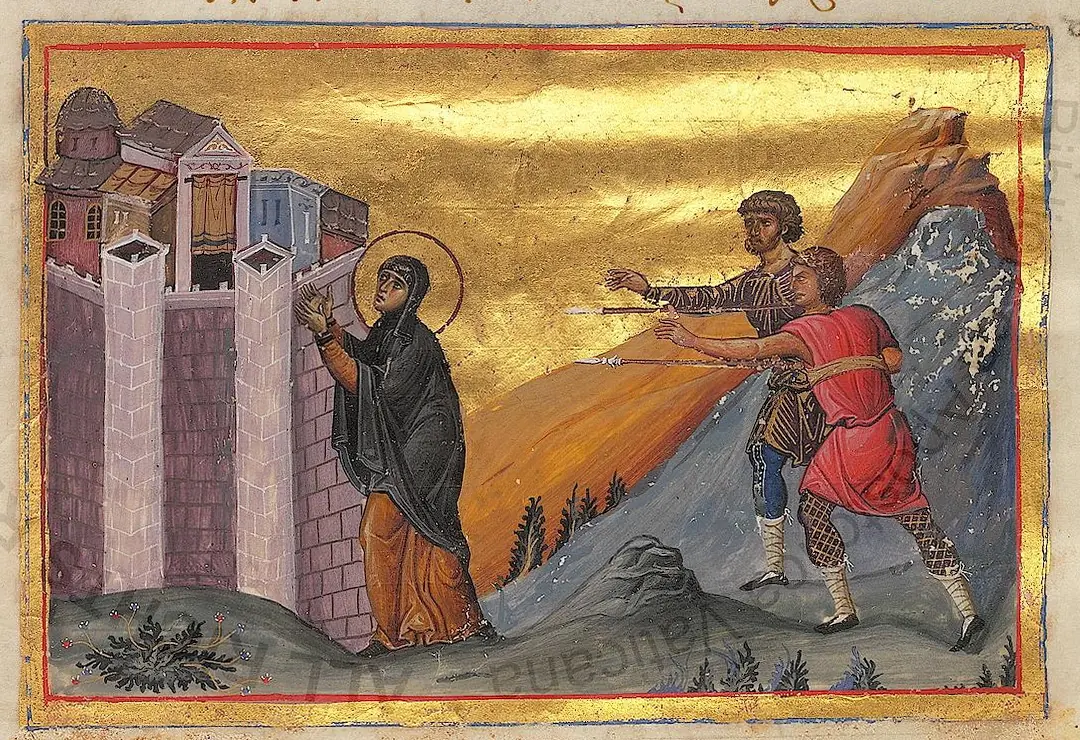
The Menologion miniature near the top of this page shows both at once, as Butler noted: a woman of the world listening to Nonnus, and a religious praying before the great church of Jerusalem. Eastern icons show her as a nun in a dark mantle, holding a cross.
Feast day and tomb
The Church keeps St. Pelagia the Penitent's feast on October 8, both in the Roman Martyrology and in the Orthodox Church. You can see who else the Church honors in October on our feast days page.
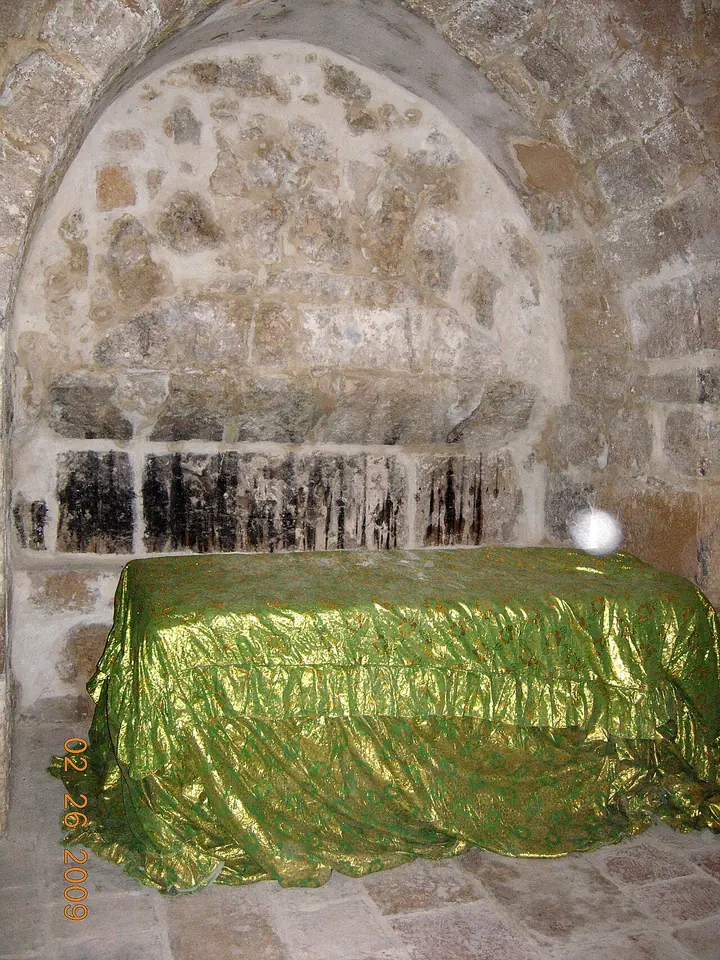
Her cell and grave on the Mount of Olives became a place of pilgrimage. Butler cites the Greek pilgrim Phocas, who in 1185 described the grotto "where the saint completed the martyrdom of her penance, and where her relics were preserved in an urn." A tomb chamber beside the Chapel of the Ascension is still pointed out as her resting place.
The other St. Pelagia: the virgin martyr of Antioch
St. Pelagia of Antioch, virgin and martyr, lived more than a century earlier. St. Ambrose tells her story in his book Concerning Virgins (377). She was about fifteen, from a Christian family of Antioch, and when the persecution began soldiers surrounded her house while her mother and sisters were away. To keep her purity she dressed as if for a wedding, Ambrose says, and the Orthodox life adds that she threw herself from a window of the house. Ambrose adds that her mother and sisters, cornered by a river, joined hands and walked into the water together. St. John Chrysostom preached a sermon in her honor in Antioch, and the Orthodox life notes that he took care to show she meant to escape violation, not simply to die. The Roman Martyrology honors her on June 9; the Orthodox Church keeps her on October 8, the same day as the penitent.
Prayer to St. Pelagia
On October 8 the Orthodox Church sings a troparion (Tone 4) and a kontakion (Tone 2) that honor her as a rose among thorns whose changed life gave joy to the faithful, and as a penitent who wore out her body in fasting and prayer and won forgiveness; the OCA prints both on its website.
We can also pray with the words of her own letter to Nonnus, from her Life: she had heard that Christ "bowed the heavens and came down to earth, not for the good men's sake, but that He might save sinners." Let us ask St. Pelagia to pray for everyone who longs to come home to God and is afraid it is too late. St. Pelagia, pray for us.
Frequently asked questions
Which St. Pelagia is celebrated on October 8?
In the Roman Martyrology, October 8 belongs to St. Pelagia the Penitent, the converted actress of Antioch. The Orthodox Church remembers both Pelagias of Antioch on October 8, the penitent and the virgin martyr. The Roman Martyrology keeps the virgin martyr on June 9.
What is the difference between the two St. Pelagias of Antioch?
Pelagia the virgin martyr was a Christian girl of about fifteen who, around the year 300, threw herself from her house rather than be seized and violated by soldiers; St. Ambrose and St. John Chrysostom both praised her. Pelagia the Penitent lived over a century later, was a famous actress converted by Bishop Nonnus, and died as a hermit in Jerusalem.
Who wrote the life of St. Pelagia the Penitent?
Her Life is told by James, a deacon of Bishop Nonnus, who says he saw her conversion in Antioch and later visited her cell on the Mount of Olives. It was written in Greek and spread in Latin, Syriac and other languages; Helen Waddell translated the Latin version into English in The Desert Fathers (1936).
Why did St. Pelagia dress as a monk?
James the Deacon says that on the eighth day after her baptism she put on a tunic and cloak of Bishop Nonnus and left Antioch secretly, and lived as "brother Pelagius" in a closed cell so that no one would recognize the famous actress. Alban Butler doubted the disguise, suggesting she simply wore a hermit's habit that could suit either sex.
Is St. Pelagia the patron saint of actresses?
The Church has given her no formal patronage, but because she was once the leading actress of Antioch she is often called a patron for actresses and for all who work in the theater, and she is a model for every penitent.
Keep exploring
Sources
- Helen Waddell, The Desert Fathers (1936): The Life of Saint Pelagia the Harlot, by James the Deacon
- Alban Butler, The Lives of the Fathers, Martyrs and Other Principal Saints, vol. 4 (1866), October 8: St. Pelagia, Penitent
- St. John Chrysostom, Homily 67 on the Gospel of Matthew (the converted actress from Phoenicia)
- St. Ambrose, Concerning Virgins, Book III, ch. 7 (Pelagia the virgin martyr)
- Orthodox Church in America: Venerable Pelagia the Penitent
- Orthodox Church in America: Virgin Martyr Pelagia of Antioch
- Orthodox Church in America: Venerable Pelagia the Penitent, troparion and kontakion
- Thomas J. Craughwell, A patron saint for actresses (Arlington Catholic Herald)