St. Faith of Agen (Sainte Foy)
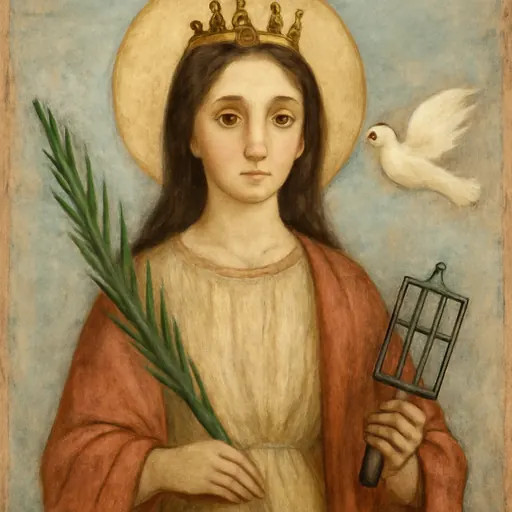
St. Faith of Agen, called Sainte Foy in French, was a young Christian girl martyred at Agen in Roman Gaul around the year 300, tradition says at about twelve, after refusing to sacrifice to the pagan gods. Her relics were carried to the abbey of Conques, where her golden reliquary statue drew pilgrims on the road to Compostela, and where freed prisoners hung up their chains. Her feast is October 6.
Who was St. Faith of Agen?
St. Faith of Agen, known in France as Sainte Foy, was a young Christian girl martyred in the city of Agen, in Roman Gaul, around the year 300. The Song of Sainte Foy, written in the 11th century, says she was twelve. Her name in Latin was Fides, "faith," a name early Christians often chose at baptism. In England she became St. Faith, in Spain Santa Fe, in Italy Santa Fede.
Very little is known about her life on earth. The oldest witness is the Martyrology of Jerome, the Church's earliest calendar of Western martyrs, which lists her under October 6. A fuller Passion followed centuries later. What we know much better is her life in heaven, so to speak: few saints of the Middle Ages had a busier or more vivid cult. From her shrine at Conques, in the hills of southern France, she was said to heal the blind, free prisoners and play pointed "jokes" on those who cheated her.
She is not the St. Faith of Rome, one of three young sisters, Faith, Hope and Charity, martyred with or after their mother Sophia. The Catholic Encyclopedia explains that early Christians took names like Fides and Sophia so often that several unrelated martyrs share them.
The legend of St. Faith
The story of her martyrdom comes from the ninth-century Passion and the 11th-century Song, both retold in English by the art historian Pamela Sheingorn. It is traditional.
Before the judge Dacian
A Roman official named Dacian arrived in Agen to enforce the persecution, and the pagans of the city welcomed him, sure he would prove their gods stronger. Faith, a girl from a wealthy family, was the first Christian brought before him. He urged her to save her life by offering sacrifice to the goddess Diana. She refused.
Dacian had her stretched on a grill over a fire and tortured her. The other Christians of Agen were hiding in a rock shelter on a hill outside the city, where they could see what was happening. Their leader, Caprasius, was praying for her when he saw a dove come down from heaven carrying a jeweled crown, which it set on the girl's head.

Caprasius and the others
The vision gave Caprasius courage. He came down from the hill and confessed his faith before Dacian, and his steadiness won over two onlookers, the brothers Primus and Felician. When none of them would yield, Dacian had them all beheaded with Faith. Caprasius became a saint of Agen in his own right, remembered on October 20.
Agen still has a church named for her, rebuilt in modern times.

How St. Faith came to Conques
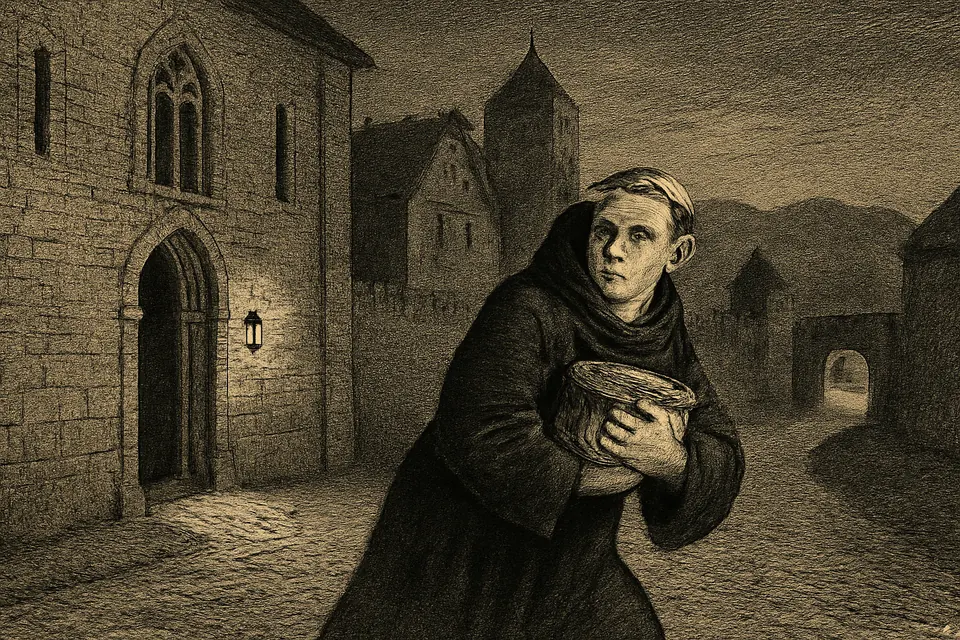
The abbey of Conques, founded around 800 in a narrow valley of the Rouergue, owned no great relics and few pilgrims came. The monks' own account, the Translation of Sainte Foy, tells how they solved that. A monk of Conques named Arinisdus went to Agen, joined the community that guarded Faith's tomb and spent years earning its trust. One night he took the relics and slipped away with them to Conques.
The Catholic Encyclopedia dates the transfer between 877 and 883. Historians call stories like this furta sacra, "holy thefts," and medieval readers took them as a sign of the saint's own will: she had allowed herself to be carried off because she wanted to go.
From then on, Conques was her home. Its Romanesque abbey church, begun under Abbot Odolric around 1030 and finished in the 12th century, became a major stop on the pilgrim road from Le Puy to St. James at Compostela. The church and the road through it are now part of a UNESCO World Heritage listing.

The miracles of St. Faith
Our main witness is Bernard of Angers, a schoolmaster who made at least three trips to Conques between about 1013 and 1020. He wrote down what he saw and what witnesses told him in the Book of Miracles of Sainte Foy, and monks of Conques added more. These accounts are reported: detailed and close to the events, but never examined by the Church in the way modern miracles are.
- The blind healed. Bernard's book opens with Guibert, a young man whose eyes had been torn out by his lord and which, he said, Sainte Foy restored. Healing of the eyes is a recurring theme in the collection.
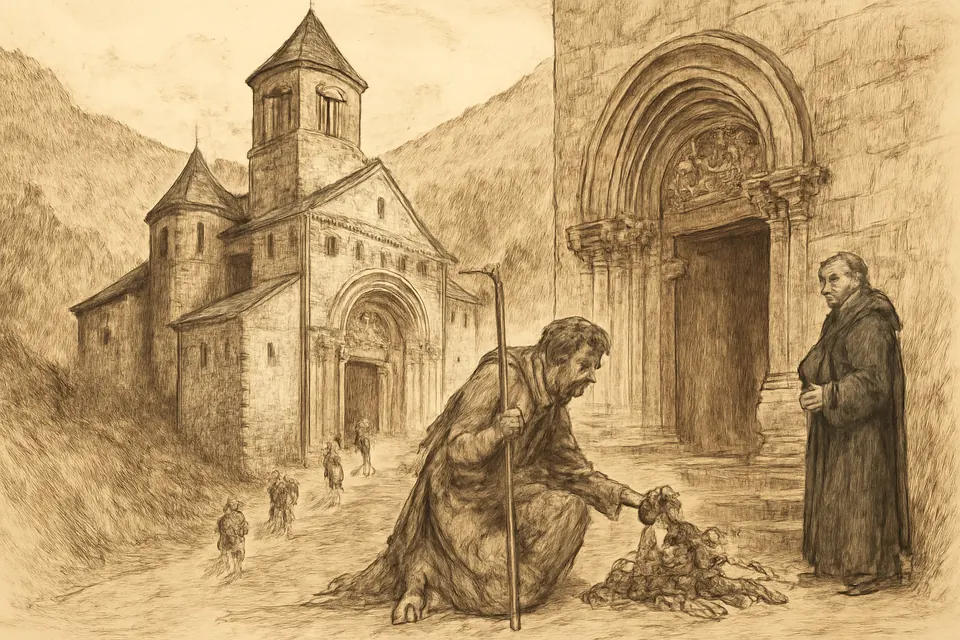
- Prisoners freed. Captives who called on her told of chains falling from them and doors opening. They walked to Conques and left their irons as thank-offerings. The New Catholic Encyclopedia says that until about 1050 her reliquary was displayed behind a screen made of these chains.
- Her "jokes." Bernard says the people of the district called some of her miracles joca, jokes. In one, a knight named Austrin kept a gold ring that his dying wife had promised to the saint and gave it to his new bride; her finger swelled until the ring flew off at the shrine.
- The dove and the crown at her martyrdom: traditional.
Bernard was honest about his first doubts. He arrived at Conques suspicious of the gold statue, thinking it looked too much like a pagan idol. He came to see it, he wrote, as a way of keeping the saint's memory and drawing people to pray, not as the saint herself.
Why St. Faith is the patron saint of prisoners and pilgrims
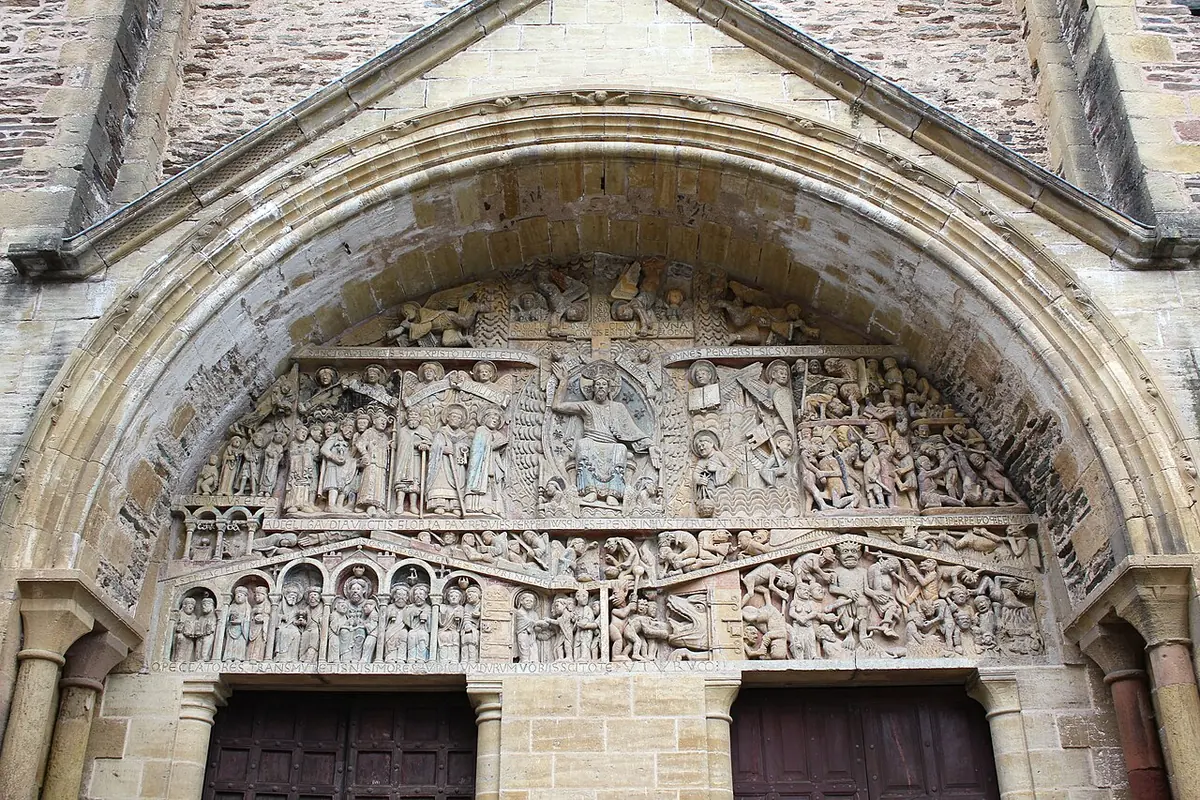
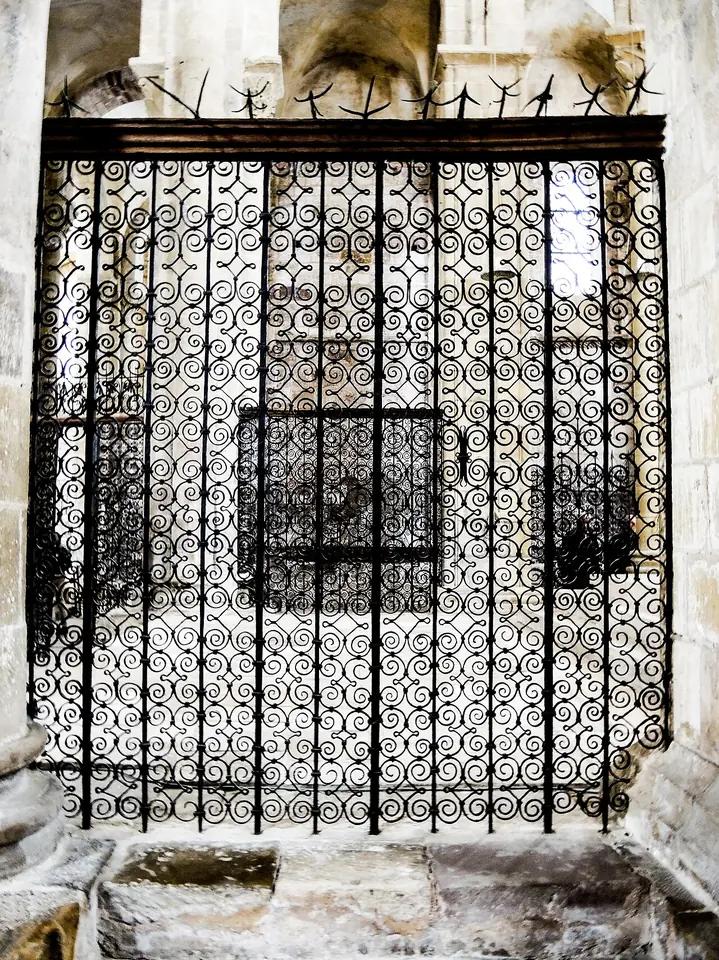
Prisoners came first because of the freed captives and their chains. The great Last Judgment carved over the west door of the abbey in the early 12th century shows Sainte Foy bowing before the hand of God, and above her, opened shackles hanging up in her honor. Inside, an iron grille of tight scrolls closes the choir. Tradition at Conques says the ironwork was forged from prisoners' chains; the earlier chain screen is documented, while the link with the present grille is local tradition.
Pilgrims came second, because Conques stood on the road to Compostela, and countless travelers to the tomb of St. James stopped to pray before her. Her cult traveled with them. The Catholic Encyclopedia notes that it spread to England, Spain and the Americas, and Pope Paschal II allowed Conques to add her name to the Canon of the Mass. In England, churches of St. Faith were founded from Norwich to London, where a chapel of St. Faith once stood under old St. Paul's Cathedral. See more on our patron saints page.
Symbols of St. Faith in art
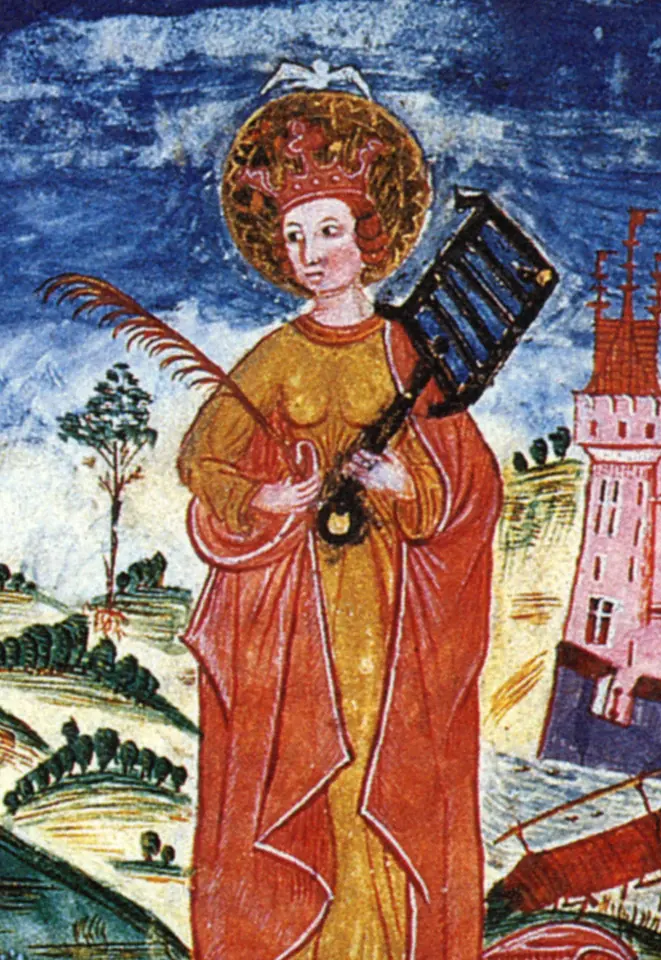
St. Faith is almost always shown as a young girl or young woman, often crowned. Richard Stracke's guide to her iconography lists her attributes, all taken from the legend:
- A gridiron: the grill of her torture, the same emblem as St. Lawrence. In images it is often a small iron grill or a rack of bars she holds in one hand.
- A palm branch: the sign of every martyr's victory.
- A crown: the crown the dove brought her, and her royal place in heaven.
- A dove: the bird of Caprasius's vision, sometimes carrying the crown.
- A sword: the instrument of her beheading.
- Shackles: at Conques especially, for the prisoners freed through her prayers.
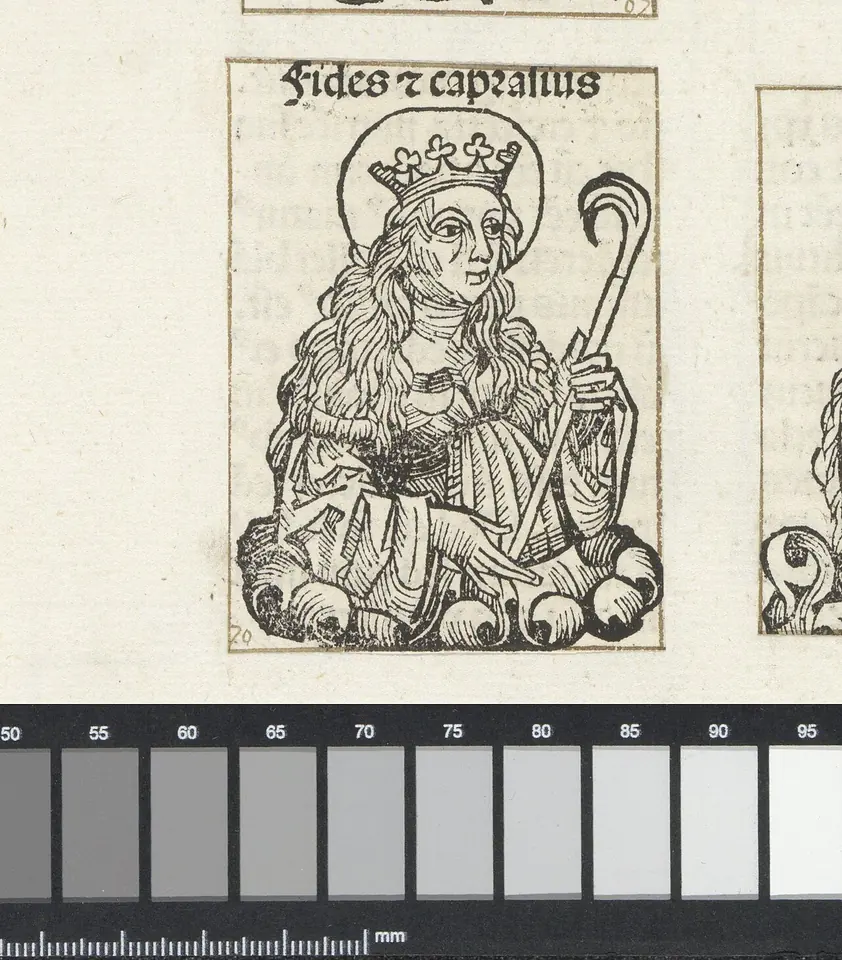
The medieval painting from Sölden in the Black Forest below shows the usual combination, a crowned girl with palm and an outsized gridiron. The Nuremberg Chronicle of 1493 gives her a simpler figure under the heading "Fides et Caprasius," linking her with her fellow martyr.
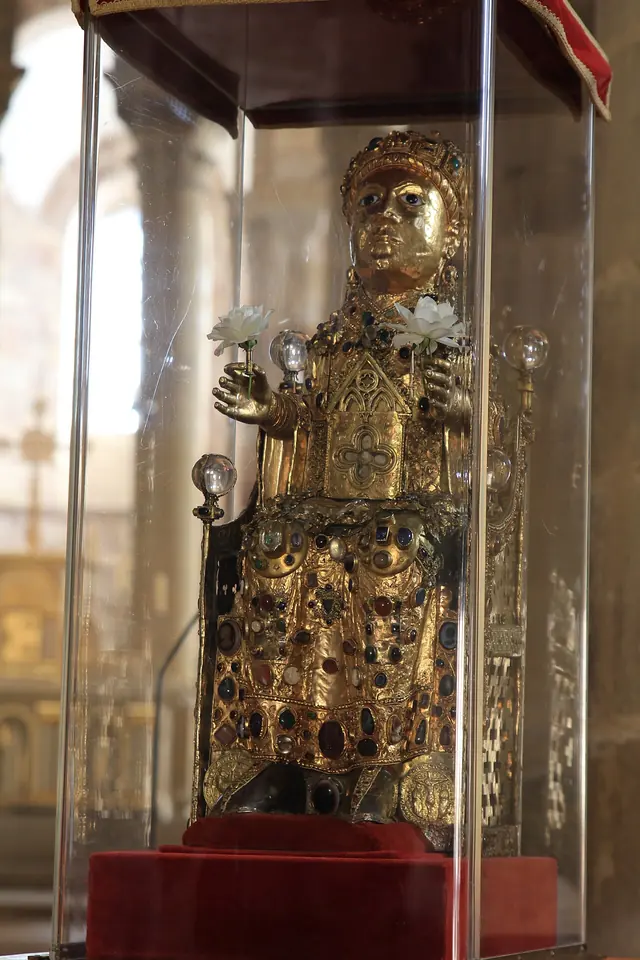
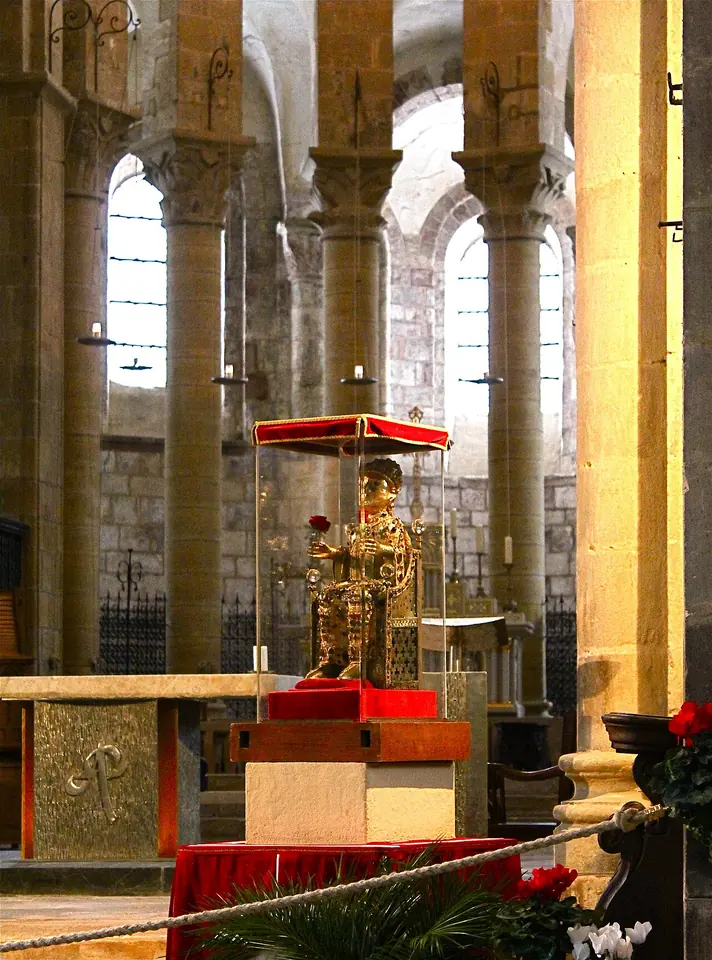
The most famous image of all is the Majesty of Sainte Foy at Conques, a seated gold figure made over a wooden core, studded with gems, cameos and enamel. The New Catholic Encyclopedia dates its commission to 949. The head, made of different gold from the body, may be a reused late Roman portrait. Pilgrims added jewels over the centuries, so the statue is, in the words of the Catholic Encyclopedia, "a living treatise on the history of the goldsmiths art in France." Note that it shows her as a grown, enthroned woman, not as a child.
Feast day and the shrine at Conques
St. Faith's feast is October 6 in the Roman Martyrology. At Conques the feast is kept on the nearest Sunday, when the Majesty is brought from the treasury into the abbey church. Find her neighbors on our feast days calendar.
The relics themselves had a dramatic history. In 1590, during the Wars of Religion, the shrine holding her bones was hidden in the masonry between the pillars of the choir. It was found again in 1875, repaired, carried to the cathedral of Rodez for a novena, and brought back to Conques, 25 miles away, on the shoulders of the clergy. Today the relics and the statue are kept at Conques, where pilgrims still walk in on the way to Compostela.
Prayer to St. Faith
No traditional prayer to St. Faith is in common use in English today. Her own office was sung for centuries at Conques and in the many churches dedicated to her, and the faithful simply ask her prayers in their own words.
Let us ask St. Faith, the brave girl of Agen, to pray for all who are imprisoned, for those held captive by fear or habit, and for pilgrims on the road. And let us pray for young people who are pressured to give up their faith, that they may share her courage.
Frequently asked questions
Who was St. Faith?
St. Faith (Sainte Foy, Latin Fides) was a girl from Agen, in southwest France, martyred in a Roman persecution around 287 or 303. The 11th-century Song of Sainte Foy says she was twelve. Her legend says she was roasted on a gridiron and then beheaded. She is not the Roman St. Faith, sister of Hope and Charity.
When is St. Faith's feast day?
October 6, the date given for her in the oldest Western martyrology, the Martyrology of Jerome, and in the Roman Martyrology today. Conques celebrates the feast on the nearest Sunday.
Why is St. Faith the patron saint of prisoners?
Medieval prisoners who prayed to her and were freed brought their chains to her church at Conques as thank-offerings. The New Catholic Encyclopedia says her reliquary stood behind a screen of these chains until about 1050, and the Last Judgment over the abbey door shows shackles hanging up in her honor.
What is the Majesty of Sainte Foy?
It is the gold reliquary statue of the saint in the treasury at Conques, a seated figure of wood covered in gold plates, gems and cameos added over centuries. Its core dates from the 10th century.
Is St. Faith the same as Sts. Faith, Hope and Charity?
No. Faith, Hope and Charity were three young Roman sisters martyred with or after their mother Sophia, remembered in the East on September 17. St. Faith of Agen is a different martyr from Gaul with her own feast on October 6.
Sources
- New Catholic Encyclopedia: Foy, St. (Encyclopedia.com)
- Catholic Encyclopedia (1912): Rodez (on Conques and the cult of Ste-Foy)
- Catholic Encyclopedia (1909): Sts. Faith, Hope and Charity
- Richard Stracke, Christian Iconography: Saint Foy
- Christian Iconography: The Conques Last Judgment tympanum, detail with the shackles of freed prisoners
- Pamela Sheingorn, trans., The Book of Sainte Foy (University of Pennsylvania Press, 1995)