St. Aurea of Paris
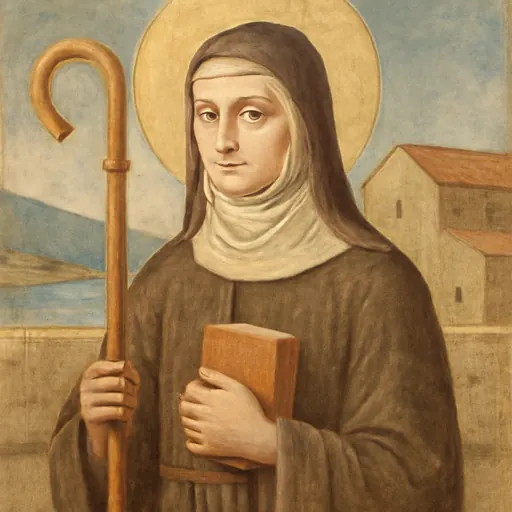
St. Aurea of Paris was the first abbess of the convent that St. Eligius founded in Paris in the 630s. The oldest life of Eligius says that during a plague he appeared in a vision to call her to God; she died with 160 of her nuns about 666. We keep her feast on October 4.
Who was St. Aurea of Paris?
St. Aurea of Paris was a young woman of seventh-century Gaul whom St. Eligius chose to lead the convent he founded in Paris. Eligius, a goldsmith who rose to be the trusted minister of King Dagobert I, gave his own house in the city to God and filled it with women who wanted to live under a rule. Aurea was their first abbess. She led them for some thirty years, and she died with many of them in a plague, about 666.
The Roman Martyrology keeps her memory in a single line on October 4: "At Paris, St. Aurea, virgin." Almost all we know of her comes from the Life of St. Eligius, written by his friend Dado, the bishop of Rouen we know as St. Ouen. That makes it an early source, close to the people it describes, though, like most lives of its time, it was written to praise.

The convent St. Eligius built
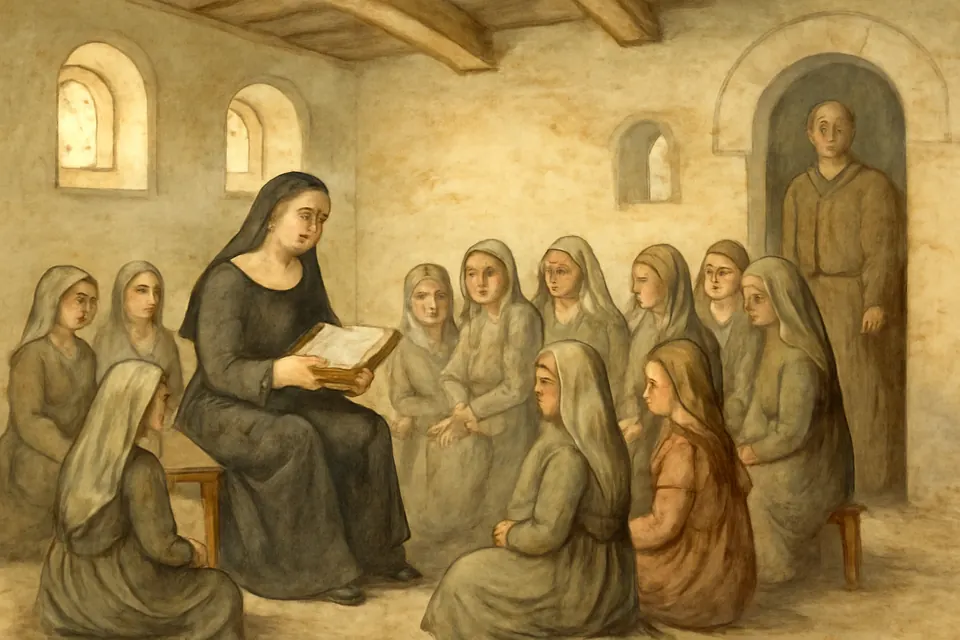
The Life tells how Eligius asked the king for a house in Paris and turned it into "a domicile of virgins of Christ." There, it says, "constituting the strict discipline of the rule, he gathered thirty girls from diverse tribes, some from among his own ancillae and other more noble matrons of the Franks." Former servants and noblewomen lived side by side.
Then comes the sentence that gives us Aurea: "He appointed an abbess fitting to God, a girl named Aurea, daughter of Maurinus and Quiria." Eligius gave the house rich lands and filled it with "vessels and vestments, sacred books and other ornaments." The 1909 Catholic Encyclopedia speaks of three hundred virgins under the Abbess Aurea; the Life itself says thirty at the start, and the house clearly grew.
Eligius and his friends lived under the Irish monastic rule that St. Columbanus had brought to Gaul, and the Catholic Encyclopedia says Eligius brought that rule, in whole or in part, to the Paris convent as well.
The foot of land
One story from the founding shows the kind of man who chose Aurea. The house needed a strip of royal land next to it, and Eligius measured it and asked the king for it. When the lines were drawn, he found the plot was a foot larger than he had said. He left the work, went back to court, threw himself on the ground and begged pardon for the lie. The king turned to his courtiers and said: "My dukes and domestics rob me of spacious villas and the servant of Christ because of the faith that he has in the Lord will not bear to hide a palm's breadth of land from us." Then he doubled the gift.
Eligius also built a basilica dedicated to St. Paul as a burial church for the sisters.
Her death in the plague
Eligius died in 660. Some years later "an evil calamity depopulated the city of Paris," and the plague reached the convent. The Life tells what happened next.
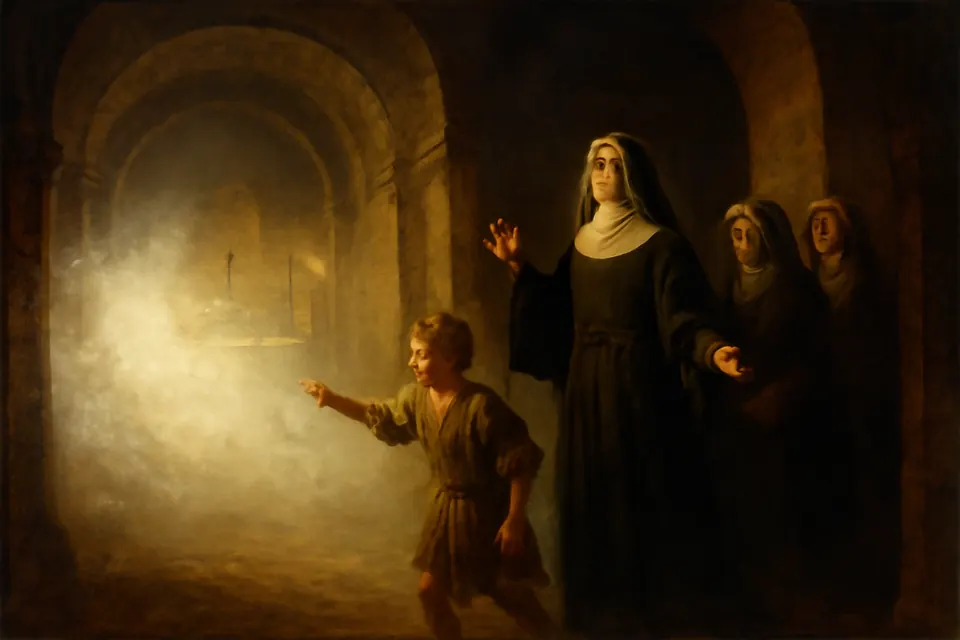
One day a young man in the convent church saw Eligius standing there in a white mantle. Terrified, he tried to hide, but the saint gently told him to go and bring the mother of the virgins. The youth ran and found Aurea: "Arise, quickly, because the lord Eligius calls you to the church." She came at once, with great joy, but the vision was gone. The church, the Life says, was "filled with cloud so thick that the candelabra were veiled and a distillation of dew was perceived."
Aurea understood that she was being called from this world. She gathered her sisters and said goodbye to each of them. Then she died, and the others followed, "so that at that time from that same monastery as many as a hundred and sixty monachae died."
The Ökumenisches Heiligenlexikon gives the date of her death as October 4, 666. It says she and her sisters were first buried outside the city, and that five years later her bones were brought back into the convent church, later known as Saint-Martial.
The miracles of St. Aurea
- Reported: the appearance of St. Eligius, after his death, in the convent church to call Aurea, and the cloud and dew that filled the church. This is recorded in the seventh-century Life of St. Eligius.
The Church has never formally examined it.
Symbols of St. Aurea in art
Images of St. Aurea are rare. When she appears, she is shown as an abbess:
- Habit and veil: the dress of a consecrated woman under a rule.
- Crosier: the staff of an abbess, the shepherd of her community.
- Book: the Rule she kept and taught.
Because her story belongs to his, she is best recognized in the company of St. Eligius, the goldsmith-bishop, usually shown with a hammer, an anvil or a chalice he has made.
Her church and her relics
The convent church stood on the Île de la Cité. The Heiligenlexikon says it lay where the courtyard of the Paris Prefecture of Police is today. Her relics were moved to the church of St. Paul in 1402 and later returned to Saint-Martial. The convent was closed in 1107 and given to Benedictine monks in 1125; the church became a parish and was torn down in 1722. We could not confirm where any of her relics are today.
Feast day and prayer
We keep the feast of St. Aurea on October 4, the same day as St. Francis of Assisi. See the feast day calendar.
We know of no traditional prayer to St. Aurea. Let us ask her, in our own words, to pray for abbesses and religious superiors, for communities struck by sickness, and for all who are called to lead others to God and then to go before them.
St. Aurea of Paris, pray for us.
Frequently asked questions
Who was St. Aurea of Paris?
The abbess of a convent of women that St. Eligius built in his own house in Paris in the 630s. The Life of St. Eligius names her as "a girl named Aurea, daughter of Maurinus and Quiria."
When is the feast of St. Aurea of Paris?
October 4. The Roman Martyrology reads, "At Paris, St. Aurea, virgin." St. Aurea of Ostia, a different saint, is remembered on August 24.
How did St. Aurea die?
In a time of plague in Paris. The Life of St. Eligius says that, after a vision of the saint in the convent church, she said goodbye to her sisters and died, and that 160 nuns of the house died at that time.
Where was her convent?
On the Île de la Cité in Paris, at the church later called Saint-Martial. The convent closed in 1107 and the church was torn down in 1722.
Keep exploring
Sources
- Medieval Sourcebook: The Life of St. Eligius, 588–660 (trans. Jo Ann McNamara). The founding of the convent, Aurea's appointment and parents, the land given by the king, and her death in the plague
- Catholic Encyclopedia (1909): St. Eligius. The convent in Paris under the Abbess Aurea
- Roman Martyrology, October 4 (1916 English edition). Her entry on October 4
- Ökumenisches Heiligenlexikon: Aurea von Paris. Her death on October 4, 666, her burials, the church of Saint-Martial and its later history