St. Dominic Loricatus, the Hermit in the Iron Shirt

St. Dominic Loricatus (died 1060) was an Italian priest and Camaldolese hermit, a disciple of St. Peter Damian at Fonte Avellana. He got his name from the lorica, the iron mail shirt he wore next to his skin as a penance for having been ordained through simony his parents paid for. His feast is October 14, and his body rests at Frontale in the Marche.
Who was St. Dominic Loricatus?
St. Dominic Loricatus was an Italian priest who became a hermit in the eleventh century, a friend and disciple of St. Peter Damian, the great reformer and Doctor of the Church. He is remembered for one thing above all: the lorica, a shirt of iron chain mail like a soldier's armor, which he wore against his skin as a penance for the rest of his life. That is where his name comes from. He died on October 14, 1060, and we keep his feast on October 14.
Almost everything we know of him comes from Peter Damian, who knew him well and wrote about him after his death.
The life of St. Dominic Loricatus
A priesthood bought with a goatskin
Dominic was born near Cagli, in the Marche region of central Italy; one tradition places his birth at Luceoli, today Cantiano. His parents wanted him to be a priest, and according to Peter Damian's account, as the Ökumenisches Heiligenlexikon retells it, they paid for his ordination with a goatskin. Buying a church office was the sin of simony, the very abuse the reformers of that century were fighting.
When Dominic later found out, he was horrified. He did not blame his parents and walk on. He took the sin on himself and set out to make reparation for it for the rest of his life.
Among the hermits
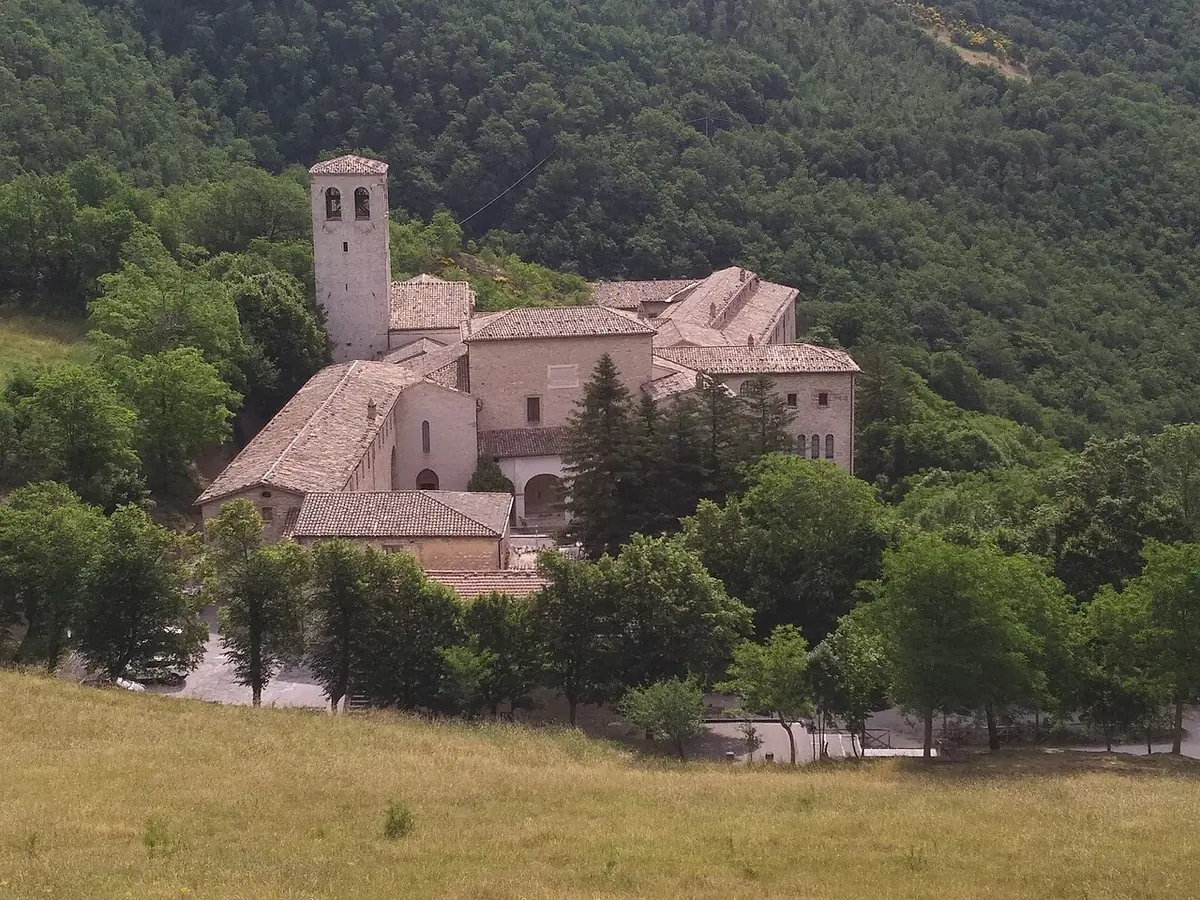
He withdrew to the Camaldolese hermitage of Luceoli, where St. Romuald and Peter Damian had both lived; tradition places it where the church of San Niccolò in Cantiano now stands. From there he moved to the hermitage of Fonte Avellana, on the slopes of Monte Catria near Gubbio, where Peter Damian was prior.
Peter Damian, the Heiligenlexikon summarizes, describes an astonishing penitent. Dominic wore the iron shirt day and night. He recited the whole Psalter twice a day while scourging himself, made countless prostrations, slept on the bare floor, and lived on bread and water, adding a few herbs only on Sundays.

These penances can shock us, and they should be understood in their time. The eleventh-century reform movement around Peter Damian took the sins of the clergy with great seriousness, and its hermits offered their bodies as a sacrifice of reparation for the Church. The Church does not ask such things of us today. What we can take from Dominic is the honesty that would not excuse a wrong done in his name, and a love of prayer that filled his days with the psalms.
At Monte San Vicino
Peter Damian called him to lead a new community of hermits he had founded, the monastery of the Holy Trinity at the foot of Monte San Vicino, near Frontale, according to Santi e Beati. A companion, Michael, lived with him and is honored as a blessed on March 24. Dominic died there on October 14, 1060.

Veneration and relics
The Roman Martyrology remembers him on October 14: at San Severino in the Marche, St. Dominic, called Loricatus for the iron he bound around his body, a priest of the Camaldolese Order who, having been ordained through simony, became a hermit monk and, as a disciple of St. Peter Damian, led a harsh life of austerity and penance.
The Martyrology names San Severino because his hermitage below Monte San Vicino lay near that town, in the hills between Apiro and San Severino Marche. His cult spread quickly wherever there were Camaldolese communities. His body was enshrined in the church of the Holy Trinity, which the monks rebuilt in the late 1200s or early 1300s and dedicated to him. When the monastery emptied in the 1400s, the secular clergy took over the care of Frontale and of his tomb, and in 1776 his body was moved to the parish church of Sant'Anna at Frontale, in the town of Apiro, where it is venerated today.
We know of no miracles attributed to him, approved, reported or traditional, with a source we can cite.
Where the relics of St. Dominic Loricatus are kept: see them on the relics map →
Symbols of St. Dominic Loricatus in art
- Iron mail shirt (lorica): his lifelong penance and his name.
- Scourge: the discipline he used while praying.
- Psalter or book: the psalms he recited day and night.
- Hermit's habit and wild landscape: his life in the hermitages of the Apennines.
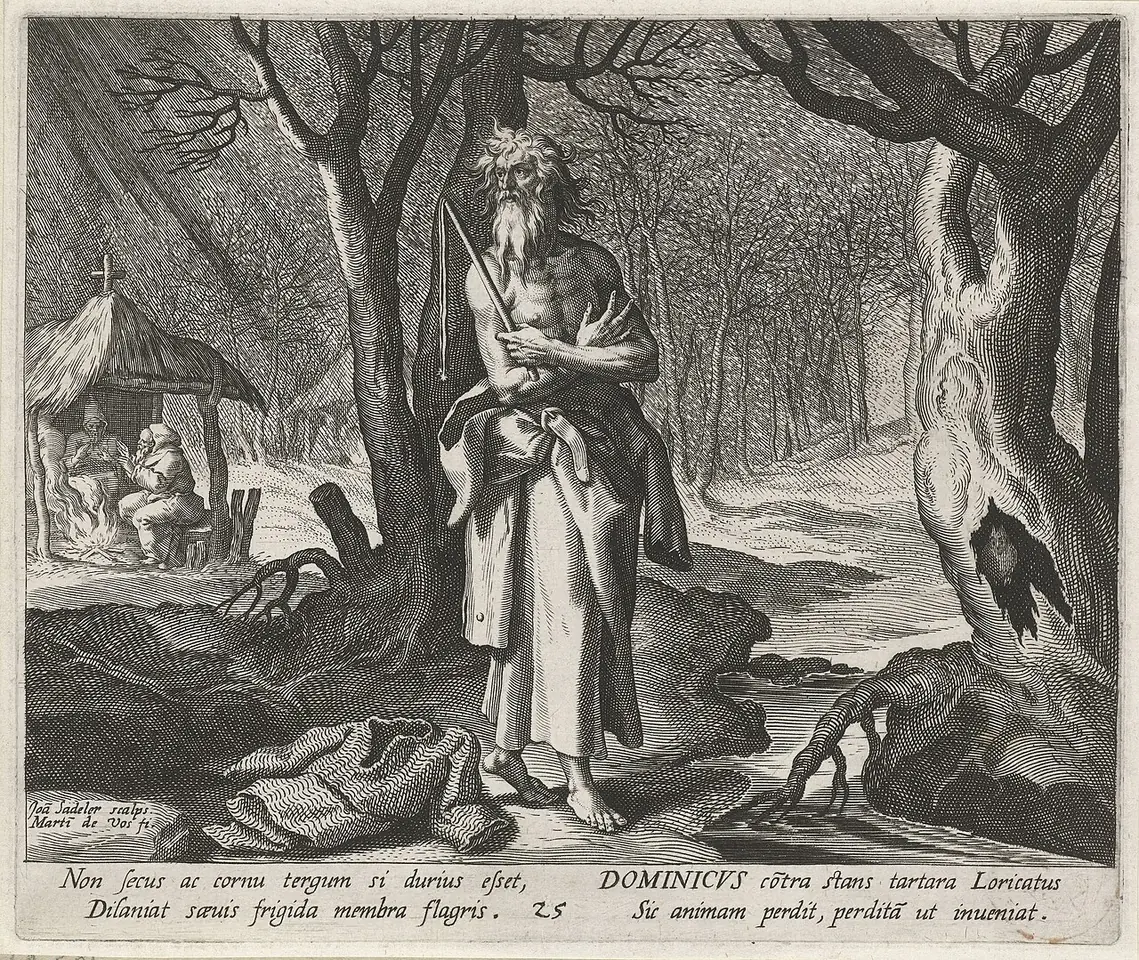
He appears in one of the most widely printed series of hermit saints, the Sylvae Sacrae engraved by Johann Sadeler after drawings by Maerten de Vos in 1594. There he stands barefoot in a wintry forest beside a hut, the mail shirt showing under his cloak. If you see a hermit wearing armor, without a sword or a soldier's helmet, it is likely Dominic Loricatus.
Praying with St. Dominic Loricatus
We know of no traditional prayer to St. Dominic Loricatus that we can cite, so we ask his help simply: "St. Dominic Loricatus, pray for us."
Let us ask him to pray for priests, that they may serve with clean hands; for all who carry the weight of a wrong done before they knew it; and for the grace of real repentance, which looks honestly at sin and then trusts in God's mercy.
Frequently asked questions
Who was St. Dominic Loricatus?
An eleventh-century Italian priest who, on learning that his parents had paid for his ordination, became a Camaldolese hermit at Fonte Avellana and lived a life of extreme penance under St. Peter Damian. He died at a hermitage below Monte San Vicino on October 14, 1060.
Why is he called Loricatus?
Loricatus means 'wearing a lorica,' the mail armor of a soldier. Dominic wore a shirt of iron chain mail as a penitent and never took it off.
When is the feast of St. Dominic Loricatus?
October 14, the day he died in 1060.
Where are the relics of St. Dominic Loricatus?
In the parish church of Sant'Anna at Frontale, near Apiro in the province of Macerata, where they were moved in 1776 from the old abbey church of the Holy Trinity.
Keep exploring
Sources
- San Domenico Loricato, Santi e Beati. The Roman Martyrology text, his birth near Cagli, his charge of the Holy Trinity hermitage below Monte San Vicino, his death on October 14, 1060, and the story of his relics to their translation to Frontale in 1776 (in Italian)
- Dominikus Loricatus, Ökumenisches Heiligenlexikon. The goatskin his parents paid for his ordination, the hermitage at Luceoli, his penances, his companion Blessed Michael, and Peter Damian as the source (in German)