St. Magdalene of Nagasaki
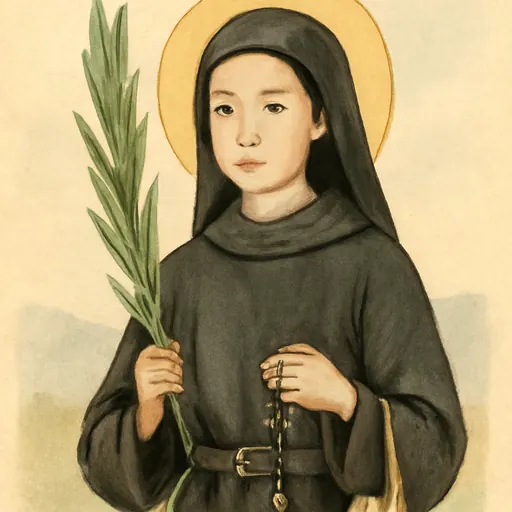
St. Magdalene of Nagasaki (1611–1634) was a Japanese Christian, the daughter of martyrs, who served the Augustinian Recollect friars as interpreter and catechist. In 1634, to strengthen Christians giving up their faith under torture, she turned herself in and died after thirteen days in the pit. Her feast day is September 28, and October 20 for the Augustinians.
Who was St. Magdalene of Nagasaki?
St. Magdalene of Nagasaki was a young Japanese laywoman who died for Christ at twenty-three, on October 15, 1634. She was born near Nagasaki in 1611, into a Church already under sentence of death. Her parents were martyred when she was a child. She grew up to serve the hunted missionaries as an interpreter and catechist, became a tertiary of the Augustinian Recollects, and at the end walked into the hands of the authorities of her own accord, so that the frightened Christians around her would see that faith could hold.
She is one of the sixteen martyrs of Japan canonized with St. Lorenzo Ruiz on October 18, 1987, and one of the two women among them, with St. Marina of Omura.
The life of St. Magdalene of Nagasaki
A daughter of martyrs
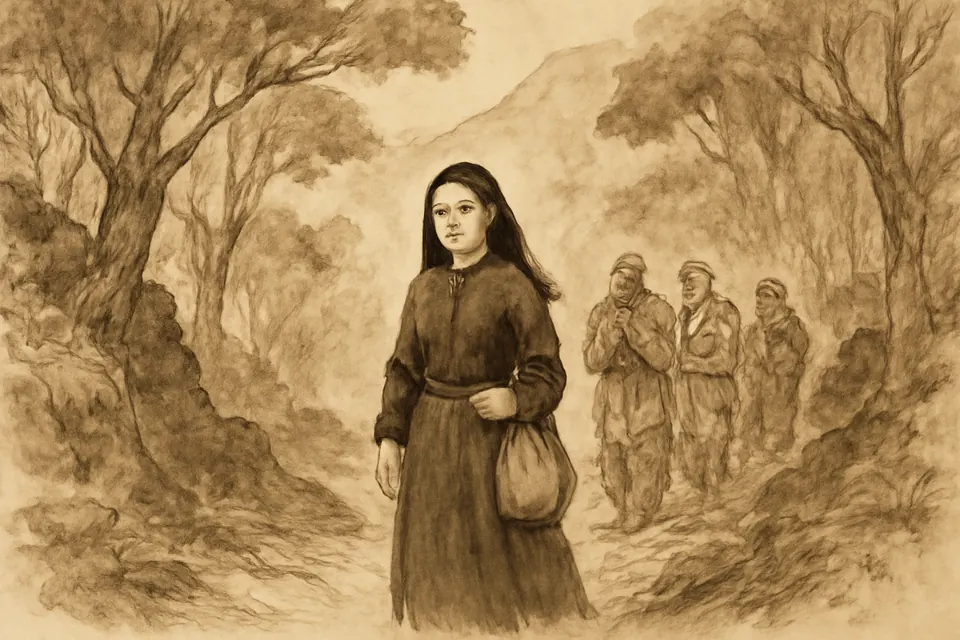
Christianity had come to Japan with St. Francis Xavier in 1549 and grown quickly, especially around Nagasaki. Then the shoguns turned against it. The edict of 1614, which the Vatican quotes in its biography of these martyrs, ordered that "in all the regions of Japan, all these Christians should be eliminated without any delay." Magdalene was three years old. The Augustinians write that while she was still young her mother, father and brothers and sisters were all martyred.
Catechist to the hidden Church
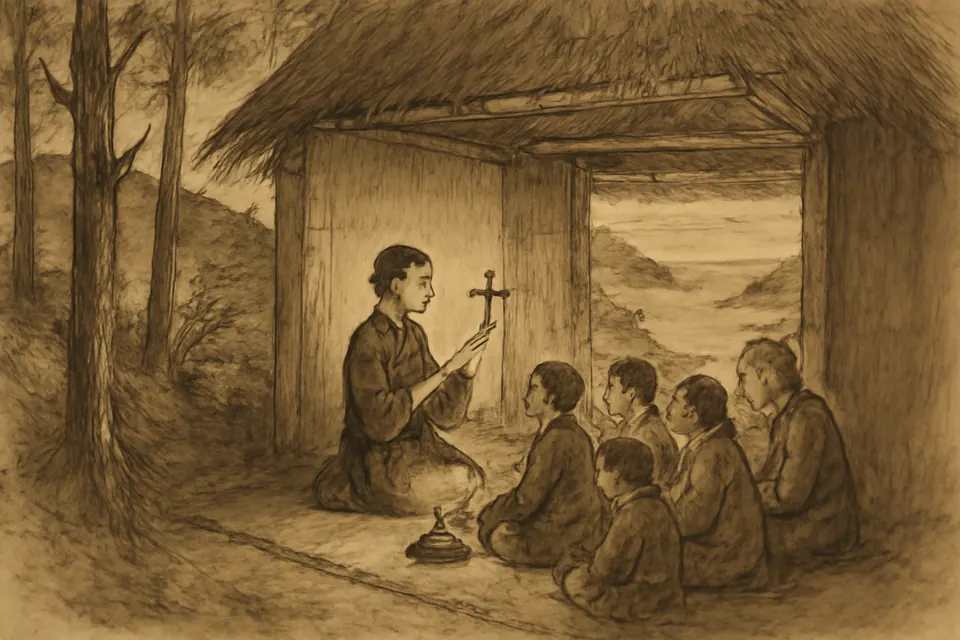
In 1624 she met two Augustinian Recollect friars working in secret around Nagasaki, Francis of Jesus and Vincent of Saint Anthony, and was drawn to their prayer and their courage. She became their interpreter and soon afterward a tertiary of the order. She taught the catechism to the young, begged alms for the poor and kept up the spirits of the faithful.
When those two friars were burned alive in 1632, she put herself under the guidance of two more Augustinians. They too were martyred. Her last director was the Sicilian Dominican Hyacinth Jordan Ansalone, which is why the Vatican also lists her as a Dominican tertiary.
From 1629 she lived as a fugitive with other Christians in the hills around Nagasaki. There, the Augustinians record, she baptized children and visited the sick.
"I am a Christian"
By 1634 torture was breaking many believers, and some were renouncing the faith. When Fr. Ansalone was arrested, Magdalene made her decision. In September 1634, wearing her tertiary's habit, she presented herself to the guards and declared that she was a Christian. The Augustinians say she did it deliberately, to encourage the others by her own acceptance of suffering.

She was tortured, and in October she was hung head down in the pit, the cruelest punishment of the persecution, meant to wring a word of apostasy out of the victim. She held out for thirteen days. The Augustinians write that on the last day the pit was filled with water and she drowned. The authorities burned her body and scattered the ashes, so that no relic of her would remain.
The miracle and the canonization
Magdalene was beatified with her companions by Pope John Paul II in Manila on February 18, 1981, during his visit to the Philippines, and canonized in Rome on October 18, 1987.
The miracle accepted for the canonization of the whole group is approved. According to the Vatican, in 1983 in Manila a two-year-old girl, Cecilia Alegria Policarpio, was completely cured of brain paralysis without any effective therapy, through the intercession of the martyrs. Pope John Paul II recognized the miracle on June 1, 1987.
No other miracles are attached to Magdalene personally, and no legends grew up around her. Her story comes from the records of the persecution and of the religious orders that knew her.
Symbols of St. Magdalene of Nagasaki in art
Two ways of picturing her are common.
- The Augustinian habit: the official image shows her in a black habit with a leather belt, the dress of a Recollect tertiary, as in the statue in Manila.
- A palm branch: the sign of a martyr.
- A small cloth bag on her arm: often read as the alms bag she carried for the poor, or the bag of a catechist on the move.
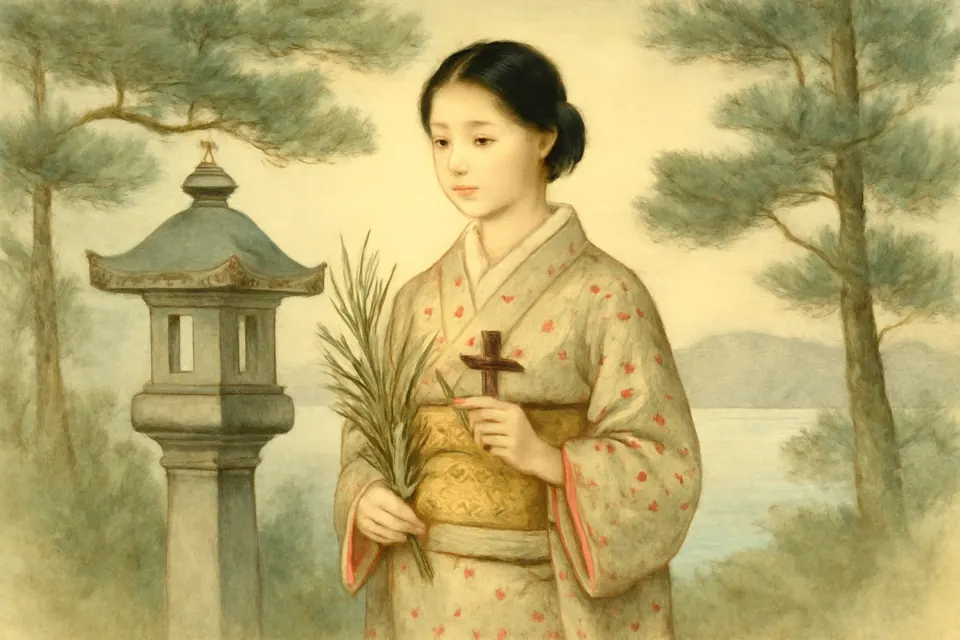
- A kimono: the Dominicans and many Filipino parishes show her in Japanese dress instead, with a cross or a rosary in her hands. Some statues give her a veil and a crown or halo.
Her feast day and where she is honored
We remember her on September 28 with St. Lorenzo Ruiz and companions, an optional memorial in the General Roman Calendar, and the Augustinian family keeps her own feast on October 20. See her neighbors on our feast days page.
Since her ashes went into the sea, there is no tomb. She is honored above all in the Philippines, where the Recollects' Basilica of San Sebastian and the Binondo shrine of St. Lorenzo Ruiz keep her image, and in Augustinian and Dominican communities around the world. Her devotion has also traveled to Latin America.

Prayer to St. Magdalene of Nagasaki
We have not found a traditional prayer to her in the standard prayer books, and we won't write one under her name. On September 28 the whole Church honors her in the Mass of St. Lorenzo Ruiz and companions.
Let us ask St. Magdalene of Nagasaki to pray for catechists, for young people who carry the faith in hard places, and for every Christian who is afraid. St. Magdalene of Nagasaki, pray for us.
Frequently asked questions
How did St. Magdalene of Nagasaki die?
After she declared herself a Christian in the autumn of 1634, the authorities hung her upside down in a pit, the torture called tsurushi. The Vatican's biography says she died on the gibbet after thirteen days, on October 15, 1634. The Augustinians add that on the last day the pit was flooded and she drowned. Her body was burned and the ashes scattered so that Christians could not keep relics.
When is St. Magdalene of Nagasaki's feast day?
September 28, the optional memorial of St. Lorenzo Ruiz and companions in the General Roman Calendar. The Augustinian orders celebrate her on October 20.
Was St. Magdalene of Nagasaki a nun?
Not a cloistered nun. She was a tertiary, a lay member of a religious order's third order, consecrated to God and wearing the habit. The Augustinian Recollects received her in the mid-1620s, and the Vatican also lists her as a Dominican tertiary.
Who canonized St. Magdalene of Nagasaki?
Pope John Paul II beatified her in Manila on February 18, 1981, and canonized her in Rome on October 18, 1987, with St. Lorenzo Ruiz and fourteen other martyrs who died in Nagasaki between 1633 and 1637.
Keep exploring
Sources
- Vatican: Lawrence Ruiz, Dominic Ibáñez de Erquicia, James Kyushei Tomonaga, and 13 companions, martyrs in Japan, biography for the canonization of October 18, 1987. Her entry, thirteen days on the gibbet, Fr. Ansalone as director, the approved 1983 miracle, the 1614 edict
- The Augustinians, Province of St. Thomas of Villanova: October 20, Saint Magdalene of Nagasaki, Virgin and Martyr. Recollect friars Francis of Jesus and Vincent of Saint Anthony; refuge in the hills in 1629; surrender in September 1634; drowning on the last day