St. Michael de Aozaraza
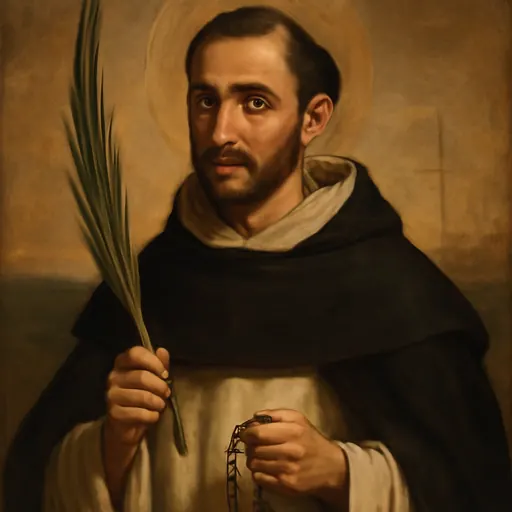
St. Michael de Aozaraza (1598–1637) was a Basque Dominican priest from Oñati, Spain, who served in the Bataan mission in the Philippines and in 1636 sailed for Japan with St. Lorenzo Ruiz and four companions. Arrested on Okinawa and tortured at Nagasaki, he was beheaded on September 29, 1637. His feast day is September 28, with St. Lorenzo Ruiz and companions.
Who was St. Michael de Aozaraza?
St. Michael de Aozaraza was a Dominican priest from the Basque Country who crossed half the world to preach Christ, worked among the people of Bataan in the Philippines, and gave his life in Japan at thirty-nine. He was beheaded at Nagasaki on September 29, 1637, after a year of prison and days of torture. He is one of the sixteen martyrs of Japan canonized with St. Lorenzo Ruiz in 1987, and we keep his feast with them on September 28.
In Spanish he is Miguel de Aozaraza, and in his native Basque, Migel Aozaratzakoa.
The life of St. Michael de Aozaraza
A son of Oñati
He was born in 1598 in Oñati (Oñate), a small university town in the green valleys of Gipuzkoa. The Basque Country had already given the missions of Asia one great saint, St. Francis Xavier, who first carried the Gospel to Japan in 1549. Michael joined the Order of Preachers, the Dominicans founded by St. Dominic, and first belonged to a province in Spain.
Missionary in Bataan
He volunteered for the Dominican Province of the Holy Rosary, which sent friars to the Philippines and the Far East from its base at Santo Domingo in Manila. According to the Vatican's biography, he worked in the mission of Bataan, on the peninsula across Manila Bay.

The voyage of 1636
By the 1630s the Church in Japan had been driven underground. The Vatican's account says that in 1636 the Dominicans of Manila organized a missionary expedition "with the intention of helping the Christians in Japan." The group sailed from Manila on June 10, 1636: three Dominican priests (the rector of the University of Santo Tomas, Antonio González; the Frenchman Guillaume Courtet; and Michael), the Japanese Dominican Vicente Shiwozuka, Lázaro of Kyoto, a layman with leprosy who served as guide and interpreter, and a Filipino layman from Binondo, Lorenzo Ruiz.

Prison and martyrdom
"As soon as they arrived in the island of Okinawa," the Vatican biography records, "they were arrested and kept in prison for a year." In September 1637 they were taken to Nagasaki and tried. For days they were tortured to make them renounce the faith. Father González died in prison on September 24.

On September 27 the survivors were hung head down over pits on Nishizaka Hill, a torture the Spanish called horca y hoya, "gallows and pit," with one hand left free to signal surrender. Lorenzo Ruiz and Lázaro died in the pit. The three priests who were still alive, Michael among them, were then beheaded on September 29, 1637. The Vatican's biography says of Michael that "he refused to give up his faith and accepted with joy tremendous suffering." The bodies were burned and the ashes scattered, so no relics of him survive.
The miracle and the canonization
Pope John Paul II beatified the sixteen martyrs in Manila on February 18, 1981, and canonized them in Rome on October 18, 1987, World Mission Sunday. In his homily the pope said that their "message of supreme fidelity to Christ speaks to Europe," which "has been a seedbed of missionaries for two thousand years." A Basque friar who died in Japan for the people he came to serve fits those words exactly.
The miracle accepted for the canonization of the whole group is approved: in 1983 in Manila, the Vatican reports, a two-year-old girl, Cecilia Alegria Policarpio, was completely cured of brain paralysis through the martyrs' intercession, with no effective treatment. No separate miracles or legends are attached to Michael himself.
Symbols of St. Michael de Aozaraza in art
Images of him are mostly found in group pictures of the sixteen martyrs, in Dominican churches in the Philippines, and in his home region. Look for:
- The Dominican habit: a white tunic and scapular with a black cape, the dress of the Order of Preachers.
- The martyr's palm: the sign of his victory through death.
- The rosary: the prayer of the Dominicans and of the Holy Rosary Province he served.
- The cross, or the gallows and pit: reminders of how the martyrs of 1637 suffered, usually shown without detail.
Feast day and prayer
We remember him on September 28 with St. Lorenzo Ruiz and companions, an optional memorial on the General Roman Calendar. He died on September 29, the feast of his patron, St. Michael the Archangel, and some Basque and Dominican calendars keep that day. See our feast days page.
There is no traditional prayer to St. Michael de Aozaraza alone. The Church prays to the sixteen martyrs together in the Mass of their memorial. Let us ask him, in our own words, to pray for missionaries far from home, for the Church in Japan and the Philippines, and for the young people of the Basque Country, that some of them may hear the same call he answered.
Frequently asked questions
Who was St. Michael de Aozaraza?
A Spanish Dominican priest born in Oñati, in the Basque province of Gipuzkoa, who joined the Dominican Province of the Holy Rosary in the Philippines, worked in the mission of Bataan, and was martyred at Nagasaki in 1637. He is one of the sixteen martyrs of Japan canonized with St. Lorenzo Ruiz.
How did St. Michael de Aozaraza die?
After a year in prison on Okinawa and long tortures at Nagasaki, he was hung head down over a pit on Nishizaka Hill on September 27, 1637. Lorenzo Ruiz and Lázaro of Kyoto died in the pit; Michael, with the two other surviving priests, was beheaded on September 29.
When is the feast of St. Michael de Aozaraza?
September 28, the optional memorial of St. Lawrence Ruiz and companions on the General Roman Calendar. He died on September 29.
Who canonized St. Michael de Aozaraza?
Pope John Paul II beatified him in Manila on February 18, 1981, and canonized him in Rome on October 18, 1987, with fifteen companion martyrs.
Keep exploring
Sources
- Vatican: Lawrence Ruiz, Dominic Ibáñez de Erquicia, James Kyushei Tomonaga, and 13 companions, martyrs in Japan, biography for the canonization of October 18, 1987. His entry (born in Oñate, Province of Spain, Holy Rosary Province, Bataan mission, age 39); the 1636 expedition and Okinawa; the approved 1983 miracle
- Vatican News: Sts. Lorenzo Ruiz and companions, martyrs. The pit torture and the beheading of the three priests
- Pope John Paul II, homily at the canonization of Lorenzo Ruiz and companions, October 18, 1987. Quotation on Europe as "a seedbed of missionaries"