St. Placidus and Companions, Martyrs of Messina
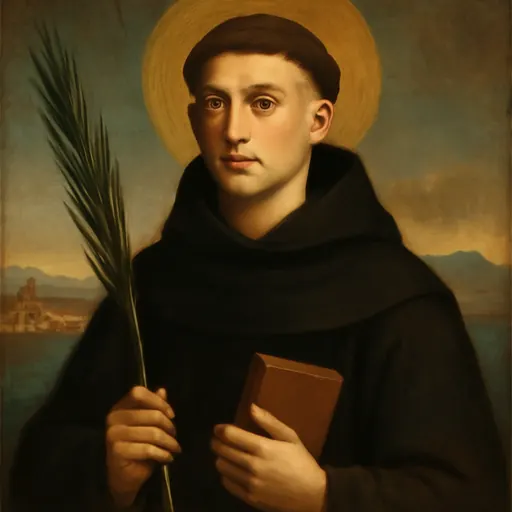
St. Placidus (St. Placid) was a disciple of St. Benedict, the Roman boy whom St. Maurus ran across a lake to save. Medieval legend made him an abbot martyred at Messina with his brothers, his sister Flavia and about thirty monks, and Messina honors St. Placidus and Companions as its patron martyrs. Their feast is October 5.
Who were St. Placidus and Companions?
St. Placidus, often called St. Placid, was one of the first disciples of St. Benedict. He was a Roman boy of noble family who grew up in Benedict's monasteries at Subiaco, and he is the child at the center of one of the best-loved stories in the Dialogues of St. Gregory the Great: the day he fell into the lake and his fellow novice St. Maurus ran across the water to pull him out.
That much is history. In the Middle Ages, a much longer story grew up around him: that Benedict sent him to Sicily, that he founded a monastery at Messina, and that he was martyred there in 541 with his brothers Eutychius and Victorinus, his sister Flavia and some thirty monks. These are the "companions" of his title. Messina has honored them for centuries as its martyrs and patrons, and we keep their feast on October 5. The Church's own scholars have long known that the martyrdom is a legend, and we will tell both stories plainly.
The boy at Subiaco
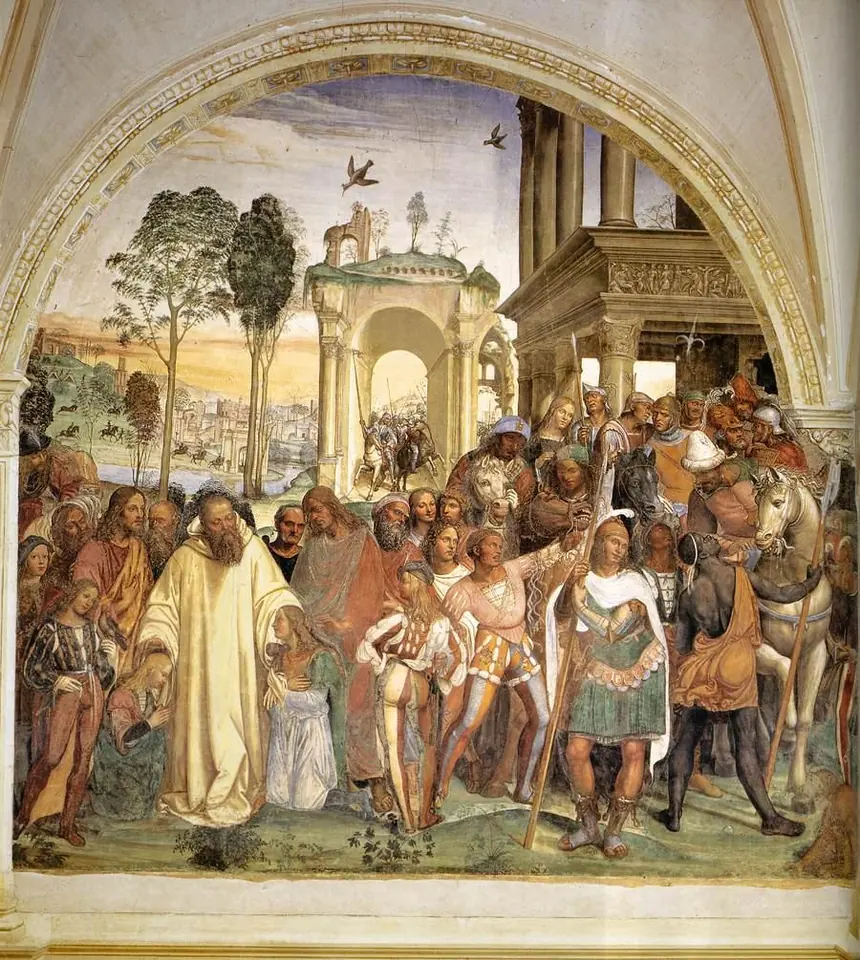
St. Gregory writes that in Benedict's early years at Subiaco "many noble and religious men of Rome came unto him, and committed their children to be brought up under him, for the service of God." Among them, "Tertullius the Senator brought Placidus." Gregory adds that Maurus grew so quickly in virtue that he became Benedict's helper, "but Placidus, as yet, was but a boy of tender years." The Catholic Encyclopedia notes that his father, Tertullus, was a patrician, and that he dedicated his son to God in the way chapter 59 of Benedict's Rule describes.
Gregory tells two stories in which the boy appears. In one, Benedict climbed the mountain at night with "only the little boy Placidus" to pray for water for three monasteries on the heights, and a spring broke out where he had marked the rock with three stones. In the other, the boy nearly drowned.
Maurus walks on the water
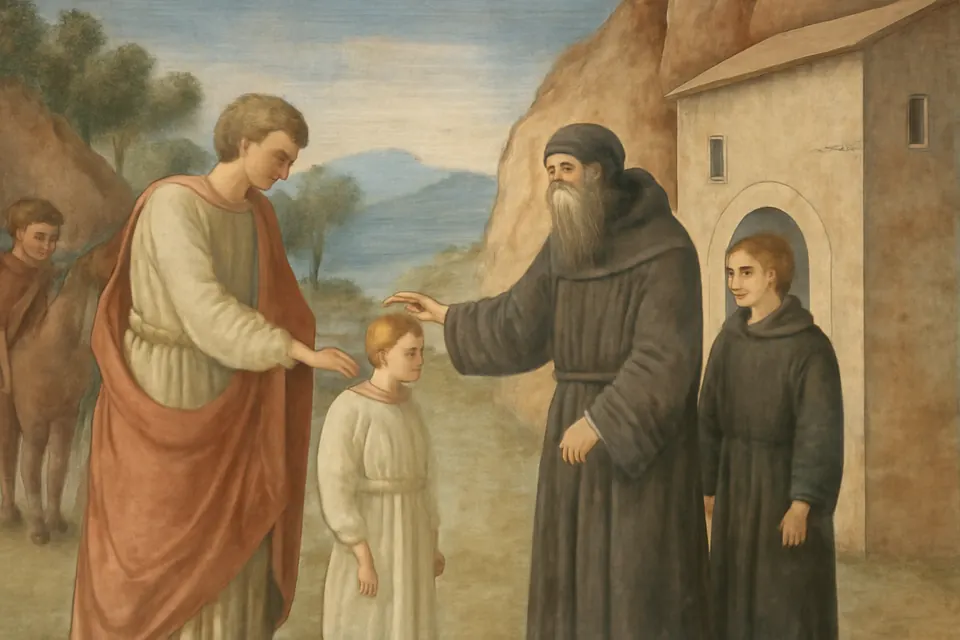
Gregory's account, in its old English translation, is worth hearing whole. Placidus "went out to take up water at the lake, and putting down his pail carelessly, fell in himself after it, whom the water forthwith carried away from the land so far as one may shoot an arrow." Benedict, in his cell, knew it at once and called Maurus: "Brother Maurus, run as fast as you can, for Placidus, that went to the lake to fetch water, is fallen in." Maurus ran, took hold of the boy "by the hair of his head," and only on reaching the shore realized he had run on the water. Benedict gave the credit to Maurus's obedience; Maurus gave it to his abbot. Placidus settled the "friendly contention": he said that as he was drawn out of the water he saw "the Abbot's garment upon his head," so it was Benedict who had saved him.
The Catholic Encyclopedia judges it "certain" that Placidus went with Benedict to Monte Cassino around 529. After that, the record falls silent. His name appears among the confessors, right after Benedict and Maurus, in a ninth-century litany of the saints at Subiaco.

The legend of the martyrs of Messina
In the twelfth century, Peter the Deacon, librarian of Monte Cassino, wrote a Passion of St. Placidus and presented it as the work of one Gordianus, who claimed to be the saint's servant. In this story Placidus went to Sicily, built a monastery at Messina, and that raiders landed and killed him with his brothers Eutychius and Victorinus, his sister Flavia and about thirty monks on October 5, 541.
Both the Catholic Encyclopedia and the Treccani Dizionario Biografico treat this as a pious invention. Peter seems to have confused the Benedictine Placidus with an older Placidus who was martyred in Sicily with Eutychius and thirty companions under Diocletian, and whose feast already stood in the early martyrologies on October 5. The Catholic Encyclopedia also notes the anachronism of blaming "Saracen invaders from Spain" in the sixth century. The Treccani entry links the legend to the Benedictine revival in Norman Sicily.
So the companions of October 5 are real martyrs of the early Church whose names reached us through a tangled story. We honor them, and we honor Placidus, while being honest that we cannot say how he died.
Relics and miracles
The miracle that history records for Placidus is traditional in the oldest sense: it is told by St. Gregory the Great about half a century after Benedict's death, and the Church has read it for fourteen centuries. Strictly speaking, the wonder was worked through Maurus and Benedict; Placidus was the one rescued.
In 1588, during building work at the church of St. John of Malta in Messina, which stood over a Roman cemetery, bones were found that were believed to be those of the martyrs. That year Placidus was proclaimed patron of Messina, and the city's senate and archbishop obtained from Pope Sixtus V the entry of Placidus and companions in the Roman Martyrology under October 5. In 1616 Pope Paul V added the feast to the Benedictine Breviary. The relics still rest in that church, now called San Giovanni di Malta or San Placido e Compagni Martiri. The identification is traditional; no one can prove whose bones they are. The Roman Martyrology revised in 2001 no longer lists the Messina martyrs.
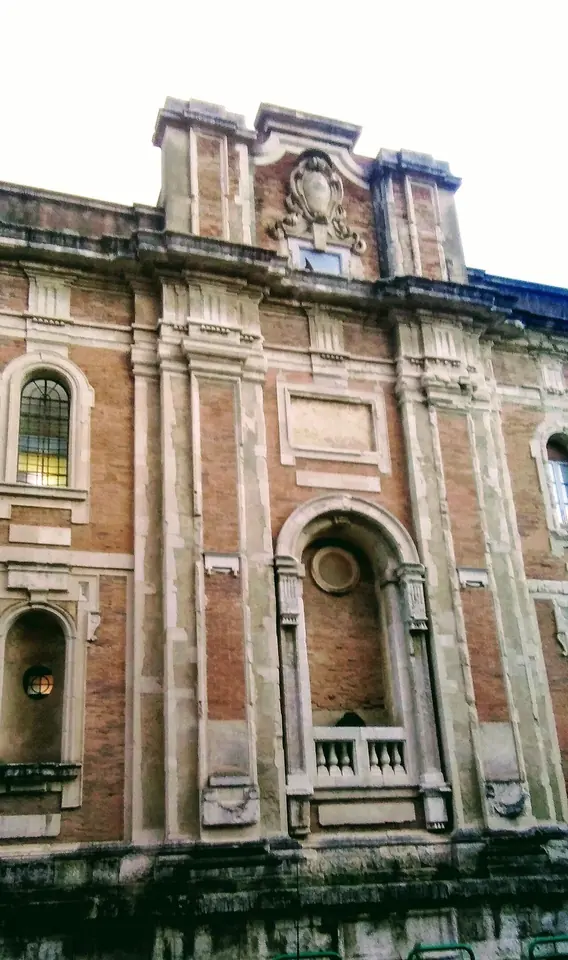
Where the relics of St. Placidus and Companions are kept: see them on the relics map →
Why St. Placidus is the patron of Messina and of novices
Messina chose him in 1588, after the finding of the relics, and the Treccani entry lists him as patron of the city, its archdiocese and other towns of Sicily and southern Italy. As the boy who entered the monastery as a child and grew up under Benedict's eye, he is also a patron of Benedictine novices.
Symbols of St. Placidus in art
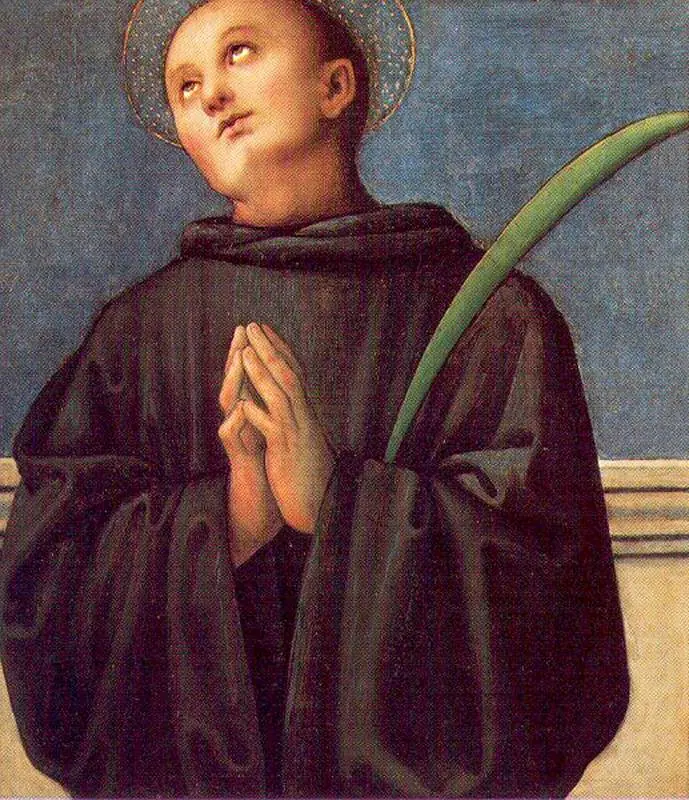
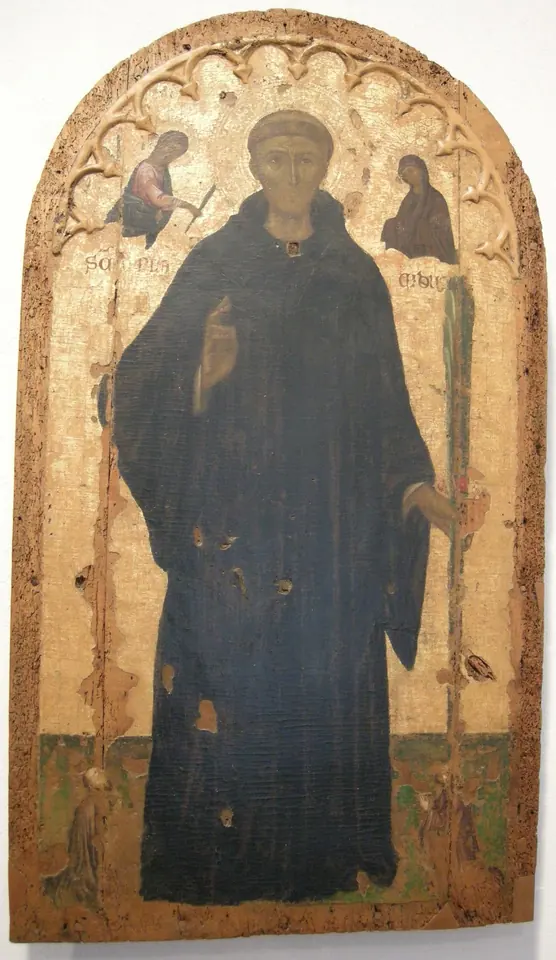
Placidus is painted as a young monk in the black Benedictine habit, usually beardless and tonsured. As the legendary martyr he carries the palm, and sometimes an abbot's crozier for the monastery at Messina, a book for the Rule, or a sword. His sister Flavia often appears beside him. In scenes from Benedict's life he is the child in the water, being pulled out by Maurus, a favorite subject of Renaissance painters such as Fra Filippo Lippi. Perugino's panel on this page gives him the palm and an upturned face. In Messina's oldest image, a fourteenth-century panel in the Museo Regionale, he stands alone in his monk's habit. Luca Giordano and Francesco Solimena painted large Baroque scenes of the martyrdom.
Feast day and where he is honored
We keep the feast of St. Placidus and Companions on October 5. Messina also celebrates the finding of the relics with a separate feast. Wherever Benedict's life is told, Placidus and Maurus are remembered together as his first disciples. See our feast days calendar for other saints of October.
Prayer to St. Placidus
We know of no widely used traditional English prayer to St. Placidus. Let us ask his prayers for children and young people discerning a vocation, for novices learning obedience, for those in danger of drowning, and for the people of Messina. St. Placidus and holy companions, pray for us.
Frequently asked questions
Who was St. Placidus?
The son of the Roman patrician Tertullus, given as a child to St. Benedict at Subiaco around the 520s or 530s. St. Gregory the Great's Dialogues tell how he fell into the lake and was saved when St. Maurus ran across the water to him. Nothing certain is known of his later life.
Who were St. Placidus's companions?
According to a twelfth-century Passion, his brothers Eutychius and Victorinus, his sister Flavia and about thirty monks, killed with him by raiders at Messina in 541. Scholars regard this Passion as a legend that merged the monk Placidus with earlier Sicilian martyrs named Placidus and Eutychius.
When is the feast of St. Placidus and Companions?
October 5. Messina also celebrates the finding of the relics in 1588 with a separate feast.
Is St. Placidus the patron of Messina?
Yes. He was proclaimed patron of Messina in 1588, the year the relics believed to be his were found there.
Keep exploring
Sources
- Catholic Encyclopedia (1911): St. Placidus. His father Tertullus, the rescue at Subiaco, the ninth-century litany at Subiaco, and the Passion forged by Peter the Deacon
- Gregory the Great, Dialogues, Book 2 (1911 translation, tertullian.org). Chapters 3, 5 and 7: Placidus brought to Benedict, the spring on the mountain, and Maurus walking on the water
- Guido De Blasi, "PLACIDO, santo," Dizionario Biografico degli Italiani, vol. 84 (2015). Peter the Deacon's three lives, the finding of the relics at Messina in 1588, Sixtus V and the Martyrology, the Benedictine Breviary in 1616, the removal from the 2001 Martyrology, and his patronages