St. René Goupil, Surgeon and First of the North American Martyrs

St. René Goupil (about 1608 to 1642) was a French surgeon and lay volunteer with the Jesuits in New France. Captured by the Mohawk with Father Isaac Jogues, he was killed in present-day New York for making the sign of the cross over a child. He is honored on September 29 and with the North American Martyrs on October 19.
Who was St. René Goupil?
St. René Goupil was a French surgeon from Anjou who gave his skills to the Jesuit missions in New France and died for the sign of the cross. He was not a priest. He was a layman who had wanted to be a Jesuit, been sent home from the novitiate because of his health, and found another way to serve. On September 29, 1642, at the Mohawk village of Ossernenon on the Mohawk River, in what is now upstate New York, a young warrior killed him with a hatchet. He was about thirty-four.

He was the first to die of the eight martyrs the Church honors together as the North American (or Canadian) Martyrs, with Isaac Jogues, John de Brébeuf and five others. Pope Pius XI canonized all eight on June 29, 1930.
Almost everything we know about him comes from one witness: Isaac Jogues, who was captured with him, wrote a short account of his life and death that was printed in The Jesuit Relations. Jogues loved him, and it shows. It is also a firsthand record by the man who knelt beside him when he died.
The life of St. René Goupil
A novice sent home
Goupil came from Anjou, in western France. The Society of Jesus gives his birth as 1608 at Angers; the 1909 Catholic Encyclopedia says 1607. As a young man he asked to enter the Jesuit novitiate in Paris and stayed some months. Jogues wrote that "his bodily indispositions" took from him "the happiness of consecrating himself to God in holy Religion," and he had to leave.
He studied surgery, and when his health improved he crossed the Atlantic to serve the Society in New France "since he had not had the blessing of giving himself to it in old France," as Jogues put it. He came as a donné, a lay volunteer who served the mission without pay and put himself under obedience to the superior.
Two years at Quebec
For two years the superior gave him what Jogues calls "the meanest offices about the house," and Goupil did them gladly. He was also put in charge of nursing the sick and wounded at the hospital in Quebec. Jogues wrote that he did it "with as much skill, for he understood surgery well, as with affection and love, continually seeing Our Lord in their persons."

In July 1642 Jogues came down from the Huron country and asked to take Goupil back with him, because the Huron mission badly needed a surgeon. Goupil was overjoyed, though he knew the Iroquois were at war with the French.
Captured on the St. Lawrence
The party left Three Rivers on August 1, 1642, in a dozen canoes. The next day a Mohawk war party ambushed them. Most of the Huron fled into the woods, and Jogues, Goupil, a young Frenchman named Guillaume Couture and a number of Huron Christians were taken. Jogues heard Goupil's confession right there while the warriors chased the others.
Jogues remembered what Goupil said to him the moment he was captured:
O my father, God be blessed; he has permitted it, he has willed it, his holy will be done. I love it, I desire it, I cherish it, I embrace it with all the strength of my heart.
The warriors tore out the prisoners' nails and crushed their fingers. On the journey south, Goupil helped Jogues instruct the Huron captives who were not yet Christians and kept working as a surgeon. Jogues wrote that he dressed the wounds of other prisoners and of their captors alike, and even opened a vein for a sick Iroquois, "with as much charity as if he had done it to persons very friendly."
His vows
Soon after the capture, Goupil told Jogues that God had always given him a great desire to take the vows of the Society, and that his sins had made him unworthy until then. He asked to make them now, "in the best manner that I can," before God and before Jogues. Jogues agreed, and Goupil pronounced the vows "with much devotion." That is why the Jesuits count him among their own, and why Jogues afterward spoke of him as "my dearest brother."

Jogues more than once urged Goupil to escape. Goupil would not leave him.
Ossernenon
At the Mohawk villages the prisoners were beaten with clubs and iron rods. Jogues said Goupil's face was so bruised that nothing could be seen but the whites of his eyes, and he applied to him, in Latin, the words of Isaiah about the Suffering Servant: Vidimus eum quasi leprosum, "we have seen him as it were a leper." They cut off Goupil's right thumb at the first joint while he prayed "Jesus, Mary, Joseph." Then the prisoners' lives were spared, and they lived on as captives.
The martyrdom of St. René Goupil
Six weeks later, with the Mohawk councils divided over the prisoners, the two of them went outside the village to pray, and two young men came after them and told them to return. Jogues, sensing what was coming, said, "My dearest brother, let us commend ourselves to Our Lord and to our good mother the blessed Virgin." They walked back saying the rosary. They had finished four decades.
At the gate of the village one of the young men drew a hatchet from under his blanket and struck Goupil on the head. He fell face down, saying the name of Jesus; the two had often told each other that this name should end both their voices and their lives. Jogues knelt to receive the next blow himself. It didn't come. He ran to Goupil and gave him absolution before two more blows killed him.
Jogues dated it "the [29th] of September, the feast of st Michael," and wrote the line the Auriesville shrine still uses for him: "this Angel in innocence, and this Martyr of Jesus Christ, gave his life for him who had given him his." (The Catholic Encyclopedia gives September 23; Jogues, the Jesuits and the shrine all give September 29.)
Why Jogues called him a martyr
Jogues was careful about the title. He called Goupil a martyr not only because he died at the hands of enemies of the Church while serving his neighbor, "but especially because he was killed on account of prayer, and notably for the sake of the holy Cross."
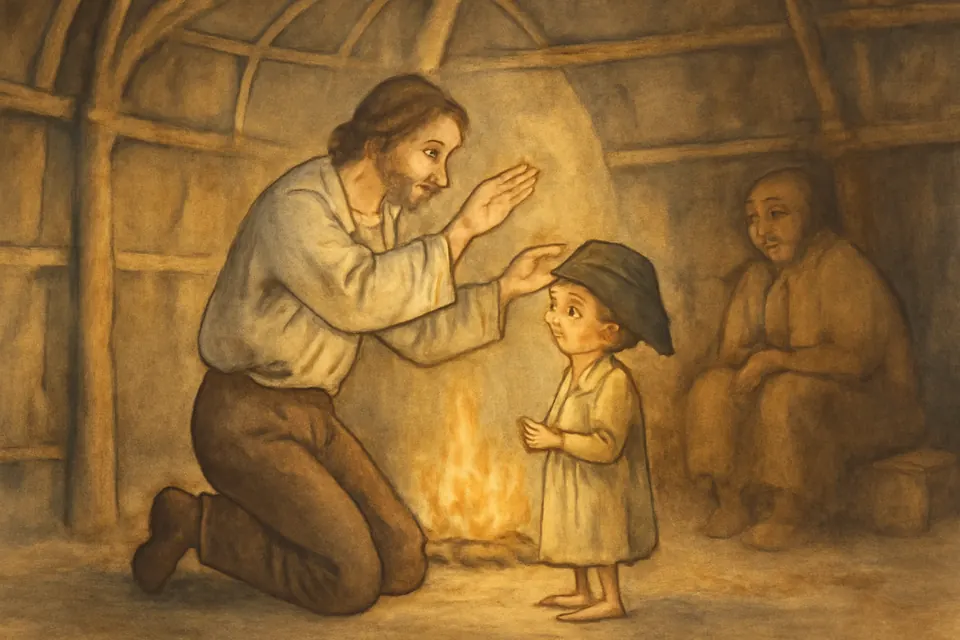
Goupil lived in a longhouse with an old man who disliked his constant prayers. One day, Jogues wrote, Goupil took off his cap, put it on the head of a little child of three or four and made a large sign of the cross over the child's body. The old man ordered a young man of the longhouse, who was about to leave for war, to kill him. Later the child's mother told Jogues that this was why Goupil had died. The old man himself, seeing Jogues make the sign of the cross before a meal, told him: "That is what we hate; that is why they have killed thy companion, and why they will kill thee."
The search for his body
The next morning Jogues found the body in a stream below the village and weighted it under the water with stones, meaning to come back and bury it. A night of rain swelled the stream, and the body was gone. Standing in the cold water, he sang the psalms for the dead.
In the spring of 1643 he was told where the body had been dragged. On his fourth search he found the skull and some bones, buried them, and "kissed them very devoutly, several times, as the bones of a martyr of Jesus Christ."
Canonization
The eight North American Martyrs were canonized together by Pope Pius XI on June 29, 1930, as martyrs, so no miracle through Goupil's own intercession was required, and none is recorded. Favors that pilgrims attribute to the martyrs at Auriesville are reported, not formally approved.
Why St. René Goupil is the patron saint of anesthesiologists
The Society of Jesus calls him "the patron saint of physician anesthetists." No older source records how the patronage began. It fits him: he was the only surgeon among the eight, and he went on treating wounds, his captors' included, while he was a prisoner himself. We can ask his prayers for anyone who keeps watch over a patient in surgery.
With his companions, he also shares the patronage of Canada. For more healer saints, see Sts. Cosmas and Damian, St. Luke and St. Giuseppe Moscati.
Symbols of St. René Goupil in art
Goupil was a layman, and good images show it. Look for:

- Plain lay clothes: a coat, breeches and boots rather than a black cassock. In group images of the eight martyrs, he and John de Lalande are the two men not dressed as priests.
- A surgeon's case, lancet or bandages: for his medical work.
- A crucifix or rosary: the two captives were saying the rosary when he was struck.
- A child: the sign of the cross he made over a Mohawk child.
- A hatchet: the instrument of his death.
- A martyr's palm, as for every martyr.
Some American church windows dress him like a frontier outdoorsman, with a powder horn and a long staff, and put a cross in his hand. In statue groups of the eight martyrs, look for the laymen in coats kneeling in front of the priests.
Feast day and the shrine at Auriesville
The Roman Martyrology remembers René Goupil on September 29, the day of his death. The Church celebrates him with his companions on October 19, the memorial of Sts. John de Brébeuf, Isaac Jogues and Companions, in the General Roman Calendar and in the United States. Canada keeps the feast on September 26. You can find the neighboring feasts on our feast days page.
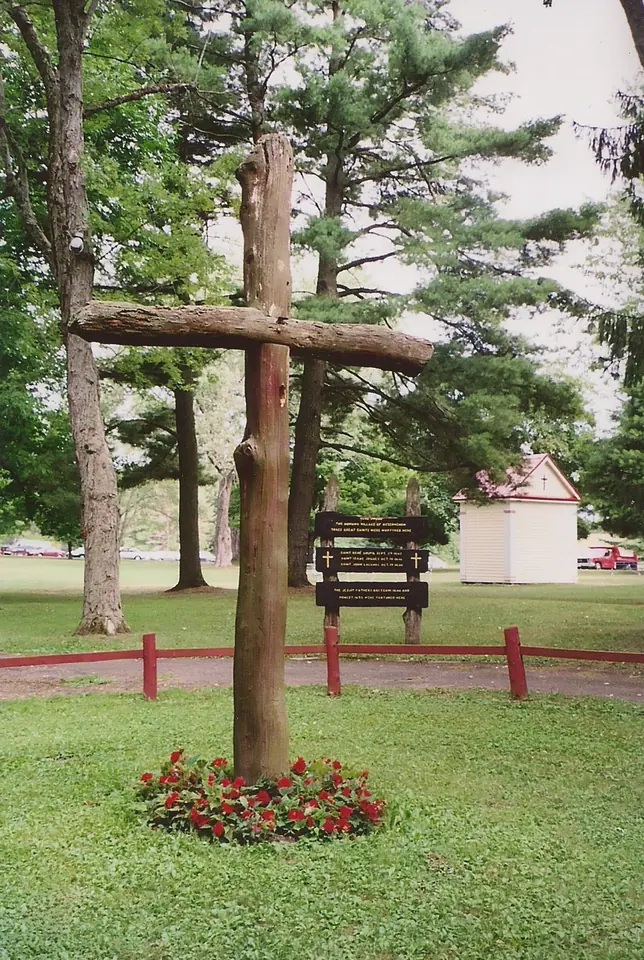
The National Shrine of Our Lady of Martyrs at Auriesville, New York, stands on the hill above the Mohawk River that the Jesuits identified as Ossernenon (some historians place the village elsewhere). Pilgrims walk down a wooded path to the Ravine, where signs give Jogues's account of Goupil's death and burial. The shrine treats the whole Ravine as a reliquary, since his bones lie somewhere in it.
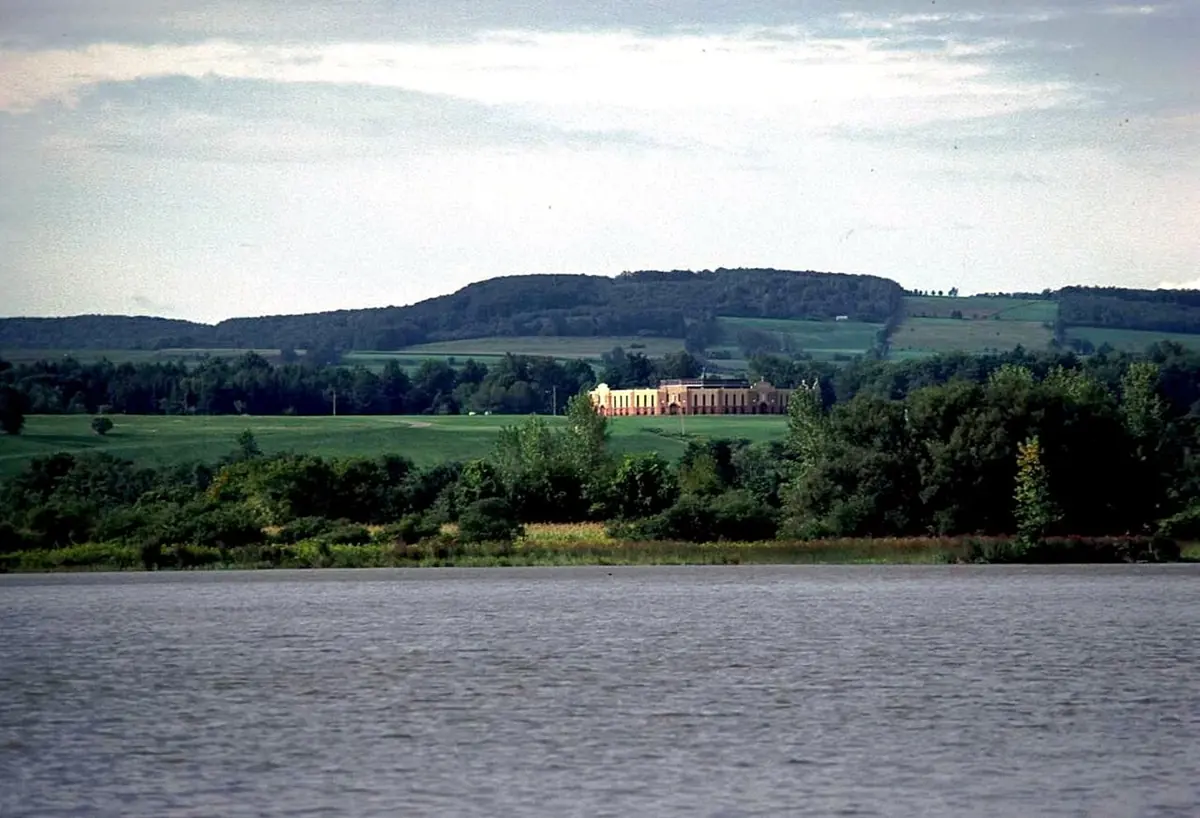

Kateri Tekakwitha was born at the same village in 1656, fourteen years after Goupil died there.
Prayer to St. René Goupil
The Church has no long traditional prayer to René Goupil alone. The novena prayed every October at the National Shrine at Auriesville gives him October 17, and ends that day with a short petition. Addressing him as the "Angel of Innocence," it asks for hearts that love as he loved, together with our own intention. The Friends of the Shrine of Our Lady of Martyrs published the novena in 2017.
The title "Angel of Innocence" comes from Jogues's own words about him. Let us ask St. René Goupil to pray for surgeons, anesthesiologists and nurses, for the sick who are afraid before an operation, and for all who make the sign of the cross where it costs something.
St. René Goupil, pray for us.
Frequently asked questions
Why was St. René Goupil killed?
According to Isaac Jogues, who was with him, Goupil took off his cap, put it on the head of a Mohawk child of three or four and made a large sign of the cross over the child. An old man of the longhouse took it for a curse and ordered a young warrior to kill him. Jogues wrote that the child's mother and the old man both later told him the sign of the cross was the reason.
When is the feast day of St. René Goupil?
September 29, the day he died in 1642, which was also the feast of St. Michael. He is celebrated with the other North American Martyrs on October 19 in the General Roman Calendar and the United States, and on September 26 in Canada.
Why is St. René Goupil the patron saint of anesthesiologists?
The Society of Jesus calls him the patron saint of physician anesthetists. He was a trained surgeon who cared for the sick and wounded at Quebec and kept treating wounds, even his captors', while he was a prisoner. No older source explains how the patronage began.
Was René Goupil a Jesuit?
Yes, at the end. Poor health forced him out of the Jesuit novitiate in Paris, so he served the missions in Canada as a donné, a lay volunteer. After his capture in 1642 he asked to take the vows of the Society, and Jogues received them, so the Jesuits count him as a brother of the order.
Where is St. René Goupil buried?
In the Ravine at the National Shrine of Our Lady of Martyrs in Auriesville, New York, which the shrine identifies with the Mohawk village of Ossernenon. Jogues found his head and some bones there in the spring of 1643 and buried them. The exact grave was never marked.
Keep exploring
- Patron saint pages
- Doctors
- Appears in
- Confirmation saints
- Feast-day calendar
- Saints remembered in SeptemberSaint of the dayWhat saint is my birthday?
- Relics
- Where the relics are kept (map)
- More
- Saints A to ZPatron saints A to ZExplore every section
Sources
- Isaac Jogues, Account of René Goupil (donné), in The Jesuit Relations and Allied Documents, vol. 28 (Thwaites ed., 1898)
- Catholic Encyclopedia (1909): René Goupil
- Society of Jesus: Saint René Goupil
- National Shrine of Our Lady of Martyrs: Story of the Martyrs
- National Shrine of Our Lady of Martyrs: Novena to the North American Martyrs (2017)
- National Catholic Register: Death Under the Sign of the Cross, St. René Goupil (K.V. Turley)