St. Nilus the Younger (Nilus of Rossano), Founder of Grottaferrata

St. Nilus the Younger (Nilus of Rossano, 910–1004) was a Greek monk from Calabria in southern Italy who spread the monastic life of St. Basil in the West, rebuked an emperor and a pope with equal frankness, and in his last years founded the Greek Abbey of Grottaferrata near Rome, where monks still follow the Byzantine rite. Catholics and Orthodox both keep his feast on September 26.
Who was St. Nilus the Younger?
St. Nilus the Younger, also called Nilus of Rossano, was a Greek monk of southern Italy who lived nearly a hundred years, from 910 to 1004. Calabria was then a Byzantine province, Greek in language and liturgy, and Nilus grew up in that world. He became one of its great abbots, a teacher of the monastic way of St. Basil, and a man who spoke the plain truth to governors, popes and emperors. His last work was the foundation of the Abbey of Grottaferrata in the hills south of Rome, a Greek monastery in communion with Rome that still celebrates the Byzantine liturgy today.
He is "the Younger" to set him apart from St. Nilus of Sinai, the ascetic writer of the fifth century. His life was written by one of his own disciples, and much of what follows comes from that early Greek life as Alban Butler retold it.
The life of St. Nilus of Rossano
Conversion
Nilus was born at Rossano in 910. He was well educated and, as a young man, took a wife; the Catholic Encyclopedia, honest about the old sources, says he was married "or lived unlawfully," and that he had a daughter. A serious illness turned him to God. Around 940 he left the world and entered a monastery, and from then on he never turned back.
Abbot and teacher
He lived for a time as a hermit and then as abbot of communities in Calabria. Butler records a visit in 976 from the archbishop of Calabria and a group of nobles who came to test his learning. Nilus put into their hands a book of sayings on the small number of the saved, which they found far too severe, and defended every line from the Fathers and the Gospel. When one of them asked whether King Solomon was saved, Nilus answered: "What does it concern us to know whether he be saved or no? But it behoves you to reflect, that Christ denounces damnation against all persons who commit impurity." He had seen into the questioner's heart.
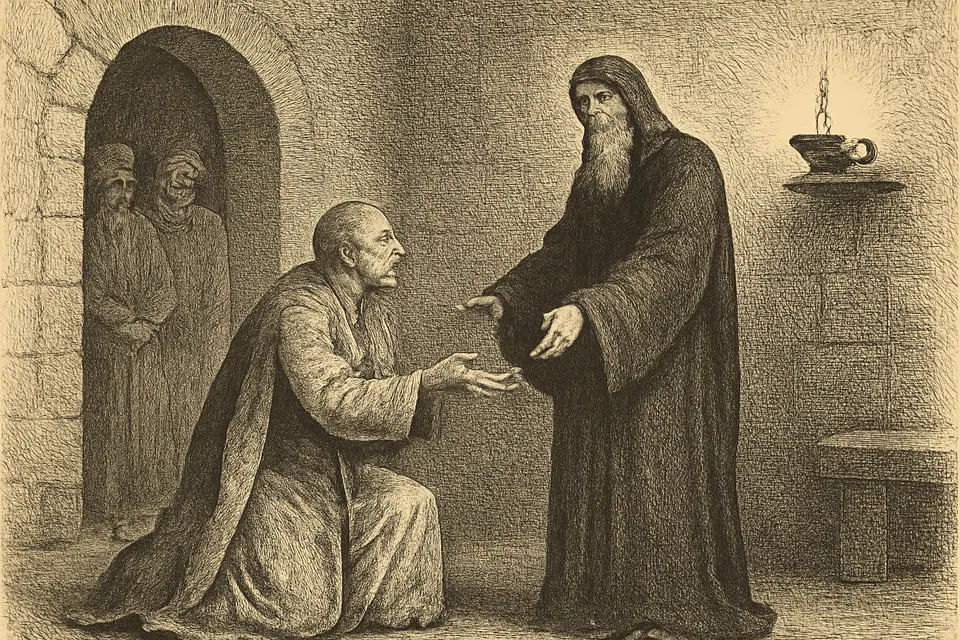
A proud governor named Euphraxus, sent from Constantinople, resented the abbot for bringing no gifts. When the governor fell ill, he sent for Nilus, begged his pardon and asked for the monastic habit. Nilus refused for a long time: "Your baptismal vows are sufficient for you. Penance requires no new vows, but a sincere change of heart and life." In the end he gave way. The governor freed his slaves, gave his goods to the poor, and died three days later.
Exile in the north
When the Saracens overran Calabria, Nilus led his monks north. The abbot of Monte Cassino, the great house of St. Benedict, gave the Greek monks the house of Valleluce, and Butler says they stayed about fifteen years before spending another ten at Serperi, near Gaeta. Nilus also spent time at the monastery of St. Alexius in Rome. He refused the bishopric of Capua and invitations to Constantinople.
Frank words to pope and emperor
In 997 the Roman noble Crescentius set up a Greek from Calabria, John Philagathos, as antipope against Pope Gregory V. When the young Emperor Otto III came to restore Gregory, the antipope was captured, tortured and mutilated. Nilus, now nearly ninety, went to Rome to plead for him and, as the Catholic Encyclopedia records, reproached both pope and emperor for the cruelty.
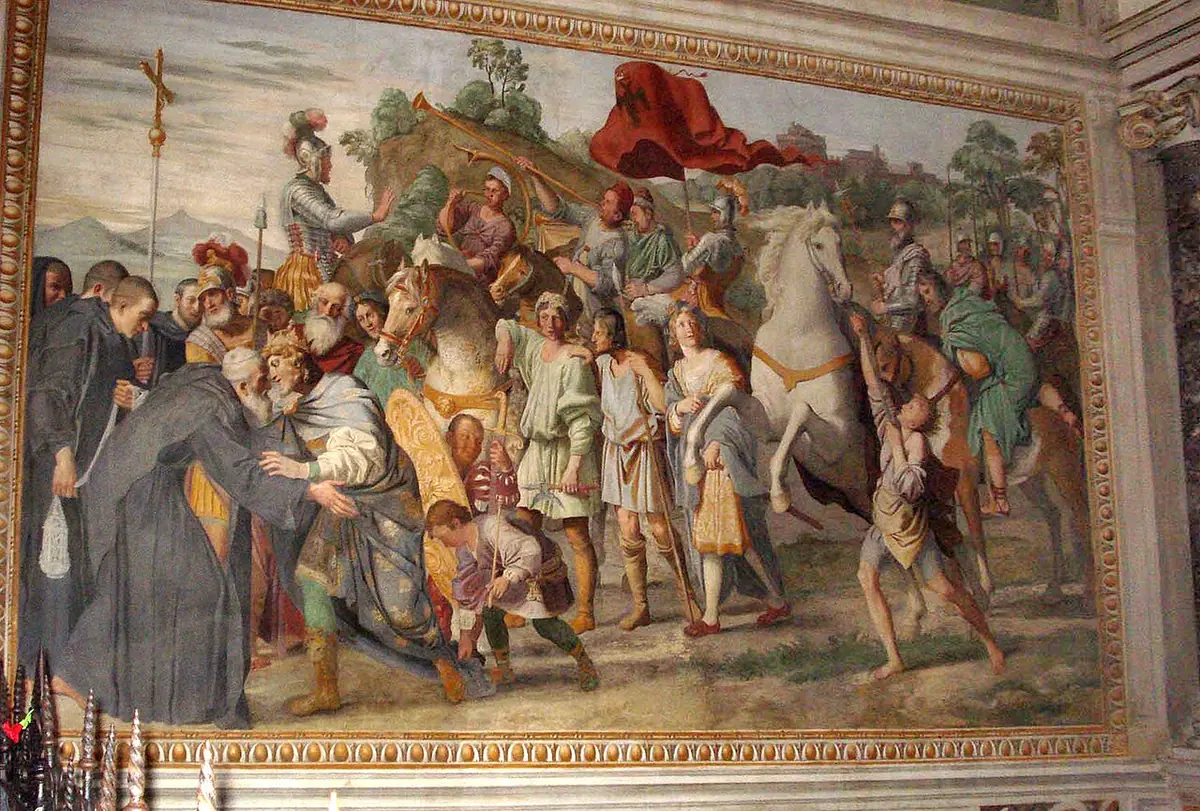
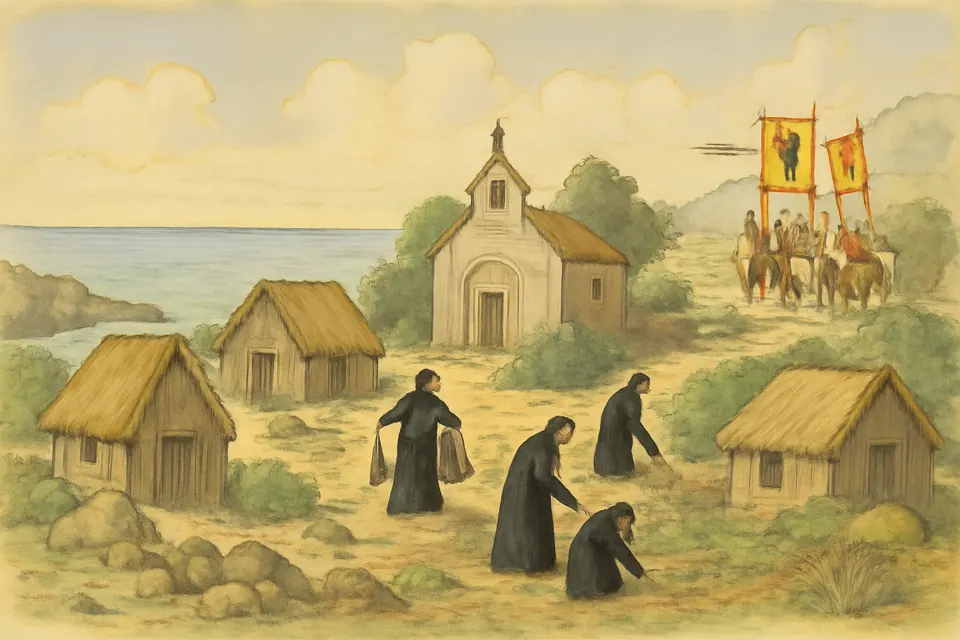
Otto did not hold it against him. On a pilgrimage to Monte Gargano he visited Nilus at Serperi and found only scattered huts. "These men are truly citizens of heaven," he said, "who live in tents as strangers on earth." He offered the abbot land anywhere in his dominions. Nilus declined: "If my brethren are truly monks, our divine Master will not forsake them when I am gone." When the emperor pressed him to ask any favor at all, the old abbot laid his hand on Otto's breast and said: "The only thing I ask of you is, that you would save your soul. Though emperor, you must die, and give an account to God, like other men."
Grottaferrata
In 1004 Nilus came to the slopes of the Alban Hills near Tusculum. Count Gregory of Tusculum, father of two future popes, gave him land. The abbey's tradition says that Our Lady appeared to him there and asked him to build a church in her honor. Nilus died within months, before the buildings rose. His disciple St. Bartholomew, the fourth abbot, finished the work and is remembered as the second founder. The church was consecrated in 1024.
The dates of his death differ in the old books: the Catholic Encyclopedia gives December 1005, Butler 1006, while his feast on September 26 has long been kept as the day of his death in 1004.
The miracles of St. Nilus
Butler writes that Nilus had "an eminent spirit of prophecy, of which many instances are recorded in his life," and his reading of the nobleman's question about Solomon is one such story. These accounts come from his disciple's life and are traditional. The appearance of the Virgin at Grottaferrata is likewise traditional, the founding story of the abbey. No miracle of his has been the subject of a formal Church inquiry.
Symbols of St. Nilus the Younger in art
Painters show him as a very old monk with a long white beard in the black habit of the Basilian monks, often with a book, since he was a scholar and copyist. In Western art the scene most often painted is his meeting with Otto III, the emperor dismounting or kneeling while the old abbot embraces him. In the early 1600s Domenichino covered the chapel of Sts. Nilus and Bartholomew at Grottaferrata with frescoes of their lives for Cardinal Odoardo Farnese, including this meeting and Nilus praying before a crucifix in the woods.

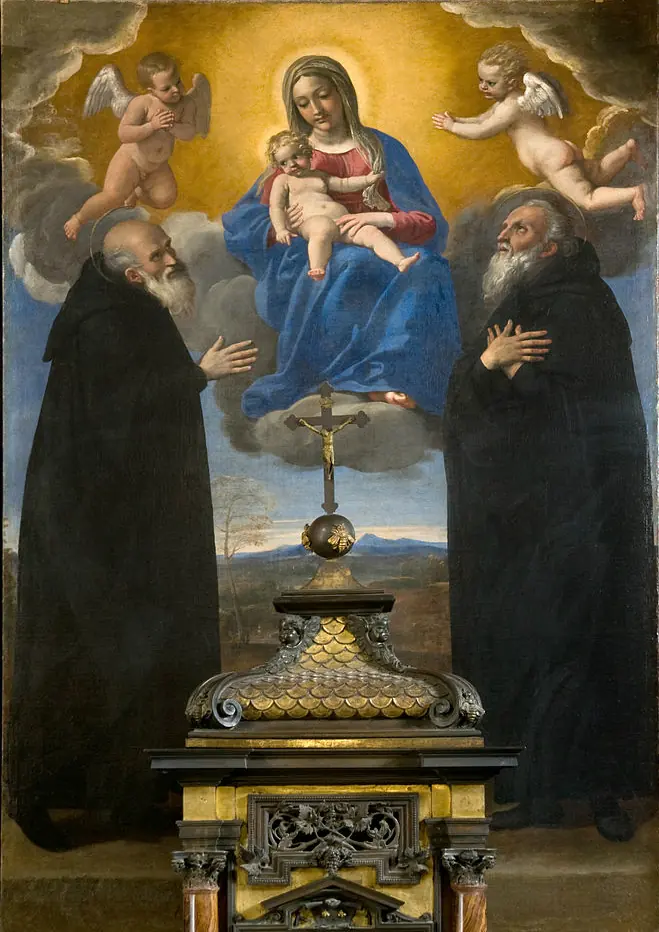
Annibale Carracci's altarpiece for the abbey pairs the two founders, Nilus and Bartholomew, under the Virgin and Child. If you see two old Greek monks together in an Italian church, they are very likely these two.
Feast day and Grottaferrata today
We keep his feast on September 26, the same day in the East and the West. The Abbey of Santa Maria di Grottaferrata still stands, fortified in the fifteenth century by Cardinal Giulio della Rovere, later Pope Julius II. Pope Leo XIII restored its Greek rite in 1881, and its monks remain a living bridge between the Byzantine East and the Church of Rome. See more saints of late September on our feast days page.
Praying with St. Nilus
We have no traditional English prayer to St. Nilus that we can cite. The Byzantine churches honor him with hymns on his feast, and his own words to Otto are a good place to begin: whatever our station, we must die and give an account to God. Let us ask him: holy Father Nilus, you feared no one but God and loved poverty more than the gifts of kings; pray for us, that we may seek first the salvation of our souls.
Frequently asked questions
Who was St. Nilus the Younger?
A Greek-speaking monk from Rossano in Calabria (910–1004). After his conversion he lived as a hermit and as abbot of several communities, fled the Saracen raids north to Monte Cassino and Gaeta, and at the end of his life founded the Abbey of Grottaferrata in the Alban Hills, which has kept the Byzantine liturgy for a thousand years.
When is the feast of St. Nilus the Younger?
September 26, in both the Roman Martyrology and the Byzantine calendar.
Why is he called "the Younger"?
To set him apart from St. Nilus of Sinai (Nilus the Elder), the ascetic writer of the fifth century.
What happened between St. Nilus and Emperor Otto III?
Otto visited his poor monastery of huts near Gaeta and offered him land and revenues. Nilus refused, and when the emperor asked him to name any favor, he laid his hand on Otto's breast and asked only that he save his soul. Domenichino painted their meeting in the abbey chapel at Grottaferrata.
Keep exploring
Sources
- Nilus the Younger (Catholic Encyclopedia, 1911). His possible marriage and daughter, his stay at Monte Cassino and at St. Alexius in Rome, his protest over the treatment of the antipope Philagathos, and the shared feast in East and West
- Abbey of Grottaferrata (Catholic Encyclopedia, 1910). The foundation in 1004, the land from Count Gregory of Tusculum, the tradition of the Virgin's appearance, St. Bartholomew as second founder, and Domenichino's frescoes
- Alban Butler, The Lives of the Fathers, Martyrs and Other Principal Saints, vol. 9 (1866), September 26. The governor Euphraxus, the visit of Otto III and the words exchanged, quoted from the early Greek life by his disciple