St. Bavo of Ghent, the Nobleman Who Became a Hermit

St. Bavo of Ghent (Allowin, Sint-Baafs) was a 7th-century Frankish nobleman who led a wild life until, as a widower, he was converted by a sermon of St. Amand. He gave away his wealth and lived as a hermit near Ghent, first in a hollow tree, until his death about 655. He is the patron of Ghent and Haarlem, and we keep his feast on October 1.
Who was St. Bavo?
St. Bavo of Ghent, known in Dutch as Sint-Baafs or Sint-Bavo, was a nobleman of the 600s who became a hermit and is the patron of Ghent in Belgium and Haarlem in the Netherlands. The cathedrals and great churches named for him in those cities sometimes overshadow the man himself: a sinner who wept his way back to God.
His name was Allowin, and Butler's Lives of the Saints, following a Life written in the 700s, says he came from the part of Brabant called the Hesbaye, near Liège. He was rich, married and, Butler writes, "led a very irregular life." We keep his feast on October 1, the day of his death.

The conversion of St. Bavo
After his wife died, Bavo heard St. Amand preach. Amand, the missionary bishop who evangelized Flanders, was working in the region with the support of the Frankish kings. Butler tells the moment plainly:
The apostolical man had no sooner finished his discourse, but Bavo followed him, and threw himself at his feet, bathed in a flood of tears.
He confessed himself "the basest and most ungrateful of all sinners." Amand did not flatter him. He spoke of God's boundless mercy, and he also set before Bavo a real course of penance, which the old Life describes as three years of canonical penance with forty days of fasting. Bavo went home, gave his money and goods to the poor, settled his affairs and went to the monastery at Ghent, where Amand gave him the tonsure.

Amand's advice to him has come down to us through Butler: "It is a kind of apostasy for a soul which has had the happiness to see the nothingness of this world, and the depth of her spiritual miseries, not to raise herself daily more and more above them."
The hermit of Ghent
After a time Amand let Bavo live as a hermit. His first home, Butler says, was "a hollow trunk of a large tree." Later he built a cell in the forest of Malmedun near Ghent, where wild herbs and water were his food. Finally he came back near the monastery of St. Peter at Ghent, where Amand had made St. Floribert the first abbot, and with Floribert's blessing he lived as a recluse in a cell in a nearby wood.
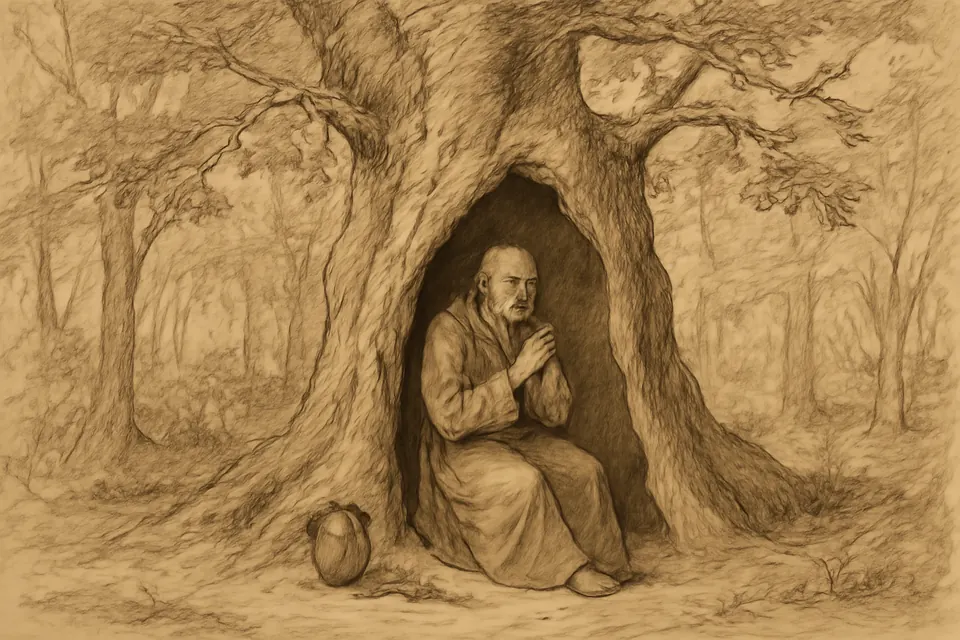
He died there on October 1, about the year 654. Butler records that Amand, Abbot Floribert with his monks, and the priest Domlinus of Turholt were with him, praying, as he died. His example moved sixty men of his own class to take up a life of penance, and they founded a church over his grave that became St. Bavo's Abbey.
The miracles of St. Bavo
The early sources tell us almost nothing of miracles, and we won't add any. The wonder in Bavo's story is a hardened man turned into a penitent. If any marvel belongs to him, it is the one Butler records as traditional from the old Life: that sixty noblemen were moved by his example to leave the world as he had.
Why St. Bavo is patron of Ghent and Haarlem
Bavo's abbey stood at Ghent for nine centuries. In 1536, on the orders of Emperor Charles V, it was suppressed, and after the Ghent revolt of 1540 most of it was pulled down for a citadel. The monks became canons and moved, with Bavo's relics, to the parish church of St. John, which from then on was called St. Bavo's. When Pope Paul IV created the diocese of Ghent in 1559, St. Bavo's became its cathedral.

Haarlem honored him as its titular saint and patron too. Butler, writing in the 1700s, reports that an arm of St. Bavo was kept there in a silver case. The great medieval church of St. Bavo in Haarlem's market square and the Catholic Cathedral of St. Bavo, begun in the 1890s, both carry his name. Penitents claim him because of his conversion, and falconers because of the bird painters gave him.
Symbols of St. Bavo in art
Bavo appears in two ways, before and after his conversion:
- As a nobleman or knight, in armor or rich robes, often with a falcon on his gloved hand and a sword. Geertgen tot Sint Jans painted him this way in the late 1400s.
- Giving alms, with a purse and beggars at his feet, as on the outer wing of the Last Judgment triptych by Hieronymus Bosch or his workshop.
- As a hermit in a rough habit, sometimes with the hollow tree.
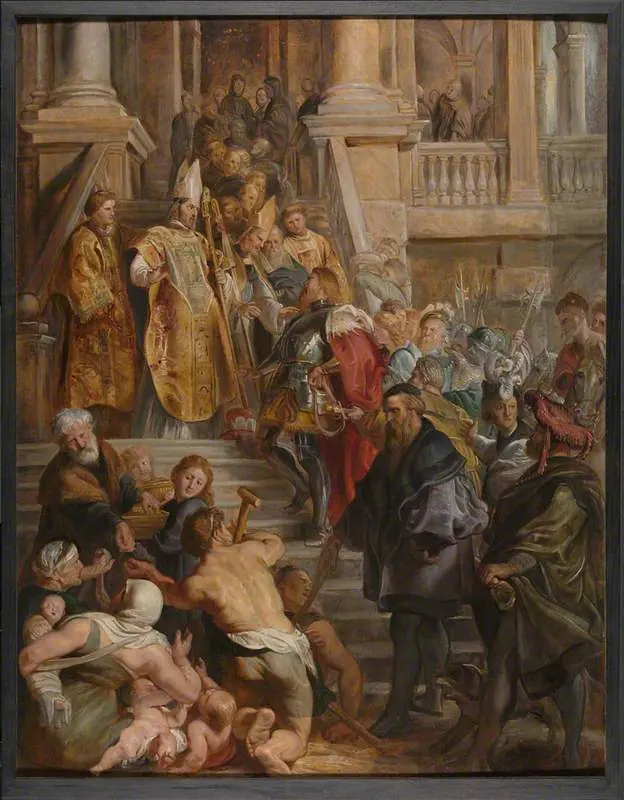
- Kneeling before St. Amand on church steps, the conversion scene Rubens painted twice: an oil sketch about 1611 and the Ghent altarpiece in 1624.
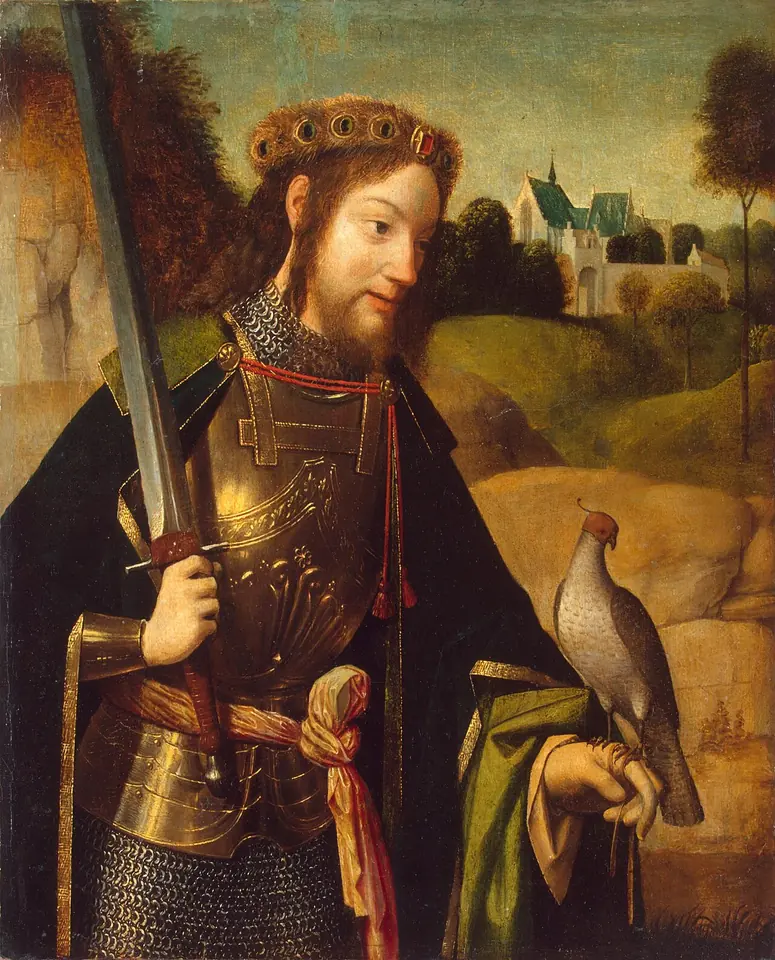
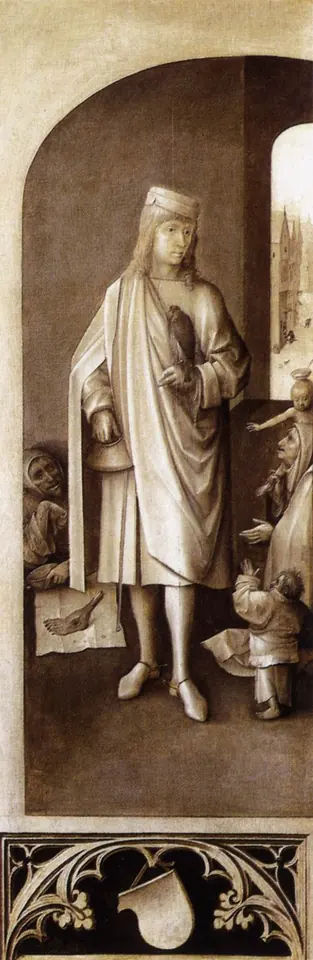
If you see a richly dressed young lord with a hawk in a Flemish or Dutch church, it is very likely Bavo.
Prayer to St. Bavo
We know of no traditional English prayer to St. Bavo with a clear source. We can ask his help in our own words:
St. Bavo, you wasted your youth and then gave everything to God with tears. Pray for us sinners, that we may not put off our conversion, and that we may make up for the harm we have done with real penance and generous alms. Amen.
See our patron saints index and the feast days calendar for more saints of the Low Countries.
Frequently asked questions
Who was St. Bavo?
A nobleman of the 600s from the Hesbaye, in what is now eastern Belgium, whose real name was Allowin. After his wife died he heard St. Amand preach, repented of his past, gave his goods to the poor and became a monk at Ghent and then a hermit in the woods nearby.
When is the feast of St. Bavo?
October 1, the day he died, about 653 to 657. Butler notes that Mabillon dated his death about 653 and the Bollandist Henschenius 657.
Why is St. Bavo the patron of Ghent?
He lived and died near Ghent, and the abbey built over his grave became St. Bavo's Abbey. When that abbey was suppressed in the 1530s, its monks and relics moved to the church of St. John, which took Bavo's name and became the cathedral of Ghent in 1559.
Why is St. Bavo shown with a falcon?
The falcon marks him as a nobleman of the hunting class, the life he left behind. Painters such as Geertgen tot Sint Jans showed him in rich clothes or armor with a falcon on his wrist, and so he is sometimes called a patron of falconers.
Sources
- Alban Butler, The Lives of the Fathers, Martyrs, and Other Principal Saints, vol. 10 (October 1), St. Bavo, Anchoret, Patron of Ghent. The 8th-century Life; the hollow tree and cell; the dates of Mabillon and Henschenius; the relics in Ghent and the arm at Haarlem
- St. Bavo's Cathedral, Ghent: Building history (Bouwgeschiedenis). The abbey suppressed in 1536; the chapter moved to St. John's; diocese of Ghent 1559; Rubens's altarpiece