St. Dionysius the Areopagite, First Bishop of Athens
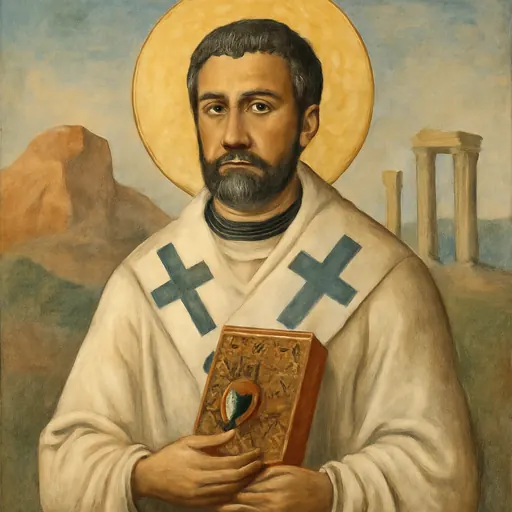
St. Dionysius the Areopagite was a member of the high council of ancient Athens who believed in Christ after hearing St. Paul preach on the Areopagus (Acts 17:34). An early bishop of Corinth names him the first bishop of Athens, and Athens honors him as its patron saint. His feast day is October 3. About 500, an unknown author wrote famous mystical works under his name.
Who was St. Dionysius the Areopagite?
St. Dionysius the Areopagite was an Athenian of the first century who became a Christian when St. Paul preached in Athens. "Areopagite" means he sat on the Areopagus, the ancient council of the city, which met on the rocky Hill of Ares below the Acropolis. St. Luke names him in one verse of the Acts of the Apostles, and that verse is almost all we know for certain about him.
His name became far larger than his life. Medieval Christians believed he had written some of the most influential mystical books ever composed, and in France they believed he was St. Denis, the first bishop of Paris. Neither is true, and we'll explain both. What is left is still worth honoring: a learned man who listened to the gospel in the most skeptical city in the world, believed it, and led its first Christian community.
The convert of the Areopagus
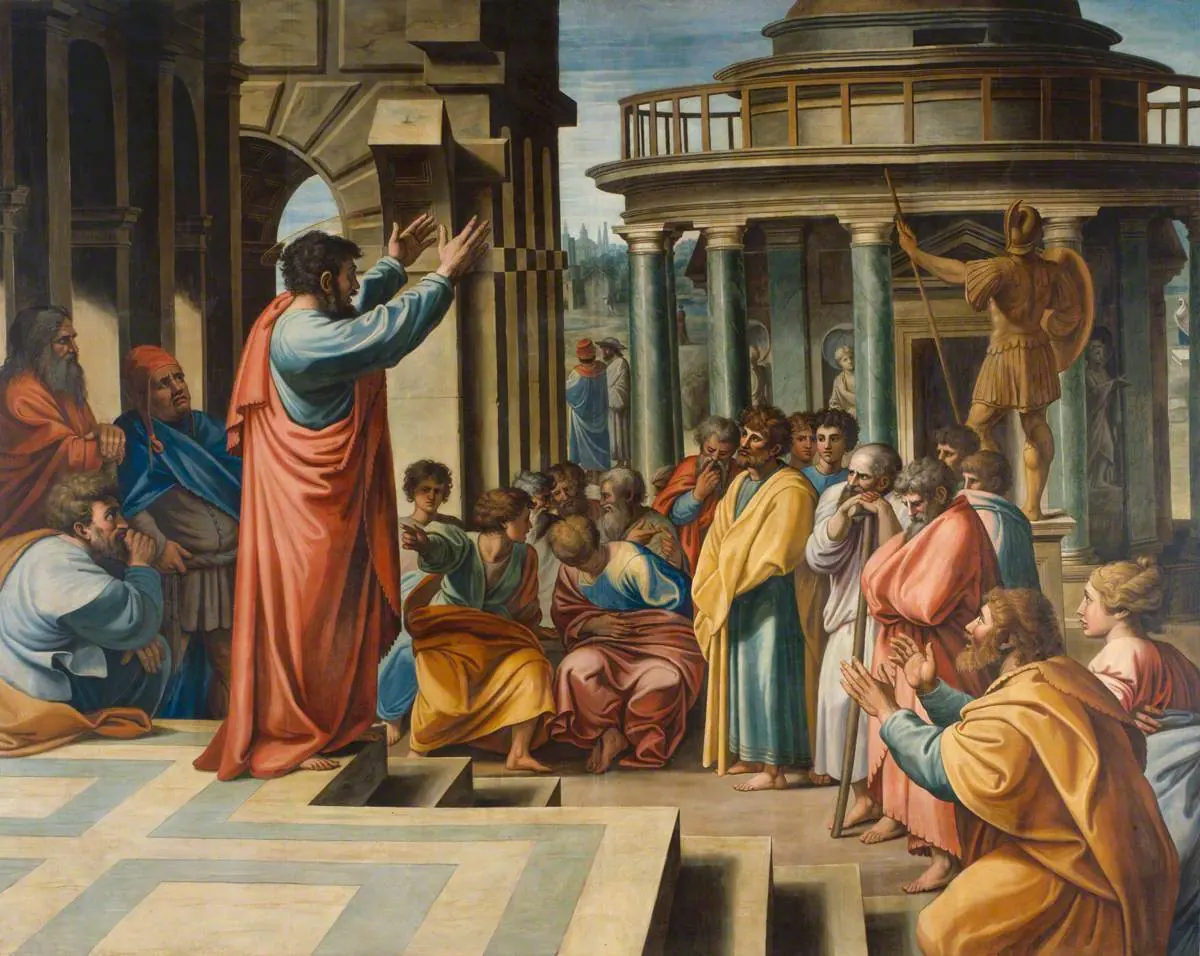
Acts 17 tells how Paul, waiting in Athens for his companions, found his heart "moved within him to find the city so much given over to idolatry," in the words of the Knox translation. He argued in the marketplace, and the philosophers brought him to the Areopagus to explain his teaching. Paul spoke of the altar "To the unknown God" and proclaimed the God who made the world and raised Jesus from the dead.
At the word "resurrection," some mocked. Others said they would hear him again. Then St. Luke writes, in the Knox translation:
But there were men who attached themselves to him and learned to believe, among them Dionysius the Areopagite; and so did a woman called Damaris, and others with them.
That is all of the history of his conversion. It was not a great success by the world's measure: a sermon to the cleverest men in Greece, and a handful of believers. But one of them was a member of the city's highest council.

First bishop of Athens
Around the year 170, another Dionysius, bishop of Corinth, wrote a letter to the Christians of Athens. The historian Eusebius read it and reports that it named "Dionysius the Areopagite, who was converted to the faith by the apostle Paul," and says that he "first obtained the episcopate of the church at Athens." This is early and sober evidence, written about a century after the events, and the Church has always accepted it.

The later stories are traditional. The Orthodox Church in America's life of the saint says he studied astronomy in Egypt and saw the darkness at Christ's crucifixion from Heliopolis, that he was present at the falling asleep of the Mother of God, and that he later preached in the West and was beheaded in Gaul with the priest Rusticus and the deacon Eleutherius. That last part belongs to St. Denis of Paris; the two lives were woven together in the Middle Ages.
The writings under his name
Around 500, an unknown Christian author, probably from Syria, wrote four treatises and ten letters under the name of Dionysius the Areopagite: The Divine Names, The Mystical Theology, The Celestial Hierarchy and The Ecclesiastical Hierarchy. The Catholic Encyclopedia dates them to the late fifth century at the earliest. Pope Benedict XVI, in a general audience of May 14, 2008, called the author "a sixth-century theologian whose name is unknown." He preferred to think the writer hid his name out of humility: "he did not want to glorify his own name."
The books shaped the whole Church. The nine choirs of angels, from the seraphim down to the angels, come from The Celestial Hierarchy (see St. Michael the Archangel). St. Maximus the Confessor commented on them in the East, and St. Thomas Aquinas wrote a commentary on The Divine Names in the West. Scholars now call the author Pseudo-Dionysius, and the Church still reads him with gratitude.
St. Dionysius and St. Denis of Paris
In the 830s Hilduin, abbot of Saint-Denis near Paris, wrote that the martyr St. Denis was the Areopagite himself, sent to Gaul by the apostles, and the author of the mystical books besides. The Catholic Encyclopedia calls the identification one of "two errors of far-reaching import." It was taken apart from the 17th century on. That is why Western paintings sometimes show "Dionysius the Areopagite" carrying his own head: that is Denis of Paris.

Why St. Dionysius is the patron saint of Athens
He is the city's first bishop and its first named convert from among its leaders, so Athens honors him as its patron. The Catholic cathedral of Athens is dedicated to him. See all patronages on our patron saints page.
Symbols of St. Dionysius the Areopagite in art
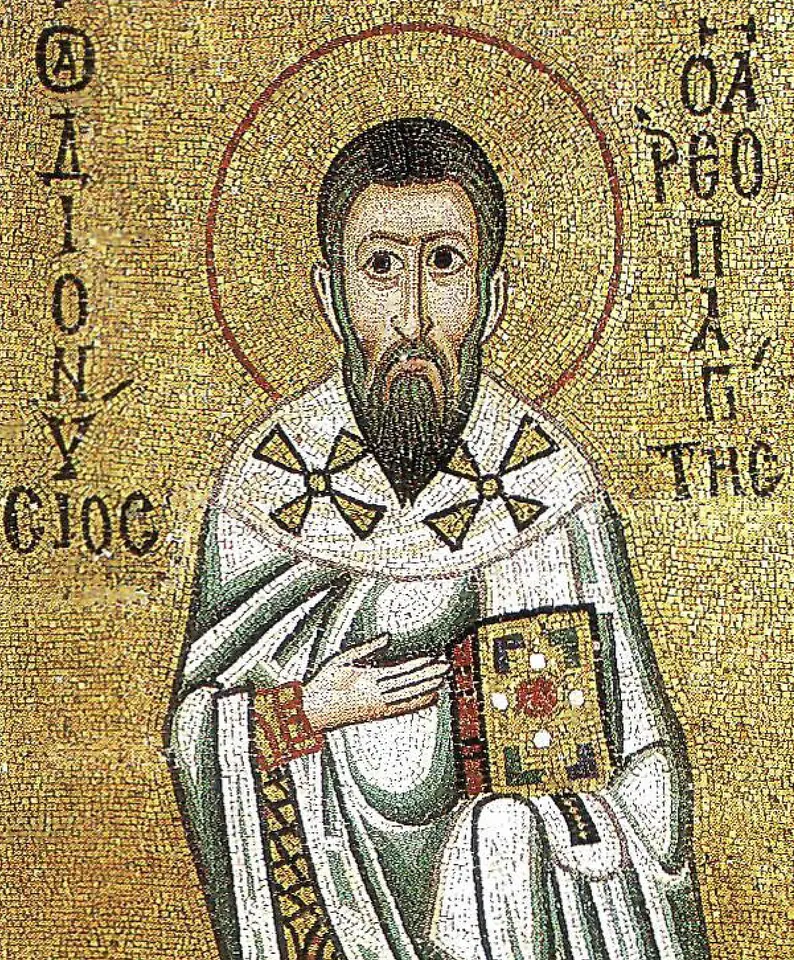
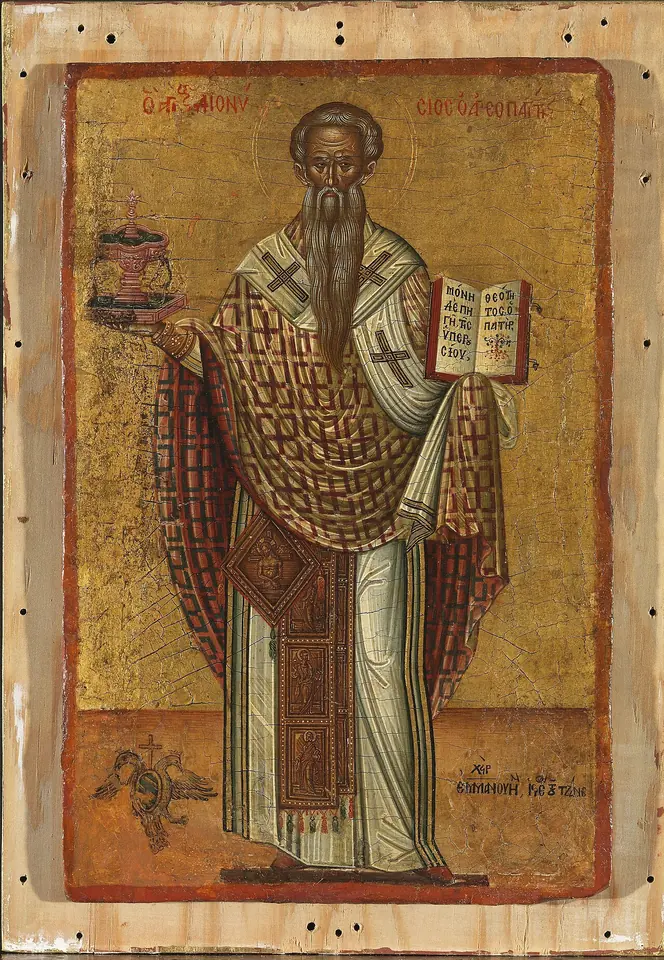
In Byzantine mosaics and icons, Dionysius is a bishop: a white omophorion marked with crosses, a Gospel book, usually a dark or graying beard, and a Greek inscription naming him "the Areopagite." The Hosios Loukas mosaic and the icon by Emmanuel Tzanes on this page are classic examples. In Western art he appears in scenes of Paul preaching at Athens, standing among the listeners in a fine robe. A bishop holding his own severed head is St. Denis of Paris.
St. Dionysius the Areopagite's feast day
We keep his feast on October 3, the date of the Roman Martyrology and of the Orthodox and Eastern Catholic calendars. You can find his neighbors on our feast days page. A bronze plaque on the Areopagus hill today carries the text of Paul's sermon, at the place where Dionysius first heard it.

Prayer to St. Dionysius the Areopagite
The Orthodox Church in America gives the troparion for his feast, in tone 4:
Having learned goodness and maintaining continence in all things, / you were arrayed with a good conscience as befits a priest. / From the chosen Vessel you drew ineffable mysteries; / you kept the faith, and finished a course equal to His. / Bishop martyr Dionysius, entreat Christ God that our souls may be saved.
The "chosen Vessel" is St. Paul. Let us ask St. Dionysius to pray for all who seek God with their minds, that like him they may hear the gospel, believe it and follow it to the end.
Frequently asked questions
Who was Dionysius the Areopagite in the Bible?
A member of the Areopagus, the high council of Athens, who came to believe after St. Paul's sermon there. Acts 17:34 names him with a woman called Damaris as the few who joined Paul when most of the audience mocked.
Is Dionysius the Areopagite the same as St. Denis of Paris?
No. Denis of Paris was a missionary bishop martyred in Gaul around 250. In the 830s Abbot Hilduin of Saint-Denis merged the two, and France believed it for centuries. Today they are honored as two saints, Dionysius on October 3 and Denis on October 9.
Did Dionysius the Areopagite write the Celestial Hierarchy?
No. The Celestial Hierarchy, the Divine Names, the Mystical Theology and the related letters were written around 500, probably in Syria, by an author who used his name. Pope Benedict XVI called him "a sixth-century theologian whose name is unknown." The works themselves are treasured, and the nine choirs of angels come from them.
When is the feast of St. Dionysius the Areopagite?
October 3, in the Roman Martyrology and in the Orthodox and Eastern Catholic calendars.
Sources
- Acts of the Apostles 17, Knox translation (New Advent). Acts 17:34, quoted
- Eusebius, Church History, Book IV, ch. 23 (New Advent). Dionysius of Corinth, about 170, names the Areopagite as the first bishop of Athens (see also Book III, ch. 4)
- Catholic Encyclopedia (1908): Dionysius the Pseudo-Areopagite. Date and Syrian origin of the writings; the two errors of the attribution and the merging with Denis of Paris
- Pope Benedict XVI, General Audience of 14 May 2008: Pseudo-Dionysius, the Areopagite. Quoted on the unknown author and the hypothesis of humility
- Orthodox Church in America: Hieromartyr Dionysius the Areopagite, Bishop of Athens. The Eastern tradition of his life; the troparion and kontakion are on the linked troparia page
- Nominis (Conférence des évêques de France): Saint Denys l'aréopagite. The Roman Martyrology entry for October 3