St. John Koukouzeles, the Angel-Voiced Chanter of Mount Athos
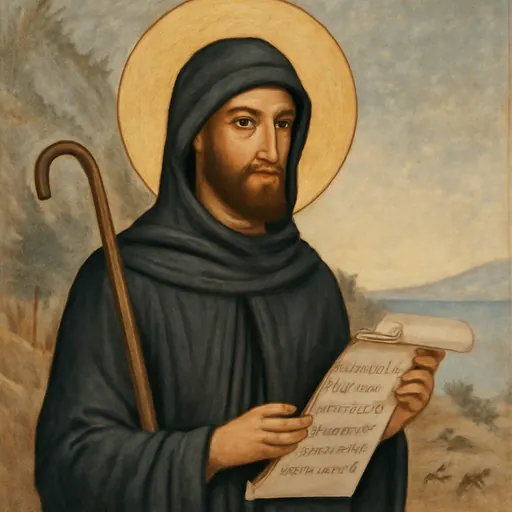
St. John Koukouzeles was the chief singer of the Byzantine imperial court who fled to Mount Athos, hid his gift as the goatherd of the Great Lavra, and became the greatest master of Orthodox chant. The Orthodox Church keeps his feast on October 1, and church singers honor him as their patron saint.
Who was St. John Koukouzeles?
St. John Koukouzeles was the finest singer of the Byzantine Empire, the chief chanter of the emperor's court in Constantinople, who gave it all up to become a hidden monk on Mount Athos. There, the story goes, he herded the monastery's goats and sang to them in the wilderness. In time he became the great master of Orthodox church music, and singers in Greek, Slavic, Romanian and Albanian churches still learn from the system of chant that carries his name.
The Orthodox Church keeps his feast on October 1, and church singers honor him as their own patron saint.
From Dyrrachium to the imperial court
His Life, as the Orthodox Church in America tells it, begins in Dyrrachium, the Adriatic port that is today Durrës in Albania. St. Nikolai of Ochrid's Prologue calls him "a Slav from Dyrrachium," and Bulgarians, Albanians and Greeks all claim him gladly. He was orphaned as a child. Gifted with a beautiful voice, he was taken into the court school of music in Constantinople and rose to be chief singer. The Life says he was the favorite of the emperor, who even arranged a marriage for him.

The splendor of the palace troubled the young man. Once, when someone asked him what he had eaten for dinner, he answered, "Beans and peas," in Greek koukia and zelia. The joke became his name: Koukouzeles.
When did he live?
Here history and the Life part ways, and it is better to say so plainly. The Life names the emperor as John II Komnenos, who reigned from 1118 to 1143, and the Prologue has John dying in the twelfth century. The music manuscripts tell a different story. The chants signed with his name, and the new style they belong to, appear in manuscripts of the fourteenth century, and scholars such as those of Cappella Romana date him to the late thirteenth and early fourteenth centuries. Either way, he is the same saint, honored by the same Church.
The goatherd of the Great Lavra
John looked for a way out of the court. He met an abbot from Mount Athos who had come to the capital on business, opened his heart to him, and received his blessing to come to the Holy Mountain. At the Great Lavra, the monastery founded by St. Athanasius the Athonite, he was tonsured a monk. Telling no one who he was, he was given the task of looking after the monastery's goats.
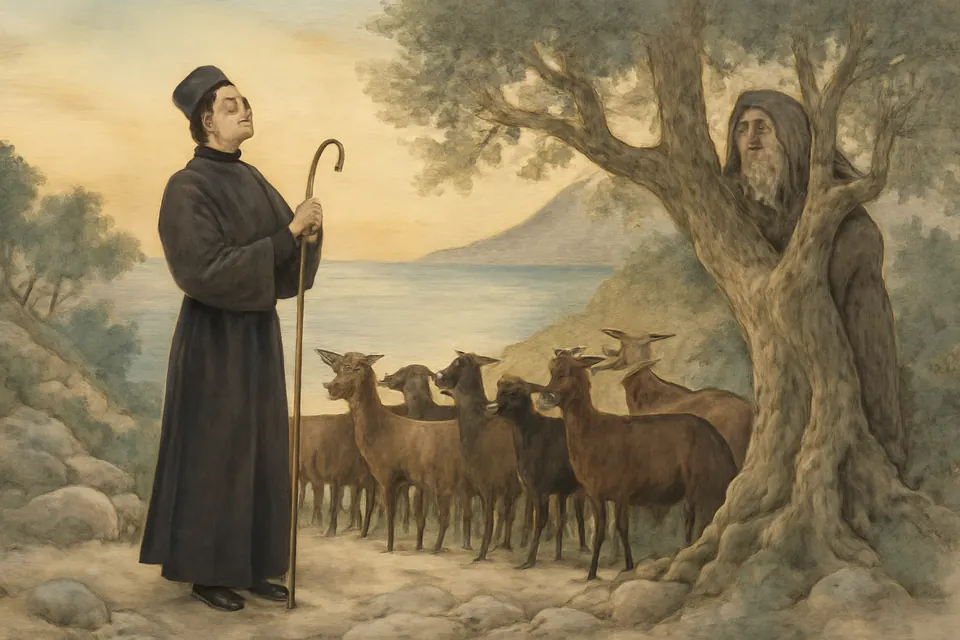
Out on the empty slopes of Athos, alone with the flock, he prayed and sang the hymns of the Church. The Life says the goats stopped grazing and gathered around him to listen, "as though entranced." A hermit living nearby heard the singing and told the abbot. John confessed that he had been the emperor's singer and begged, with tears, to be left with his goats. The abbot, afraid of the emperor's anger, went to Constantinople himself to explain, and asked the emperor not to stand in the young monk's way. From then on, John sang on the right-hand choir of the monastery church on Sundays and feast days.
The Koukouzelissa and the gold coin
The best-loved story of St. John is a traditional one. Once, after he had sung the Akathist hymn before an icon of the Mother of God, the Virgin appeared to him in a dream. In the Orthodox Church in America's telling, she said to him: "Rejoice, John, and do not cease to sing. For that, I shall not forsake you." She put a gold coin into his hand and vanished. The coin was placed beneath the icon, which is known since then as the Koukouzelissa, and the Lavra still keeps it. Many miracles are credited to the coin and the icon.
A second time, the Life says, the Mother of God appeared to him and healed his legs, which had been badly damaged by hours of standing in church.

Master of chant
John spent the rest of his life in prayer, fasting and music. He became, in the words of his Life, "master teacher and regent" of church singing. He arranged and composed melodies for the stichera, troparia and kontakia of the services, edited hymn texts and wrote new chants of his own. Manuscripts of the services carry his name in their titles, and he is credited with a teaching work on "the science of song and singing signs."
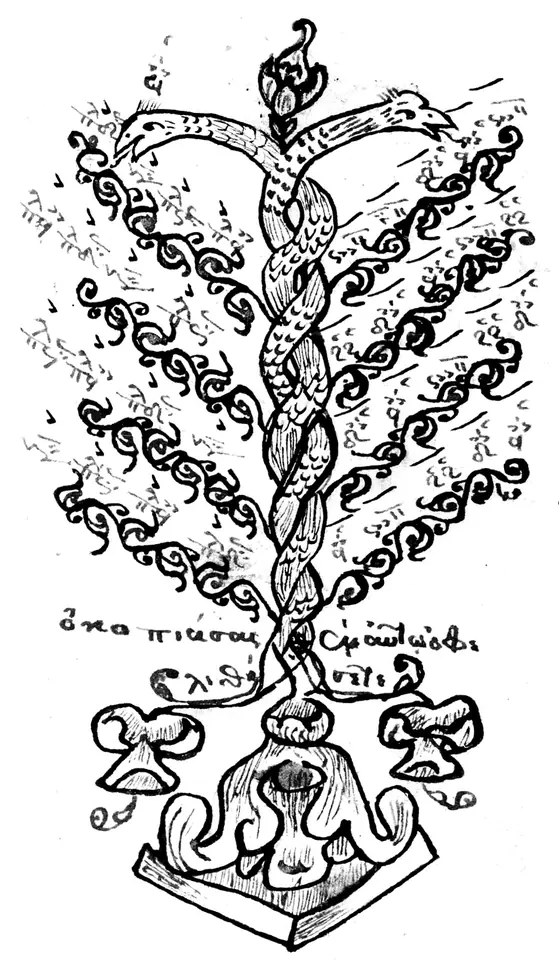
Scholars link him with the kalophonic, or "beautiful-sounding," style of chant: long, richly ornamented settings that spread through the whole Orthodox world. Teaching manuals of Byzantine chant, the Papadikai, often include the "Koukouzelian wheel" or "tree," a diagram that lays out the signs and modes of chant for students, still bearing his name centuries later.
Foreseeing his death, he said goodbye to the brethren and asked to be buried in the Church of the Archangel that he had built at the Lavra.
Symbols of St. John Koukouzeles in art
In icons and wall paintings St. John Koukouzeles is usually shown as a monk, and his attributes tell his story:
- The black monastic habit: the monk of the Great Lavra.
- Goats and a shepherd's staff: his hidden years as the monastery's goatherd.
- An open scroll or book: often written with chant signs, for the master of music.
- The Mother of God: for the Koukouzelissa icon and the Virgin's gift of the gold coin.
In the Balkans he is often painted among the saints of the Slavs. At the Ardenica Monastery in Albania, a wall painting of 1744 shows him with the Seven Saints, Sts. Cyril and Methodius and their disciples.

Feast day and prayer
We keep his memory on October 1, the same day as St. Romanos the Melodist, the other great singer-saint of Byzantium. See the feast day calendar.
The Orthodox Church sings to him the troparion of holy monks, in the translation of the Orthodox Church in America:
By a flood of tears you made the desert fertile, and your longing for God brought forth fruits in abundance. By the radiance of miracles you illumined the whole universe! O our holy father John pray to Christ our God to save our souls!
Let us ask St. John to pray for church singers and choir directors, for everyone who gives God the gift of a voice, and for all who sing quietly where only God can hear.
Frequently asked questions
Who was St. John Koukouzeles?
A Byzantine singer and composer from Dyrrachium (Durrës) who became chief singer at the emperor's court in Constantinople, then left to become a monk at the Great Lavra on Mount Athos. He reshaped Byzantine chant, and the Orthodox Church venerates him as a saint and patron of church singers.
What does Koukouzeles mean?
According to his Life, when someone at court asked him what he had eaten, he answered, "Beans and peas," koukia and zelia in Greek. The nickname stuck.
When is the feast of St. John Koukouzeles?
October 1, the same day as St. Romanos the Melodist.
What is the Koukouzelissa icon?
An icon of the Mother of God at the Great Lavra on Mount Athos, named for St. John. His Life says the Virgin appeared to him after he sang the Akathist before it and gave him a gold coin, which was placed beneath the icon.
Keep exploring
Sources
- Orthodox Church in America: Venerable John (Koukouzelis) the Hymnographer of Mount Athos. His Life as the Church tells it, the name, the goats, the gold coin and the Koukouzelissa icon, his works, burial in the Church of the Archangel, and his patronage of church singers
- St. Nikolai Velimirović, The Prologue from Ochrid: Our Holy Father John Kukuzelis (orthodox.net). Calls him "a Slav from Dyrrachium" and dates his death to the twelfth century
- Cappella Romana: Cyprus, the Ars nova and its Byzantine counterpart. The musicological dating (late thirteenth to early fourteenth century) and his kalophonic style