St. Matrona of Perge

St. Matrona of Perge was a 5th-century wife and mother from Asia Minor who left her husband for the monastic life, lived for years in a men's monastery in Constantinople disguised as the eunuch Babylas, and became an abbess at Emesa, Beirut and finally Constantinople, where she died at about a hundred. The Orthodox Church keeps her feast on November 9.
Who was St. Matrona of Perge?
St. Matrona of Perge was a holy woman of the 5th century who left a hard marriage for God, hid for years among monks under a man's name, and ended her long life as the abbess of a large convent in Constantinople. The Orthodox Church honors her as Venerable Matrona, Abbess of Constantinople, on November 9.
She came from Perge in Pamphylia, on the south coast of Asia Minor. Her story is one of a small group of Byzantine lives about women who lived in monasteries of men, alongside St. Marina the Monk and St. Euphrosyne of Alexandria. Unlike most of them, Matrona had been married and was a mother.

Where her story comes from
Two Greek lives tell her story. The older one, the vita prima, was written by an unknown author at an unknown date and survives in a single 10th-century manuscript in Paris. In the 10th century Symeon Metaphrastes rewrote it, and his version spread everywhere: the Medieval Sourcebook counts more than 700 surviving manuscripts of his collection. The Bollandist Hippolyte Delehaye doubted the value of parts of the text, so we read the details with some care. The broad outline, a married woman from Perge who became an abbess in the capital, is accepted as historical.
The life of St. Matrona of Perge
A young wife in the capital
Matrona was well educated and married young to a man named Domitianus. They had one daughter, Theodote. When the family moved to Constantinople, Matrona spent her days and nights in the churches, fasting, praying and giving to the poor. She was about twenty-five. A devout woman named Eugenia taught her the ascetic life.
Domitianus did not trust her long absences and at times kept her locked in the house. The Metaphrastes life says she was threatened and sometimes beaten. One evening she prayed in the Church of the Holy Apostles to be freed for God, and she left her daughter in the care of a consecrated virgin named Susanna.
Brother Babylas
She dreamed that her husband was chasing her and that a crowd of monks hid her. So she cut her hair, dressed as a eunuch, and entered the monastery of St. Bassianus as "Babylas." The monks admired how hard the young eunuch worked.
Once a new monk named Barnabas, digging beside her in the garden, asked why her ears were pierced. Her answer, as the life gives it, was both a dodge and a lesson: "One must pay attention to the land and not gaze curiously on human features." Then she explained that the woman who raised her had wanted to give her earrings.
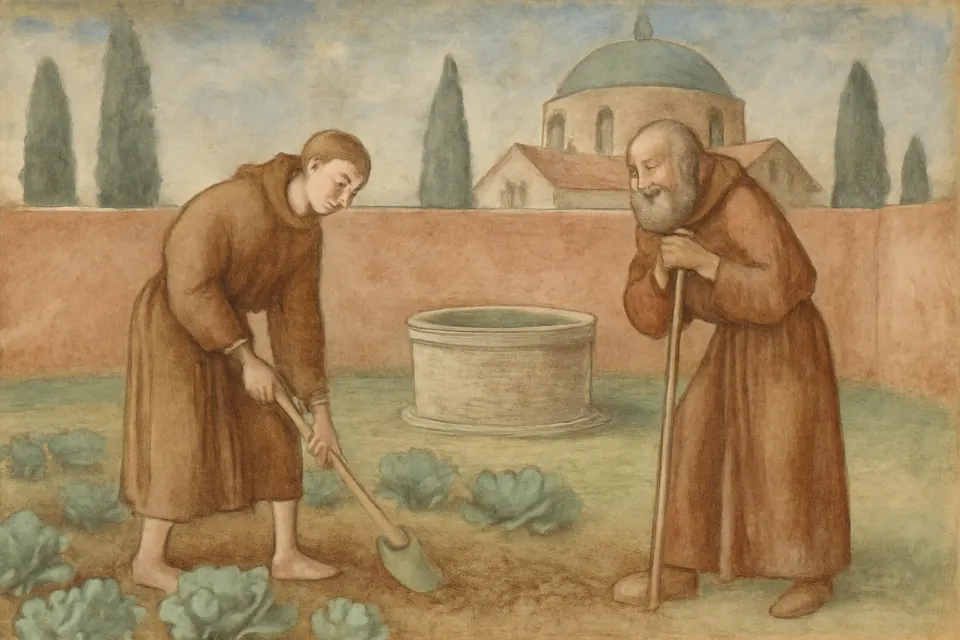
In time Bassianus learned the truth in a dream, and so did the abbot of a neighboring monastery. He questioned her sternly. When he heard her story, he told her, "Take courage, my daughter," and asked her to cover her head again.
Emesa, Jerusalem and Beirut
Her husband came to the monastery and shouted for his wife. The monks answered truthfully that they had no woman, only a eunuch who had left for Jerusalem. Bassianus sent her by ship to a community of women at Emesa in Syria, where the nuns later made her abbess.
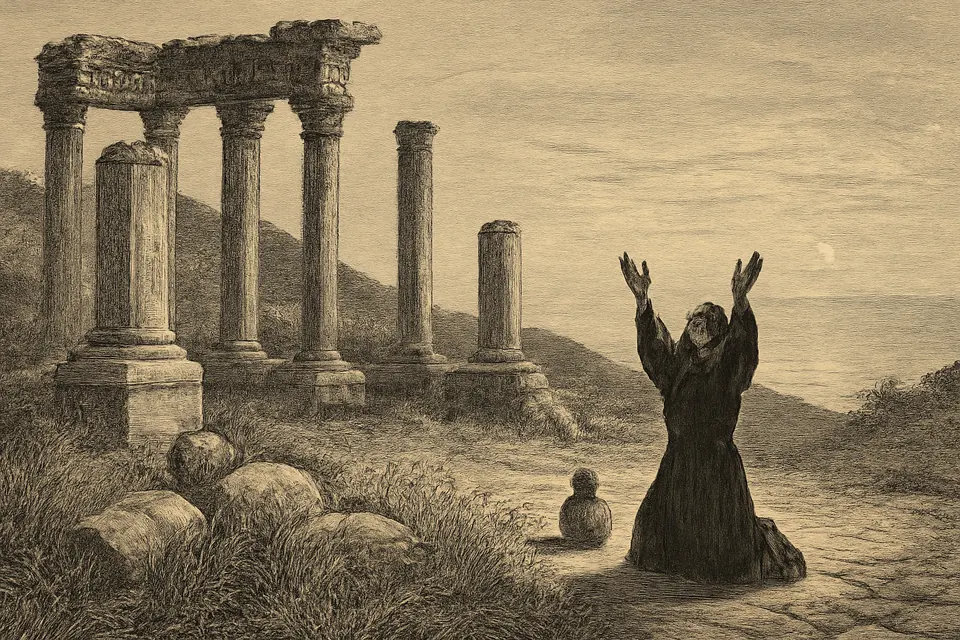
When Domitianus tracked her down again, she slipped away to Jerusalem, then, with him on her trail, to an abandoned pagan temple near Beirut. She lived there alone on wild herbs and water. Women from the city began to come to her, and some were baptized, among them a young pagan priestess who took the name Euche. A small community grew around her.
Abbess of Constantinople
A dream of three suitors called Alexander, Antiochus and Constantine told her where to go next, and Constantine won. She sailed back to the capital. Bassianus found her a quiet house near his own monastery, and her sisters from Beirut joined her. The life says the empress Verina, wife of Emperor Leo I, came to visit and that Matrona would not take her gifts.
A noblewoman cured through her prayers gave her a large property by the sea, and another, Athanasia, gave her fortune to build. The community grew. In the OCA's telling, the nuns kept a strict rule. Bassianus allowed them to wear the leather belts and white mantles of monks instead of the usual women's dress.

Shortly before her death she dreamed of a beautiful house in a garden and heard women say, "It is yours." She died at about one hundred years old, having spent seventy-five of them, the lives say, in the monastic life.
Miracles and legends of St. Matrona
All of these come from her lives and are traditional.
- The blind man at Emesa: the Metaphrastes life says she was present when the head of St. John the Baptist was found at Emesa, and that a man born blind received his sight when she anointed his eyes with myrrh from it.
- The demons of the temple: in the ruins near Beirut she drove off demons by the sign of the cross.
- A sick noblewoman healed: the wife of the patrician Sphoracius, given up by her doctors, recovered after Matrona prayed with her and laid a hand on her.
Symbols of St. Matrona in art
Matrona appears in Byzantine and Russian art, not in Western painting.
- The dark habit and veil of a nun mark her as a monastic and an abbess.
- Hands raised in prayer, the old orans gesture, as in the Menologion of Basil II.
- A monastery wall or building beside her recalls the convent she founded.
- A scroll, carried in some later icons, is the sign of a teacher of monks and nuns.
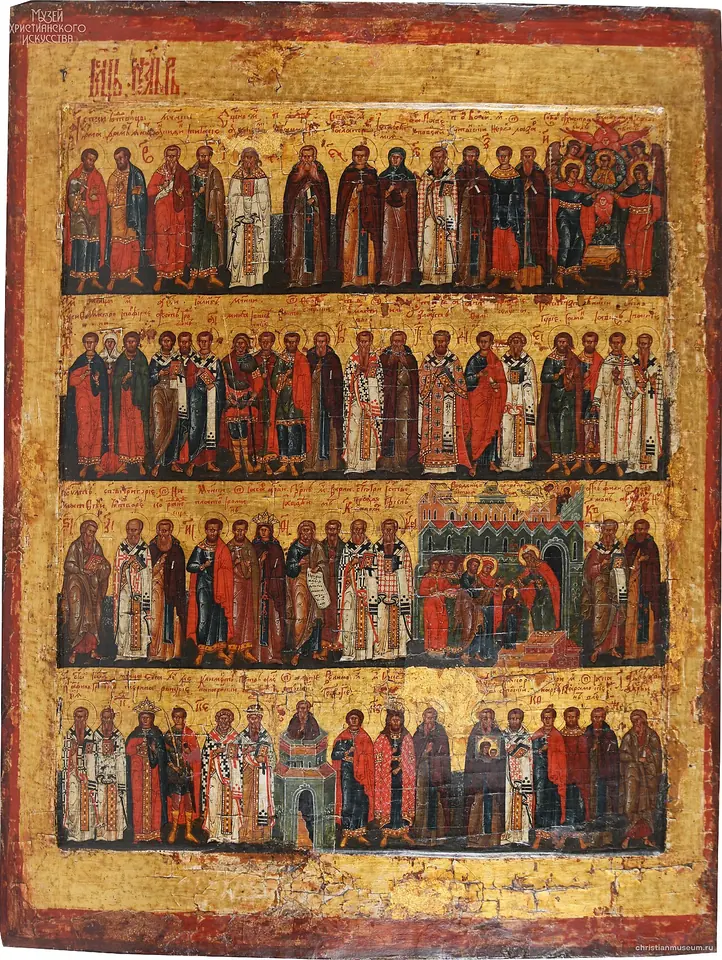
Russian calendar icons place her among the saints of November, and the Russian Lives of the Saints printed an engraving of her for her day.

Her feast day and prayer
We keep her memory on November 9, with the Orthodox and Byzantine Catholic churches. Her relics and her monastery have not survived. See her neighbors on our feast days page.
The Orthodox Church sings this troparion for her, in the OCA's translation:
The image of God was truly preserved in you, O Mother, / for you took up the Cross and followed Christ. / By so doing, you taught us to disregard the flesh, for it passes away; / but to care instead for the soul, since it is immortal. / Therefore your spirit, O holy Mother Matróna, rejoices with the angels.
Let us ask St. Matrona to pray for wives and mothers in unhappy homes, and for everyone who is searching for a quiet place to give their life to God.
Frequently asked questions
Why did St. Matrona of Perge dress as a man?
Her life says she dreamed that her husband was chasing her and that monks hid her among them. She took this as a sign, cut her hair and entered the monastery of St. Bassianus in Constantinople as a eunuch called Babylas, so that her husband would not find her.
When is the feast of St. Matrona of Perge?
November 9 in the Orthodox Church, where she is honored as Venerable Matrona, Abbess of Constantinople. Some Byzantine calendars place her on November 7 or 8.
Is St. Matrona of Perge the same as St. Matrona of Moscow?
No. Matrona of Perge lived in the 5th and early 6th centuries and founded a monastery in Constantinople. St. Matrona of Moscow was a blind Russian holy woman who died in 1952.
How do we know about St. Matrona of Perge?
From two Greek lives. An early life (the vita prima), of unknown author and date, survives in one 10th-century manuscript. A later retelling by Symeon Metaphrastes in the 10th century was copied hundreds of times and shaped her later cult.
Keep exploring
Sources
- Medieval Sourcebook (Fordham University): The Life of St. Matrona of Perge, d. c. 510. English translation by Khalifa Ben Nasser of the Metaphrastes life and excerpts of the vita prima; manuscript tradition, Babylas, Emesa, Beirut, Empress Verina, age one hundred
- Orthodox Church in America: Venerable Matrona, Abbess of Constantinople. The Orthodox life read on November 9
- Orthodox Church in America: Troparia and kontakia for November 9. Text of her troparion, tone 8
- Alice-Mary Talbot, ed., Holy Women of Byzantium: Ten Saints' Lives in English Translation (Dumbarton Oaks, 1996). Full English translation of the vita prima, pp. 13–64, with an introduction by Cyril Mango (cited by the Medieval Sourcebook)