St. Alphonsus Rodriguez
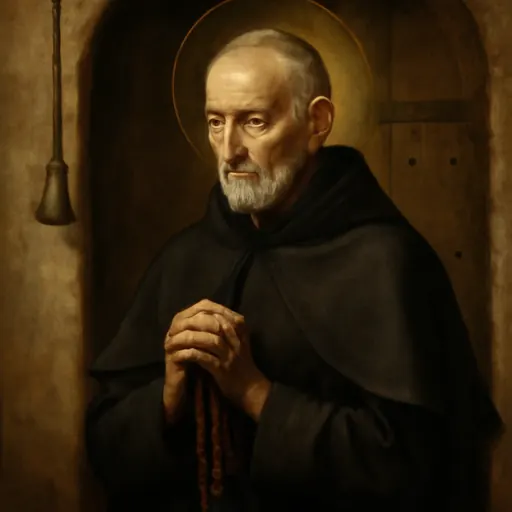
St. Alphonsus Rodriguez (1532–1617) was a Spanish wool merchant who lost his wife and children, entered the Jesuits as a lay brother at nearly forty, and served for 46 years as doorkeeper of the Jesuit college in Palma de Mallorca. He treated every caller as Christ and guided the young St. Peter Claver toward the Americas. His feast day is October 31 (the Jesuits keep it on October 30), and he is a patron of lay brothers and of Majorca.
Who was St. Alphonsus Rodriguez?
St. Alphonsus Rodriguez (in Spanish, Alonso Rodríguez) was a Jesuit lay brother who opened and shut one door for most of his life. For forty-six years he was the porter of the Jesuit college of Montesión in Palma, on the island of Majorca. He never preached, never taught a class and never left the island once he arrived. Yet bishops, viceroys, students and beggars came to his little lodge by the gate for advice, and one young student he counseled became St. Peter Claver, the apostle of the enslaved in Cartagena.
He came to religious life late and by a hard road: a failed business, the deaths of his wife and all three of his children, and years of being told he was too old and too unlettered to be a Jesuit. We keep his feast on October 31, the day he died in 1617.
The life of St. Alphonsus Rodriguez
A wool merchant of Segovia
Alonso was born in Segovia on July 25, 1532, the son of a wool merchant. According to the Catholic Encyclopedia, he had less than a full year of schooling at a new college in Alcalá before family troubles called him home, and the business that came to him was already sliding toward ruin. As a boy he had met some of the first Jesuits to come to Spain, among them St. Peter Faber.
At twenty-six he married María Suárez, a woman of his own station. They had three children. Within a few years the business failed, and death took his wife and then, one by one, the children. The Catholic Encyclopedia says that after the death of the last child "his thoughts turned to a life in some religious order." He began to live a life of prayer and penance while still in the world.
Turned away, then received
The Jesuits hesitated. He was close to forty, his health was poor from his penances, and he had almost no Latin. He tried sitting in the classroom with schoolboys at the Jesuit college in Barcelona to make up the lack, and it didn't work. Finally he went to Valencia to see the Provincial of Aragon, Father Antonio Cordeses. The fathers were divided over admitting a sickly man of forty, and the 1873 Life says Cordeses settled it by declaring he would receive Alphonsus "in order that the Society should not lose a Saint." Alphonsus entered the Society of Jesus as a lay brother on January 31, 1571. After six months of novitiate he was sent to the new college at Palma de Mallorca.
Forty-six years at the door
At Montesión he was made porter, the brother who answers the bell, receives visitors, runs errands and calls the fathers to the parlor. It sounds like small work. He made it his whole way to God. The 1873 English Life of the saint, drawn from the records of his beatification, says he regarded the sound of the bell "as the voice of God" and answered within himself, "I am ready, O Lord! Thou hast called me. What is Thy will?" Among the notes he left is this rule for himself:
You shall receive, hear, and address the person at the gate as Christ, not as man, which also you shall observe with those of the house when you open the door to let them out.


His obedience became legendary. The same Life tells how the rector once ordered him to admit no one during a school ceremony without first reporting who it was. The Viceroy of Majorca arrived with his retinue, and his guards pounded on the closed door. Alphonsus calmly went to inform the rector first. The viceroy, a devout man, was not offended; he praised the porter's obedience.
The fathers of the house noticed how much he suffered too. The Catholic Encyclopedia speaks of extreme bodily penances, frequent scruples and "mental agitation," and a mind that stayed absorbed in God through the busiest days. Gerard Manley Hopkins, writing to a friend in 1888, summed up the tradition: it was believed that God gave him "heavenly light" and that he was "much persecuted by evil spirits."
Spiritual father of St. Peter Claver
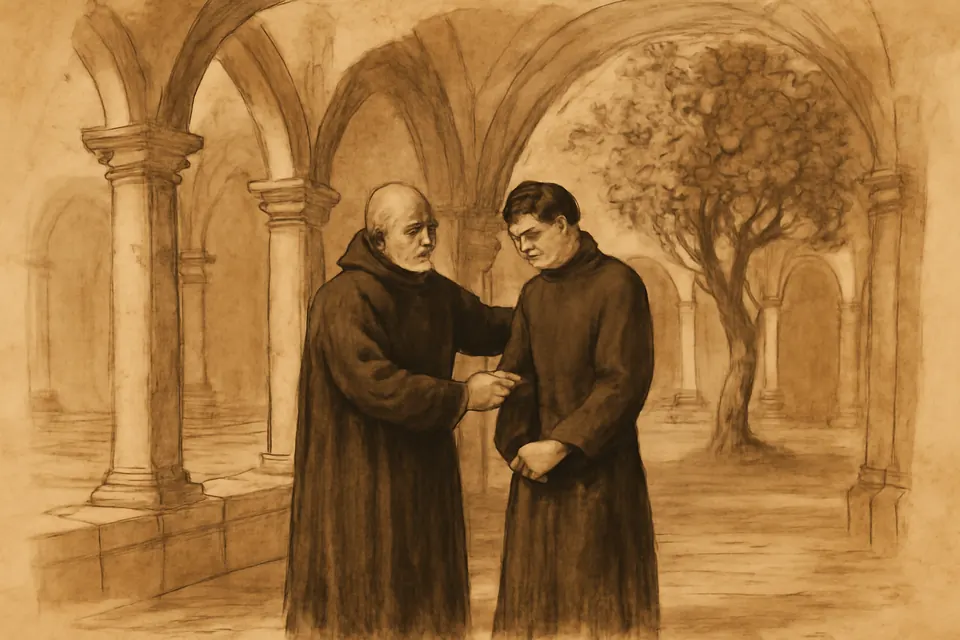
In 1605 a young Catalan Jesuit named Peter Claver came to Montesión to study philosophy. He sought out the old porter, and the two spoke often. The Catholic Encyclopedia says Claver "followed his advice in asking for the missions of South America." Claver sailed for Cartagena in 1610 and spent the next forty years baptizing, nursing and defending the Africans brought there in chains. He kept the notes Alphonsus gave him for the rest of his life.
His writings
Alphonsus was no scholar, but his superiors ordered him to write down his prayer and his counsels. The manuscripts were published in Barcelona in 1885 as Obras espirituales del B. Alonso Rodríguez. The Catholic Encyclopedia calls them plain in style and full of repetition, but "remarkable for the correctness and soundness of their doctrine." He is also credited with spreading devotion to the Little Office of the Immaculate Conception, though the office itself is older than he is.
His death
He was porter as long as he could stand. In his last illness, in October 1617, the 1873 Life describes a long ecstasy in which he was heard murmuring "O sweet Jesus, O my dear Mother," and a final return of pain in which he kept saying, "Yet more, good Lord, yet more." He died with the holy name of Jesus on his lips on October 31, 1617, at eighty-five.

The miracles of St. Alphonsus Rodriguez
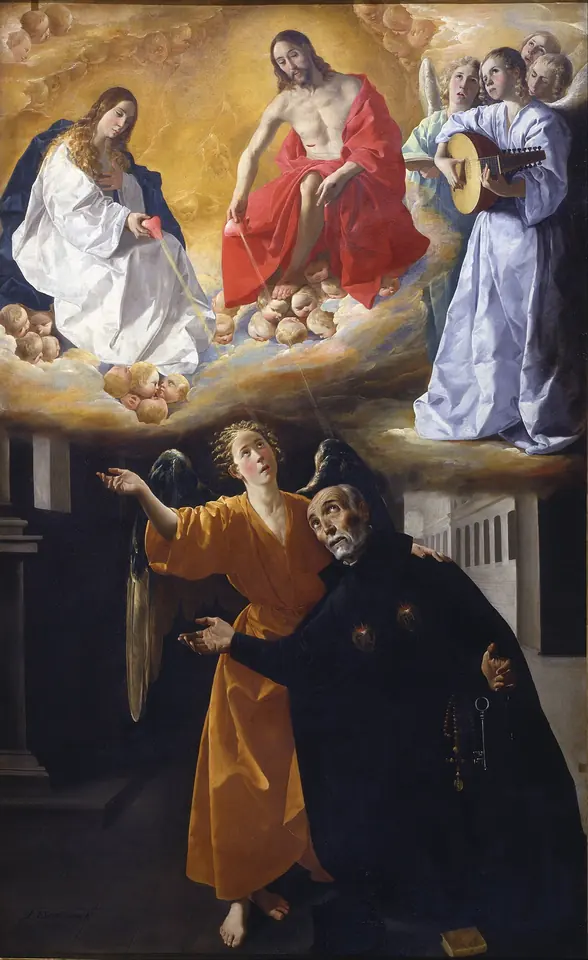
- Visions, healings and prophecies in his lifetime: reported. The 1873 Life, drawn from the beatification records, gives whole chapters to his visions, his gift of healing and his gift of prophecy. Zurbarán's painting shows one such vision of Christ and Our Lady.
- His foreknowledge of Peter Claver's mission: traditional, from the early lives.
- Cures at his tomb: reported. The 1873 Life gathers several. In February 1618, Giovanna Companya, a woman of thirty-eight, lost the use of her left arm; after eight months without improvement she made a novena, laid on the arm a cloth that had rested on his tomb, and recovered at once.
- Miracles for his beatification and canonization: approved. As every cause requires, miracles were examined and accepted before Pope Leo XII beatified him on June 12, 1825, and before Pope Leo XIII canonized him on January 15, 1888, in one ceremony with St. Peter Claver and St. John Berchmans.
His cause was slow for reasons that had nothing to do with him. He was declared Venerable in 1626, and Clement XIII declared his virtues heroic in 1760, but the expulsion and suppression of the Jesuits delayed the beatification for decades.
Why St. Alphonsus Rodriguez is the patron of lay brothers
The 1873 Life was written by a lay brother for lay brothers, and it calls Alphonsus their "patron and model." He showed that holiness in religious life doesn't depend on ordination, study or important offices. Majorca adopted him much earlier: in 1633, sixteen years after his death, the island's Council General chose him as one of the special patrons of the city and island. See more on our patron saints page.
Other holy doorkeepers followed his path, among them St. André Bessette in Montreal and St. Conrad of Parzham in Bavaria. We can ask his prayers for any work that keeps us at a desk, a counter or a door, receiving people one at a time.
Symbols of St. Alphonsus Rodriguez in art
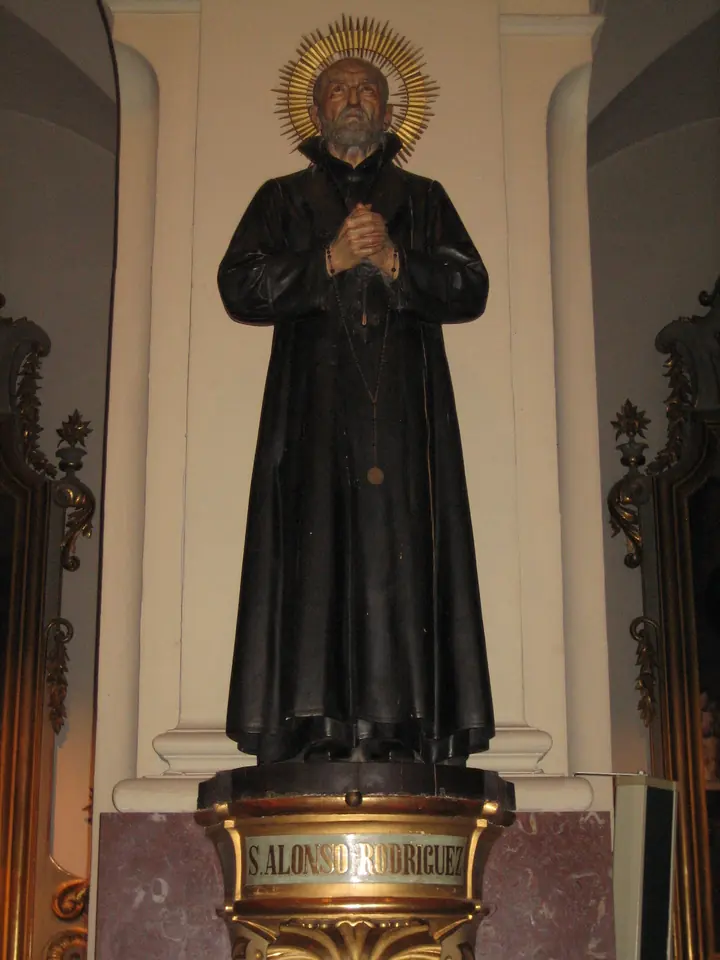
Alphonsus is painted as an old, very thin man in the plain black cassock of a Jesuit brother, without the biretta a priest would wear. Look for:
- The rosary: he prayed it constantly at the door, and almost every portrait puts it in his hands.
- A door, keys or a bell: the signs of his office as porter, more common in modern statues and holy cards.
- A vision of Christ and Mary: in Zurbarán's painting an angel holds him up as he gazes at the Lord and the Virgin enthroned in clouds, with angel musicians.
- Joined hands and lowered eyes: the humility for which he was known.
Don't mix him up with his namesake. Father Alonso Rodríguez (1526–1616), a Jesuit priest who wrote the famous Practice of Christian Perfection, lived at the same time and died a year earlier. The Catholic Encyclopedia warns that the two "often" get confounded. Portraits of the writer show a priest with books and a pen; the saint holds a rosary.

Feast day and his tomb in Palma
His feast is October 31 in the Roman Martyrology, and the Jesuits keep it on October 30. In Palma, his sepulcher is in the first side chapel on the left in the Church of Montesión (in Catalan, Monti-sion), next to the old college where he answered the door. Find his neighbors on our feast days calendar.
In 1888, for the first feast after the canonization, the Jesuit poet Gerard Manley Hopkins wrote a sonnet "to order" that was sent to Majorca. Its last lines are the best short life of the saint ever written:
Yet God (that hews mountain and continent,
Earth, all, out; who, with trickling increment,
Veins violets and tall trees makes more and more)
Could crowd career with conquest while there went
Those years and years by of world without event
That in Majorca Alfonso watched the door.
Prayer to St. Alphonsus Rodriguez
No traditional prayer composed by the saint himself is widely used. The prayer most closely tied to him is his own response to the doorbell, which we can make ours whenever someone needs us: "I am ready, O Lord! Thou hast called me. What is Thy will?"
We can also take his rule for the door as a daily resolution, to receive each person "as Christ, not as man." Let us ask St. Alphonsus to pray for us, that we may serve faithfully in hidden work, bear our griefs with patience, and recognize the Lord in everyone who comes to our door.
Frequently asked questions
What is St. Alphonsus Rodriguez the patron saint of?
He is honored as the patron and model of religious lay brothers, and Majorca's Council General chose him as one of the special patrons of the city and island of Palma in 1633. Many Catholics also ask his prayers for humble, hidden work done for God, especially by doorkeepers, receptionists and anyone who serves people at a desk or door.
When is the feast day of St. Alphonsus Rodriguez?
October 31, the day he died in 1617, in the Roman Martyrology. The Society of Jesus celebrates him on October 30 in its own calendar.
What did St. Alphonsus Rodriguez say when the doorbell rang?
His early biographers say he took the bell as the voice of God and answered within himself, "I am ready, O Lord! Thou hast called me." He left a note for himself to receive everyone at the gate "as Christ, not as man." The popular short form is "I'm coming, Lord."
How was St. Alphonsus Rodriguez connected to St. Peter Claver?
Peter Claver studied at the Montesión college in Majorca while Alphonsus was its porter. The old brother became his spiritual guide and urged him to ask for the missions in Spanish America. Claver went to Cartagena in 1610 and spent his life serving enslaved Africans there. The two were canonized together in 1888.
Is he the same Alonso Rodríguez who wrote "Practice of Christian Perfection"?
No. That book was written by Father Alonso Rodríguez (1526–1616), a Jesuit priest and spiritual writer who was never canonized. The saint was a lay brother with little schooling. The Catholic Encyclopedia notes that the two are often confused.
Keep exploring
Sources
- Catholic Encyclopedia (1907): St. Alphonsus Rodriguez
- The Life of Blessed Alphonsus Rodriguez, Lay-Brother of the Society of Jesus (London, 1873). The porter's rule, the bell as God's voice, his death, and the reported cures at his tomb
- Gerard Manley Hopkins, In honour of St. Alphonsus Rodriguez, in Poems of Gerard Manley Hopkins (1918), Project Gutenberg. The sonnet and Hopkins's letter of October 1888 about it
- GCatholic: Canonizations in the Pontificate of Pope Leo XIII
- Viquipèdia: Convent de Monti-sion (Palma). only source found for the position of his tomb in the church