St. Stefan Milutin, the Holy King of Serbia
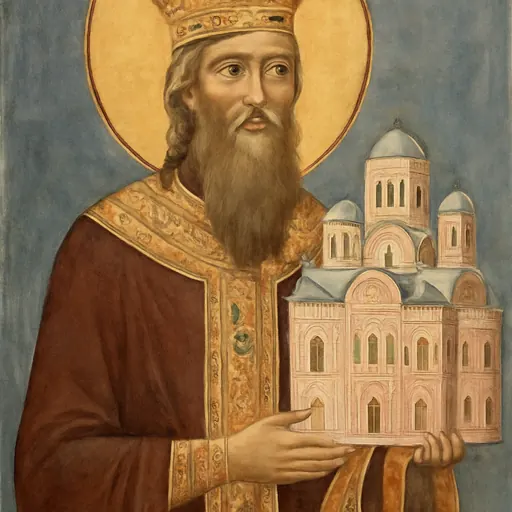
St. Stefan Milutin (about 1253–1321), King Stefan Uroš II of Serbia, was one of the most powerful rulers of medieval Serbia and a great builder of churches, among them Gračanica. The Orthodox Church honors him as the Holy King; his incorrupt relics rest in St. Nedelya Cathedral in Sofia, and his feast is October 30.
Who was St. Stefan Milutin?
St. Stefan Milutin was a medieval king of Serbia whom the Orthodox Church honors as the Holy King. Born about 1253 into the Nemanjić dynasty, he ruled Serbia for about forty years, until his death on October 29, 1321, and in that time made it one of the strongest states of southeastern Europe. He is remembered above all as a builder: the Orthodox life credits him with more than forty churches, along with monasteries and hostels for travelers. The Orthodox Church keeps his feast on October 30, and his incorrupt relics rest today not in Serbia but in the center of Sofia, Bulgaria.
A prince of a holy dynasty
Milutin was the younger son of King Stefan Uroš I and a grandson of King Stefan the First-Crowned, both honored in the Serbian Church, and the great-grandson of St. Simeon Nemanja, the founder of the dynasty and father of St. Sava. His mother, Queen Helen, is honored by the Orthodox as St. Helen of Serbia on the same day as her son. His elder brother, Stefan Dragutin, became king first but after a short reign handed the throne to Milutin; Dragutin too is venerated as a saint, under his monastic name Theoctistus.
King and defender of the faith
The Orthodox life says that as king Milutin "bravely defended, by both word and by deed, the Orthodox Serbs and other Orthodox peoples from their enemies." He extended Serbia to the south, deep into lands that had been Byzantine, and later made peace with the emperor in Constantinople.
His long reign also had dark pages. He married several times for political reasons, and he came into bitter conflict with his own son Stefan, the future St. Stefan of Dečani, whom he punished harshly before they were reconciled near the end of his life. The Serbian Church has never hidden these failings. It honors Milutin for his faith, his repentance and his gifts to the Church, not as a man without sin.
The builder of Gračanica
Milutin did not forget to thank God for His gifts, says the Orthodox life, and his thanks took the form of stone. He founded or rebuilt churches across his kingdom and beyond it. Gračanica in Kosovo, finished in the last year of his life, is his masterpiece, a soaring church of five domes. He also built Banjska, which he meant as his burial church, and renewed the Church of the Mother of God of Ljeviša at Prizren. He took special care of the monasteries of Mount Athos, above all the Serbian monastery of Hilandar. The Orthodox life notes that when the Serbian kingdom later fell, those monasteries remained centers of the nation's faith and culture.

Death and the incorrupt relics
Milutin died on October 29, 1321 (the Orthodox life gives 1320) and was buried at Banjska. Two years later, the Orthodox life says, his relics were found incorrupt, and from then on the Serbian Church honored him as a saint.
The relics traveled far. According to the history of St. Nedelya Cathedral, about 1460, during a plague, Metropolitan Silvanus of Sofia carried them from Trepča, north of Priština, to a monastery near Sofia that came to be called "St. Kral." Over the following centuries they moved from church to church in Sofia and finally came to the cathedral of St. Nedelya. In the nineteenth and early twentieth centuries the cathedral itself was called "Sveti Kral," the Holy King, because of them. Today the reliquary stands before the cathedral's south altar.

Where the relics of St. Stefan Milutin are kept: see them on the relics map →
The miracles of St. Stefan Milutin
The history of St. Nedelya Cathedral published on Pravoslavieto.com says that "many are the miracles that have happened at the relics of the Holy King." These are reported miracles, not formally investigated. Every Tuesday after the Divine Liturgy an akathist to St. Stefan Milutin is sung there. By an old local custom, the faithful leave clothes overnight beside the relics, and the next day a prayer for health is read over them; those who come with reverence, that history says, receive help. The finding of his body incorrupt two years after his death is part of the traditional account kept by the Serbian Church.
Symbols of St. Stefan Milutin in art
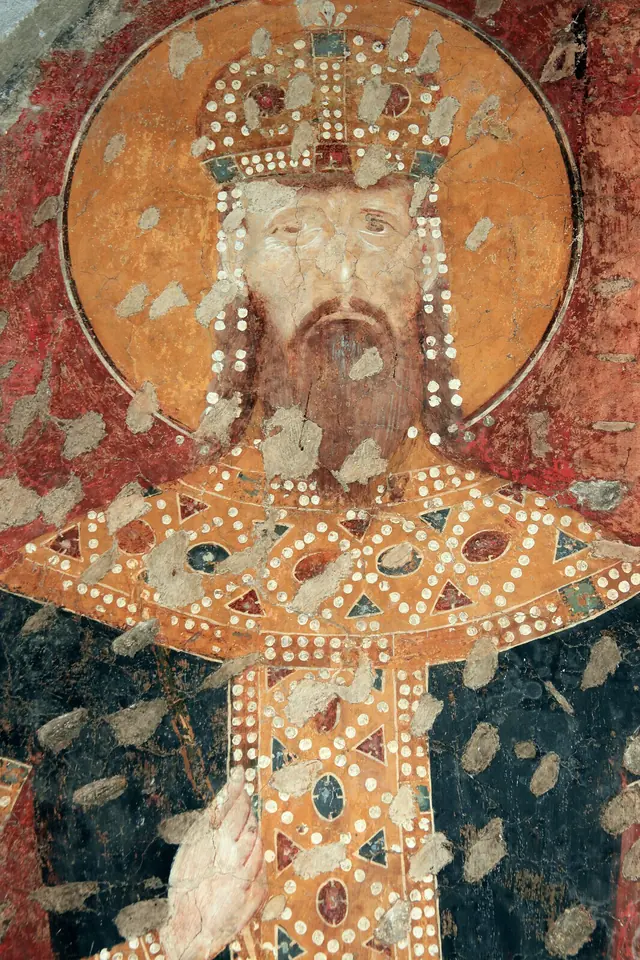
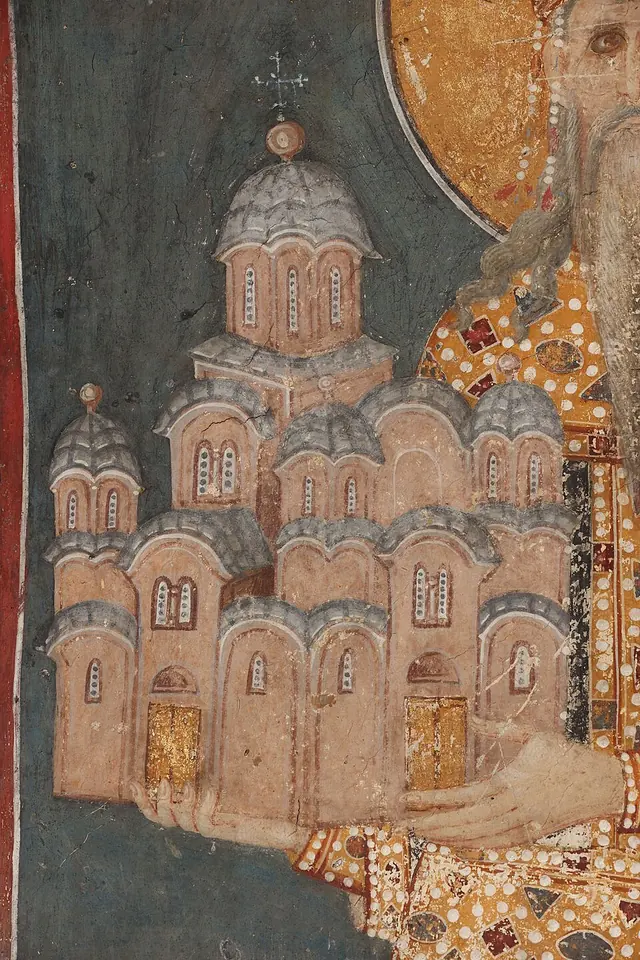
Byzantine and Serbian painters show Milutin as a king in Byzantine imperial dress: a tall crown hung with pendants, a robe covered with pearls and jewels and the gold loros, a long jeweled band wrapped around the body. As a founder (ktetor) he often holds a model of a church, as in his portrait at Gračanica. Because he was painted in his own lifetime, at Gračanica, Prizren and elsewhere, these portraits likely show something of his real face. In the narthex of Gračanica he and his mother appear in monastic dress, a custom for founders who took monastic vows at the end of life or were honored with them after death.

Feast day and prayer
The Orthodox Church keeps the memory of St. Stefan Milutin on October 30, together with his mother St. Helen and his brother St. Dragutin. See the feast day calendar for other saints of October.
The faithful at St. Nedelya sing this short refrain to him, recorded in the cathedral's history (our translation from the Church Slavonic): "Holy God-crowned King Stefan, pray to God for us!" Let us join them, asking St. Stefan Milutin to pray for the peoples of the Balkans, for all who rule, and for every sinner who hopes, as he did, in God's mercy.
Frequently asked questions
Who was St. Stefan Milutin?
King Stefan Uroš II Milutin of Serbia, of the Nemanjić dynasty, younger son of King Stefan Uroš I and grandson of St. Stefan the First-Crowned. He received the throne from his brother St. Dragutin, ruled Serbia for about forty years, defended the Orthodox faith and built more than forty churches and monasteries.
When is the feast of St. Stefan Milutin?
October 30 in the Orthodox calendar, which falls on November 12 on the civil calendar for churches that follow the Julian reckoning.
Where are the relics of St. Stefan Milutin?
In St. Nedelya Cathedral in the center of Sofia, Bulgaria, in a reliquary before the south altar. For this reason the church was long called "Sveti Kral," the Holy King.
What churches did King Milutin build?
The Orthodox life credits him with more than forty churches as well as monasteries and hostels for travelers. The best known include Gračanica in Kosovo, Banjska, where he was first buried, and works at Hilandar on Mount Athos.
Keep exploring
Sources
- Saint Stephen Milutin of Serbia, Orthodox Church in America. His family, reign, the forty churches and his care for Athos, burial at Banjska and the incorrupt relics
- София. Катедралата Света Неделя (Sofia: St. Nedelya Cathedral), Pravoslavieto.com. The journey of the relics from about 1460, the name "Sveti Kral," the reliquary before the south altar, the Tuesday akathist and the custom of leaving clothes by the relics