St. Victorinus of Pettau

St. Victorinus of Pettau was bishop of Poetovio, today Ptuj in Slovenia, in the late 3rd century, and one of the first Latin writers to comment on whole books of the Bible. His Commentary on the Apocalypse is the oldest Latin commentary on Revelation that survives. He died a martyr, probably in 304 under Diocletian. His feast is November 2.
Who was St. Victorinus of Pettau?
St. Victorinus of Pettau was bishop of Poetovio, a Roman garrison town on the Drava River, today Ptuj in Slovenia, in the last decades of the 3rd century. He was one of the first Christians to write commentaries on the Scriptures in Latin, and the one work of his that survives whole, the Commentary on the Apocalypse, is the oldest Latin commentary on the Book of Revelation that has come down to us. He died a martyr, most likely in 304, in the persecution of Diocletian. The Roman Martyrology keeps his memory on November 2.
We know him mostly through St. Jerome, who gave him an honored place in his catalog of Christian writers a lifetime later.

A bishop on the frontier
Poetovio stood where the Latin West met the Greek East, on the great road along the Danube frontier. The Catholic Encyclopedia notes that Victorinus spoke Greek better than Latin, which suggests he came from the East. Jerome said as much, kindly but frankly:
Victorinus, bishop of Pettau, was not equally familiar with Latin and Greek. On this account his works though noble in thought, are inferior in style.
Jerome then lists what he wrote: commentaries on Genesis, Exodus, Leviticus, Isaiah, Ezekiel, Habakkuk, Ecclesiastes, the Song of Songs and the Apocalypse of John, a treatise Against all heresies, "and many others." He closes with one line: "At the last he received the crown of martyrdom."
That line is nearly all we know of his death. The date of 303 or 304 comes from the timing of Diocletian's persecution, and no reliable account of his trial survives. We should be honest about that, and grateful for what we have.

His writings
Most of his work is lost. Two pieces survive: the Commentary on the Apocalypse and a short meditation On the Creation of the World, which may be part of his lost commentary on Genesis. The Catholic Encyclopedia cautions that scholars disagree about how much of these texts is really his, since the commentary came down in more than one form.
The four living creatures
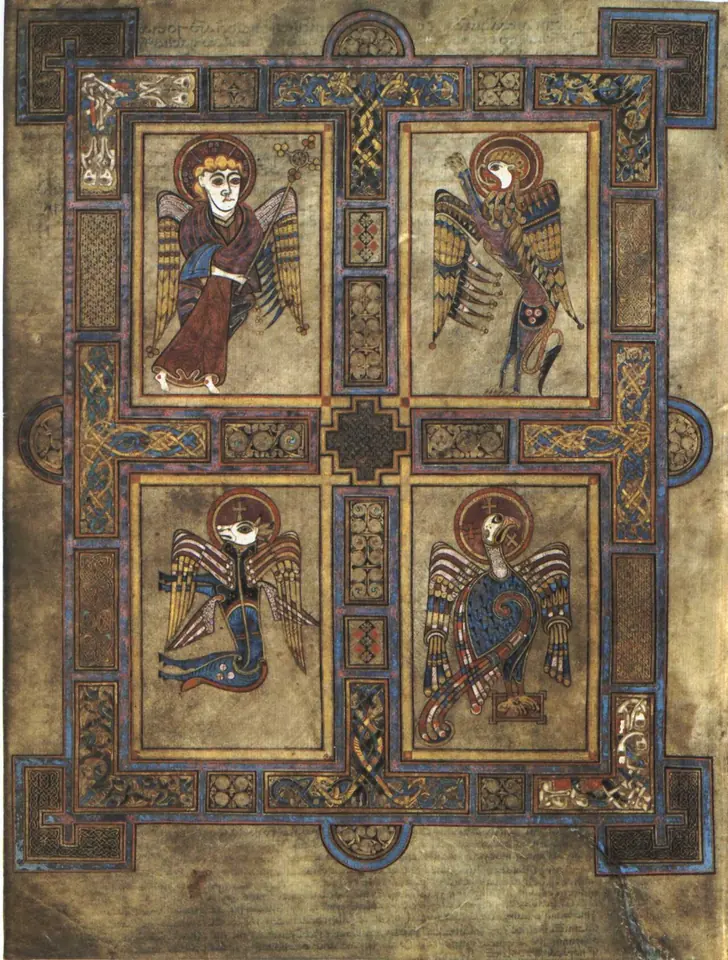
Victorinus's best-known pages explain the four living creatures around God's throne in Revelation 4. He reads them as the four Gospels, each matched to the way its Gospel begins:
The living creature like to a lion designates Mark, in whom is heard the voice of the lion roaring in the desert. And in the figure of a man, Matthew strives to declare to us the genealogy of Mary, from whom Christ took flesh.
Luke, who opens with the priest Zechariah offering sacrifice, is the calf, and John, who soars to the Word of God, is the eagle. "These announcements, although they are four, yet are one," he writes, "because it proceeded from one mouth." St. Jerome later used the same pairing, and it became the one Western art has used ever since for the four evangelists.
The thousand years
Like St. Irenaeus and other early writers, Victorinus expected Christ to reign on earth for a thousand years before the end. The Church did not adopt that reading, and the Catholic Encyclopedia notes that, for this reason, a decree attributed to Pope Gelasius placed his works among those not to be read in church. His holiness and martyrdom were never in question.
His meditation On the Creation of the World is a window onto the prayer of a 3rd-century church. He explains why Christians fasted on Wednesday and Friday, and why they kept the Friday fast strictly, "that on the Lord's day we may go forth to our bread with giving of thanks."

Miracles
No miracles are told of Victorinus, not even traditional ones. No legendary Acts grew up around him as they did around many martyrs. His witness is what he wrote and how he died.
Mistaken identities
For centuries Victorinus was confused with others. His Latin surname, Petavionensis, was misread as Pictaviensis, "of Poitiers," so the old Martyrology made him a French bishop. Until the 17th century he was also mixed up with Marius Victorinus, the Roman rhetorician whose conversion St. Augustine describes in the Confessions. Two poems once printed under his name are not his.
Symbols of St. Victorinus in art
Old images of Victorinus are rare; most are modern and come from Slovenia, where his see stood. He is shown as a bishop. Look for:
- Bishop's vestments: his office as shepherd of Poetovio.
- A book or scroll of the Apocalypse: his commentary on Revelation.
- A pen: one of the first Latin commentators on whole books of the Bible.
- The four living creatures: his reading of them as the four Gospels.
- A martyr's palm: his death in the persecution.
Feast day and prayer
The Roman Martyrology remembers him on November 2. Since that is All Souls' Day, his memory is kept mostly in Slovenia, near his old see. See the feast day calendar for the other saints of November.
We have not found a traditional English prayer to St. Victorinus. Let us ask him to pray for all who study and teach the Scriptures, and for the Church in Slovenia. St. Victorinus of Pettau, pray for us.
Frequently asked questions
Who was St. Victorinus of Pettau?
A bishop of Poetovio (Pettau, now Ptuj in Slovenia) who flourished around 270 to 300. St. Jerome lists his commentaries on many books of the Bible and says he "received the crown of martyrdom." He probably died in 304, in the persecution of Diocletian.
What did Victorinus of Pettau write?
Jerome names commentaries on Genesis, Exodus, Leviticus, Isaiah, Ezekiel, Habakkuk, Ecclesiastes, the Song of Songs, Matthew and the Apocalypse, and a book against all heresies. Only the Commentary on the Apocalypse and a short piece On the Creation of the World survive.
When is the feast of St. Victorinus of Pettau?
November 2 in the Roman Martyrology.
Is Victorinus of Pettau the same as Marius Victorinus?
No. Marius Victorinus was a 4th-century Roman teacher of rhetoric whose conversion St. Augustine describes. The two were confused until the 17th century, and the bishop was also mistaken for a bishop of Poitiers because of his Latin surname.
Keep exploring
Sources
- Catholic Encyclopedia (1912): St. Victorinus. His see at Pettau, the Martyrology entry and the confusion with Poitiers and Victorinus Afer, his Greek, his millenarian views and Pope Gelasius
- St. Jerome, De Viris Illustribus, chapter 74: Victorinus of Pettau. The list of his works and his martyrdom (quoted)
- Victorinus, Commentary on the Apocalypse of the Blessed John (trans. R. E. Wallis). The four living creatures as the four evangelists (quoted)
- Victorinus, On the Creation of the World. The Wednesday and Friday fasts and the Lord's day