St. Arsenios the Cappadocian
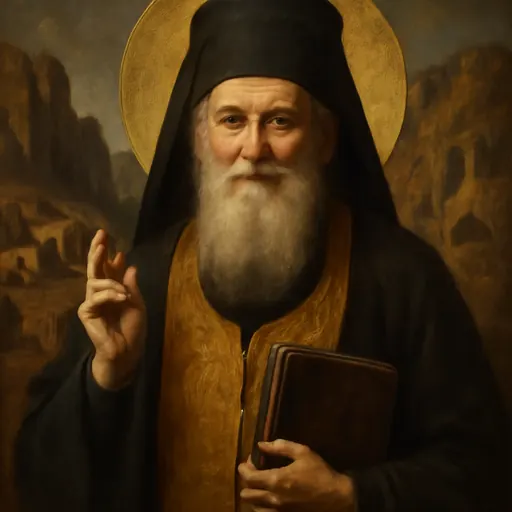
St. Arsenios the Cappadocian (about 1840–1924) was a Greek Orthodox priest-monk who served the village of Pharasa in Cappadocia, in present-day Turkey, for about fifty years as teacher, confessor and healer of Christians and Muslims alike. He baptized the future St. Paisios, led his people to Greece in the 1924 population exchange and died on Corfu. His feast is November 10.
Who was St. Arsenios the Cappadocian?
St. Arsenios the Cappadocian was a Greek priest-monk who spent about fifty years as the pastor of Pharasa, a cluster of six Christian villages hidden in the mountains of Cappadocia, in what is now central Turkey. His people called him Hadjiefendis, a title of respect for a priest who had made the pilgrimage to Jerusalem. He taught their children to read, heard their confessions and prayed over their sick, Christian and Muslim alike. In 1924, when the Greeks of Anatolia were sent to Greece in the exchange of populations, the old man led his flock into exile and died on the island of Corfu forty days after reaching Greece, as he had foretold.
Almost everything we know about him comes from one book: Saint Arsenios the Cappadocian, written by his godson, St. Paisios the Athonite, who spent years collecting the memories of the Pharasiotes who had known him. Paisios wrote down their stories in their own words, naming the witnesses. That gives the life an unusual freshness, and it also means most of the wonders in it are reported: told by eyewitnesses, but never examined by any formal inquiry.
The life of St. Arsenios
An orphan of Pharasa
He was born Theodoros, around 1840, in Pharasa (also called Varasos), the largest of the six villages. His father, Eleftherios Annitsalichos, was a teacher, and his mother was Varvara. Both died when Theodoros and his older brother Vlasios were small, and an aunt raised them.
Paisios records a story the family told. Vlasios once took his little brother across a mountain stream, and the current swept Theodoros away. Vlasios cried out to St. George, whose chapel stood nearby, and suddenly found the boy beside him, safe and happy, saying that a horseman dressed like a monk had pulled him out of the water and carried him to the bank on his horse. From then on Theodoros said he would become a monk. The rescue is traditional, a family memory.
Student, monk and secret teacher
He studied at Niğde and then in Smyrna, where he learned Greek letters and church studies, along with Armenian, Turkish and some French. His aunt tried to arrange a marriage for him. The girl turned him down, saying Theodoros was a fine young man, "but he's a monk!" He left for good the next day.
At about twenty-six he entered the Monastery of the Forerunner at Flaviana (Zincidere), near Caesarea, where he was tonsured and given the name Arsenios. He did not stay long. Metropolitan Paisios II of Caesarea ordained him a deacon and sent him home to teach the children of Pharasa, who had no school.
Teaching Greek drew suspicion from the Ottoman authorities, so Arsenios was careful. He had the children kneel on long-haired goatskins instead of sitting at desks. When outsiders glanced in, they assumed the boys were praying. Sometimes he gathered them in the Chapel of the Mother of God built into a cave high on a cliff.

Priest and pilgrim
Around the age of thirty he was ordained a priest at Caesarea, with the rank of archimandrite and the blessing to hear confessions. He then made a pilgrimage to the Holy Land; Paisios says he went to Jerusalem five times, walking five days each way to the port of Mersin to take the boat. After that the villagers called him Hadjiefendis.
He had rules for himself that the Pharasiotes never forgot. He never rode an animal, saying he was worse than a donkey, so how could he sit on one; he usually walked barefoot and slipped his shoes on only when he met people. He kept total silence and prayer in his cell every Wednesday and Friday. On the great feasts he kept all-night vigils in the outlying chapels, standing from sunset to sunrise.
He also hid his holiness behind a gruff manner. If someone told him he was a saint, he would snap back an insult so the person would stop. He was especially brusque with the women who tried to cook for him, telling his chanter Prodromos that if he had wanted women to serve him, he would have married and become a parish priest. His smiling eyes, the villagers said, usually gave him away.
The miracles of St. Arsenios
Paisios gathered dozens of accounts from people who had lived in Pharasa, each with the witness named. They are reported miracles: eyewitness testimony, never formally investigated. The Orthodox Church glorified Arsenios in 1986 on the strength of his life and the wonders reported at his relics.
- Healing by prayer and the Gospel. There was no doctor in Pharasa, Paisios writes, "except Father Arsenios himself." He read a prayer suited to each illness, and when none existed he used the Psalms. For the blind, the mute, the paralyzed and the possessed he read the Gospel. Witnesses told of a paralyzed Turkish woman carried to him in a blanket, a woman cured of leprosy and a mute Turkish man who began to speak before Arsenios had finished reading.
- "Our faith is not for sale." He never accepted money for his prayers and would not even touch it.
- The soil from his threshold. On Wednesdays and Fridays, when he would not open his door, the sick took earth from his doorstep and rubbed it on the afflicted part. A blind Muslim woman named Fatma, told to do the same, began to see dimly and then pounded on his door; he read the Gospel over her and her sight returned fully. When she fell at his feet, he told her to bow down to Christ, who had given her the light, and not to him.
- The fall from the cliff. After a Liturgy in the cave chapel, a plank of the wooden balcony gave way and he fell into the ravine. A farmer ran to gather his body and found him unhurt. Arsenios said that as he fell a Woman had caught him in her arms like a child and set him down. This is a reported account from the villagers.
- Prophecies. He told the Pharasiotes years in advance that they would leave for Greece, and that he would live only forty days there.
Since the translation of his relics to Souroti in 1970, many healings have been reported there, according to the monastery's tradition, as at Pantanassa in Australia, which received a portion in 1983.
Exile, the baptism of Paisios and death on Corfu
The 1923 Treaty of Lausanne sent the Orthodox Christians of Turkey to Greece. The Synaxarion dates the departure of the Pharasiotes to August 14, 1924. Just before they left, the Eznepidis family brought their son, born on July 25, to be baptized. The godfather wanted to name him Christos after his grandfather, but Arsenios refused, as the Orthodox Church in America's life of St. Paisios records: "Not so! He shall be called Arsenios. You shall have many other children, but I am a monk; I will have no children. I want him to be a reminder of me." That baby became St. Paisios the Athonite.
The old priest, now past eighty, set out with his people on the long road across Anatolia to the sea. The refugees from Pharasa were taken by ship to Greece and settled for a time on Corfu.
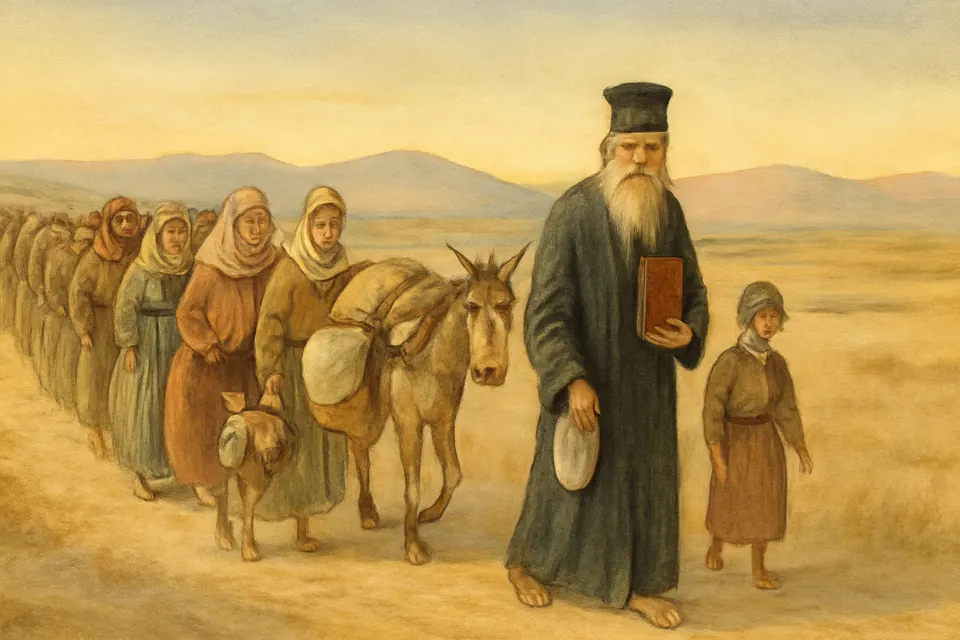

He was worn out. The Synaxarion says that three days before his death the Mother of God appeared to him, showed him the monasteries of Mount Athos that he had always longed to see, and told him that in three days he would stand before the Lord; this is traditional. The Pantanassa Monastery records his last words: "The soul, the soul, take care of it more than the flesh, which will return to earth and be eaten by worms!" He died on November 10, 1924, on Corfu, the island of St. Spyridon.
His relics and his glorification
Arsenios's godson never forgot him. In 1958 the monk Paisios went to Corfu, took up his relics and brought them to Konitsa, in Epirus, where his own family had settled. In 1970 he moved them again, to the women's monastery of St. John the Theologian at Souroti, near Thessaloniki. The Ecumenical Patriarchate glorified Arsenios as a saint on February 11, 1986.

Paisios himself was buried at Souroti in 1994, beside his godfather, and pilgrims who come to pray at the tomb of one now pray before the relics of the other.

Where the relics of St. Arsenios the Cappadocian are kept: see them on the relics map →
Why St. Arsenios is invoked for the sick
His whole ministry in Pharasa was prayer over the sick, so the faithful naturally ask his intercession in illness. The Pantanassa Monastery, which keeps part of his relics, writes that his relic "has also been known to heal those who have cancer and to grant children to infertile couples." Many Greek families bring their sick to Souroti on his feast. We ask him to pray for us as his people did, trusting, as he insisted, that the healing comes from Christ.
Symbols of St. Arsenios in art
Arsenios is a modern saint, so his icons follow the memory of people who knew him rather than an old artistic tradition. Look for:
- An old, thin priest-monk with a long white beard, often with a gentle smile in the eyes, as the Pharasiotes remembered him.
- The black monastic habit and kalimavkion with a veil, showing he was a monk.
- A priest's stole (epitrachelion), sometimes in a checkered pattern: he served as a priest and confessor.
- A Gospel book, often held to his chest, because he read the Gospel over the gravely ill.
- A hand raised in blessing.
- The rocky village of Pharasa with its cliff chapels, painted at his feet in many Greek icons, and sometimes the monastery at Souroti.
He often appears with St. Paisios, and at Souroti he stands among the monastery's patron saints with St. John the Theologian.
Feast day and prayer
The Orthodox Church keeps his feast on November 10, the day of his repose. The great celebration is at Souroti, with a vigil and Divine Liturgy beside his relics. You can find other saints of the season on our feast days page.
The Church sings a troparion and full service in his honor, composed for his glorification. We have not printed a translation here, since none we could verify is in the public domain. No special formula is needed to ask his help. Orthodox Christians simply say, as they do to every saint, "Holy Father Arsenios, pray to God for us," and bring their sick before Christ, who heals.
Frequently asked questions
When is the feast of St. Arsenios the Cappadocian?
November 10, the day he died on Corfu in 1924. The Ecumenical Patriarchate glorified him as a saint on February 11, 1986, and Greek Orthodox parishes and monasteries keep his feast with a vigil and the Divine Liturgy, especially at Souroti, where his relics rest.
Where are the relics of St. Arsenios?
At the Monastery of St. John the Theologian in Souroti, about 13 miles southeast of Thessaloniki, Greece. St. Paisios brought them from Corfu to Konitsa in 1958 and to Souroti in 1970. In 1983 he sent a portion to the Pantanassa Monastery in Australia.
What is St. Arsenios the Cappadocian known for?
For healing the sick by reading prayers, Psalms and the Gospel over them, without ever accepting money; for teaching the children of Pharasa in secret; for foretelling the departure of his people for Greece and his own death; and for baptizing St. Paisios the Athonite and giving him his name.
What is St. Arsenios invoked for?
Orthodox faithful ask his prayers above all for the sick. The Pantanassa Monastery, which keeps a relic, notes that his relic is known for healing people with cancer and for granting children to couples unable to conceive.
What was the relationship between St. Arsenios and St. Paisios?
Arsenios was the parish priest of Pharasa and the spiritual father of the Eznepidis family. In August 1924, days before the village left for Greece, he baptized their newborn son and insisted on naming him Arsenios after himself, saying he wanted to leave a monk behind him. That child became St. Paisios the Athonite, who wrote the life of his godfather and cared for his relics.
Keep exploring
- Patron saint pages
- HealingCancerFertility
- Feast-day calendar
- Saints remembered in NovemberSaint of the dayWhat saint is my birthday?
- Relics
- Where the relics are kept (map)
- More
- Saints A to ZPatron saints A to ZExplore every section
Sources
- Elder Paisios of Mount Athos, Saint Arsenios the Cappadocian, excerpts part 1 (Pemptousia). His family, the rescue from the torrent, his studies, the secret school, his healings and "Our faith is not for sale"
- Elder Paisios of Mount Athos, Saint Arsenios the Cappadocian, excerpts part 2 (Pemptousia). His Wednesday and Friday seclusion, the soil from his threshold, his feigned sternness and his five pilgrimages to Jerusalem on foot
- Orthodox Synaxarion (saint.gr): Όσιος Αρσένιος ο Καππαδόκης. Departure on August 14, 1924; the fall from the cliff chapel; translation of the relics in 1958 and 1970; glorification on February 11, 1986
- Pantanassa Monastery: Who is our Venerable Father Arsenios of Cappadocia, the Wonderworker?. His prophecy of forty days in Greece, his last words, the relic sent to Pantanassa in 1983
- Orthodox Church in America: Venerable Paisios of the Holy Mountain. The baptism of Paisios and Arsenios's words about naming him