St. Nuno Álvares Pereira (St. Nuno of St. Mary), the Holy Constable of Portugal
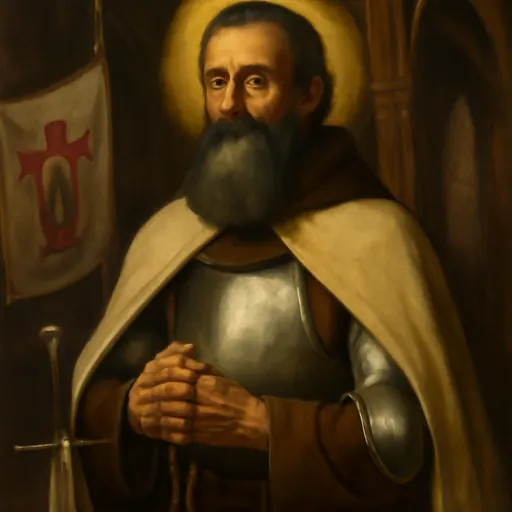
St. Nuno Álvares Pereira (1360–1431) was the constable of Portugal whose victory at Aljubarrota in 1385 secured the kingdom's independence. He gave away his wealth, entered the Carmelite convent he had built in Lisbon as a lay brother, and served the poor until his death. Benedict XVI canonized him in 2009. His feast is November 6.
Who was St. Nuno Álvares Pereira?
St. Nuno Álvares Pereira was the great soldier of medieval Portugal who became a humble Carmelite brother. As constable, commander-in-chief of the army of King John I, he won the Battle of Aljubarrota in 1385 and with it the kingdom's independence from Castile. Then he gave nearly everything away, entered the Carmelite convent he had built in Lisbon and spent his last years as Brother Nuno of St. Mary, the lowest of the lay brothers, feeding the poor at the door.
The Portuguese have called him the Santo Condestável, the Holy Constable, since the day he died. Pope Benedict XVI canonized him on April 26, 2009, and offered him "to the whole Church" as proof "that in any situation, even military or in war time, it is possible to act and to put into practice the values and principles of Christian life."

The life of St. Nuno Álvares Pereira
Knight and husband
Nuno was born on June 24, 1360, most probably at Cernache do Bonjardim. He was the son of Álvaro Gonçalves Pereira, a knight and prior of the Hospitallers, and Iria Gonçalves do Carvalhal. A royal decree soon made him legitimate, so he could be raised as a knight. At thirteen he became a page of Queen Leonor, and at sixteen, at his father's wish, he married a rich young widow, Leonor de Alvim. Of their three children only a daughter, Beatriz, lived; she married Afonso, the first Duke of Bragança, and from her descend the later kings of Portugal.
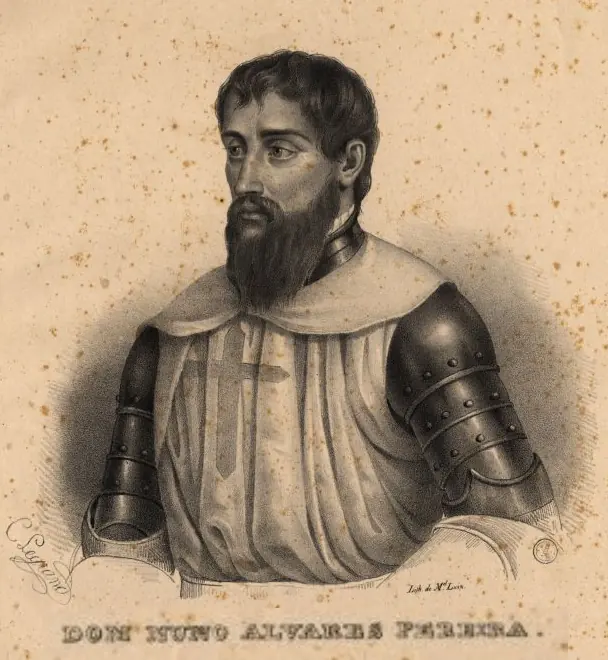
The constable of Aljubarrota
When King Ferdinand died without a son in 1383, the King of Castile claimed the throne through his marriage to Ferdinand's daughter. Nuno backed John, Master of Aviz, who made him constable. He won battle after battle, ending at Aljubarrota on August 14, 1385. The Holy See's biography says his "military capabilities were tempered by a deep spirituality, a profound love of the Eucharist and of the Blessed Virgin." He fasted in Mary's honor on Wednesdays, Fridays and Saturdays and on the eve of her feasts. His banner bore the cross, the Virgin, and the knight saints James and George. Benedict XVI noted that he "publicly attributed his victories" to Our Lady.
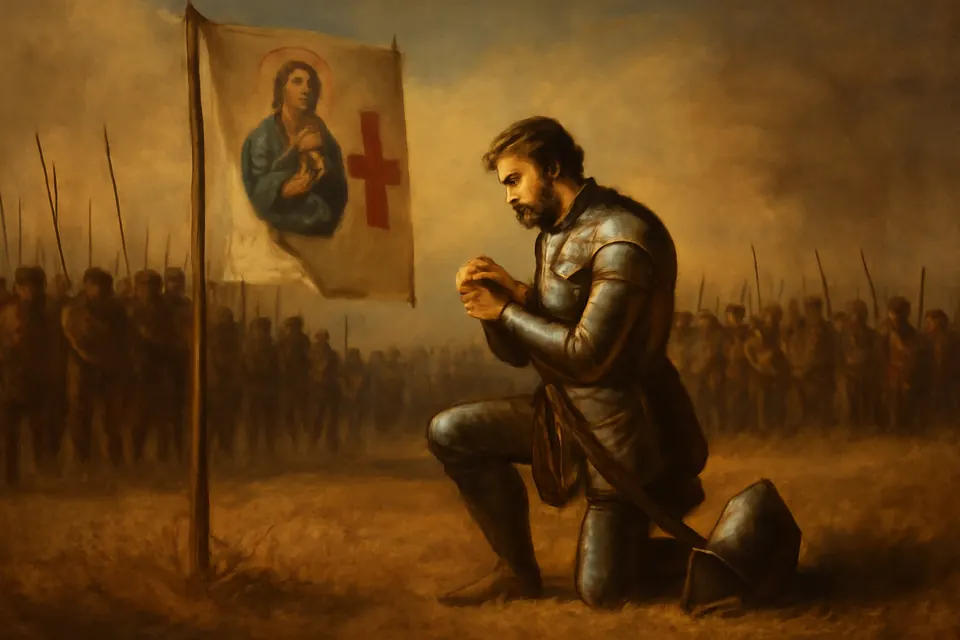
Tradition tells that at the Battle of Valverde, a few weeks later, he was found kneeling among the rocks in prayer while the fighting went on, and rose to lead the charge. The scene became a favorite of Portuguese illustrators.

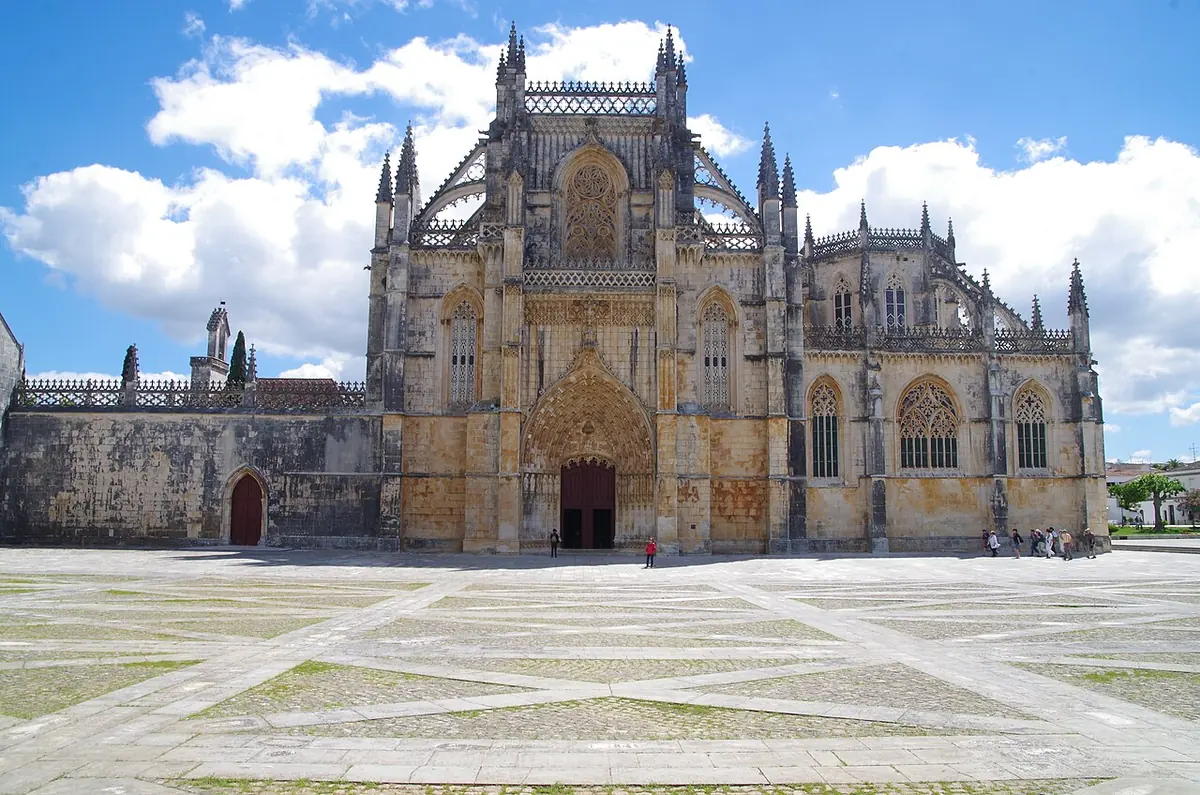
With his own money he built churches and monasteries, among them the Carmelite church in Lisbon. The Holy See's biography also credits him with a church of Our Lady of Victories at Batalha, where King John raised his great monastery in thanksgiving for Aljubarrota.
Brother Nuno of St. Mary
His wife died in 1387 and he never remarried. When peace came he gave most of his estates to his veterans. In 1423 he entered the Carmo convent in Lisbon, took the name Brother Nuno of St. Mary and refused every privilege, asking to be a simple lay brother. He wished to go far away from Portugal, but the king's son, Prince Duarte, would not allow it. Every day he organized the giving of food to the poor of Lisbon.
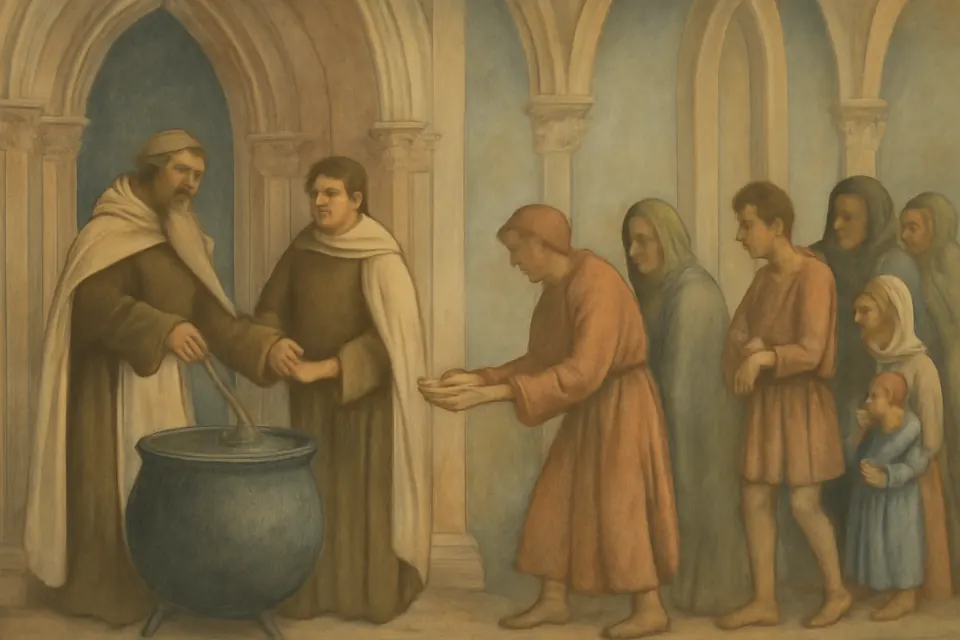
He died on April 1, 1431, which was Easter Sunday, and the crowds at once acclaimed him a saint.
The miracles of St. Nuno Álvares Pereira
The miracle approved for his canonization was the healing of Guilhermina de Jesus, a woman in her sixties from Vila Franca de Xira. Boiling oil splashed into her left eye while she was frying fish, leaving what Cardinal José Saraiva Martins called "an ulcer on the cornea, a very serious thing." After she and her family asked Blessed Nuno's intercession, the eye healed. Vatican doctors examined the case in April 2008 and theologians in May, and Benedict XVI approved the decree on July 3, 2008. The healing took place in 2000, according to the Holy See's biography.
St. Nuno, a model for soldiers
He has no formal patronage, but the Church holds him up as a model for those in military service: a professional soldier who never let war crowd out prayer. The Holy See's biography says he left behind "the weapons of war and power in order to be vested in spiritual armor as the Rule of Carmel recommends."
Symbols of St. Nuno Álvares Pereira in art
Older art shows him as a knight: armor, sword and his banner with the cross and the Virgin. Since his beatification he is more often painted in the brown Carmelite habit and white mantle, sometimes over his armor, with a rosary or a bowl for the poor, to show the two halves of his life. His statue on top of the colonnade at Fátima shows him as a Carmelite.
Feast day, tomb and shrines
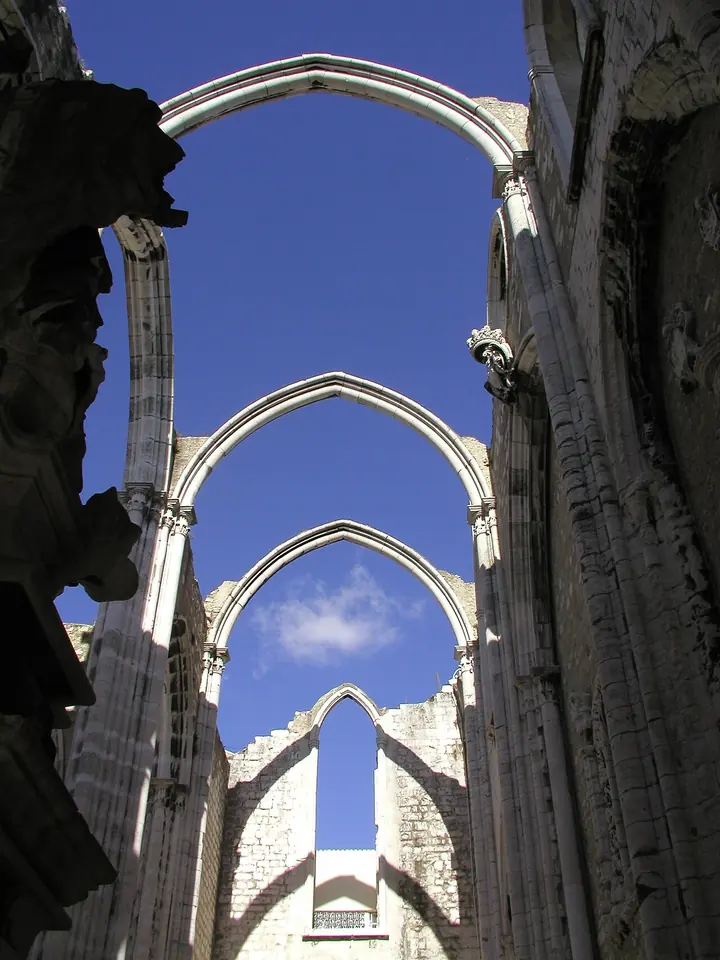
His feast is November 6. Benedict XV confirmed his ancient cult in 1918 with the decree Clementissimus Deus. His relics have a sad history: they were moved many times, and the silver reliquary was stolen after 1961 and never found. In 1996 the site of his original tomb was found in the ruined Carmo church in Lisbon, with some authenticated bone fragments. Lisbon also has the twentieth-century Church of the Holy Constable in Campo de Ourique. Fátima keeps a legend that he once prayed near the Cova da Iria on his way to Aljubarrota. See more November saints on our feast days page.
Praying with St. Nuno
We know of no traditional English prayer to him that we can cite. Let us pray as he did, with Our Lady: St. Nuno of St. Mary, you served your country with courage and the poor with humility; pray for all who serve in the armed forces, for all who hold power, and for us, that we may put God first in whatever work is given us.
Frequently asked questions
Who was St. Nuno Álvares Pereira?
The commander-in-chief of Portugal under King John I, victor at Aljubarrota in 1385, who in 1423 gave up his titles to become a Carmelite lay brother in Lisbon. The Portuguese call him the Santo Condestável, the Holy Constable.
When is the feast of St. Nuno Álvares Pereira?
November 6, in Portugal and in the Carmelite Order.
What was the miracle for St. Nuno's canonization?
The healing of Guilhermina de Jesus, a woman from Vila Franca de Xira whose left eye was badly burned by boiling oil while she was frying fish. After her family prayed to Blessed Nuno, the eye healed in a way doctors could not explain. Benedict XVI approved the miracle on July 3, 2008.
When was Nuno Álvares Pereira canonized?
On April 26, 2009, in St. Peter's Square, by Pope Benedict XVI, with four other saints. Benedict XV had confirmed his cult as Blessed in 1918.
Keep exploring
Sources
- Nuno de Santa Maria Álvares Pereira (1360-1431), Biography (Holy See). His birth, banner, fasts in Mary's honor, entry into Carmel in 1423, death on Easter Sunday 1431, the 1918 decree, the lost reliquary and the 1996 discovery of his tomb
- Benedict XVI, Homily at the canonization of five new saints (April 26, 2009). Quoted in the article
- Nuno Álvares Pereira canonizado a 26 de Abril (RTP / Lusa, February 21, 2009). The healing of Guilhermina de Jesus and how the cause was examined in 2008 (in Portuguese)
- O santo guerreiro que era devoto de Nossa Senhora (Santuário de Fátima, November 6, 2024). His statue on the Fátima colonnade and the legend that he prayed at the Cova da Iria (in Portuguese)