St. Hugh of Lincoln: Carthusian Monk, Bishop and Friend of the Swan
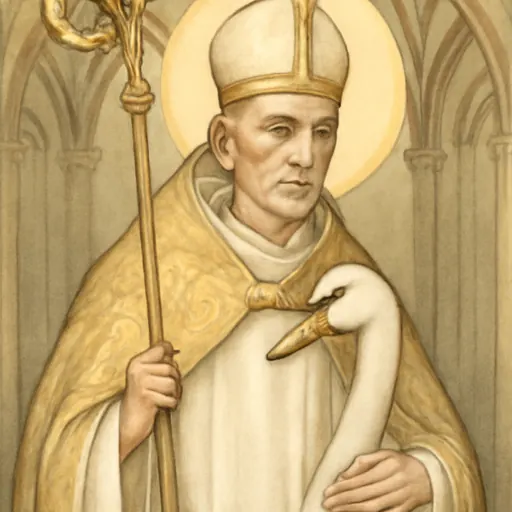
St. Hugh of Lincoln (Hugh of Avalon, about 1135–1200) was a Burgundian Carthusian monk who became bishop of Lincoln in England in 1186. He rebuilt Lincoln Cathedral, cared for lepers with his own hands, protected the Jews of his diocese and stood up to three kings. A wild swan at his manor of Stow became his inseparable companion. His feast day is November 17, and he is a patron of sick children.
Who was St. Hugh of Lincoln?
St. Hugh of Lincoln, also called Hugh of Avalon, was a Carthusian monk from Burgundy who became bishop of Lincoln, the largest diocese in medieval England, from 1186 until his death in 1200. He was a man of prayer who loved silence, yet he faced down Henry II, Richard the Lionheart and King John, and won the affection of all three. He nursed lepers, defended the Jews of Lincoln against mobs, confirmed village children until midnight, and rebuilt his cathedral after an earthquake. And a wild swan adopted him.
We know him unusually well. His chaplain, the Benedictine monk Adam of Eynsham, lived with him for his last years and wrote the long Magna Vita (Great Life) soon after his death, and the gossipy Gerald of Wales wrote another. The Catholic Encyclopedia draws on both, as does George Perry's 1879 biography, which quotes them at length.
He is not to be confused with St. Hugh of Grenoble, the bishop who welcomed St. Bruno to the Chartreuse, or with "Little St. Hugh," a boy whose death in 1255 was falsely blamed on Lincoln's Jews and who was never canonized.

The life of St. Hugh
A boy in a priory, a monk at the Chartreuse
Hugh was born around 1135–1140 at the castle of Avalon, near Pontcharra in Burgundy. His mother died while he was small, and his father, William, entered the Augustinian priory of Villard-Benoît near Grenoble and took the boy with him. Hugh grew up among canons, became one of them, and was made a deacon at nineteen.
A visit to the Grande Chartreuse, the mother house of the silent, hermit-like Carthusians founded by St. Bruno, changed him. His prior made him promise not to leave, but Hugh came to see the promise as rash and not binding, and entered the Chartreuse as a novice. He was ordained a priest there and served for years as procurator, the monk who handles the monastery's dealings with the outside world.
Prior of Witham
After the murder of St. Thomas Becket, Henry II had promised to go on crusade, and founded instead the first Carthusian house in England, at Witham in Somerset. It went badly: the monks had no buildings, and two priors gave up. Henry asked for Hugh, who arrived around 1180. Hugh insisted that the king pay full compensation to the tenants who had to be moved off the land, and then pestered him until the charterhouse was finished.
Henry came to love him and to listen to him, though Hugh rebuked him to his face for keeping bishoprics vacant so he could pocket their income.
Bishop of Lincoln
In 1186 the canons of Lincoln, who had been without a bishop for years, chose Hugh at the king's wish. Hugh refused because the election had not been free. They elected him again, properly, at Lincoln, and he still refused until his own superior at the Grande Chartreuse ordered him to accept. He was consecrated on September 21, 1186.
He at once excommunicated the king's chief forester for abusing the poor under the harsh forest laws, and refused a canon's stall to a courtier Henry had recommended. The king summoned him to Woodstock. Perry tells what happened, from the Magna Vita: Henry and his courtiers sat in a circle on the grass and ignored him. Hugh moved a nobleman aside and sat down by the king. Henry, to fill the silence, called for a needle and thread and began stitching a bandage on his finger. Hugh watched, then said quietly, "How like you are now to your kinsfolk of Falaise." William the Conqueror's mother came from Falaise, a town known for leatherwork. Henry bent his head to the ground and burst out laughing, explained the joke to his baffled courtiers, and made peace.

A builder and a pastor
An earthquake had wrecked Lincoln Cathedral in 1185. Hugh began rebuilding it, and the Catholic Encyclopedia credits him with the choir, one of the earliest works of the English Gothic style. He rarely left his diocese, knew his priests, visited parishes and chose pastors with care.
He would get down from his horse to confirm children at the roadside, which many bishops did not bother to do. Perry tells of a day spent consecrating churches and confirming, when a new band of children came trooping in at dusk; Hugh, still fasting, confirmed them until midnight. Babies smiled and reached for him, and he loved them back.
He went into the leper houses himself, washed the sick, ate from the same dish with them and kissed them. When his chancellor remarked, at Newark, that St. Martin had healed the leper he kissed, Hugh answered, as Gerald of Wales records: "Martin by his kiss brought bodily health to the leper, but the leper by his kiss brings to me the health of the soul."
Friend of the Jews in a dangerous time
When Richard I was crowned in 1189, mobs attacked Jewish communities across England. The Catholic Encyclopedia says Hugh worked to protect the Jews, many of whom lived in Lincoln, and put down violence against them in several places. At his funeral, Perry notes, the Jews of Lincoln were among the most conspicuous mourners.
Standing up to Richard and John
In 1197 or 1198, at a council in Oxford, Hugh refused to grant Richard money and knights for his wars in France, arguing that his church owed no such service abroad. Richard ordered his goods seized; no one dared touch them. Hugh crossed to Normandy, found the king at Château-Gaillard, and won him over, then rebuked him for his infidelity to his wife. "Truly," Richard told his court, "if all the prelates of the Church were like him, there is not a king in Christendom who would dare to raise his head in the presence of a bishop."
The swan of Stow
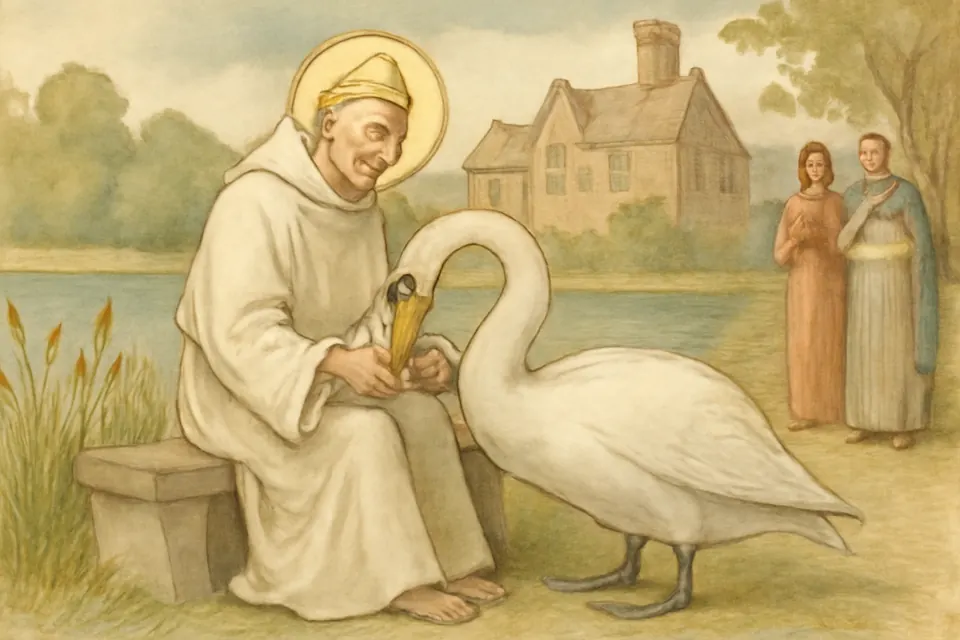
On the day Hugh was enthroned at Lincoln, Gerald of Wales writes, a huge swan appeared on the lake at the bishop's manor of Stow. It killed the other swans except one female, and it was bigger than any swan anyone had seen, with a straight yellow bill. Brought to Hugh, it ate from his hand. It would push its head and long neck into his wide sleeve and "seem to mutter as though holding a friendly conversation with its master." It knew when he was coming home. It followed him upstairs to his room, and when he slept it let no one pass his bed. To everyone else it was a terror.
The Magna Vita, by a man who lived in the household, adds that on Hugh's last visit to Stow, in the spring of 1200, the swan hid in the reeds and would not come to him, and when it was caught it hung its head like a sick creature. Six months later Hugh was dead.
The relic at Fécamp
One story about Hugh is so odd that his biographers could not leave it out. At the abbey of Fécamp in Normandy, the monks showed him an arm bone of St. Mary Magdalene, wrapped in silk that no one had ever opened. Perry, following the Magna Vita, says Hugh borrowed a knife from one of his men, cut the wrappings, put the bone to his mouth and bit off a fragment, which he handed to his chaplain to keep. The monks were scandalized; Hugh calmly explained himself and kept the relic. His Victorian biographer disapproved. It is still a glimpse of a fierce, single-minded love for the saints.
A holy death
Returning from a visit to the Grande Chartreuse in 1200, Hugh fell ill with fever and was carried to the bishop of Lincoln's house at the Old Temple in London. He asked his monks to spread blessed ashes on the floor in the shape of a cross and to lay him on them when his end was near. On the evening of Thursday, November 16, 1200, during Compline, he signed that it was time. They laid him on the ashes, and as the choir began the Nunc dimittis, "Now thou dost dismiss thy servant, O Lord," he died.
His body was carried to Lincoln. King John helped carry the coffin into the cathedral.
The miracles of St. Hugh of Lincoln
Hugh distrusted people who chased after miracles, and he rarely spoke of his own. The stories gathered around him anyway.
- Healings at his tomb (approved). Pope Honorius III sent a commission in 1219 to investigate the miracles reported at his grave in Lincoln. On their report he canonized Hugh on February 17, 1220, with a bull that called the miracles too numerous to list.
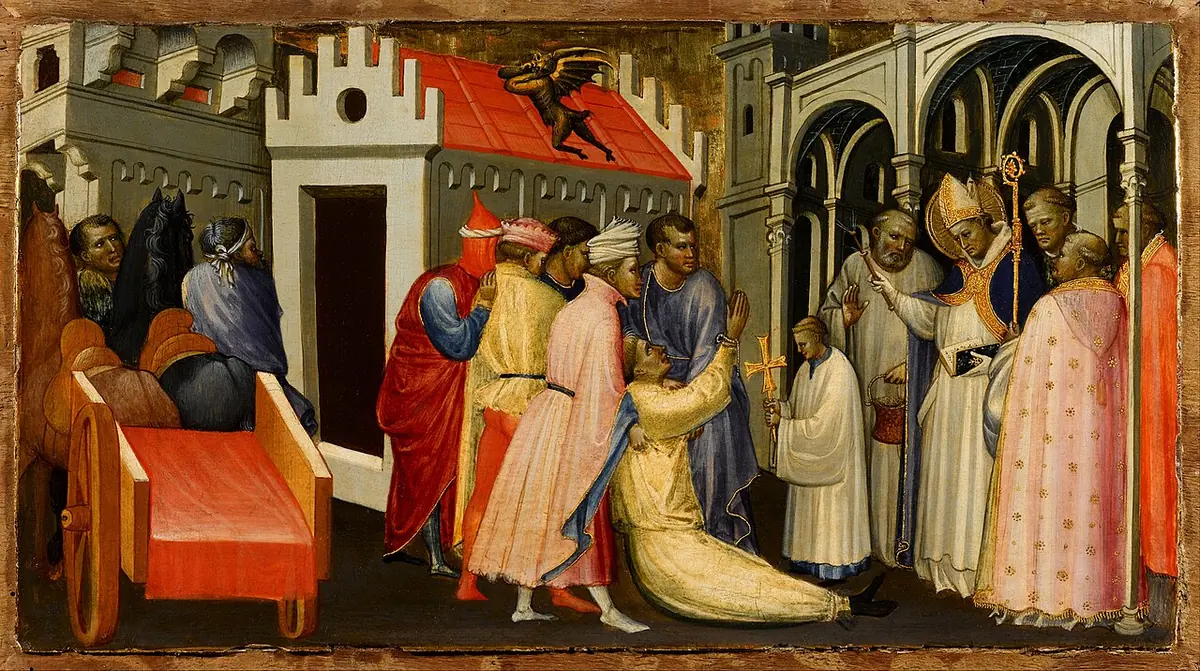
- Deliverance of the possessed and healings in his lifetime (reported), in the Lives. Gherardo Starnina's panel below shows one.
- The swan (reported), by two eyewitnesses, Gerald of Wales and Adam of Eynsham. Gerald wrote that it was "manifestly sent to him for a sign."
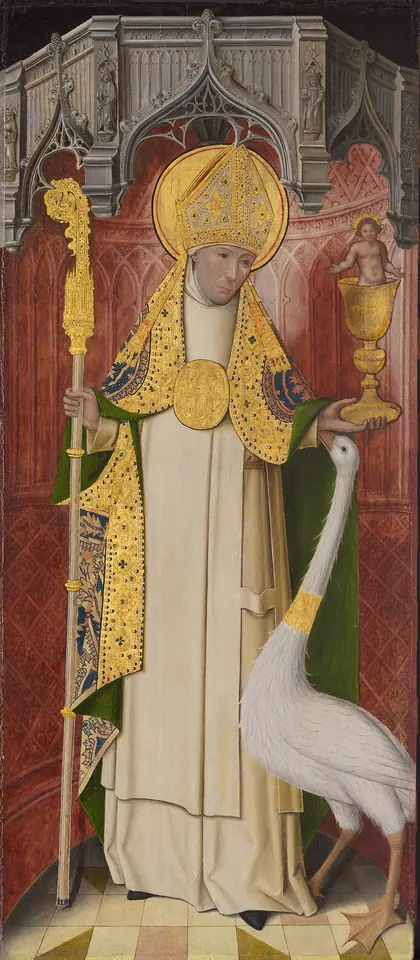
- The Christ Child in the chalice (traditional). Later Carthusian art shows the Infant appearing in Hugh's chalice at Mass, a sign of his devotion to the Eucharist.
Why St. Hugh is a patron of sick children
Hugh's love of children was famous in his lifetime. After his death, according to the Diocese of Nottingham, a picture of him in the charterhouse of Paris became a place of pilgrimage for mothers and sick children. He is also patron of the Diocese of Nottingham, which was formed partly from the old Diocese of Lincoln, and of the city of Lincoln, and because of the swan he is linked with swans and birds. See more on our patron saints page.

Symbols of St. Hugh of Lincoln in art
Hugh is easy to spot once you know what to look for:
- A white swan at his side, often pressing against him or looking up at him. It is his surest sign.
- A white Carthusian habit, sometimes under a bishop's cope, because he remained a monk all his life.
- A miter and crozier, for the bishop of Lincoln.
- A chalice with the Christ Child, in Carthusian art especially, as in the Zurbarán and the Thuison panel.
- A model of a cathedral, now and then, for the builder of Lincoln.
Most of the great paintings of him come from Carthusian houses in Spain, France, Italy and Flanders, since the order counts him second only to St. Bruno. In England you will meet him mostly in Victorian stained glass and statues, nearly always with the swan.
Feast day, shrine and pilgrimage
We keep his feast on November 17, the date Honorius III's bull gave. You can find his neighbors on our feast days page.
In 1280 Hugh's body was moved with great ceremony, in the presence of Edward I, to a gold shrine in the new Angel Choir built east of his own choir. Lincoln became the greatest place of pilgrimage in the north of England. His head was kept in its own shrine nearby. Around 1364 thieves stole it for its jewels; Perry records that it was found in a field, guarded by a raven, and set in a new reliquary. Henry VIII's commissioners stripped the shrines in 1540, and no one knows what became of the relics.

The stone base of the head shrine still stands in the cathedral.

The great charterhouse of Parkminster in West Sussex, built in the 1880s, is dedicated to him and keeps his white linen stole.

Prayer to St. Hugh of Lincoln
There is no single traditional prayer to St. Hugh in wide use. We ask his help for sick children, for bishops and priests, for courage before the powerful, and for a peaceful death.
The prayer Hugh himself died with is the Canticle of Simeon, which the Church sings every night at Compline. In the Douay-Rheims translation (Luke 2:29–32):
Now thou dost dismiss thy servant, O Lord, according to thy word in peace; because my eyes have seen thy salvation, which thou hast prepared before the face of all peoples: a light to the revelation of the Gentiles, and the glory of thy people Israel.
St. Hugh of Lincoln, friend of children, of lepers and of the poor, pray for us.
Frequently asked questions
Why is St. Hugh of Lincoln shown with a swan?
Soon after he became bishop in 1186, a huge wild swan appeared on the lake at his manor of Stow, near Lincoln. It would eat bread from his hand, put its head into his sleeve and follow him up the stairs, but it drove everyone else away and guarded him while he slept. Gerald of Wales and Hugh's chaplain Adam of Eynsham both saw it and wrote about it. The swan became his emblem.
When is St. Hugh of Lincoln's feast day?
November 17. He died on the evening of November 16, 1200, and Pope Honorius III's canonization bull of 1220 set November 17 as his feast. It is kept on that day in England and Wales, by the Carthusians, and in the Roman Martyrology.
What is St. Hugh of Lincoln the patron saint of?
He is patron of the Diocese of Nottingham, which was carved partly out of his old diocese, and of the city of Lincoln. He is invoked for sick children: a picture of him in the Paris charterhouse became a place of pilgrimage for mothers with sick children. Because of his swan, he is also linked with swans and birds.
Is St. Hugh of Lincoln the same as "Little St. Hugh"?
No. Little Hugh was a boy whose death in Lincoln in 1255 was falsely blamed on the city's Jews; he was never canonized, and the story is a medieval libel. The Carthusian bishop St. Hugh died fifty-five years earlier and is remembered for protecting the Jews of Lincoln. He is also distinct from St. Hugh of Grenoble, another bishop connected with the Carthusians.
Where are St. Hugh of Lincoln's relics?
His body was moved in 1280 to a gold shrine in the Angel Choir of Lincoln Cathedral, which was stripped under Henry VIII; what became of the bones is unknown. The base of his head shrine survives in the cathedral, and his white linen stole is kept at St. Hugh's Charterhouse, Parkminster, in West Sussex.
Keep exploring
- Appears in
- Saint names for boys
- Feast-day calendar
- Saints remembered in NovemberSaint of the day
- More
- Saints A to ZPatron saints A to ZExplore every section
Sources
- Catholic Encyclopedia (1910): St. Hugh of Lincoln
- George G. Perry, The Life of St. Hugh of Avalon, Bishop of Lincoln (1879). Quotes the Magna Vita and Gerald of Wales on the swan, the lepers, Woodstock, Fécamp, his death, the 1220 bulls and the theft of his head
- Diocese of Nottingham: St. Hugh of Lincoln, Patron of the Diocese of Nottingham