Blessed Rupert Mayer, the Apostle of Munich
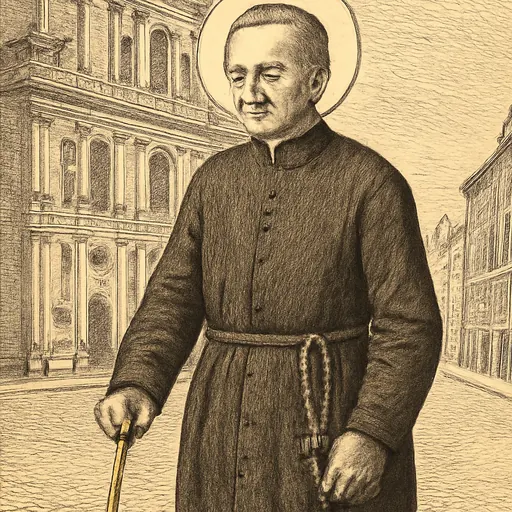
Blessed Rupert Mayer (1876–1945) was a German Jesuit priest, the "Apostle of Munich." He lost a leg as a chaplain in World War I, then served Munich's poor and preached so boldly against Nazism that the Gestapo banned him from speaking and jailed him three times. Pope John Paul II beatified him in 1987; his memorial is November 3.
Who was Blessed Rupert Mayer?
Blessed Rupert Mayer was a German Jesuit priest who spent most of his ministry in Munich, where people still call him the "Apostle of Munich." He was a wounded war chaplain, a tireless helper of the poor, and the priest who would not stop preaching when the Nazi state ordered him to be silent. He died on All Saints' Day 1945, a few months after the war ended, and Pope John Paul II beatified him in 1987. We keep his memorial on November 3.
He is often searched for as "St. Rupert Mayer," but the Church has declared him Blessed. His cause for canonization continues.
A Swabian priest becomes a Jesuit
Rupert Mayer was born in Stuttgart on January 23, 1876, the son of a merchant, and grew up with five brothers and sisters. After studying theology at Fribourg, Munich and Tübingen, he was ordained a priest for the Diocese of Rottenburg on May 2, 1899, and served as a curate in Spaichingen.
A year later, on October 1, 1900, he entered the Society of Jesus at Feldkirch in Austria. It was a costly choice: the Jesuits were banned in the German Empire at the time, and John Paul II recalled in his beatification homily that they were treated as "enemies of the Reich." After his studies in the Netherlands, Fr. Mayer spent five years preaching parish missions in Germany, Austria, Switzerland and the Netherlands.
Munich, the war and the lost leg
In January 1912 his superiors sent him to Munich as pastor to the Catholic newcomers who were moving to the city. In 1914 he helped found the Sisters of the Holy Family there to support Christian families.
When World War I broke out he volunteered as a chaplain, first in a field hospital and then as a division chaplain in Alsace, Galicia and Romania, and he received several military decorations. On December 30, 1916, he was badly wounded in the Sulta valley in Romania, and on January 23, 1917, his forty-first birthday, his left leg was amputated. For the rest of his life he walked on an artificial leg.
Father of the poor
Back in Munich he became, in 1921, the leader of the Marian Men's Congregation at the Bürgersaal, a large lay sodality, and the Jesuits returned to St. Michael's Church, where he preached and heard confessions. John Paul II said that sixty or seventy people in need knocked at his door every day, and that the poor called him their "fifteenth Holy Helper." In 1925 he began Sunday Masses at Munich's railway station.

He was not naive about the people he helped. The Pope quoted him at the beatification (our translation): "Whoever has never been cheated has never done anything good."
The preacher the Gestapo could not silence
Fr. Mayer saw early what National Socialism meant for the Church and for Germany. After 1933 he knew the police were taking notes on his sermons, and he kept preaching. John Paul II said there were months when he preached up to seventy times.
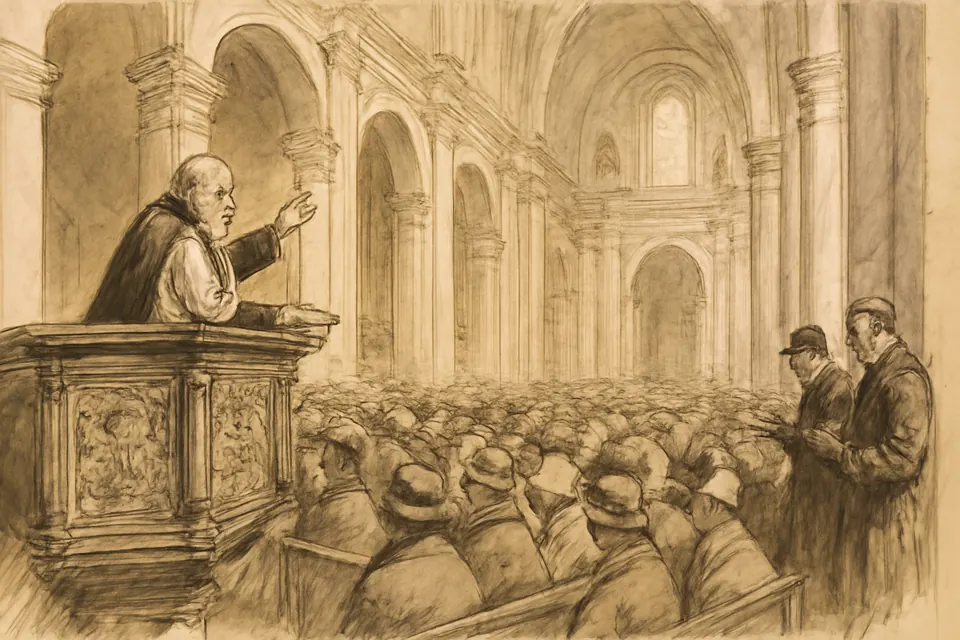
On April 7, 1937, the Gestapo in Berlin banned him from preaching anywhere in the Reich. He preached anyway and was arrested on June 5, 1937. Cardinal Faulhaber defended him from the pulpit of St. Michael's. In July a special court sentenced him to six months for "malicious attacks" on party and state and "misuse of the pulpit." He told the Gestapo, in words the Pope quoted, that if he were released he would go on preaching "in the churches of Munich and in the rest of Bavaria" despite the ban. Arrested again in January 1938, he was held in Landsberg prison until an amnesty in May.
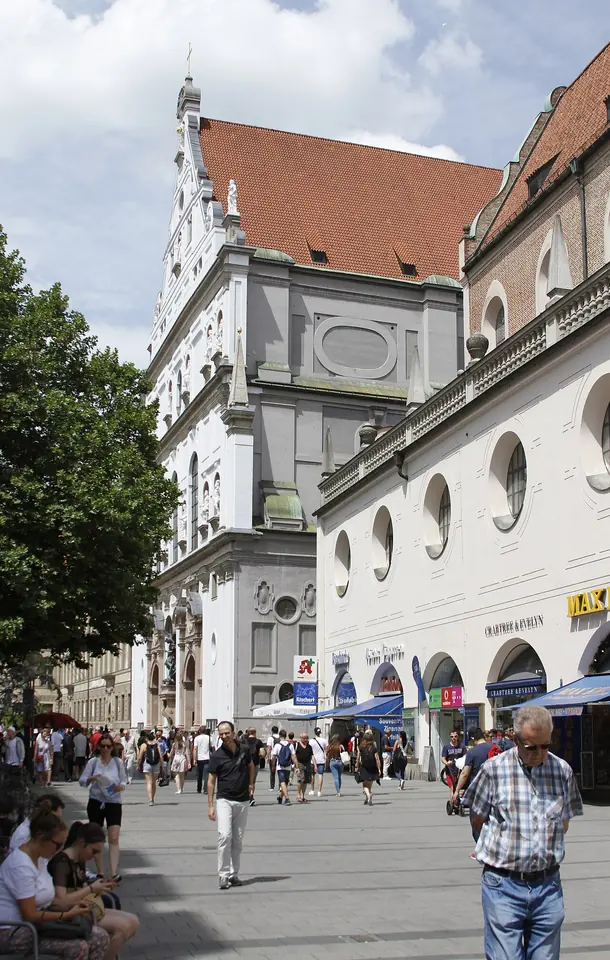
On November 3, 1939, he was arrested a third time, because he would not reveal what he knew from confessions. In December he was sent to the concentration camp at Sachsenhausen and kept in solitary confinement. From there he wrote to his mother, in words John Paul II read out (our translation): "Now I really have nothing and no one left but the dear God. And that is enough, more than enough."
Ettal, return and death
When his health became dangerously poor, the authorities moved him on August 7, 1940, to Ettal Abbey in the Bavarian Alps and confined him there, cut off from preaching, until American troops freed him on May 6, 1945. He returned to Munich and threw himself into helping the bombed-out city.

On November 1, 1945, the feast of All Saints, he suffered a stroke while celebrating Mass in St. Michael's Church and died soon afterward. He was buried in the Jesuit cemetery at Pullach, and on May 3, 1948, his body was moved to the lower church of the Bürgersaal, where pilgrims still come to pray at his grave.
Beatification
Cardinal Faulhaber opened the diocesan inquiry into his life on June 26, 1950. On May 3, 1987, Pope John Paul II beatified him before a huge crowd in Munich's Olympic Stadium, calling him a "courageous witness to the truth and apostle of the love of God and neighbor."
Symbols of Blessed Rupert Mayer in art
As a twentieth-century Blessed, he is usually shown from his photographs: a gray-haired priest in a black Jesuit cassock. Artists often add a cane or crutch for the leg he lost in the war, a pulpit for his preaching, and a rosary. Medallion portraits and plaques in Munich churches show him the same way. A gray-haired Jesuit leaning on a cane in a Munich church is almost certainly Fr. Mayer.
His favorite prayer
John Paul II quoted the first lines of Fr. Mayer's favorite prayer at the beatification. The full text is kept by the Marian Men's Congregation at the Bürgersaal:
Herr, wie Du willst, soll mir gescheh'n, / und wie Du willst, so will ich geh'n, / hilf Deinen Willen nur versteh'n.
Herr, wann Du willst, dann ist es Zeit, / und wann Du willst, bin ich bereit, / heut und in alle Ewigkeit.
In English (our translation): "Lord, as you will, so let it be done to me, and as you will, so will I go; only help me understand your will. Lord, when you will, then it is time, and when you will, I am ready, today and for all eternity." The prayer continues with two more verses of the same kind.
Let us pray it with him, and ask Blessed Rupert Mayer to obtain for us his courage to speak the truth and his open door for the poor.
Frequently asked questions
Is Rupert Mayer a saint?
He is Blessed, not yet a canonized saint. Cardinal Faulhaber opened his cause in 1950, and Pope John Paul II beatified him in Munich's Olympic Stadium on May 3, 1987. People who search for "St. Rupert Mayer" mean this Blessed Rupert Mayer.
When is the feast of Blessed Rupert Mayer?
November 3, kept in the Archdiocese of Munich and Freising and by the Jesuits. He died on November 1, 1945, All Saints' Day, after collapsing while celebrating Mass.
Why was Rupert Mayer arrested by the Nazis?
He was banned from preaching anywhere in the Reich in April 1937 and kept preaching. He was arrested in June 1937 and January 1938 for breaking the ban, and in November 1939 for refusing to reveal what he had heard in confession. He spent seven months in solitary confinement at Sachsenhausen before being confined at Ettal Abbey.
What was Rupert Mayer's favorite prayer?
A short German prayer of surrender to God's will that begins "Herr, wie Du willst, soll mir gescheh'n" (Lord, as you will, so let it be done to me). Pope John Paul II quoted it at his beatification.
Keep exploring
Sources
- Marianische Männerkongregation am Bürgersaal: Lebenslauf von Pater Rupert Mayer SJ (German). The congregation he led; dates of his life, wound and amputation, preaching ban, arrests, Sachsenhausen, Ettal, death, burials and beatification
- Marianische Männerkongregation am Bürgersaal: Lieblingsgebet (German). The text of his favorite prayer
- Pope John Paul II, homily at the beatification of Fr. Rupert Mayer, Munich, May 3, 1987 (German). Quotations from his letters and statements, and the titles Apostle of Munich and Father of the Poor (translations are ours)