Blessed Margaret of Lorraine, Duchess of Alençon and Poor Clare

Blessed Margaret of Lorraine (1463–1521) was a French princess who married René, Duke of Alençon, ruled the duchy as a widow while raising her children, and then gave up everything to found a monastery of Poor Clares at Argentan in Normandy, where she lived her last year as a nun. Her feast is November 2, the day she died in 1521. Pope Benedict XV confirmed her cult in 1921.
Who was Blessed Margaret of Lorraine?
Blessed Margaret of Lorraine was a duchess who died a Poor Clare. Born a princess of the house of Lorraine in 1463, she married René, Duke of Alençon, and was left a widow with small children four years later. She ruled the duchy of Alençon well for nearly three decades, and when her son was grown she gave all of it up. At Argentan in Normandy she founded a monastery of Poor Clares, took the habit herself, and lived one year as a nun before she died on November 2, 1521.
We know her life mainly through the French tradition kept by the Poor Clares and through Léon Clugnet's careful article in the 1910 Catholic Encyclopedia, which is the source for the dates below.
The life of Blessed Margaret
A princess raised by King René
Margaret was born in 1463 at the castle of Vaudémont in Lorraine, the daughter of Ferry de Vaudémont and Yolande of Anjou. She lost her parents young and was brought up at Aix-en-Provence by her grandfather, René of Anjou, the titular king of Naples, who was famous in his own day as a patron of poets and painters. When King René died in 1480, Margaret went home to Lorraine to live with her brother, Duke René II.
Duchess of Alençon
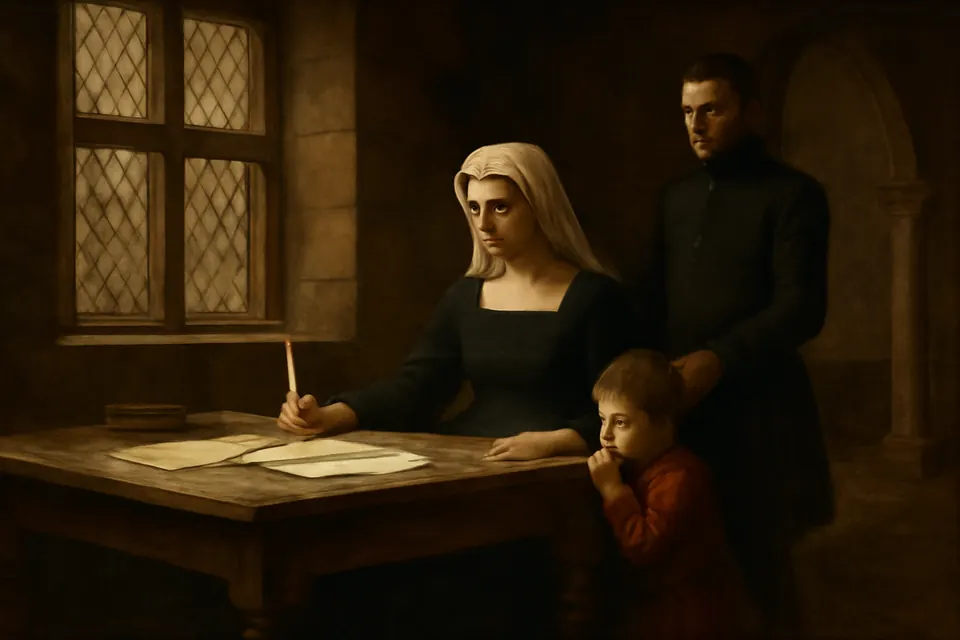
In 1488 her brother arranged her marriage, celebrated in Paris, to René, Duke of Alençon. The marriage was short. The duke died in 1492, and Margaret, still under thirty, was left to govern the duchy and to bring up her children. Clugnet says simply that she managed the duchy and saw to her children's education. Her son Charles became Duke of Alençon in turn.
For a widow of her rank there was pressure to remarry. Margaret did not. She lived plainly in the middle of a court, and tradition remembers her for care of the poor and the sick of her lands.
From Mortagne to Argentan
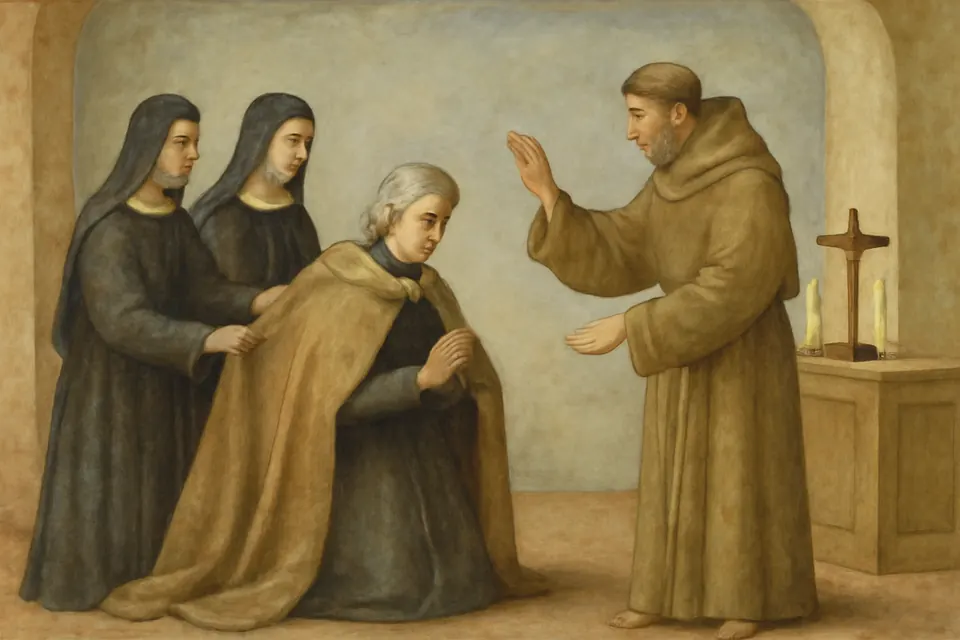
When her duties were done, Margaret left the world. She went first to Mortagne, to a house of women who followed the rule of St. Elizabeth of Hungary, the Franciscan Third Order. That was not enough for her. She took some of those sisters with her to Argentan and, with the pope's authorization, founded a monastery there under the Rule of St. Clare as the Observant Franciscans kept it, the strict enclosed life of the Poor Clares.
The foundress then became one of the sisters. Margaret took the habit at Argentan and made her vows on October 11, 1520.
A year as a nun
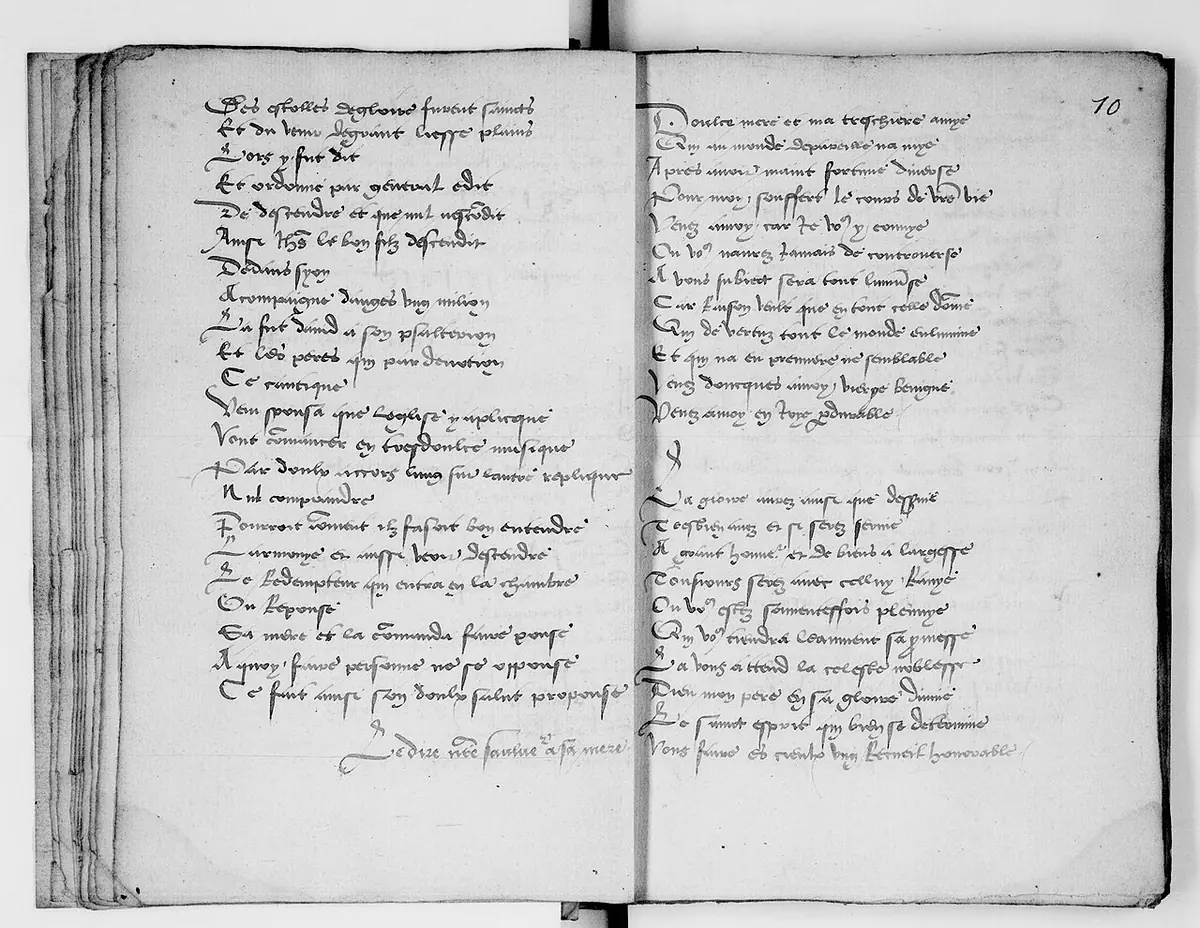
She lived only one more year. Clugnet writes that she spent it in humility and austerity, and she died in her small cell at Argentan on November 2, 1521. He gives her age as sixty-two, though a birth in 1463 would make her fifty-eight. A book of devotional poems in French, copied in her century and now in the Bibliothèque nationale de France, carries her name.

Her body and her cause
Margaret was buried in her own monastery. When the monastery was suppressed, her body was carried to the church of Saint-Germain in Argentan. In 1793, during the Revolution, it was profaned and thrown into the common burial ground. No relics of her body are known to survive.
Her memory never died out. The Franciscan Martyrology and the Gallican Martyrology recorded her as blessed. In the 1600s, at the request of the bishop of Séez, King Louis XIII asked Pope Urban VIII to open an inquiry into her virtues and miracles, but the matter was lost in the political troubles of the time. A later bishop of Séez took up the cause again, and in 1921 Pope Benedict XV confirmed her long-standing cult. This was an equipollent beatification: the Church recognized the honor she had received for centuries rather than judging a new miracle. No individual miracle was approved in her cause, and the favors told of her in Normandy remain traditional.
Symbols of Blessed Margaret of Lorraine in art
Margaret is shown in the habit she wore for only a year, because that is how she chose to be remembered.
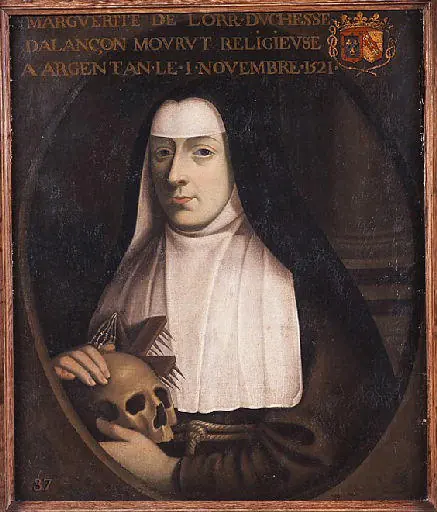
- Poor Clare habit: a brown habit with a cord, a white wimple and a black veil, as in the oval portrait above.
- Skull: her hand rests on a skull in the best-known portrait. It is the old sign of a soul that meditates on death and on the passing of worldly things.
- Crown laid aside: statues in Normandy and Maine show her as a duchess in a crown and ermine-lined mantle, sometimes holding a model of her monastery, to recall what she gave up.
- Book: for her prayer and the devotional poems that bear her name.
To recognize her in a church, look for a nun with a noble face beside the arms of Lorraine or Alençon, or a crowned lady holding a convent.
Feast day and where she is honored
We keep her feast on November 2, the day she died, which falls on All Souls' Day. She is honored especially in the Orne, at Argentan and at Alençon, and by the Poor Clares of France, who count her among their foundresses. See more on our feast days page.
Praying with Blessed Margaret
We have not found a traditional prayer to Blessed Margaret of Lorraine in English, so we do not print one. Let us ask her to pray for widows raising children alone, for those who govern and manage the affairs of others, and for all who hear God's call late in life and wonder whether it is too late to answer. Blessed Margaret of Lorraine, pray for us.
Frequently asked questions
Who was Blessed Margaret of Lorraine?
A princess of the house of Lorraine, born in 1463, who became Duchess of Alençon by marriage. Widowed in 1492, she governed the duchy for her young son, then retired to religious life and founded the Poor Clare monastery at Argentan, where she made her vows in 1520 and died in 1521.
When is the feast of Blessed Margaret of Lorraine?
November 2, the anniversary of her death at Argentan in 1521.
Where are the relics of Blessed Margaret of Lorraine?
They no longer exist. Her body was moved from the Poor Clare monastery to the church of Saint-Germain in Argentan, and in 1793, during the French Revolution, it was profaned and thrown into a common grave.
Why is she called Blessed if there was no beatification Mass?
Pope Benedict XV confirmed in 1921 the honor she had received as Blessed for centuries. This is called an equipollent beatification: the Church recognizes an existing, long-standing cult instead of holding a new process with an approved miracle.
Keep exploring
Sources
- Léon Clugnet, "Blessed Margaret of Lorraine," Catholic Encyclopedia (1910). Birth at Vaudémont, upbringing at Aix with King René, marriage in 1488, widowhood in 1492, Mortagne, vows on October 11, 1520, death on November 2, 1521, the profanation of 1793 and the request of Louis XIII to Urban VIII
- Poésies pieuses de Marguerite de Lorraine, duchesse d'Alençon, Bibliothèque nationale de France, NAF 1857 (Gallica). The sixteenth-century manuscript of devotional verse that bears her name