St. Pachomius the Great
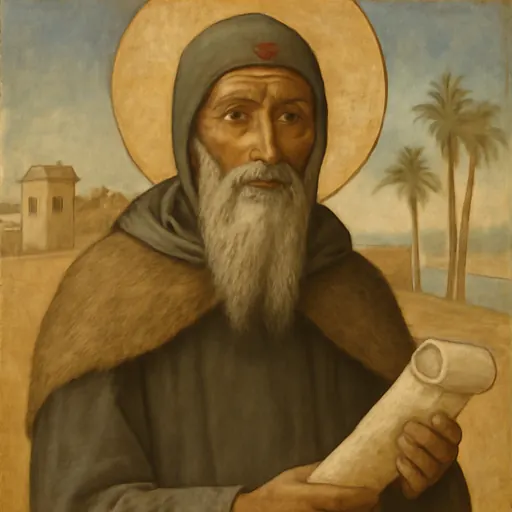
St. Pachomius the Great (died about 346) was an Egyptian who became a Christian after leaving the army and founded the first monasteries of common life, beginning at Tabennisi on the Nile. His rule shaped every monastic order that followed. We keep his feast on May 9; the Byzantine churches honor him on May 15.
Who was St. Pachomius the Great?
St. Pachomius the Great was an Egyptian monk of the fourth century who founded the first Christian monasteries of common life. Before him, the monks of Egypt were hermits who lived alone or in loose clusters around a famous elder like St. Anthony. Pachomius gathered monks into one community with one rule, one superior, common prayer, common meals and shared work. Every abbey, convent and religious house that has followed owes something to him. We keep his feast on May 9, and the Byzantine churches honor him on May 15.
The life of St. Pachomius
A soldier who learned charity
Pachomius was born in the late third century in the Thebaid, the long valley of Upper Egypt, to pagan parents. When he was about twenty he was conscripted into the army of Constantine. The young recruits were held in a city prison, and the local Christians came to feed them and care for them. When Pachomius asked who these people were and why they did it, he was told they did it for the love of God, to keep His command to love one's neighbor. The Orthodox life says he vowed then to become a Christian, and after his release he was baptized.

Disciple of Palamon
Wanting a guide, he went to an old hermit named Palamon and lived under him for years in hard fasting and prayer. Then, on a journey through the desert, he came to the empty village of Tabennisi by the Nile and heard a voice telling him to stay and build a monastery. The Catholic Encyclopedia records the promise it carried: "very many eager to embrace the monastic life will come hither to thee." Palamon helped him build his first cell, and his elder brother John was the first to join him.

Founder of the common life
At first his companions wanted to remain hermits with a few shared customs. Pachomius was patient. The Catholic Encyclopedia notes that with his first recruits he let them give all their time to prayer while he himself did the heavy work of the house. Disciples came who understood his plan, and the community grew so fast that a second monastery was founded at Pbow, then others. By his death there were nine monasteries of men and two of women. His sister Maria came to see him; he would not meet her, but he blessed her to take up the monastic life, and a women's monastery grew up around her across the river.
The life was ordered but humane. In the Pachomian monasteries, the Catholic Encyclopedia explains, monks lived in houses grouped by trade, worked with their hands, met for prayer and ate together, though anyone who wished to fast more could take bread and salt in his cell. Palladius, who knew the Pachomian monks, says the main monastery had 1,300 brothers and the whole congregation 7,000. At Panopolis he found a house of 300 with "fifteen tailors, seven smiths, four carpenters, twelve camel-drivers, and fifteen fullers."
His death
Plague swept the region in his last years. Pachomius fell ill and was nursed by his beloved disciple St. Theodore. He died about 346 and was buried on a hill near the monastery.
The miracles and legends of St. Pachomius
Ancient writers called Pachomius a prophet and a wonderworker. We label these accounts honestly:
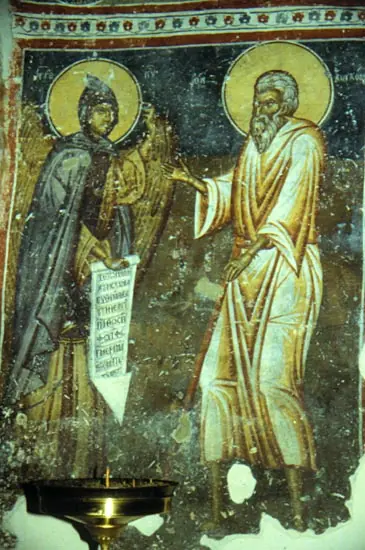
- Traditional: the angel's rule. Palladius, writing about 420, says an angel appeared to Pachomius in his cave, told him to gather the young monks, and gave him a bronze tablet with the rule. It divided the monks into twenty-four sections named for the letters of the Greek alphabet, "to the simpler and more unworldly thou shalt give the Iota, and to the more difficult and perverse thou shalt assign the Xi." The Catholic Encyclopedia notes that in important points this rule was never followed by Pachomius's monks, so it is best read as a pious tradition.
- Traditional: St. Macarius of Alexandria in disguise. Palladius tells how the old ascetic came to Tabennisi as a stranger, outfasted everyone through Lent, and was recognized by Pachomius after prayer: "Here, good old man, you are Macarius and you hid it from me."
- Traditional: bread in a famine. The Orthodox life says that when the monastery ran short of grain, Pachomius prayed all night, and in the morning bread was sent from the city at no charge.
None of these has been formally examined; his cult is far older than canonization processes.
Symbols of St. Pachomius in art
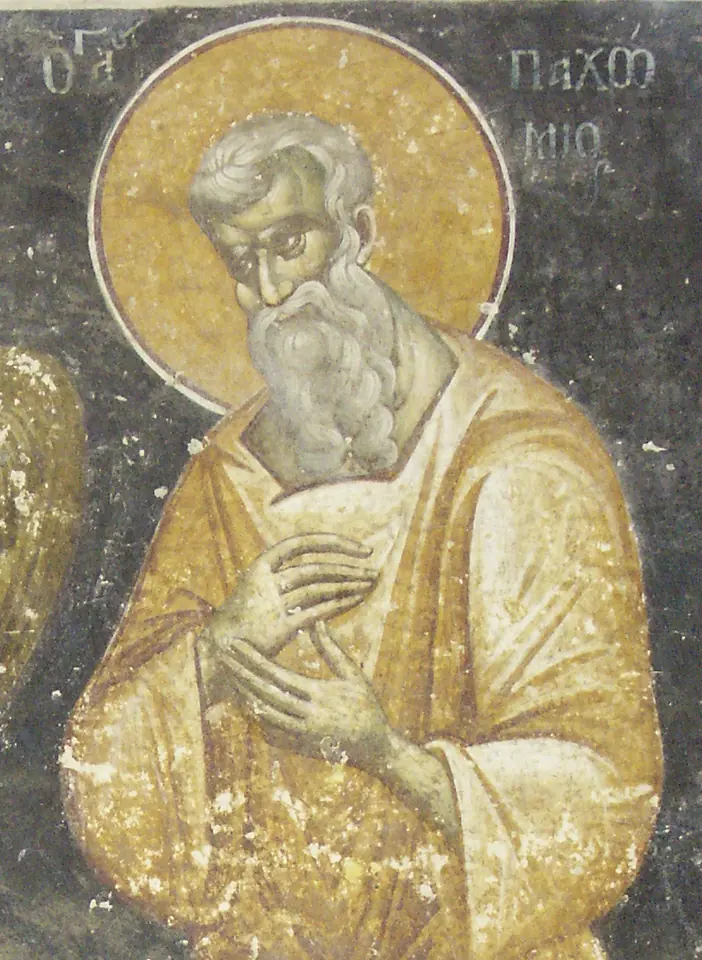
Pachomius is shown as an old monk with a long beard, and his attributes come from the rule:
- An angel with a tablet or scroll: the angel's rule from Palladius. This is the scene most often painted, East and West.
- The tablet itself, sometimes bronze, sometimes a scroll with lines of text.
- A monk's cowl with a cross: Palladius says the Pachomian cowls carried a cross worked in dark red.
- A goatskin cloak, part of the monks' dress in the same account.
Feast day and prayer
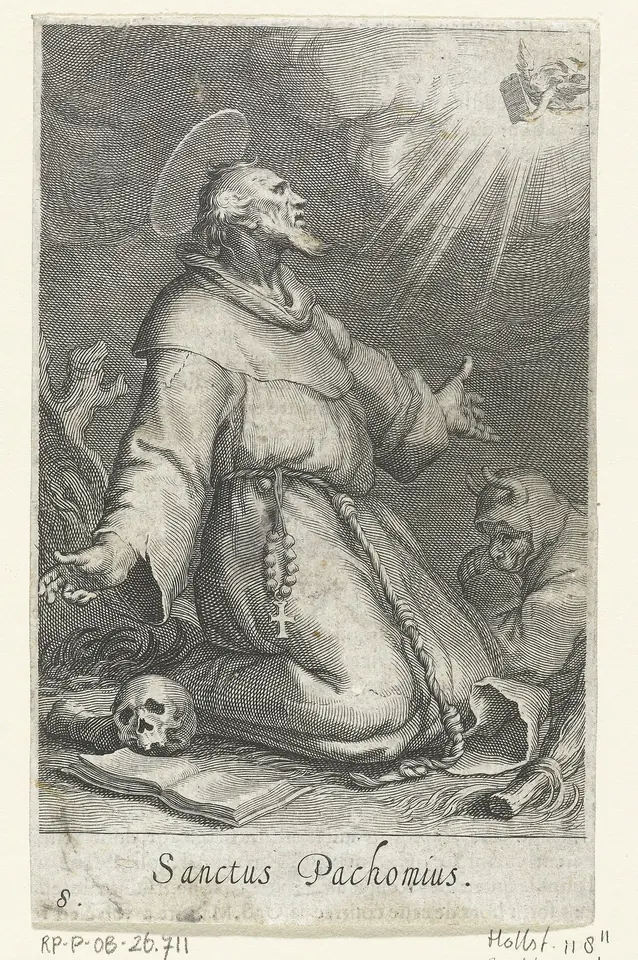
We keep the feast of St. Pachomius on May 9; see the feast day calendar. No prayer of his own is widely used today. Let us ask him, in our own words, to pray for monks and nuns, for every religious community that lives by a rule, and for all of us who must learn to live and work patiently with others. Like the Christians who fed a frightened young conscript, let us remember that a simple act of charity can bring a soul to God.
Frequently asked questions
Who was St. Pachomius?
An Egyptian of pagan birth who was conscripted into the Roman army as a young man, was moved by the charity of Christians who fed the conscripts, and was baptized after his release. He learned the ascetic life from the hermit Palamon, then founded a monastery at Tabennisi where monks lived in community under a rule. By his death about 346 there were nine monasteries of men and two of women.
What is St. Pachomius known for?
He is the founder of cenobitic monasticism, the common life of monks in one community under one rule and superior. The hermits before him, such as St. Anthony, lived alone or loosely together.
When is the feast of St. Pachomius?
May 9 in the current Roman list of saints. Older editions of the Roman Martyrology gave May 14, and the Orthodox and Byzantine Catholic churches keep May 15.
Did an angel give St. Pachomius his rule?
Palladius, writing about 420, tells that an angel gave Pachomius a bronze tablet with the rule written on it. The Catholic Encyclopedia notes that this "angel's rule" in several points does not match how the Pachomian monks actually lived, so we treat it as a traditional account.
Keep exploring
Sources
- Catholic Encyclopedia (1913): St. Pachomius. Palemon, Tabennisi, Pbow and Chenoboskion, nine monasteries of men and two of women, and the scholarly doubts about Palladius's angel rule
- Palladius, The Lausiac History, chapter 32: Pachomius and the Tabennesiots (tr. W. K. Lowther Clarke, 1918; tertullian.org). The angel and the bronze tablet, the twenty-four lettered sections, the 7,000 monks, and the trades at Panopolis
- Orthodox Church in America: Venerable Pachomius the Great, Founder of Coenobitic Monasticism. The Byzantine life, his conversion in the army, his sister Maria and the women's monastery, and his death in the plague
- Catholic Encyclopedia (1913): Monasticism. The Pachomian houses grouped by trade, organized work, and freedom to eat in common or fast in one's cell
- Vatican News: Saint of the Day, May 9. St. Pachomius, Abbot, on May 9