St. Rose Venerini
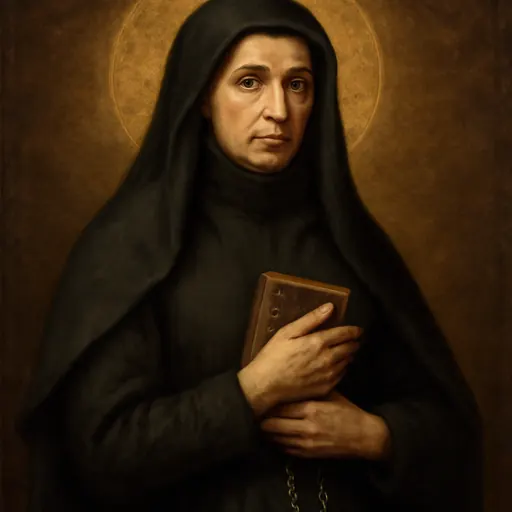
St. Rose Venerini (1656–1728) was a doctor's daughter from Viterbo, Italy, who opened what is counted as the first public school for girls in Italy in 1685 and founded the Religious Teachers Venerini (Maestre Pie Venerini), who still teach today. Pope Benedict XVI canonized her in 2006. Her feast day is May 7.
Who was St. Rose Venerini?
St. Rose Venerini was a doctor's daughter from Viterbo, north of Rome, who saw that the girls and women around her had no way to learn to read or to learn their faith, and decided to do something about it. On August 30, 1685, she opened a free school for girls in a rented house. Her congregation, the Religious Teachers Venerini (in Italian, the Maestre Pie Venerini), calls it the first public school for girls in Italy. When she died in Rome in 1728, she had founded about fifty schools.
Pope Pius XII beatified her in 1952, and Pope Benedict XVI canonized her on October 15, 2006. We keep her feast on May 7.
She shouldn't be confused with St. Rose of Viterbo, the young Franciscan laywoman of the same city who died in 1251.

The life of St. Rose Venerini
A doctor's daughter in Viterbo
Rose was born in Viterbo on February 9, 1656, the third of four children. Her father, Goffredo Venerini, came from the Marche and practiced medicine at the city's main hospital; her mother, Marzia Zampichetti, came from an old Viterbo family. Rose was bright, attractive and strong-willed. A woman of her time had two roads open to her, marriage or the cloister, and she felt drawn to both without being satisfied by either.
Her faith was formed by the Dominicans at the nearby shrine of Our Lady of the Oak (Madonna della Quercia) and above all by the Jesuits, especially Father Ignatius Martinelli, who taught at the Jesuit college in Viterbo and guided her major decisions. Through them she took in the balanced, practical spirituality of St. Ignatius of Loyola.
Losses and a long search
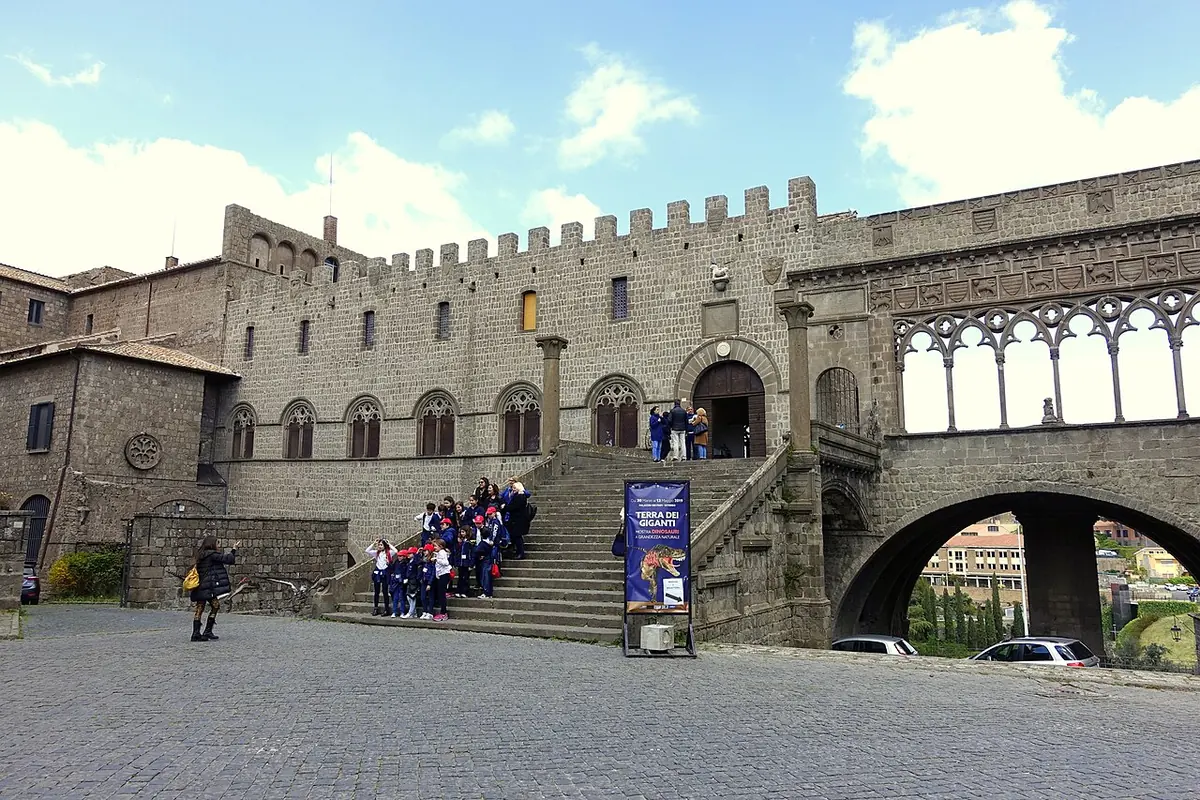
In the fall of 1676 she entered the Dominican monastery of St. Catherine in Viterbo, where an aunt was a nun, to try the cloistered life. She stayed only a few months. Her father died on January 29, 1677, and she went home to her family.
Then 1680 changed everything. Her sister Maria Maddalena married in January. Her brother Domenico, a young doctor, died in February at twenty-seven. Her mother died in October. Rose, twenty-four, was left in the family house with her younger brother Orazio, a lawyer.
The rosary that became a school
Rose began inviting the girls and women of the neighborhood to her house in the afternoons to pray the rosary. As she got to know them, she saw how little they knew: many couldn't read, and many knew almost nothing of the faith they prayed. The rosary group wasn't enough. What they needed, she concluded, was a real school.
At his beatification address in 1952, Pope Pius XII described how it grew: her spiritual director had invited her to gather women and girls to pray the rosary with her, she began explaining the prayers, then the main mysteries of the faith, then the rest of Christian doctrine. "From the very beginning," he said, in our translation of the text her congregation publishes, "Blessed Rose taught in order to sanctify."

She waited until her brother Orazio married in December 1684, so her choice wouldn't burden him. Then she left the family house, rented another, and on August 30, 1685, with the approval of the bishop of Viterbo, Cardinal Urbano Sacchetti, opened her school with two companions, Porzia Bacci and Girolama Coluzzelli. The school was free. Girls learned to read, to pray, to know their faith and to work, so that they could earn a living with dignity.
It wasn't easy. Her congregation's biography says she suffered for the founding of every one of her schools. Rose kept going.
Montefiascone and St. Lucy Filippini
Word spread. Cardinal Marco Antonio Barbarigo, bishop of nearby Montefiascone, asked her to open schools in his diocese. From 1692 to 1694 she founded about ten of them, in Montefiascone, Tarquinia (then Corneto), Valentano, Gradoli, Capodimonte, Marta and other towns. Before she left, she trained a gifted young woman to direct them: Lucy Filippini, now a saint, who went on to lead the Religious Teachers Filippini.
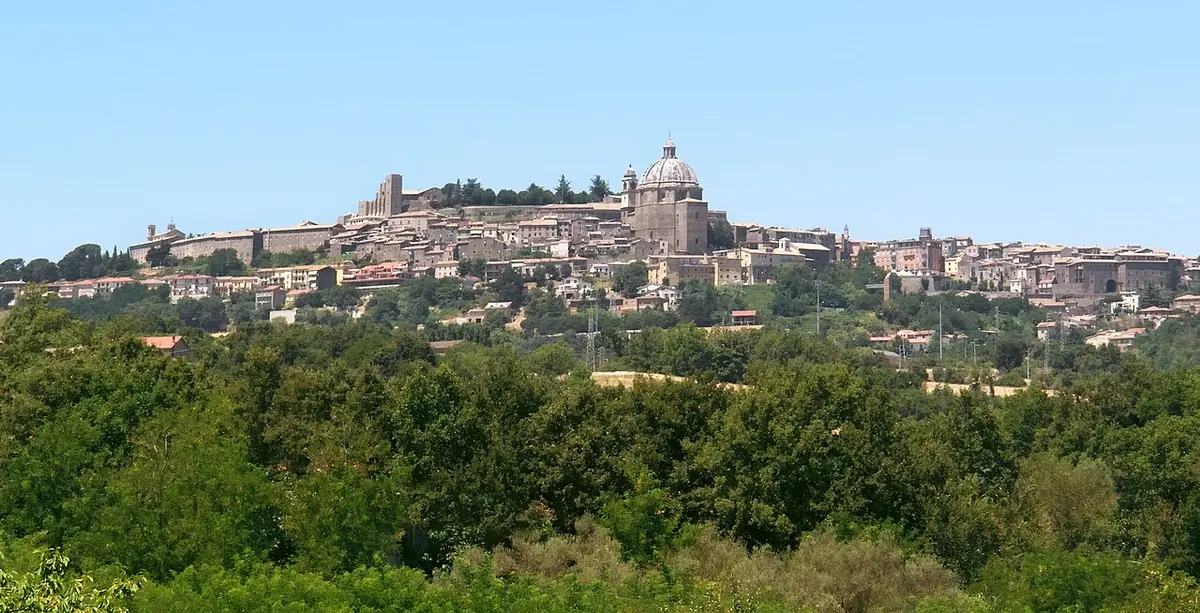
Back in Viterbo she found her own school nearly empty. Most of the teachers had left to start a rival school across the street. Rose reconciled them with patience, let them keep teaching in their new house under her methods, and closed her own school. That house became the mother house of her institute.
Rome and the Pope's visit
For the rest of her life she kept founding schools wherever a bishop or a town asked, trusting Providence for the money. Her biography by Anna Maria Tassi lists more than forty towns in central Italy. After several attempts, she opened a school in Rome on December 8, 1713, near the Church of San Marco, and settled there for good. In 1714 she published a short guide to her methods so that the Church could approve them.

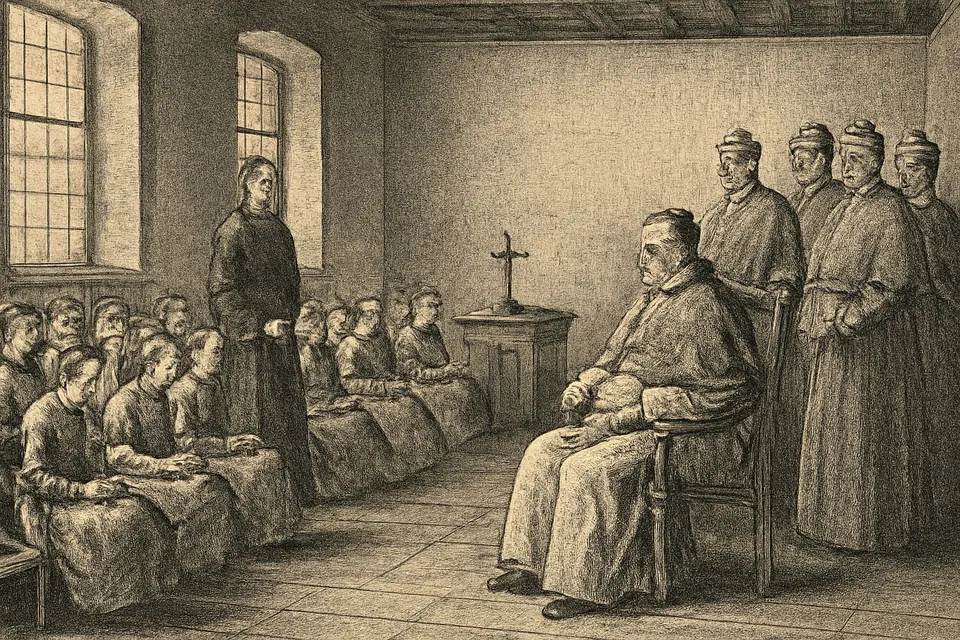
On October 24, 1716, Pope Clement XI came to see the school for himself, with several cardinals, and sat through the lessons. According to her congregation's biography, he told her (in our translation), "Signora Rosa, you are helping us carry out our office. You do what we cannot do, and we thank you very much," and added, "With these schools you will sanctify Rome for us."
Her death
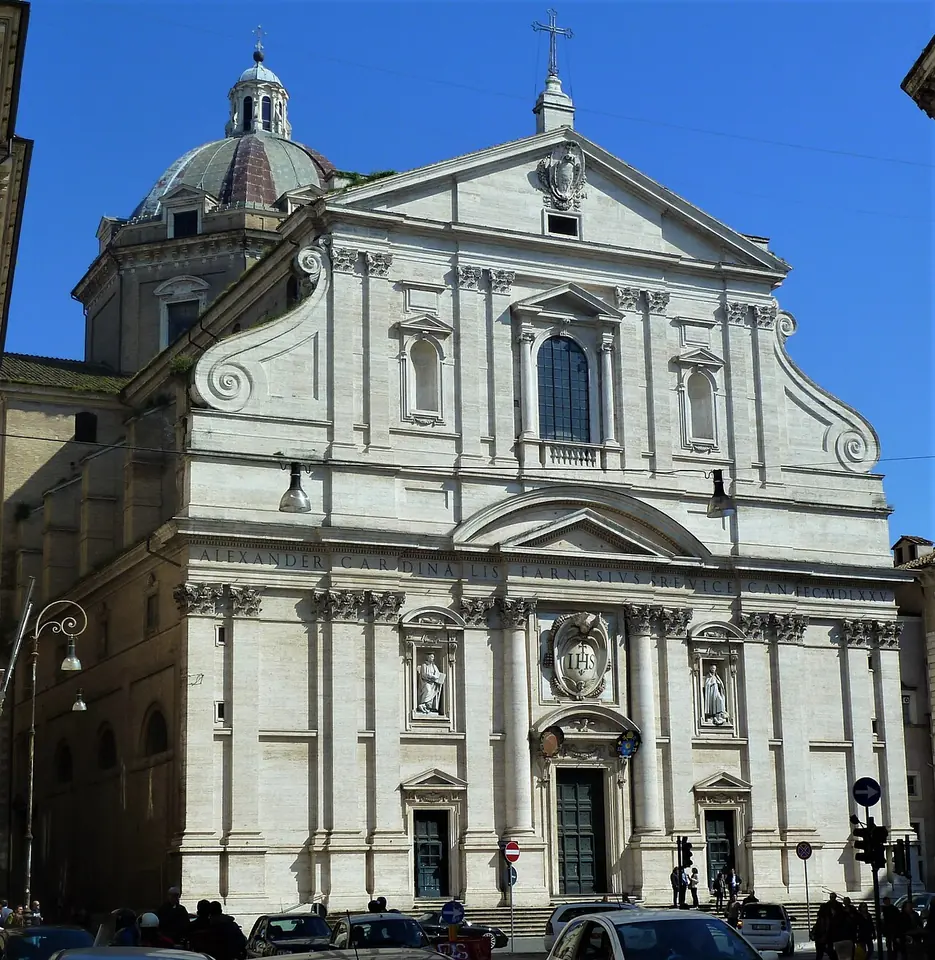
Rose Venerini died at her school near San Marco on May 7, 1728, at seventy-two. She had asked to be buried in the nearby Church of the Gesù, the Jesuits' mother church, and she was. One of her last foundations, at Poggio Mirteto, opened in the same month she died.
Beatification and canonization
Pope Pius XII beatified Rose Venerini in St. Peter's Basilica on May 4, 1952. That January her remains had been moved from the Gesù to the chapel of her congregation's general house in Rome, where they rest today.
The miracle for her canonization came from Cameroon. Onguene Meyong, born in 1992 in Sangmelima, fell gravely ill in 1997. By June 1999 he had a swollen gland in his neck, a hugely swollen abdomen, and weighed only about 42 pounds. Doctors at the Presbyterian hospital of Enongal took a biopsy and sent him home to wait for the results while he grew worse. In desperation his mother and grandmother took him to the leprosarium of Ngalane, near Ebolowa, run by Sister Maria José Carregosa Santana, a Brazilian Venerini sister. She asked the patients to pray a novena to Blessed Rose. Catholics, Lutherans and followers of traditional religion prayed it together. On the fifth day the boy began to eat and play, and by the end of the novena the swelling and pain were gone. When the biopsy result finally arrived months later, it confirmed tuberculous adenitis; by then Onguene was running with his friends.
This healing is approved. The diocese of Ebolowa-Kribi held the inquiry in 2004. The medical board of the Congregation for the Causes of Saints found the cure scientifically unexplainable on February 3, 2005; the theologians agreed that May, and the cardinals and bishops in December. Pope Benedict XVI approved the miracle on April 28, 2006, and canonized Rose on October 15, 2006, in St. Peter's Square, along with St. Theodore Guérin, St. Rafael Guízar y Valencia and St. Filippo Smaldone. Onguene himself carried her relics in the procession.
In his homily the Pope quoted her own words: "I find myself so bound to the divine will that neither death nor life is important: I want to live as he wishes and I want to serve him as he likes, and nothing more." He added that she "did not content herself with providing the girls an adequate education, but she was concerned with assuring their complete formation."
Why St. Rose Venerini is honored
Rose Venerini has no traditional patronages; she died long after most were assigned. She is honored as foundress by the Religious Teachers Venerini, who keep her schools in Italy and, since 1909, in the United States, with communities in Worcester, Massachusetts, and Schenectady, New York, among others, and in India, Brazil, Cameroon, Romania, Albania, Chile, Benin and Nigeria. Teachers, Catholic schools and anyone who works for the education of girls and women find a natural friend in her. See more saints by cause on our patron saints page.
Symbols of St. Rose Venerini in art
Rose lived before photography, but her congregation keeps a painted portrait dated 1699, shown near the top of this page, and later pictures follow it. Look for:
- A black dress and dark veil drawn around a long, pale face. She never wore a nun's habit; this is the plain dress of a devout laywoman of her day.
- Girls gathered around her, sometimes with books on their laps: her school.
- A small book, the catechism she taught from.
- A rosary, from the neighborhood rosary that started it all.
- A crucifix, often in devotional pictures of her at prayer.
Her statues in Venerini schools often show her with open arms, welcoming her pupils. At her beatification in 1952 her image was hung in the "Glory" of Bernini above the Chair of St. Peter.

Feast day of St. Rose Venerini
Her feast is May 7, the day she died. She is not on the General Roman Calendar, but the Religious Teachers Venerini and their schools celebrate it, as do the churches of Viterbo and Rome. Pilgrims visit her tomb in the chapel of the general house on Via Giuseppe Gioachino Belli in Rome's Prati district. You can find her neighbors in May on our feast days page.
Prayer to St. Rose Venerini
The Religious Teachers Venerini publish their own prayer asking graces through St. Rose's intercession, which can be found through the congregation. There is no older traditional prayer to her.
Her words quoted by Benedict XVI at her canonization make a short prayer of surrender of their own:
I find myself so bound to the divine will that neither death nor life is important: I want to live as he wishes and I want to serve him as he likes, and nothing more.
Let us ask St. Rose Venerini to pray for teachers, for children who are denied an education, and for every girl who has never had the chance to learn.
Frequently asked questions
What is St. Rose Venerini known for?
She opened a free school for girls in Viterbo on August 30, 1685, which her congregation calls the first public school for girls in Italy. By her death in 1728 she had founded about fifty schools in central Italy, and the Religious Teachers Venerini she began now teach in Italy, the United States, India, Brazil, Cameroon and other countries.
When is the feast day of St. Rose Venerini?
May 7, the day she died in Rome in 1728. She is not on the General Roman Calendar; her feast is kept by the Religious Teachers Venerini, their schools and parishes, and the Church in Viterbo and Rome.
What miracle led to the canonization of St. Rose Venerini?
The healing of Onguene Meyong, a boy from Cameroon who in 1999 was gravely ill with tuberculous adenitis. A Venerini sister at the leprosarium of Ngalane, near Ebolowa, asked the patients to pray a novena to Blessed Rose; by its end the swelling and pain were gone. The Church's medical board found the cure unexplainable in 2005, and Pope Benedict XVI approved the miracle in April 2006.
Is St. Rose Venerini the same as St. Rose of Viterbo?
No. Both came from Viterbo, but St. Rose of Viterbo was a young Franciscan laywoman who died in 1251, more than four hundred years before Rose Venerini was born. Rose Venerini is the educator who founded the Religious Teachers Venerini.
Where is St. Rose Venerini buried?
In the chapel of the general house of the Religious Teachers Venerini, Via Giuseppe Gioachino Belli 31, in Rome. She was first buried in the Church of the Gesù, as she had asked, and her remains were moved to the chapel on January 7, 1952.
Keep exploring
Sources
- Benedict XVI, Homily for the Canonization of Four Saints, October 15, 2006 (vatican.va)
- Maestre Pie Venerini: La Fondatrice (Anna Maria Tassi, 2002)
- Maestre Pie Venerini: Il miracolo che ha portato alla canonizzazione
- Maestre Pie Venerini: Beatificazione di Rosa Venerini
- Maestre Pie Venerini: Canonizzazione di Rosa Venerini