St. Pelagia of Tarsus, Virgin and Martyr
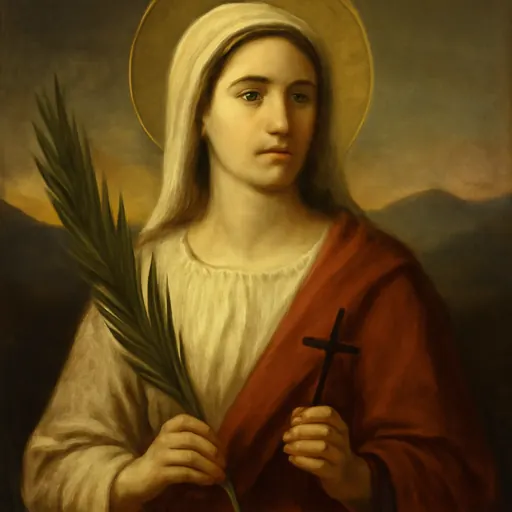
St. Pelagia of Tarsus is a virgin martyr of Cilicia, honored by tradition as a young woman of a noble pagan family who was baptized in secret, refused to marry the adopted son of the Emperor Diocletian and was put to death in a red-hot bronze bull. We keep her feast on May 4. She is a different saint from St. Pelagia the Penitent, though scholars think her story may have grown from the martyr Pelagia of Antioch.
Who was St. Pelagia of Tarsus?
St. Pelagia of Tarsus is a virgin martyr of Cilicia, the region of southern Asia Minor where St. Paul was born. The Church honors her as a young woman who gave herself entirely to Christ, refused an imperial marriage and died for the faith under the Emperor Diocletian. We keep her feast on May 4, and the Orthodox Church also remembers her on October 7.
Her name causes some confusion, so it helps to say at once who she is not. She is not St. Pelagia the Penitent, the actress of Antioch who became a hermit on the Mount of Olives. Nor is she, by name at least, the fifteen-year-old Pelagia of Antioch whom St. John Chrysostom praised in a sermon, who chose death rather than dishonor in the persecution.
History and legend
The story of Pelagia of Tarsus comes to us in a Greek Life written well after her time. The Catholic Encyclopedia of 1911 calls it "a legend of later date." It also suggests something worth knowing: because Tarsus lies near Antioch, and the feast of the Antioch martyr was also kept at Tarsus, "St. Pelagia of Tarsus should probably be identified with the Antiochene martyr," who was later "turned into a martyr of Tarsus."
That does not make her less ours. The Church has honored a holy virgin martyr named Pelagia in this corner of Asia Minor since the early centuries. The legend below is how the Eastern Church tells her story, and we read it as a traditional account, not as a court record.
Her legend
The Orthodox Church in America's life tells it this way. Pelagia was the daughter of noble pagans in Tarsus. She heard about Christ from Christian friends, believed, and wished to keep her virginity for the Lord. The adopted son and heir of Diocletian saw her and asked to marry her. She told him she was already betrothed to Christ, "the Immortal Bridegroom."
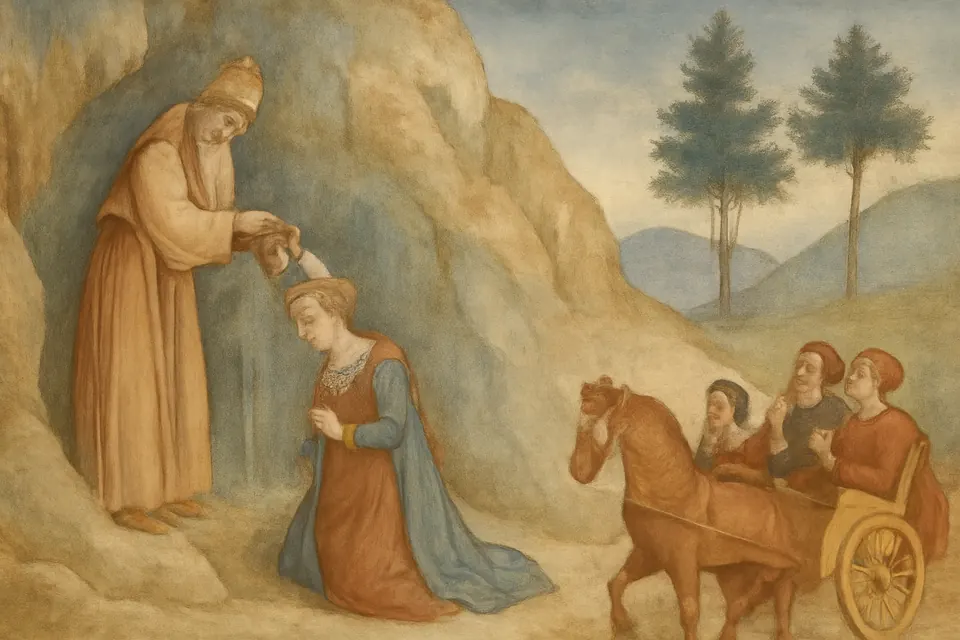
She had seen in a dream the face of Linus, the bishop of Tarsus, who was hiding on a mountain during the persecution. Asking her mother's leave to visit the nurse who had raised her, she set out in a chariot, dressed in rich clothes as her mother wished, with a train of servants. On the way she met Linus and knew him at once from her dream. She fell at his feet and asked for baptism. At the bishop's prayer, the Life says, a spring of water flowed from the ground, and during the baptism angels covered her with a bright mantle.
She traded her fine clothes for a simple white garment and gave her possessions to the poor. Her servants heard her speak of Christ, and many believed. Her mother did not. She sent word to the emperor's son that Pelagia was a Christian and would never marry him, and the young man, in despair, fell on his sword.
Before the emperor
Pelagia's mother, afraid of the emperor's anger, bound her daughter and brought her to Diocletian. The emperor was struck by her beauty and promised her everything if she would renounce Christ and marry him. Her answer, as the OCA's life gives it, is the heart of her story:
I do not desire your worldly crowns which last only a short while. The Lord in His heavenly Kingdom has prepared three imperishable crowns for me. The first is for faith, since I have believed in the true God with all my heart; the second is for purity, because I have dedicated my virginity to Him; the third is for martyrdom, since I want to accept every suffering for Him and offer up my soul because of my love for Him.

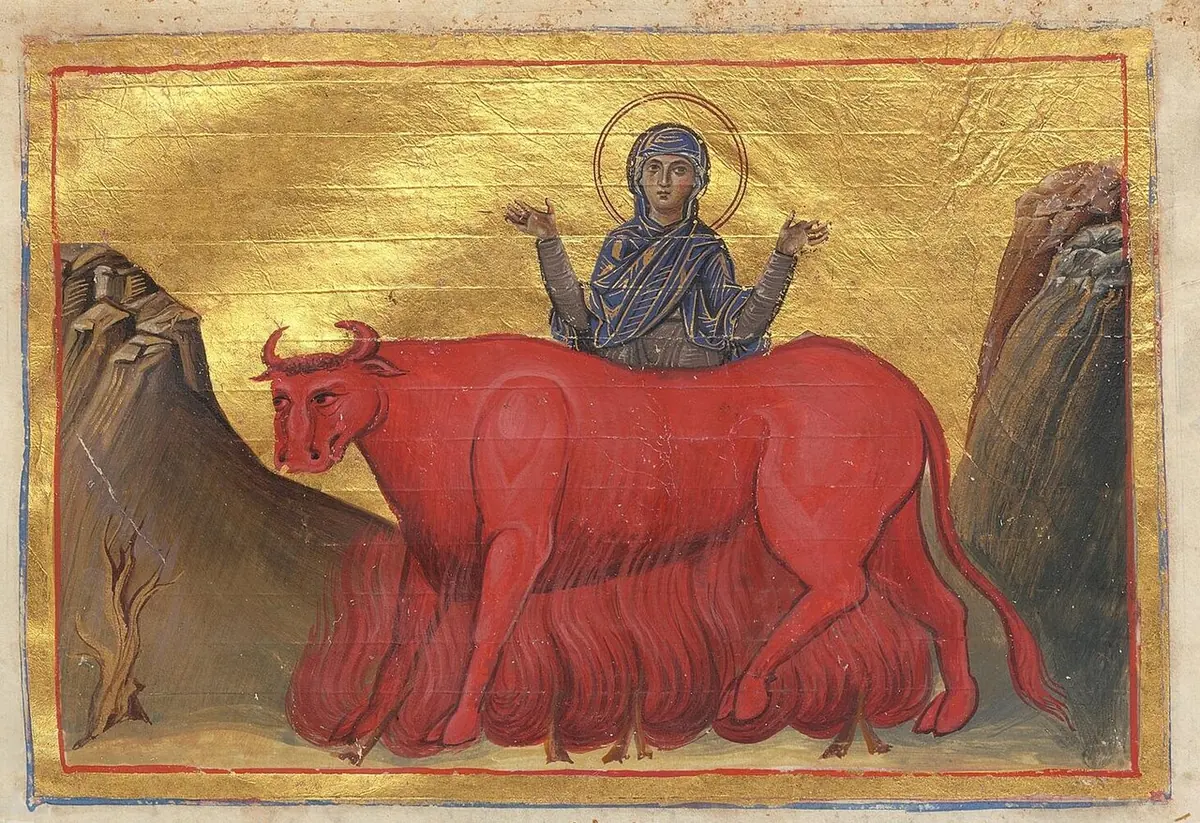
Diocletian sentenced her to die in a bronze bull heated red-hot. She would not let the executioners touch her. She made the Sign of the Cross and walked in herself.
The miracles of St. Pelagia of Tarsus
Every wonder in her story is traditional, handed down in her Life and in the hymns of her feast:
- The spring that rose at Bishop Linus's prayer for her baptism, and the angels who clothed her in light.
- The fragrance like myrrh that filled the city at her death.
- Her bones, which remained whole. The Life says pagans carried them outside the city, and four lions came out of the wilderness and kept birds and beasts away until Bishop Linus came and buried them with honor.
The OCA adds that when the persecutions ended, in the reign of Constantine, a church was built over her grave. The service for her feast calls her "deemed worthy of most strange and divine visions."

Symbols of St. Pelagia of Tarsus in art
She is easy to tell from the other Pelagias if you look for one thing: the bull. Byzantine painters show her standing or praying above a large bronze bull, often painted red, with flames beneath it. She wears a dark veil and raises her hands in the ancient posture of prayer. Western engravers, like Jacques Callot in his book of saints for every day of the year, show her standing beside the bull. Other attributes:
- A white garment: her baptism and her purity.
- The palm and the crown: the martyr's victory, and the three crowns she spoke of to the emperor.
- Lions: sometimes shown guarding her relics.
St. Pelagia the Penitent, by contrast, is shown in a monk's habit or with pearls and fine clothes she gave up.

Prayer to St. Pelagia of Tarsus
The Orthodox Church sings this troparion on May 4, in the translation of the Orthodox Church in America:
Through your knowledge of the Faith you abandoned the darkness of ignorance, / fairest virgin of Christ. / You were refreshed by dew and finished your contest by fire. / Glorious martyr Pelagia, / entreat Christ our God to grant us His great mercy!
And the kontakion:
Abandoning your mortal betrothed in order to wed the Immortal One, / as your dowry you offered chastity and your contest. / Therefore, we acclaim you, Pelagia.
Let us ask St. Pelagia to pray for young people who are pressed to give up their faith, for converts whose families do not understand them, and for all consecrated virgins. St. Pelagia of Tarsus, pray for us.
Frequently asked questions
Who was St. Pelagia of Tarsus?
A virgin martyr of Tarsus in Cilicia, honored in the Roman Martyrology and the Orthodox Church. Her legend says she was the daughter of noble pagans, was baptized by Bishop Linus on a mountain, refused marriage to Diocletian's adopted son and to the emperor himself, and was martyred in a heated bronze bull.
When is the feast day of St. Pelagia of Tarsus?
May 4. The Orthodox Church in America also commemorates her on October 7.
Is St. Pelagia of Tarsus the same as St. Pelagia the Penitent?
No. St. Pelagia the Penitent was an actress of Antioch who repented and became a hermit, honored on October 8. Pelagia of Tarsus is a virgin martyr. The Catholic Encyclopedia suggests that Pelagia of Tarsus may be the virgin martyr Pelagia of Antioch, whose cult spread to nearby Tarsus.
How did St. Pelagia of Tarsus die?
According to her legend, the emperor sentenced her to be shut inside a bronze bull heated by fire. She made the Sign of the Cross and entered it herself. Her Life says her bones remained whole and lions guarded them until the bishop buried them.
Keep exploring
Sources
- J. P. Kirsch, "Pelagia," Catholic Encyclopedia (1911). The several Pelagias, the May 4 date in the Roman Martyrology, the later legend, and the probable identity with the martyr of Antioch
- Orthodox Church in America: Virgin Martyr Pelagia of Tarsus in Asia Minor (May 4). The legend in full, including her words to the emperor (quoted) and the church built under Constantine
- Orthodox Church in America: Troparion and Kontakion for May 4. The troparion and kontakion quoted here