St. Angelus of Jerusalem, Carmelite Martyr of Licata
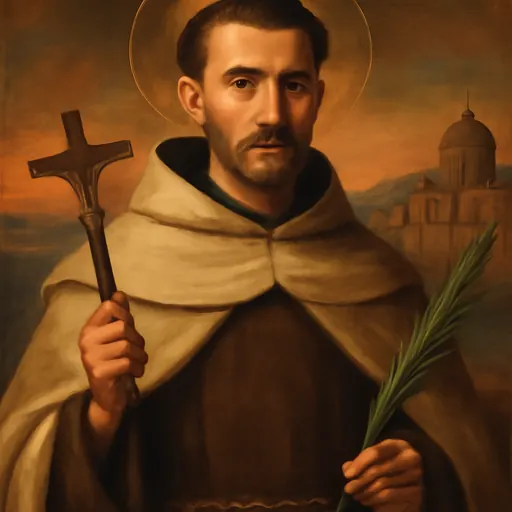
St. Angelus of Jerusalem was a Carmelite friar who, according to tradition, came from the Holy Land to preach in Sicily and was stabbed to death at Licata in 1220, forgiving his killer. His old cult was approved by Pope Pius II. We keep his feast on May 5, and he is the patron of Licata, where his relics rest.
Who was St. Angelus of Jerusalem?
St. Angelus of Jerusalem was one of the first saints of the Carmelite Order: a friar who, according to the Carmelite tradition, came from the Holy Land to Sicily and was killed while preaching at Licata on May 5, 1220. Licata calls him simply Sant'Angelo, its patron, and keeps his body in a silver urn in the church built where he fell.
His story reaches us in two layers. The first is an old and certain devotion: the Carmelites honored him as a saint at least from 1456, his feast first appears in their breviary in 1458, and Pope Pius II approved the cult. The second is a long Life that claims to be written by his brother Enoch, Patriarch of Jerusalem. The Catholic Encyclopedia explains that this Life is "a work of the fifteenth century" and unreliable where it can be checked, and that the breviary readings before 1579 called him simply "a Sicilian by birth." We tell his story as the Carmelites and the people of Licata tell it, and say plainly where history ends.
The life of St. Angelus
Jerusalem and Mount Carmel
According to his traditional Life, Angelus was born in Jerusalem in 1185 to Jewish parents, Jesse and Mary, who had become Christians. After their deaths he and his twin brother John entered the Carmelites and made their vows on Mount Carmel before the prior general, St. Brocard. He was ordained a priest at twenty-five and spent five years in strict penance in the desert.
Rome, Francis and Dominic
In 1218, the Life says, he was sent to Rome to ask Pope Honorius III to confirm the Carmelite Rule. There he preached in the Basilica of St. John Lateran and met St. Francis of Assisi and St. Dominic. The story goes that Angelus foretold the stigmata of Francis and Francis foretold the martyrdom of Angelus. It is a beautiful scene, but the Catholic Encyclopedia notes that the oldest lives of Francis and Dominic say nothing of it.
Preaching in Sicily
He went on to preach in southern Italy and then in Sicily, at Palermo, Cefalù, Caltabellotta, Muxaro and Agrigento, against the Cathar teaching that was spreading on the island. At Licata he met a local lord named Berengar, a Cathar who was living in an incestuous union. Angelus persuaded the woman to leave him.
The martyrdom at Licata
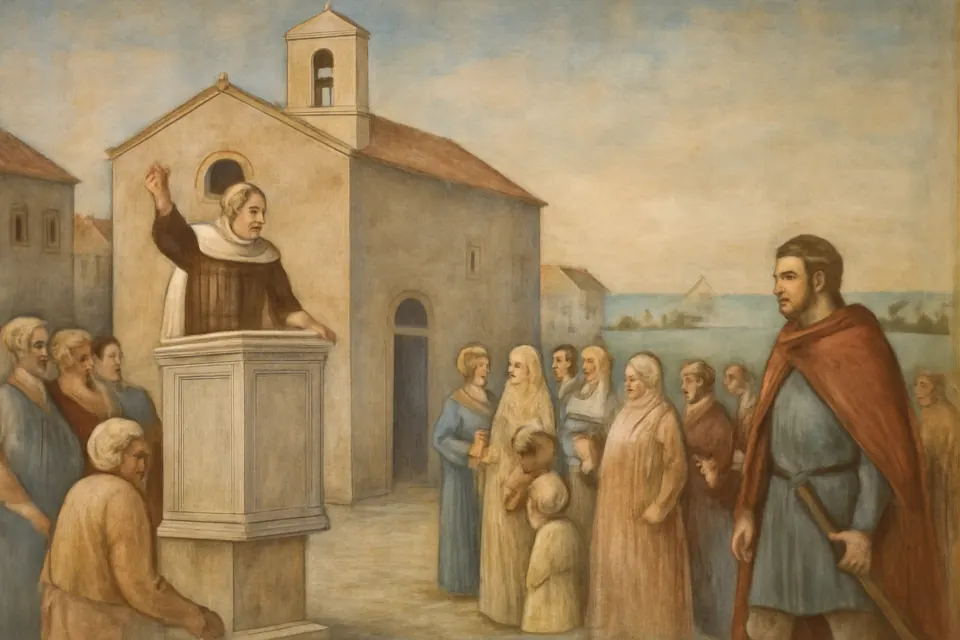
Berengar's revenge was swift. He attacked Angelus as he preached from the pulpit outside the little church of Sts. Philip and James, striking him with five sword blows. Angelus died of his wounds, asking the people of Licata to forgive his murderer. The sanctuary dates his death to May 5, 1220; other accounts give 1225. He was buried in the same church, and his grave drew pilgrims at once.
The miracles of St. Angelus
His Life is full of wonders: healings of seven lepers on his way through Sicily, the gift of speech to a mute man, and the casting out of demons. These are traditional, carried by a late and uncertain source.
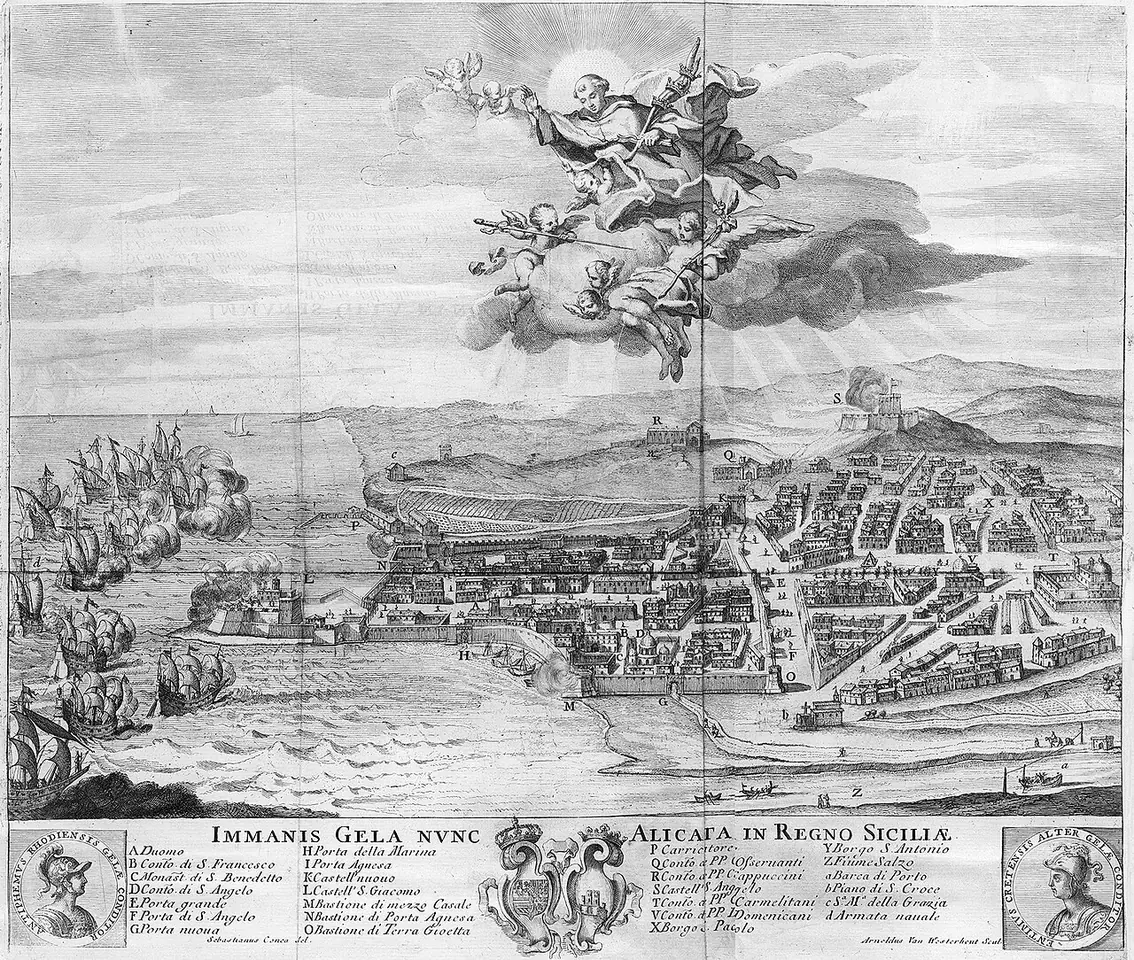
The city's own memory is stronger. Licata credits his intercession with ending the plague of June 1625; in thanksgiving it added a second feast on August 16 of that year and began rebuilding his church. The city also keeps three anniversaries for earthquakes it believes he spared it from, on January 11 (1693), February 5 (1783) and December 28 (1908). These are reported graces, kept by a whole city for centuries, though never examined by a Church inquiry.
Why St. Angelus is the patron of Licata
He died in Licata, his body has stayed there for eight centuries, and the city has turned to him in plague and earthquake. The sanctuary calls him "Santo Patrono di Licata." Palermo also counts him among its protectors, and the village of Sant'Angelo Muxaro, which bears his name, honors him as its principal patron. See more on our patron saints page.
Symbols of St. Angelus in art
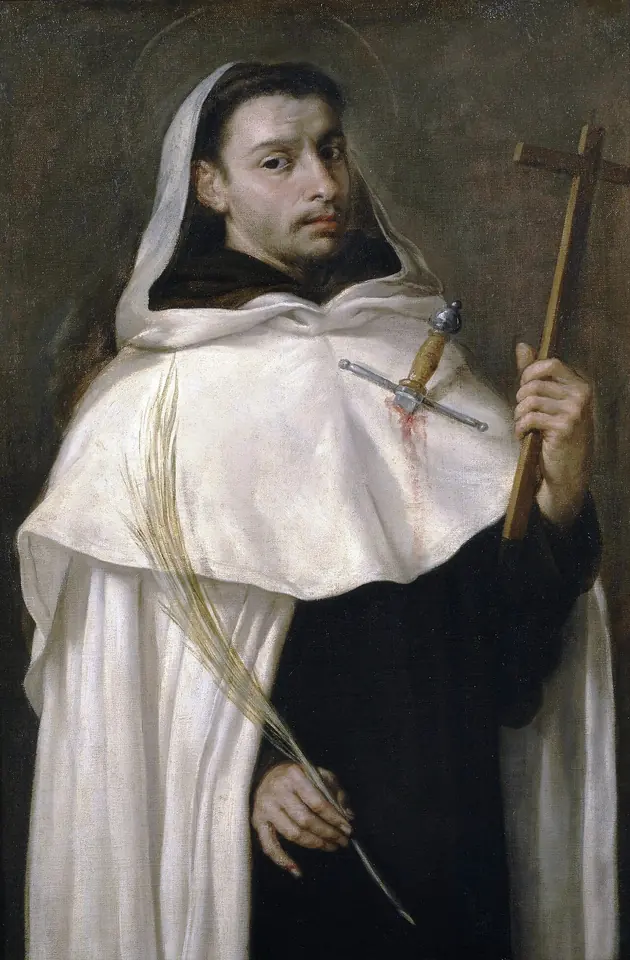
- Carmelite habit and white cloak: the dress of his order. The Catholic Encyclopedia names him and St. Albert of Trapani as the two saints of the Carmelites in the thirteenth century, and the order's painters liked to pair them.
- Sword in the breast or head: the weapon of his martyrdom.
- Martyr's palm: his victory through death.
- Three crowns: for his virginity, his preaching and his martyrdom.
- Crucifix or book: the preacher of the Gospel.
To tell him from St. Albert of Trapani, look for the sword and palm: Albert, who was not a martyr, usually holds a lily and a book. Pereda's 1667 canvas in the Prado on this page is one of the finest images of him.
His feast, his urn and his sanctuary
Licata's great feast is May 5. It opens on the evening of May 4 with solemn vespers and the moving of his relics from their chapel to the high altar. On the morning of the feast come the mule parate, mules dressed in peacock feathers, flowers and silk, bringing gifts to the saint, and that evening the silver urn is carried through the crowded streets.

The urn itself was ordered from the Ragusa silversmith Lucio de Anizi on December 6, 1621, and the relics were moved into it in the spring of 1623. Its panels show his life: pirates chasing his ship, his preaching at the Lateran, the attack at Sts. Philip and James and his death. The church above his grave was rebuilt after the plague, opened in 1662 and consecrated in 1733. It was closed for safety from 1996 to 2005, made a diocesan sanctuary in 2010, and in 2020 given back to the Carmelites.
Prayer to St. Angelus
The Sanctuary of Licata prays to its patron with a prayer that begins:
O glorioso Sant'Angelo, gemma preziosa della mistica vigna del Carmelo, perfetto seguace del patriarca Elia, specchio di ogni eroica virtù...
In English, it calls him a precious jewel of the mystical vineyard of Carmel and a perfect follower of the prophet Elijah. It asks him to uphold our faith and raise our hope, and it closes by asking him to remember Licata and all its people, at home and scattered through the world, and to keep protecting them from every scourge. Let us join that prayer: St. Angelus, who forgave the man who killed you, pray for us, that we may preach Christ with courage and forgive those who wound us. Find other saints of May on our feast days page.
Frequently asked questions
Who was St. Angelus of Jerusalem?
A Carmelite friar and martyr, also called Angelus of Sicily or of Licata. His traditional Life says he was born in Jerusalem in 1185 to Jewish parents who became Christians, entered the Carmelites on Mount Carmel, and was killed while preaching at Licata in 1220.
When is the feast of St. Angelus?
May 5, the day of his martyrdom. Licata also keeps a second feast in August in thanksgiving for its deliverance from plague in 1625.
Where are the relics of St. Angelus?
In a silver urn made between 1621 and 1623, in his chapel at the Sanctuary of Sant'Angelo in Licata, Sicily. The urn is carried through the city in procession on his feast.
How is St. Angelus shown in art?
As a Carmelite in a brown habit and white cloak, with a sword in his breast or head, a martyr's palm and sometimes three crowns, for virginity, preaching and martyrdom.
Keep exploring
Sources
- The Carmelite Order, Catholic Encyclopedia (1908). The 15th-century date of his Life, its unreliable details, and the first appearance of his feast in 1458
- Sant'Angelo: la vita, Santuario di Sant'Angelo, Licata
- Le reliquie di Sant'Angelo, Santuario di Sant'Angelo, Licata. The silver urn of 1621–1623 and its return to the sanctuary in 2005
- Le ricorrenze della festa di Sant'Angelo, Santuario di Sant'Angelo, Licata. The May and August feasts, the plague of 1625 and the earthquake anniversaries
- Il Santuario, Santuario di Sant'Angelo, Licata
- Preghiere e canti, Santuario di Sant'Angelo, Licata. The prayer to St. Angelus quoted on this page
- Sant'Angelo da Gerusalemme (di Sicilia), Santi e Beati