St. Nino, Enlightener of Georgia

St. Nino (also called Nina) was a 4th-century Christian woman who came to Iberia, in present-day Georgia, as a captive, healed the queen through prayer and led King Mirian and his people to Christ. The Orthodox Church honors her as Equal-to-the-Apostles and Enlightener of Georgia; her feast day is January 14 (January 27 in Georgia).
Who was St. Nino?
St. Nino, also called Nina, is the woman who brought the Christian faith to Georgia in the 4th century. She came to the kingdom of Iberia, which Georgians call Kartli, as a stranger and a captive. Through her prayers a sick child and then the queen were healed, the king turned to Christ, and the royal family asked the emperor Constantine to send them bishops. The Orthodox Church honors her as Equal-to-the-Apostles and Enlightener of Georgia, and Georgians still trace their faith to her.
We have two kinds of sources for her life, and it helps to keep them apart. The oldest is the Church History of Rufinus of Aquileia, written around 402. Rufinus says he heard the story from Bacurius, an Iberian prince who later served as a Roman general. His version was retold by the Greek historians Socrates and Sozomen. It never gives the woman's name. The fuller story, with her name, her family, her vision of the Mother of God and the grapevine cross, comes from Georgian tradition, written down in chronicles centuries later and kept in the lives the Orthodox Church reads on her feast.

The life of St. Nino
A girl from Cappadocia
Georgian tradition, as the Orthodox Church in America tells it, says Nino came from Cappadocia, in the middle of present-day Turkey, and was a relative of the great martyr St. George. Her father, Zabulon, was an officer in the Roman army; her mother, Sosana, was a sister of the patriarch of Jerusalem. When Nino was twelve the family moved to Jerusalem. Her father became a monk in the Jordan wilderness, her mother served as a deaconess, and Nino was raised by a devout old woman named Sara Niaphor.
From Sara she heard about Iberia, a pagan land where, Georgian tradition holds, the robe of Christ had been brought after the Crucifixion, and she began to pray that she might go there.
The grapevine cross
The Mother of God answered her in a dream. According to the Georgian life, the Virgin told her, "Go to the country that was assigned to me by lot and preach the Gospel of our Lord Jesus Christ." When Nino protested that she was only a weak girl, Mary gave her a cross made of grapevine stems and said, "Receive this cross as a shield against visible and invisible enemies!" Nino woke holding the cross and bound it together with strands of her own hair. (Another version says the Virgin bound it with her own hair.) This story is traditional, and the cross it describes became the symbol of the Georgian Church.

The tradition adds that Nino traveled with St. Rhipsime and other consecrated virgins who were martyred in Armenia, and that she escaped by hiding among rose bushes and crossed the mountains into Iberia alone.
The captive in Mtskheta
Here the two kinds of sources meet. Rufinus, as Socrates retells him, says simply that "a certain woman leading a devout and chaste life" was "taken captive by the Iberians." The people marveled at her fasting and prayer. Georgian tradition says she lived in the royal city of Mtskheta in a little shelter under a bramble bush in the king's garden, with the family of the royal gardener, and that when she saw the crowds worshiping the great idol Armazi on the hill above the city, she prayed, and a storm of wind and hail threw the idols down. The storm is traditional.
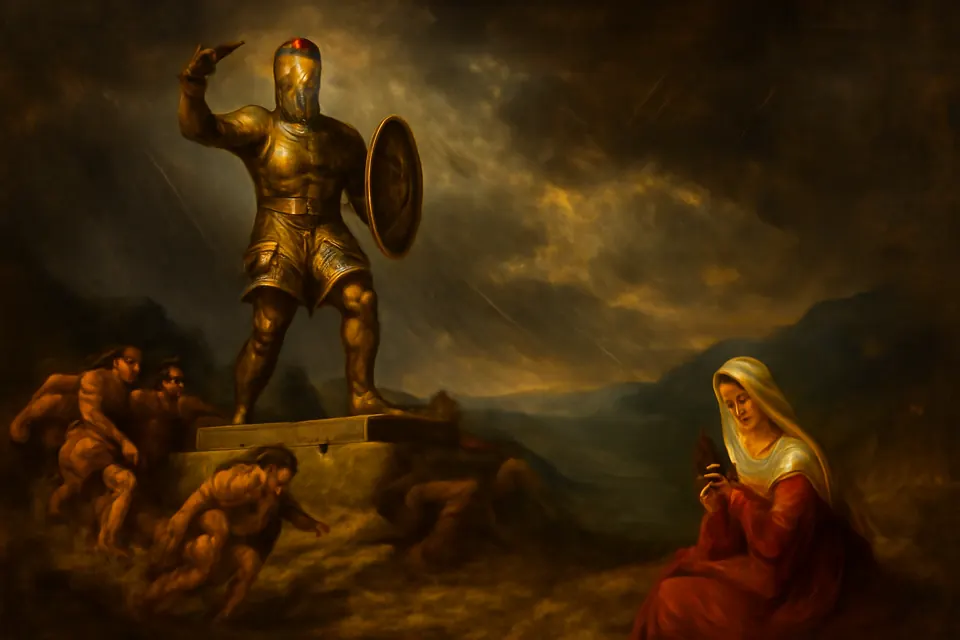
The healing of a child and the queen
Rufinus tells what happened next. A little son of the royal house fell sick, and by local custom his mother had him carried from house to house so the women could suggest a cure. Nothing helped, and at last they brought him to the captive. She used no medicine. She laid the child on her bed of horsecloth and said, "Christ, who healed many, will heal this child also," and prayed, and the boy recovered.
The news reached the queen, whom Georgian tradition names Nana. When she fell gravely ill herself, the captive, being modest, would not go to the palace, so the queen was carried to her and was healed in the same way. The queen tried to thank her, and she answered, in Socrates's words, "this work is not mine, but Christ's, who is the Son of God that made the world." She sent back the king's gifts. Both healings are reported by Rufinus, who wrote within living memory of the conversion and learned it from a member of the Iberian royal family.
King Mirian in the darkness
The king, Mirian in Georgian tradition, was not yet won over. The next day he went hunting, and a thick mist and darkness came down on the mountain forest so that he and his men lost their way. He called on his gods and nothing happened. Then he called on the captive's God, and the darkness lifted at once. The Georgian life gives his prayer: "God of Nino, illumine this night for me and guide my footsteps, and I will declare Thy Holy Name." Rufinus reports the darkness and its lifting; this is a reported miracle.
Mirian asked the woman to teach him. Then, Socrates says, he gathered his people and "exhorted them to worship the God of the captive," and "both the king and the queen were made preachers of Christ, the one addressing their male, and the other their female subjects."

The living pillar
The king began a church in Mtskheta, on the plan the captive described from the churches of the Romans. When the builders came to raise the columns, one would not move. Ropes snapped and the machinery broke. That night the woman went alone to the site and prayed until dawn. In the morning the king found the great pillar standing upright in the air above its base, not touching it, and while everyone watched it settled gently onto its pedestal. The people shouted praise to "the God of the captive" and finished the church quickly. This is the third miracle Rufinus reports. Georgian tradition places that church where Svetitskhoveli Cathedral, "the Life-Giving Pillar," stands today.

Mirian then sent envoys to Constantine asking for an alliance and for "a bishop and consecrated clergy." This was in Constantine's reign, which ended in 337; Georgian tradition dates the conversion of Kartli to the 320s or 330s.
Her death at Bodbe
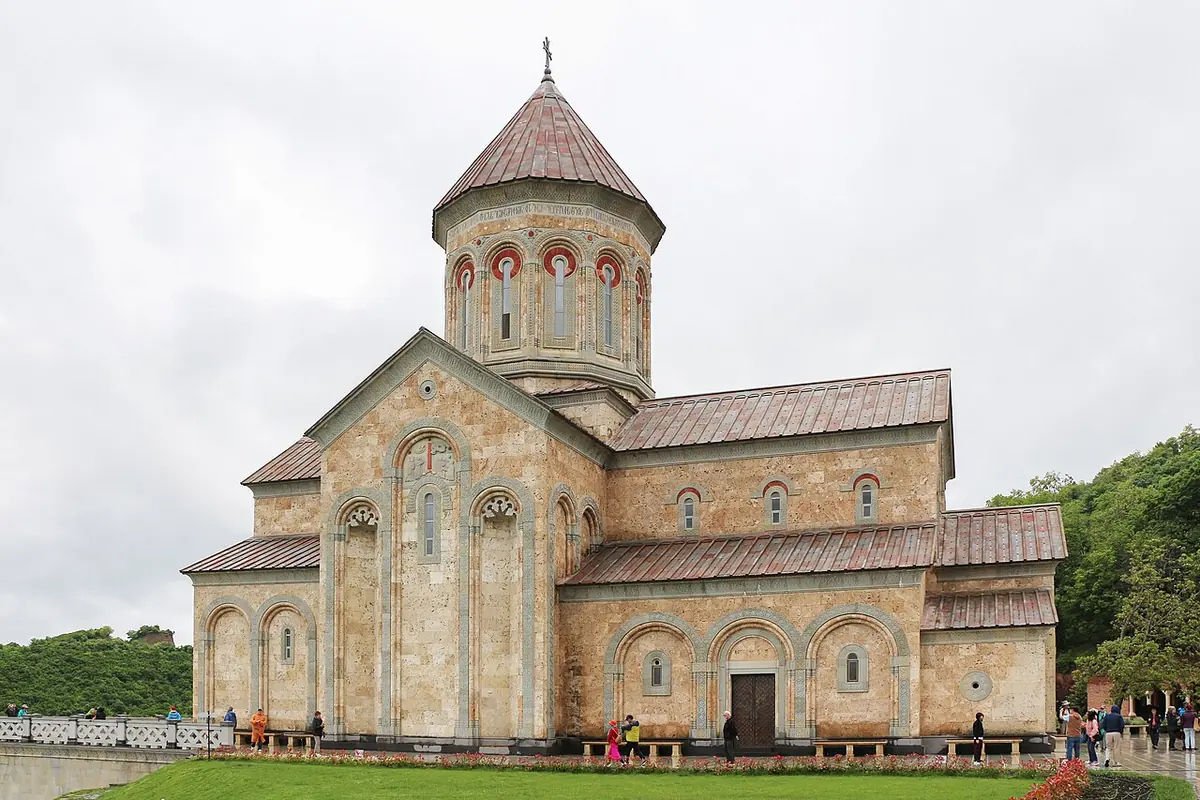
Nino kept preaching in the mountain villages. She died at Bodbe, in Kakheti in the east of the kingdom, and asked to be buried where she died. King Mirian built a church over her grave, the Orthodox life says, in honor of St. George. Georgian tradition places her death around 335 or a few years later.
The miracles of St. Nino
None of St. Nino's miracles has been investigated in the way modern canonizations require. The healings, the lifting of the darkness and the living pillar are reported by Rufinus around 402; the grapevine cross and the storm at Armazi are traditional, from the Georgian life. The greatest sign is a nation that has kept the faith for some seventeen centuries.
Why St. Nino is the patron saint of Georgia
She is Georgia's spiritual mother, its first teacher of the faith. Her troparion calls her "enlightener of Iberia" and says she "equaled the first-called Apostle Andrew in preaching," because Georgian tradition also says St. Andrew preached in the land. The Georgian Church has made her cross its emblem, and with St. George she is the patron Georgians call on most. When Pope Francis celebrated Mass in Tbilisi on October 1, 2016, he praised the grandmothers and mothers who "unceasingly defend and pass on the faith that was sown in this land of Saint Nino." See more national patrons on our patron saints page.
Symbols of St. Nino in art
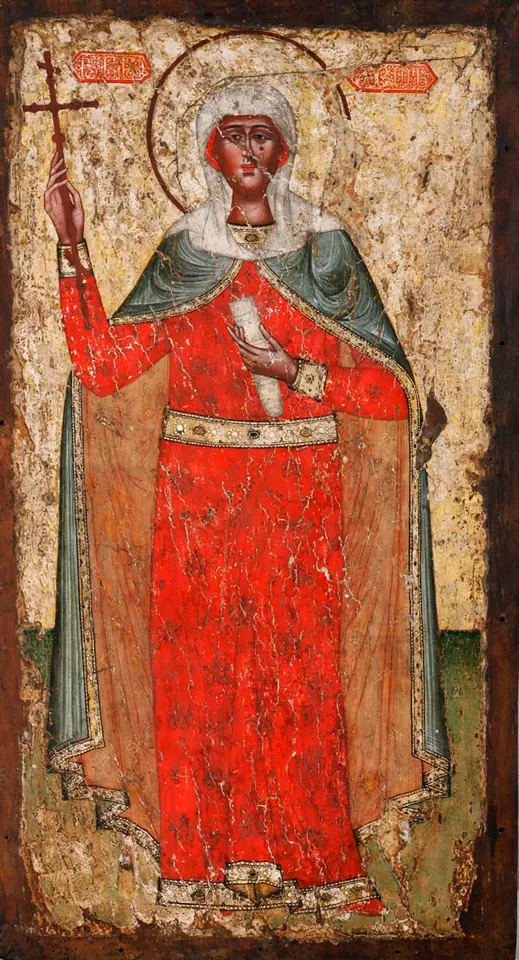
St. Nino is one of the easiest saints to recognize in an icon. Look for:

- The grapevine cross: a cross of two vine stems whose arms droop slightly downward, sometimes shown bound at the center with her hair. It is her main attribute and the emblem of the Georgian Church.
- The Book of the Gospels: usually in her other hand, for her preaching.
- A white or blue veil and a long red mantle: the dress of a holy virgin and teacher.
- A raised right hand: in some frescoes she lifts her hand in the gesture of a preacher.
Georgian icons usually show her standing alone, full length, as in the Shiomgvime icon above; 19th-century Russian prints like the Odessa icon give her a gold background and a youthful face. Narrative cycles show her healing the queen or praying beside the pillar, as on the walls of the ruined church of Tigran Honents at Ani, now in eastern Turkey.
Feast days, the grapevine cross and pilgrimage
The Orthodox Church celebrates St. Nino on January 14. The Georgian Orthodox Church follows the Julian calendar, so in Georgia her great feast, Ninooba, falls on January 27 of the civil calendar, and families who have a Nino or Nina celebrate their name day. The Roman Martyrology remembers her on December 15, describing how the queen, whose son she had healed by her prayers, the king and all the people embraced the Christian faith. Find her neighbors in the year on our feast days page.
Pilgrims go above all to Bodbe, near Sighnaghi in Kakheti, where her tomb lies in the church of a working convent. In Mtskheta, the Samtavro convent marks the place of her bramble-bush shelter by tradition, and Svetitskhoveli Cathedral stands on the site of the first church.
The grapevine cross itself had a long journey. The Great Synaxarion says it was hidden from invaders for centuries in Armenia and in the mountains, taken to Russia in 1749 and given back to Georgia in 1801. It is kept today in a silver case by the north pillar of the sanctuary in Sioni Cathedral, Tbilisi.
Prayer to St. Nino
The Orthodox Church sings two hymns on her feast. The troparion (Tone 4) calls her a handmaiden of the Word of God who matched the apostles in preaching and enlightened Iberia. The kontakion (Tone 2) invites us to sing praise to the chosen preacher who brought the people of Kartli to the path of life and truth, a disciple of the Mother of God. The OCA prints the full text on its website.
We may also make our own the words the captive spoke over the sick child, "Christ, who healed many, will heal this child also," and ask St. Nino to pray for the sick, for Georgia, and for all who carry the faith to those who have not yet heard it. Holy Nino, pray for us.
Frequently asked questions
Who was St. Nino?
St. Nino was a 4th-century Christian woman who brought the faith to Georgia, then called Iberia or Kartli. The historian Rufinus, writing around 402, tells how a captive woman's prayers healed a sick child and the queen, how the king found his way out of darkness by calling on her God, and how the royal family asked Constantine for bishops. Georgian tradition names her Nino and says she came from Cappadocia.
What is the grapevine cross of St. Nino?
Georgian tradition says the Virgin Mary appeared to Nino in a dream and gave her a cross made of grapevine stems, and that Nino bound it with strands of her own hair. The cross, with its gently drooping arms, became the symbol of the Georgian Church. A cross venerated as hers is kept at Sioni Cathedral in Tbilisi.
When is St. Nino's feast day?
The Orthodox Church keeps January 14. Because the Georgian Orthodox Church follows the Julian calendar, Georgians celebrate it on January 27 of the civil calendar, a feast called Ninooba. The Roman Martyrology commemorates her on December 15.
Is St. Nino Catholic or Orthodox?
Both. She lived centuries before the split between East and West. The Roman Martyrology lists her on December 15, and Pope Francis, celebrating Mass in Tbilisi in 2016, called Georgia "this land of Saint Nino." She is most loved in the Georgian Orthodox Church, which honors her as its founder.
Where is St. Nino buried?
At Bodbe, in the Kakheti region of eastern Georgia, near the town of Sighnaghi. She died there and asked to be buried where she died; King Mirian built a church over her grave. The Monastery of St. Nino at Bodbe is a convent today and one of Georgia's great places of pilgrimage.
Keep exploring
Sources
- Socrates Scholasticus, Church History, Book I, ch. 20: How the Iberians were converted (following Rufinus)
- Sozomen, Ecclesiastical History, Book II, ch. 7
- Orthodox Church in America: Saint Nino (Nina), Equal of the Apostles, Enlightener of Georgia
- Orthodox Church in America: Saint Nino, troparion and kontakion
- Catholic.net (Spanish): Nino (Nina, Cristiana) de Georgia, Santa, with the Roman Martyrology entry
- Pope Francis, Homily at Mass in M. Meskhi Stadium, Tbilisi (October 1, 2016)
- Concerning the Cross of Saint Nina, from the Great Synaxarion (Mystagogy Resource Center)