Blessed Jerzy Popiełuszko

Blessed Jerzy Popiełuszko (1947–1984) was a Polish priest in Warsaw who became the chaplain of the Solidarity movement and preached the monthly Masses for the Homeland under communist rule. Officers of the secret police kidnapped and killed him on October 19, 1984. The Church declared him a martyr, and he was beatified in 2010. We keep his feast on October 19.
Who was Blessed Jerzy Popiełuszko?
Blessed Jerzy Popiełuszko was a young Polish priest of Warsaw who stood with the workers of the Solidarity movement in the dark years of martial law, and who was murdered for it by officers of the communist secret police on October 19, 1984. He was 37. The Church has declared him a martyr, killed out of hatred for the faith, and we keep his feast on October 19.
He was not a politician and never wanted to be one. He was a parish priest who prayed with frightened people, heard their confessions, and told them from the pulpit that they had a dignity no government could take away. His whole message fits in one line of St. Paul that he made his own: overcome evil with good.
A farm boy from Okopy
He was born on September 14, 1947, in Okopy, a farming village near Suchowola in northeastern Poland, into a family of devout country people. He was baptized Alfons and later took the names Jerzy Aleksander. From his family he inherited a deep devotion to Our Lady, which the decree on his martyrdom names as one of the roots of his priesthood.
He entered the seminary of Warsaw, but after a year the communist state drafted him into the army. The two years of military service were his first real trial: according to the decree on his martyrdom, he was persecuted for his faith while in uniform. He went back to the seminary, and on May 28, 1972, Cardinal Stefan Wyszyński ordained him a priest. For his first Mass he chose the words of Isaiah that Jesus read in Nazareth: God has sent me to bring good news and to bind up broken hearts.
Chaplain to the workers
His health was never strong, and after several years as a curate he was sent to live at the parish of St. Stanislaus Kostka in the Żoliborz district of Warsaw. It was 1980, two years after the election of St. John Paul II. When the steelworkers of Warsaw went on strike that August, they asked for a priest to say Mass for them. Father Jerzy went, and from then on he was their chaplain.

The Masses for the Homeland
When the regime declared martial law in December 1981, arresting thousands and banning Solidarity, Father Jerzy began a monthly Mass for the Homeland at St. Stanislaus Kostka. People came from all over Poland. The crowds filled the church, the churchyard and the streets around it. In his homilies he defended religious freedom, freedom of conscience, human rights and justice, and he begged the people never to answer violence with violence.
The Dicastery for the Causes of Saints records how he ended his last Mass, on October 19, 1984. He asked the people to pray "to be free from fear, from terror, but above all from the desire for revenge," and said: "We must overcome evil with good and keep our human dignity intact; for that reason we cannot use violence" (our translation).
He was also, the decree says, a tireless confessor, and he cared for people broken by their own mistakes as tenderly as for the brave.

"I cannot leave these people"
The state answered with a campaign of slander, police harassment, interrogations and a trial on political charges. He received threatening letters and obscene phone calls. Knowing that he was risking his life, he kept repeating, in words his cause has preserved: "I cannot abandon these people, who hear the teaching of the Church through my voice, and think only of myself. I must stay with them to the end."
Near the end he said: "I have overcome the barrier of fear. I am no longer afraid. I am ready for anything. I have trusted in God."
His martyrdom
A first attempt on his life failed on October 13, 1984. Six days later, as he drove home from a Mass in Bydgoszcz, three officers of the Ministry of the Interior stopped his car, beat him savagely, bound him and threw him into the trunk. He died of the beating that same day. His body, weighted with stones, was thrown into the Vistula River at the dam near Włocławek. Fear of an uprising forced the authorities to investigate, and his body was found on October 30.
Half a million people came to his funeral in Warsaw. He was buried beside the church where he had preached, and the Dicastery reports that more than 18 million people have since prayed at his grave.

Beatification and the cause for canonization
The Archdiocese of Warsaw held the diocesan inquiry from 1997 to 2001. Pope Benedict XVI approved the decree on his martyrdom on December 19, 2009, and Father Jerzy was beatified in Warsaw on June 6, 2010. That day, speaking from Cyprus, the Pope called his service and martyrdom "a special sign of the victory of good over evil."
A martyr needs no miracle for beatification, but one is needed for canonization. The healing of a Frenchman, François Audelan, from leukemia in 2012 was proposed. It remains reported, not approved: in January 2023 it was reported that two teams of doctors consulted by the Dicastery found the recovery medically possible. His cause continues.

Symbols of Blessed Jerzy Popiełuszko in art
He lived in the age of photography, so the oldest images of him are photographs, and his paintings follow them closely.
- Red vestments: the color of martyrs. His beatification portrait shows him in a red chasuble.
- Priest's stole and Mass vestments: he died as a priest, for preaching from the altar.
- Rosary: the Marian devotion he inherited from his family.
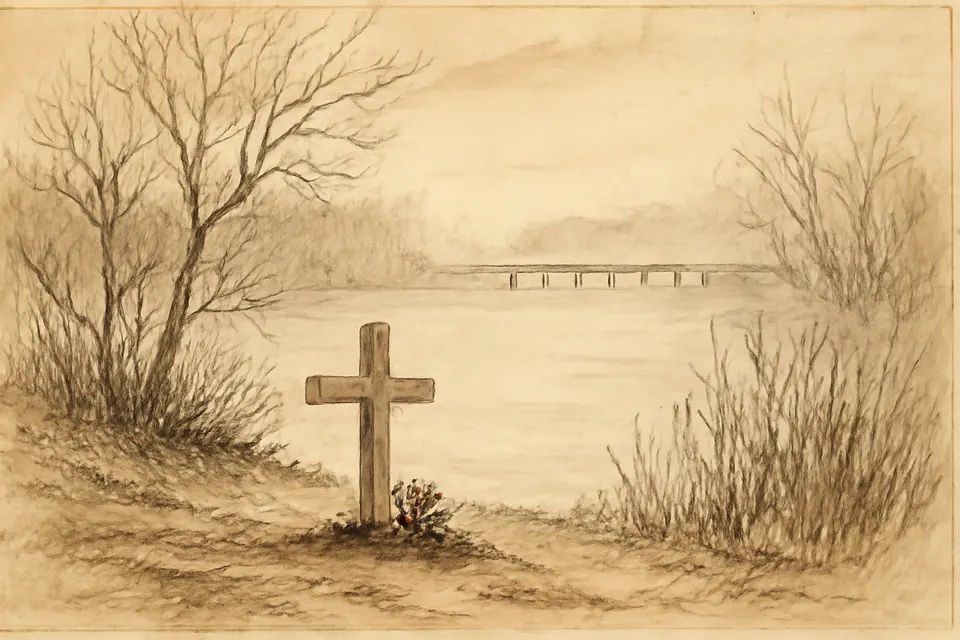
- Cross: often a simple wooden cross, like the one by the Vistula where his body was thrown.
- Solidarity banners and Polish flags: the workers he served, often shown around his grave.
Feast day and prayer
We keep his feast on October 19. See the feast day calendar.
We know of no traditional prayer to him in public-domain form. Let us pray with his own words in mind: may we be free from fear and from the desire for revenge, and overcome evil with good. Blessed Jerzy, pray for priests, for workers, and for everyone who suffers under injustice.
Frequently asked questions
Who was Blessed Jerzy Popiełuszko?
A Catholic priest of the Archdiocese of Warsaw, born in 1947 in the village of Okopy in northeastern Poland. From 1980 he ministered to the workers of the Solidarity movement, and his monthly Masses for the Homeland at St. Stanislaus Kostka Church drew thousands. Three officers of the Ministry of the Interior murdered him on October 19, 1984, at the age of 37.
When is Blessed Jerzy Popiełuszko's feast day?
October 19, the day he was killed in 1984.
Why is Jerzy Popiełuszko a martyr?
Because the Church judged that he was killed out of hatred for the faith. The Dicastery for the Causes of Saints found that the political charges brought against him were used "to cover the hatred of the faith that stood behind them." Pope Benedict XVI approved the decree on his martyrdom on December 19, 2009, and he was beatified on June 6, 2010.
Is there a miracle for Jerzy Popiełuszko's canonization?
Not yet an approved one. The healing of a Frenchman, François Audelan, from leukemia in 2012 was sent to Rome as a possible miracle, but in January 2023 it was reported that the Dicastery's medical experts had judged the recovery medically explainable. The search for a miracle continues, and his cause for canonization remains open.
Keep exploring
Sources
- Dicastery for the Causes of Saints: Jerzy Popiełuszko (1947–1984), biography and decree on martyrdom. His birth, baptismal name, ordination, the Masses for the Homeland, his words before death, the kidnapping, the 18 million visitors to his tomb, and the decree of December 19, 2009
- Pope Benedict XVI, Angelus, Nicosia, June 6, 2010. The Pope's greeting to Poland on the day of the beatification
- Notes From Poland: Sainthood of Polish priest murdered by communists delayed after miracle not proven (January 24, 2023). The proposed French miracle and the medical verdict