St. Didymus the Blind, the Sightless Teacher of Alexandria
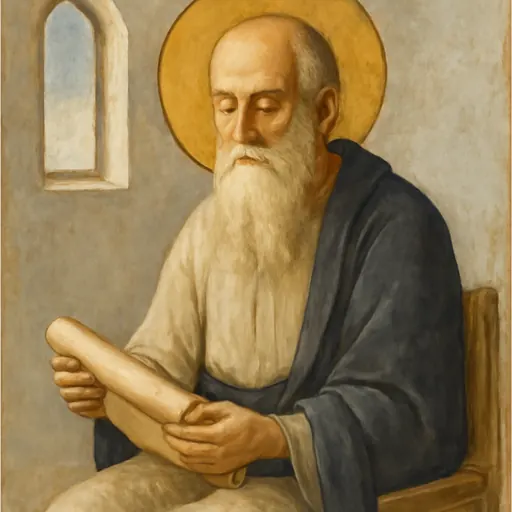
St. Didymus the Blind (about 313–398) lost his sight at four, yet became one of the most learned Christians of his age and led the catechetical school of Alexandria for about fifty years. St. Antony visited him, St. Jerome studied with him, and he wrote against the Arians on the Trinity and the Holy Spirit. The Orthodox Church commemorates him on October 18.
Who was St. Didymus the Blind?
St. Didymus the Blind was a teacher of the Church in Alexandria, Egypt, in the fourth century. He lost his sight at four, never learned to read, and still became one of the most learned men of his time, mastering the whole of Scripture by ear. For about fifty years he led the famous catechetical school of Alexandria. The Orthodox Church commemorates him on October 18.
His story is also complicated. Didymus admired Origen, and two centuries after his death the Church condemned Origenist ideas that his books contained. That is why most of his writings were lost, and why the Catholic calendar does not keep his feast, even though Catholic writers have always honored his defense of the Trinity.
The life of Didymus
Blind from childhood
Palladius, who visited him four times over ten years, wrote down what Didymus told him: he had lost his sight at the age of four, "and he had never learned to read nor gone to school." According to his pupil Rufinus, he prayed as a young man not for the sight of his eyes but for the light of the heart. He learned by listening. Readers read to him through long vigils, and when a reader nodded off from weariness, Didymus kept going over what he had heard, until, in the words the Catholic Encyclopedia takes from Rufinus, he "chewed the cud" of it and it was inscribed on the pages of his mind.
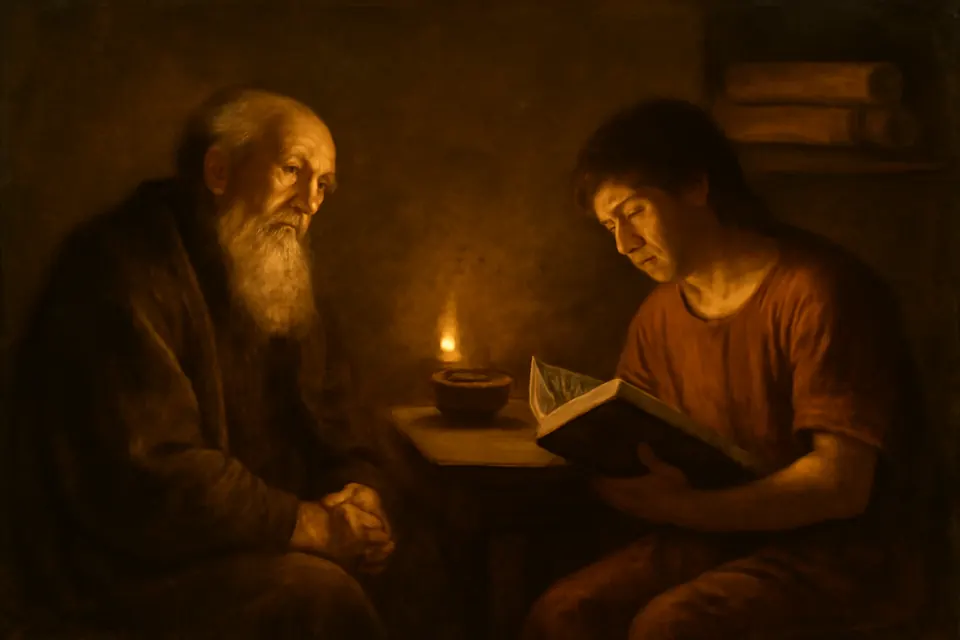
In this way he learned grammar, rhetoric, logic, music, arithmetic and geometry, and above all the Bible. St. Jerome wrote that he "displayed such a miracle of intelligence as to learn perfectly dialectics and even geometry, sciences which especially require sight." Palladius applied the psalm to him: "The Lord maketh the blind wise."
Head of the school of Alexandria
Didymus was placed early at the head of Alexandria's catechetical school and led it for roughly half a century. St. Athanasius, the great bishop of the city, thought highly of him. He remained a layman all his life and lived as an ascetic, in the city rather than in the desert. Rufinus studied with him for six years. Jerome came for a month to have his questions on hard passages of Scripture answered, and Jerome liked to call him not "the Blind" but "the Seer."
St. Antony's visit
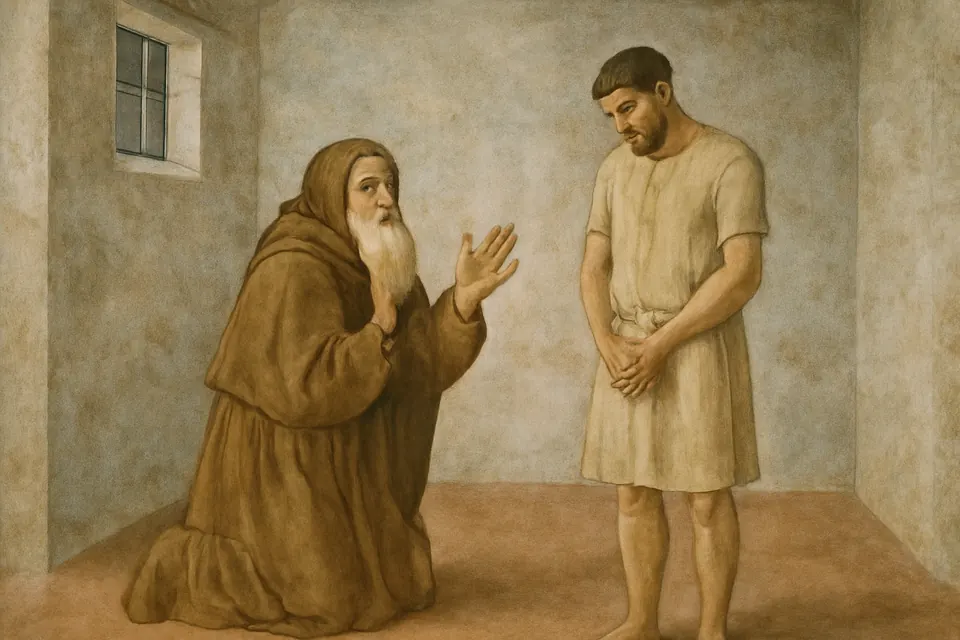
St. Antony the Great used to stay with Didymus when he came in from the desert. Didymus once admitted to him that his blindness grieved him. Antony answered, as the Catholic Encyclopedia retells it from Rufinus, that he wondered how a wise man could mourn the loss of what he shared with ants, flies and gnats, instead of rejoicing in the spiritual sight he shared with the saints and apostles. Didymus also told Palladius how Antony gave him a lesson in humility:
Into this cell Antony entered for the third time on a visit to me. I besought him to say a prayer and he instantly knelt down in the cell and did not make me repeat my words, giving me by his action a lesson in obedience.
The vision of Julian's death
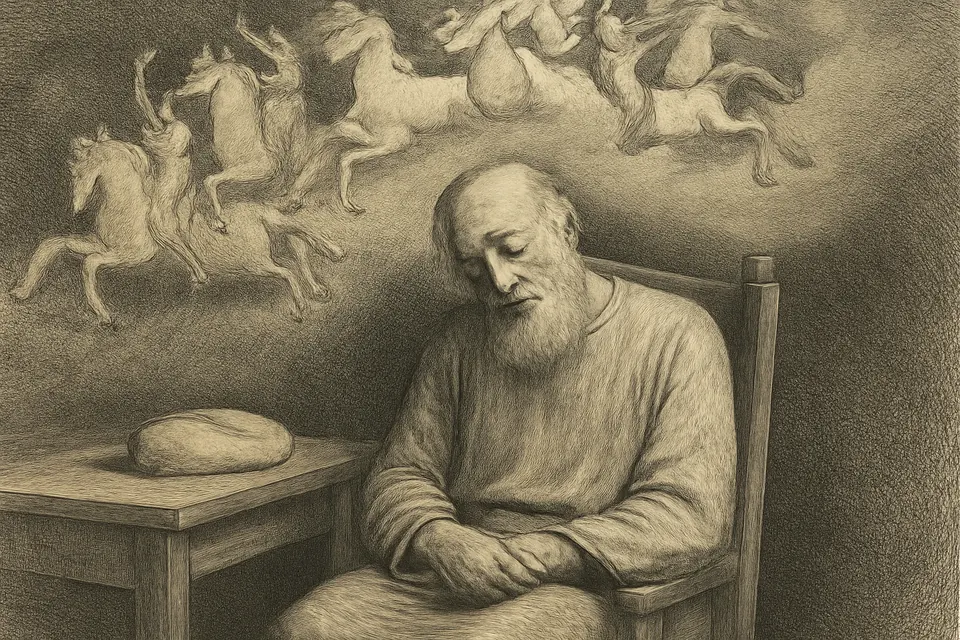
The best-known wonder of his life comes from his own lips by way of Palladius, so we count it as reported. In 363 the emperor Julian the Apostate was campaigning against the Persians. Didymus had grieved over the persecuting emperor so much that he had eaten nothing all day. He dozed in his chair and saw white horses with riders, who cried:
Tell Didymus, to-day at the seventh hour Julian died. Rise then and eat, ... and send to Athanasius the bishop, that he too may know.
He noted the hour, the day and the week, and the news, when it came, matched. The Orthodox Prologue pairs him on October 18 with St. Julian the Hermit of Mesopotamia, who is said to have seen the same death in spirit.
His teaching and his books
Didymus was one of the strongest opponents of Arianism. The Catholic Encyclopedia calls his teaching on the Trinity and on Christ "perfectly orthodox" and says he was even more explicit than Athanasius about the divinity of the Holy Spirit. He used the formula that became the Church's watchword: three hypostases, one ousia (three Persons, one essence). Jerome lists commentaries on all the Psalms, on Matthew and John, eighteen volumes on Isaiah, books on Hosea, Zechariah and Job, two books against the Arians, and On the Holy Spirit, which Jerome himself translated into Latin. That Latin version is how the book survives.
The shadow of Origen
Didymus loved Origen and followed him in some of his speculations. After the Fifth Ecumenical Council (553) condemned Origenism, Didymus was anathematized along with Evagrius Ponticus in the edict that put the council's decree into effect, and later councils repeated the condemnation. The Catholic Encyclopedia judges that "this censure is to be taken as applying to his doctrine and not to his person." Its sad result was that copyists stopped copying him, and nearly all his books disappeared.
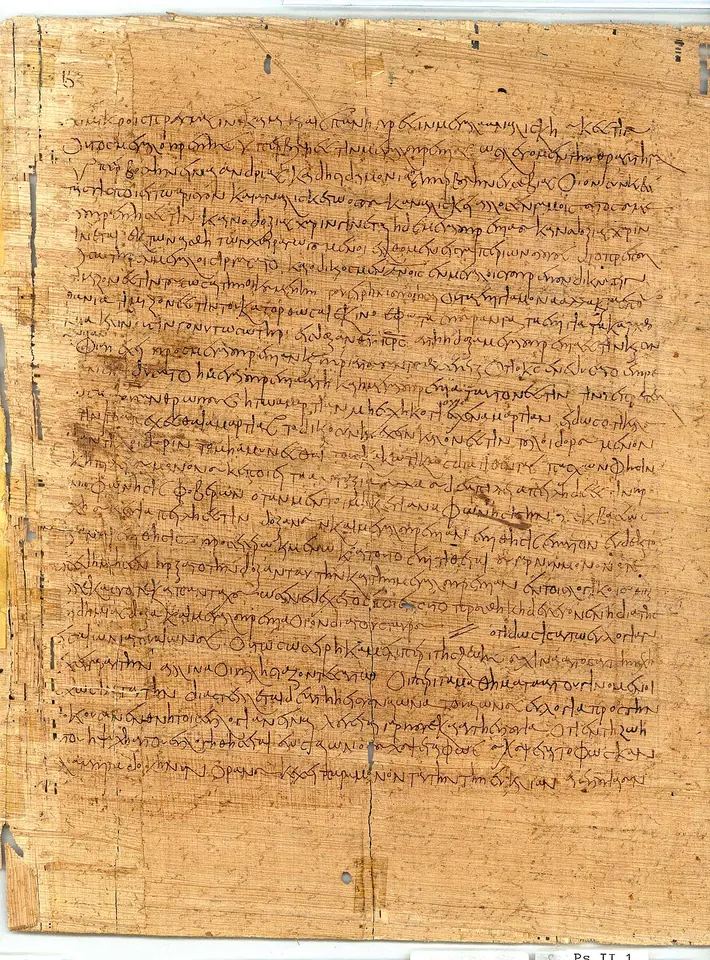
Some came back from the sand. Papyrus books of his commentaries on Zechariah, Job, Ecclesiastes and the Psalms were found at Tura, near Cairo, and their pages are now divided among Cologne, Cairo, Geneva and other collections.
Symbols of Didymus in art
Didymus is seldom painted. Where he is pictured, he is an old man with closed or sightless eyes, holding a book or scroll, sometimes seated in a teacher's chair, as in the portrait at the top of this page. Be careful with old prints labeled simply "Didymus": the desert fathers included more than one monk of that name.
Feast day and praying with Didymus
The Orthodox Church keeps his memory on October 18. In the Catholic Church he has no feast, but his book On the Holy Spirit and his witness belong to the whole Church. We have found no traditional prayer to him that we can cite.
Let us thank God for him by praying for the blind and for all who live with disability, that they may know the inner sight Antony spoke of, and for teachers and students of Scripture, that they may love the Word of God as he did.
Frequently asked questions
Who was Didymus the Blind?
A layman and ascetic of Alexandria in Egypt who was blinded as a small child but learned Scripture, theology and even geometry by listening. He headed the city's catechetical school for decades and taught or advised Rufinus, Palladius and St. Jerome.
Is Didymus the Blind a saint?
The Orthodox Church commemorates him as a saint on October 18. He was never canonized in the Catholic Church and is not on the Roman calendar. After his death some of his teachings, drawn from Origen, were condemned; the Catholic Encyclopedia explains that the censure touched his doctrine, not his person.
What did Didymus the Blind write?
Commentaries on the Psalms, Isaiah, Hosea, Zechariah, Job and the Gospels, two books against the Arians, and a book On the Holy Spirit, which St. Jerome translated into Latin. Most of his works were lost, but papyrus copies of several commentaries were found at Tura in Egypt.
How did Didymus the Blind learn without sight?
By listening. Others read to him, and Rufinus says that when the reader fell asleep, Didymus went over what he had heard until it was fixed in his memory.
Keep exploring
Sources
- Didymus the Blind, Catholic Encyclopedia (1908), New Advent. His blindness, his learning by listening (from Rufinus), St. Antony's words to him, Jerome's name 'the Seer,' his fifty years at the school, the later condemnation of his Origenism, and his doctrine of the Trinity
- Palladius, The Lausiac History, chapter 4, translated by W. K. Lowther Clarke (1918), Tertullian Project. An eyewitness account: his age at death, blindness at four, St. Antony's visit and the vision of Julian's death, quoted on this page
- Jerome, De Viris Illustribus, chapter 109, New Advent. Jerome's list of his works, including On the Holy Spirit, which Jerome translated
- Sts. Julian and Didymus the Blind, commemorated October 18, from the Prologue of Ochrid by St. Nikolai Velimirovich, Orthodox.net. The Orthodox commemoration on October 18
- Die Kölner Tura-Papyri, Institut für Altertumskunde, University of Cologne. The Tura papyrus codices of his commentaries on Zechariah, Job, Ecclesiastes and the Psalms, now divided among Cologne, Cairo, Geneva and other collections (in German)