St. Noël Chabanel, Jesuit Martyr of the Huron Mission
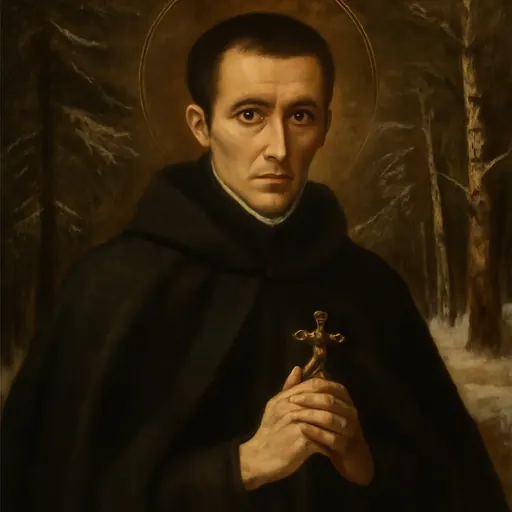
St. Noël Chabanel (1613–1649) was a French Jesuit, a brilliant teacher of rhetoric, who could never learn the Huron language and felt a deep repugnance for mission life in New France. Rather than ask to go home, he vowed in 1647 to stay among the Hurons until death. He was killed by an apostate Huron on December 8, 1649. He is one of the eight North American Martyrs, honored on October 19, and a co-patron of Canada.
Who was St. Noël Chabanel?
St. Noël Chabanel was a French Jesuit priest who served the Huron mission in New France for five hard years and died a martyr there in 1649. He is the least famous of the eight North American Martyrs, and perhaps the one ordinary Christians understand best. He did not find the mission exciting. He found it miserable. He could not learn the language, could not stomach the food, and felt no consolation in prayer. He stayed anyway, and bound himself by vow to stay until death.
The Jesuit superior Paul Ragueneau, who wrote his story in the Relation of 1650, called him the sixth victim God had taken from the Huron mission.
The life of St. Noël Chabanel
A gifted teacher
Noël Chabanel was born on February 2, 1613, at Saugues, in the mountains of the Haute-Loire. He entered the Jesuit novitiate at Toulouse on February 9, 1630, at seventeen. He taught in the college at Toulouse, studied theology, made his tertianship, and taught rhetoric at Rodez. Ragueneau says he had done this "successfully" for some years, and was deficient "neither in memory nor mind."
New France
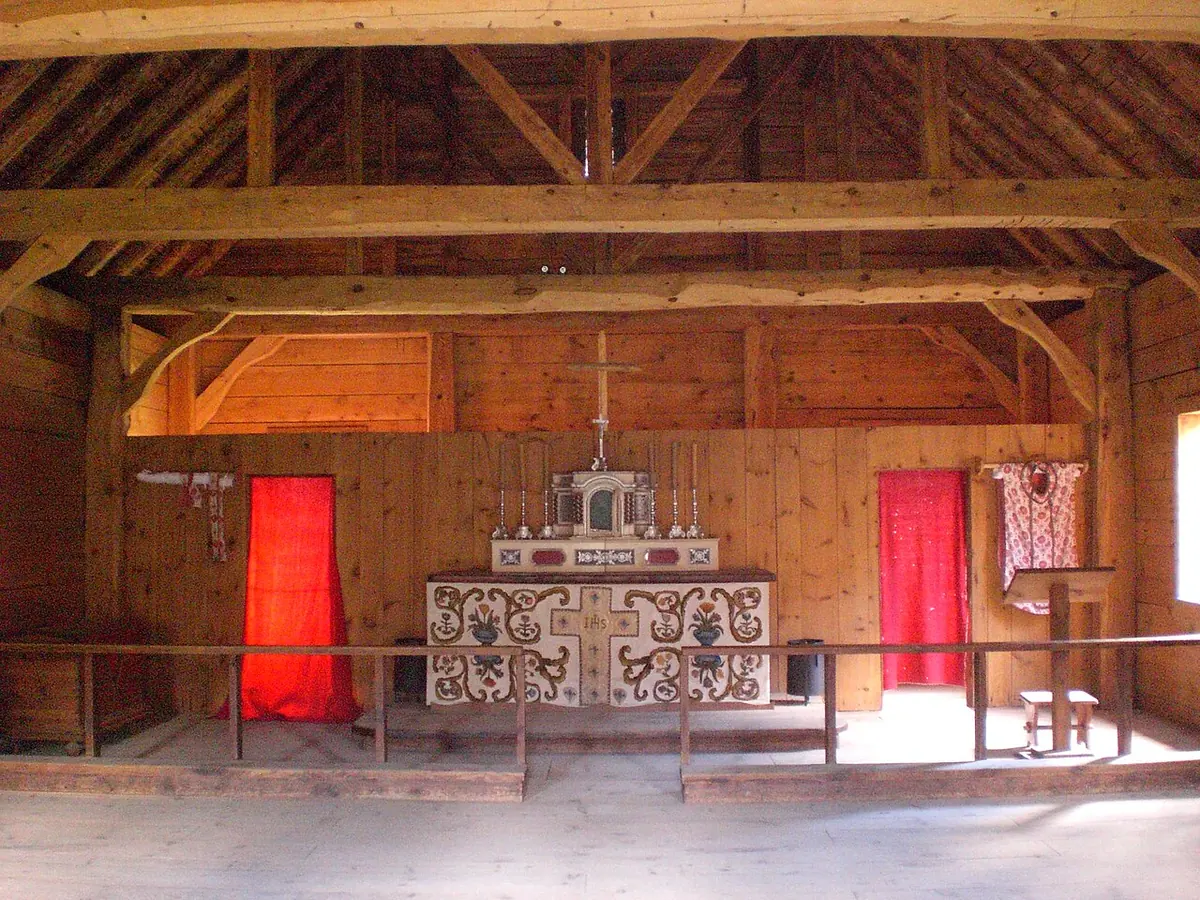
God gave him, Ragueneau writes, "a strong vocation for these countries." He landed at Quebec on August 15, 1643, spent a year there studying native languages, and then went west to the Huron country around Sainte-Marie, the Jesuits' fortified mission on Georgian Bay.
There everything went against his nature. After three, four and five years of trying, "hardly could he make himself understood even in the most ordinary matters." The Dictionary of Canadian Biography notes that of the eight Canadian martyrs he was the only one with no gift for languages. Ragueneau describes the life he faced: sleeping on bare ground, living "from morning to night in a little hell of smoke," snow drifting into the bark cabins, nothing to drink but water, and not one moment of the day in private. And God, Ragueneau adds, withdrew his "sensible graces" and left him in dryness.
The vow
The devil, as Ragueneau tells it, reminded him every day of the joy and comfort he could have back in France, where a man of his talents would find useful work. "Never, for all that, would he break away from the Cross on which God had placed him." On the feast of Corpus Christi in 1647, before the Blessed Sacrament, he wrote and made a vow in Latin. The Relation preserves it, and we give it below as a prayer.

"A martyr in the shadow"
Early in 1649 he was replaced at the mission of Saint-Louis by Gabriel Lalemant and sent to a more distant post. Weeks later the Iroquois captured Saint-Louis and killed Lalemant and John de Brébeuf. Chabanel wrote to his brother Pierre, also a Jesuit, that his brother had come close to having a martyr in the family, but that God required "a virtue of another stamp than mine." He hoped to be, in his own Latin phrase, martyrem in umbra et martyrium sine sanguine: a martyr in the shadow, a martyrdom without blood.
The martyrdom of St. Noël Chabanel
That autumn he was serving with St. Charles Garnier among the Tobacco Nation (the Petun). In early December 1649 he was ordered back to the main mission, now moved to Christian Island. On the night of December 7, in the forest, his companions slept while he kept watch in prayer. Toward midnight they heard the war songs of an Iroquois party returning from the village of Saint-Jean, where Garnier had just been killed. His companions fled. Exhausted, Chabanel fell to his knees and told them:
"It matters not that I die; this life is a very small consideration; of the blessedness of Paradise, the Iroquois can never rob me."
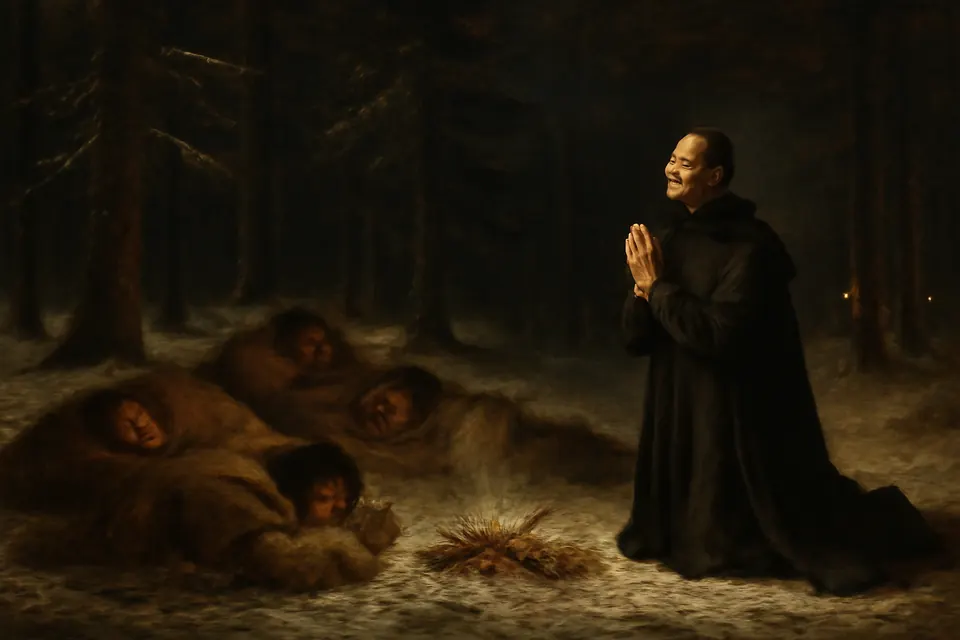
At dawn he went on alone toward the island and came to a river he could not cross. A Huron who had once been a Christian took him into his canoe. He was never seen again. Ragueneau later learned that this man, Louis Honarreennha, had killed him and thrown his body into the river, and that he confessed he had done it out of hatred for the faith. His body was never found.
Canonization
Pope Pius XI beatified Noël Chabanel with the seven other Jesuit martyrs and lay helpers of New France on June 21, 1925, and canonized them on June 29, 1930. Martyrs are beatified on the strength of their martyrdom; canonization requires a miracle examined and approved by the Church, and the sources we used do not describe the one accepted for this group, so we leave it out.
Symbols of St. Noël Chabanel in art
- Black Jesuit cassock: his religious order, the Society of Jesus.
- Palm branch: the sign of a martyr.
- Crucifix or breviary: the prayer that carried him through years of dryness.
- Snowy forest or canoe: the place and manner of his death, in some images.
He usually appears among the eight martyrs in group paintings and windows, as in the series at St. John's Church in Omaha.
Feast day and where he is honored
We honor him on October 19 with St. Isaac Jogues, St. John de Brébeuf and their companions; Canada keeps the Canadian Martyrs on September 26. The Martyrs' Shrine at Midland, Ontario, beside the reconstructed Sainte-Marie, honors all eight. See other saints of October on our feast days page.
Prayer of St. Noël Chabanel: his vow
This is the vow he made on Corpus Christi, 1647, in the English of the Thwaites edition of the Jesuit Relations. Anyone struggling to stay faithful where God has placed them can pray it in their own circumstances.
"Jesus Christ, my Savior, who by a wonderful dispensation of your Paternal Providence have willed that I, though altogether unworthy, should be a Coadjutor of the Holy Apostles in this vineyard of the Hurons; impelled by the desire of ministering to the purpose which your holy Spirit hath respecting me, that I should help forward the conversion to the faith of the barbarians of this Huron country: I, Noel Chabanel, — being in the presence of the most holy Sacrament of your Body and your precious Blood, which is the tabernacle of God among men, — make a vow of perpetual stability in this Mission of the Hurons; understanding all things as the Superiors of the Society expound them, and as they choose to dispose of me. I conjure you, therefore, O my Savior, to be pleased to receive me as a perpetual servant of this Mission, and to make me worthy of so lofty a ministry. Amen."
Let us ask St. Noël Chabanel to pray for missionaries, for priests and religious in dryness, and for everyone who keeps a promise when the feeling is gone.
Frequently asked questions
Who was St. Noël Chabanel?
A Jesuit priest from Saugues in southern France who taught rhetoric before going to New France in 1643. He worked in the Huron mission for five years with almost no consolation, bound himself by vow never to leave it, and was murdered in December 1649 as the mission collapsed.
What was St. Noël Chabanel's vow?
On the feast of Corpus Christi in 1647, before the Blessed Sacrament, he vowed 'perpetual stability in this Mission of the Hurons,' asking Christ to receive him as a perpetual servant of the mission. The text is preserved in the Jesuit Relation of 1650.
How did St. Noël Chabanel die?
Ordered back to the main mission on Christian Island, he was crossing the country on December 8, 1649, when a Huron who had abandoned the faith killed him and threw his body into a river. The killer later confessed that he did it out of hatred for the faith.
When is the feast of St. Noël Chabanel?
October 19 in the United States and the General Roman Calendar, with Sts. John de Brébeuf, Isaac Jogues and Companions; September 26 in Canada.
Keep exploring
Sources
- Relation of 1649–50, The Jesuit Relations and Allied Documents, ed. R. G. Thwaites, vol. 35 (1898). Paul Ragueneau's account of his death, his life among the Hurons, the full text of his vow, his letter to his brother Pierre, and his words 'the blessedness of Paradise, the Iroquois can never rob me'
- Léon Pouliot, Chabanel, Noël, Dictionary of Canadian Biography, vol. 1. His dates in the Society, arrival at Quebec on August 15, 1643, and the confession of Louis Honarreennha recorded by Ragueneau in 1652
- Noel Chabanel, The Catholic Encyclopedia (1908)