St. Evaristus, Pope and Martyr

St. Evaristus was the fifth pope, the fourth successor of St. Peter, who led the Roman Church for about eight years around 99 to 107 AD, after St. Clement. Almost nothing certain is known of his life; tradition holds that he died a martyr under the emperor Trajan. His feast day is October 27 (October 26 in the older calendar).
Who was St. Evaristus?
St. Evaristus was the fifth pope, the bishop of Rome who came after St. Clement around the year 99 and led the Church in the city for about eight years, into the reign of the emperor Trajan. He is one of the first links in the chain of shepherds that runs from St. Peter to the pope of our own day, and the Church has honored him as a saint since its earliest centuries.
That is most of what we can say with certainty. The Catholic Encyclopedia puts it plainly: "The earliest historical sources offer no authentic data about him." What we have are his name, his place in the list of popes, the length of his time in office, and a handful of details recorded centuries later. Let us honor him for what he was, a faithful bishop of Rome in a dangerous age, and not ask the sources to say more than they do.
What the oldest sources say
St. Irenaeus, about the year 180
The earliest witness is St. Irenaeus, bishop of Lyon, who set down the bishops of Rome to show that the teaching of the apostles had been handed on faithfully from one bishop to the next. He wrote: "To this Clement there succeeded Evaristus. Alexander followed Evaristus." Irenaeus was writing only about seventy years after Evaristus died, and his order of succession is, in the Catholic Encyclopedia's words, "undoubtedly correct."
Eusebius, about the year 325
The historian Eusebius adds dates. He says that in the third year of Trajan, Clement "committed the episcopal government of the church of Rome to Evarestus," and that Alexander succeeded him after "Evarestus had held the office eight years." By the usual reckoning that runs from about 99 to about 107. The fourth-century Liberian Catalog spells his name Aristus.
The Liber Pontificalis, sixth century
The Liber Pontificalis, the old Roman Book of the Popes, gives the fullest account, but it was compiled more than four hundred years after his death. It says that Evaristus was "by nationality a Greek of Antioch," the son of a Jew named Judah from Bethlehem. It says that "he divided the parish churches in the city of Rome among the priests," ordained seven deacons to stand by the bishop when he preached, and held three ordinations in December, making 17 priests, 2 deacons and 15 bishops. It ends: "He was crowned with martyrdom," and "he also was buried near the body of the blessed Peter in the Vatican, October 27."
Historians treat these details with care. The Catholic Encyclopedia judges that the Book of the Popes "arbitrarily refers to the time of Evaristus a later institution of the Roman Church" when it credits him with the titular churches and the seven deaconries, which took shape later. Its note on his burial beside St. Peter is, in the same article's judgment, "more trustworthy." Two letters once attributed to him in the medieval False Decretals are forgeries.
A shepherd in the age of Trajan
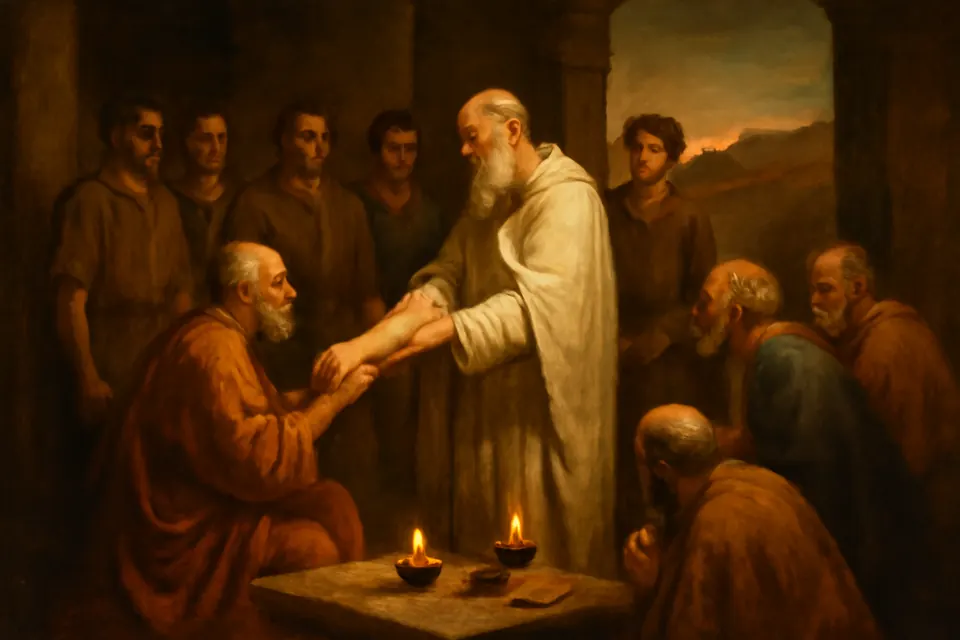
Even with so few facts, we can picture the Church Evaristus led. Christians in Rome met in private homes. The faith was not legal, and under Trajan a Christian who was denounced and refused to sacrifice to the gods could be put to death. In those same years St. Ignatius of Antioch was taken to Rome in chains to die in the arena, and his letter to the Roman Christians, written on the way, may well have reached the church while Evaristus was its bishop. In that letter Ignatius greets the Roman Church as the church that presides in love. Evaristus was the man presiding.
Was St. Evaristus a martyr?
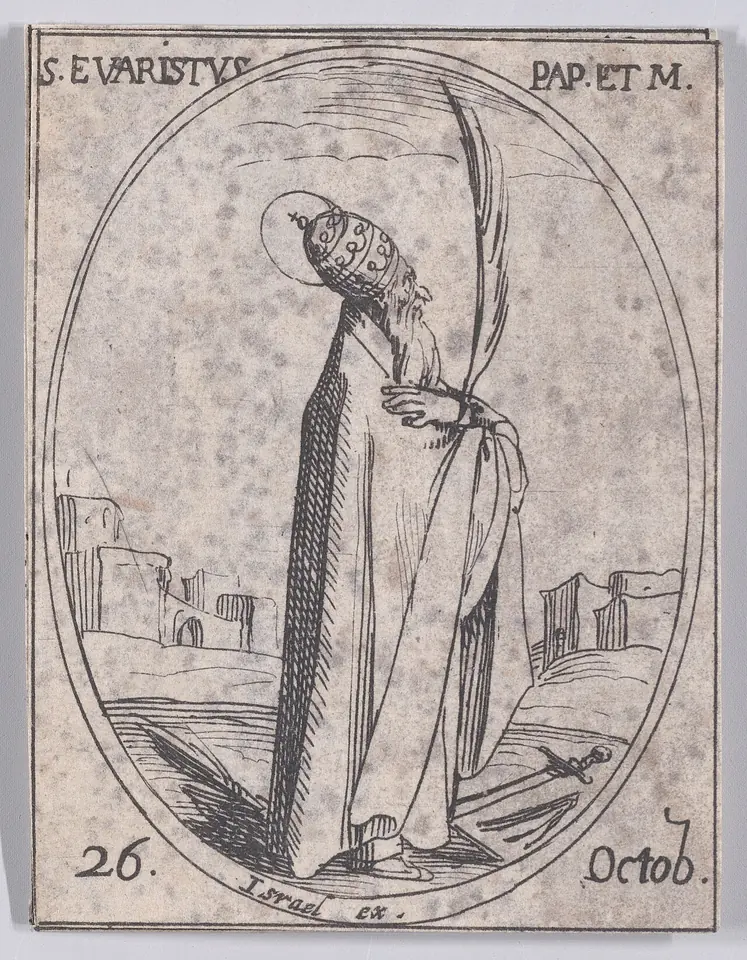
The Book of the Popes says so, and the Church long kept his feast as that of a pope and martyr; the 1636 etching by Jacques Callot on this page shows him with the martyr's palm. No account of his death survives, though, and the Catholic Encyclopedia says his martyrdom, "though traditional, is not historically proven." So we call it traditional. No miracles are recorded for him at all, and we will not invent any.
What is St. Evaristus the patron saint of?
No traditional patronage has come down to us for St. Evaristus, the way St. Blaise is invoked for sore throats. We list him among the saints who pray for the popes, since he was one of the first: a witness to the unbroken succession of the bishops of Rome rather than a helper for one particular need. You can browse the saints by their patronages on our patron saints page.
Symbols of St. Evaristus in art
Artists had no early portrait of Evaristus to work from, so he is shown with the signs of his office and his tradition:
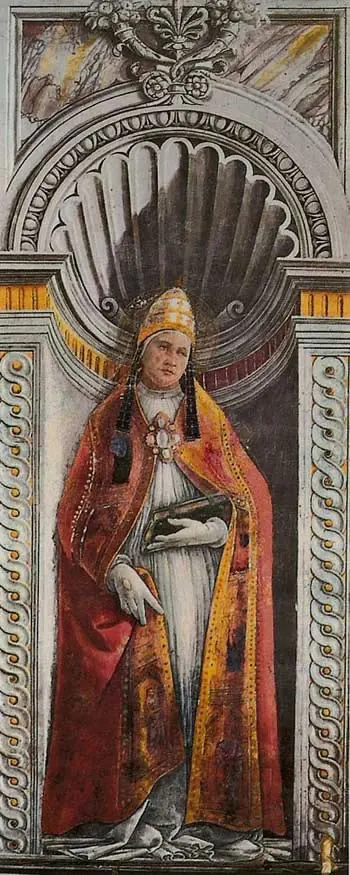
- Papal tiara or bishop's miter: later painters dressed the early popes in the regalia of their own day, as in the Sistine Chapel fresco.
- Pallium: the white wool band with black crosses worn over the shoulders, a sign of a bishop's office.
- Book of the Gospels: the bishop as teacher.
- Martyr's palm: his traditional martyrdom.
- Sword: in some engravings, as in Callot's print, though no source says how he died.

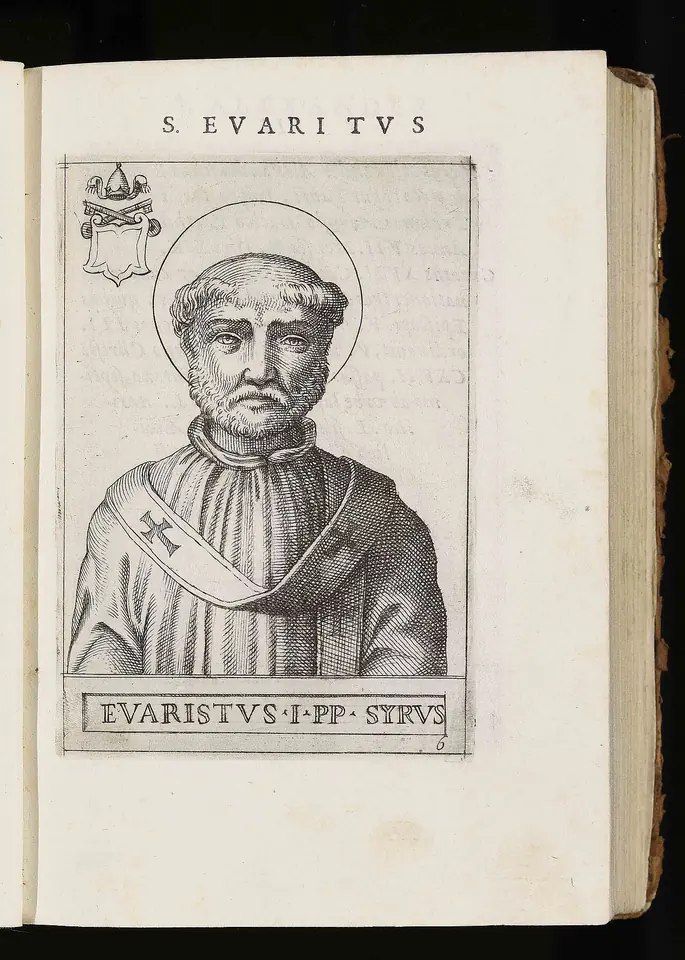
Inscriptions are often the surest way to know him. Cavalieri's engraving labels him "Evaristus I PP Syrus," and the series of round mosaic portraits of every pope in Rome's Basilica of St. Paul Outside the Walls includes him.
St. Evaristus's feast day and tomb
We keep his feast on October 27, the day the current Roman Martyrology lists him, which is also the burial date in the Book of the Popes. Before the calendar reform of 1969 his feast fell on October 26, which is why older missals and prints show that day. You can see the saints around him on our feast days page.
His body was laid near the tomb of St. Peter on the Vatican hill, in the cemetery that now lies under St. Peter's Basilica. His own grave has never been found. When we pray at the tomb of the Apostle, we pray near the earliest popes who were buried around him.

Prayer to St. Evaristus
There is no traditional prayer written for St. Evaristus alone. In the older Roman Missal his feast used the common Mass for a martyred pope, which prays for the whole flock through his intercession. We can pray in the same spirit and simply ask: St. Evaristus, pray for us.
Let us ask him to pray for the pope and the bishops in communion with him, for the parishes and their priests, and for Christians who still live their faith in danger, as he did in the Rome of Trajan.
Frequently asked questions
Who was St. Evaristus?
The bishop of Rome who came after St. Clement, around the year 99, and led the Church there for about eight years under the emperor Trajan. St. Irenaeus, writing about 180, names him in his list of the bishops of Rome. Counting St. Peter as the first, he was the fifth pope.
When is the feast of St. Evaristus?
October 27 in the current Roman Martyrology, the date the Liber Pontificalis gives for his burial. Before 1969 the Roman calendar kept him on October 26, so older missals and prints show that date.
Was Pope Evaristus a martyr?
The Liber Pontificalis says he "was crowned with martyrdom," and the older calendar honored him as pope and martyr. The Catholic Encyclopedia notes that his martyrdom is traditional but not historically proven, since no early account of his death survives.
Where is St. Evaristus buried?
According to the Liber Pontificalis, near the body of St. Peter on the Vatican hill, under what is now St. Peter's Basilica. His own grave has never been identified.
Keep exploring
Sources
- J.P. Kirsch, Pope St. Evaristus (Catholic Encyclopedia, 1909). The second-century lists, Aristus in the Liberian Catalog, the later origin of the tituli and deaconries, burial near St. Peter, martyrdom traditional, the forged decretals
- Louise Ropes Loomis, The Book of the Popes (Liber Pontificalis), New York: Columbia University Press, 1916. His Greek and Jewish ancestry, the parish churches and seven deacons, three December ordinations, martyrdom, burial on October 27
- St. Irenaeus, Against Heresies, Book III, chapter 3. To this Clement there succeeded Evaristus
- Eusebius, Church History, Book III, chapter 34. Succeeded Clement in the third year of Trajan