St. Colman mac Duagh
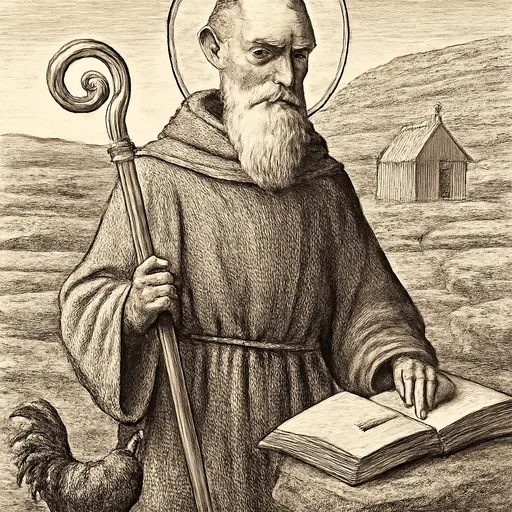
St. Colman mac Duagh (about 560–632) was an Irish hermit and bishop who lived in the Burren hills of County Clare, by tradition with only a rooster, a mouse and a fly for company. He then founded the monastery of Kilmacduagh in County Galway. He is the patron of the Diocese of Kilmacduagh, and his feast day is October 29.
Who was St. Colman mac Duagh?
St. Colman mac Duagh was an Irish hermit and bishop who died in 632, the founder and patron of Kilmacduagh in south County Galway. The Martyrology of Donegal names more than a hundred saints called Colman. This one is "Mac Duagh," the son of Duagh, and the place he founded still carries his name: Cill Mhic Duach, the church of the son of Duagh.
He belonged to the royal race of Fiachra, the same kindred as Guaire Aidhne, the open-handed king of Connacht whose name was a byword for generosity. The Catholic Encyclopedia gives his birth at Kiltartan about 560. Almost everything else we know comes through the seventeenth-century scholar John Colgan, who gathered the old Irish accounts of his life, and through the memory of the people of his diocese. Bishop Jerome Fahey, who wrote the history of Kilmacduagh in 1893, sifted these traditions with care, and we follow him here.
His life
A hunted mother and a holy well
Local tradition, always held in the diocese, tells that a prophecy had foretold greatness for the child of Rhinagh, Colman's mother. The jealous king of the day had her thrown into the Kiltartan river with a stone tied to her neck, but she was saved from drowning. Her son was born at Corker, and two old pilgrim clerics, one blind and one lame, baptized him at a spring that burst from the ground. Fahey himself notes that the same story is told of St. Patrick. The well at Corker still bears Colman's name.
Aranmore and the Burren
We first meet Colman as a grown monk on Aranmore, "Aran of the Saints," the island where St. Enda had trained a generation of Irish monks. The Catholic Encyclopedia says he built two churches there, at Kilmurvy. About 592 he went looking for deeper solitude in the forests that then covered the Burren hills of County Clare, with a single disciple. He made a small oratory at the foot of a cliff, lived on wild herbs and spring water, and dressed in deerskins.
Colgan records that in a time of spiritual dryness he wrote to St. Columba on Iona, a kinsman, for advice. Columba answered gently that a man can only complain of losses where there was first a treasure to lose.
The rooster, the mouse and the fly
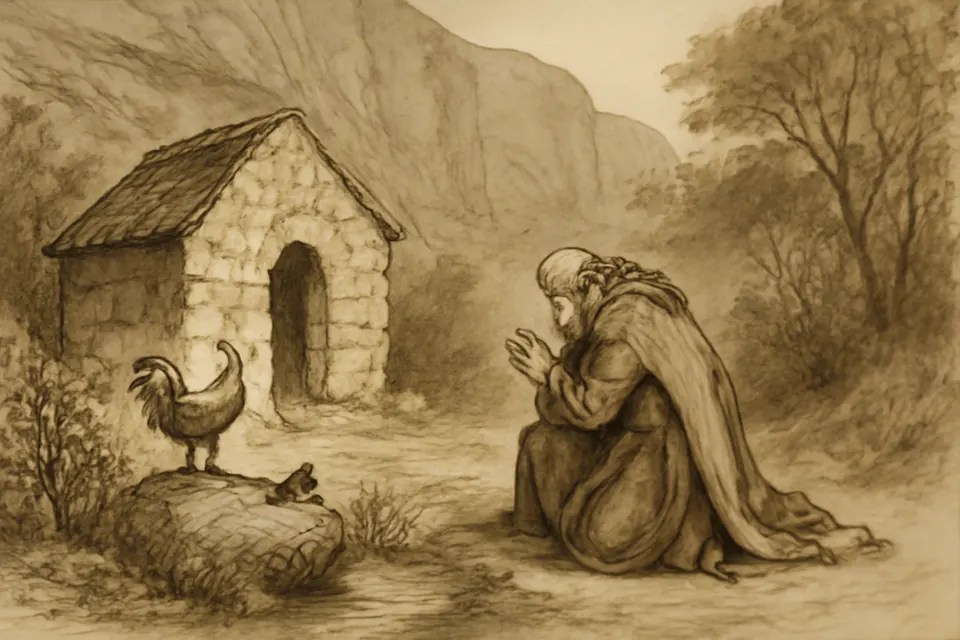
The best-loved story about Colman comes from Geoffrey Keating's seventeenth-century history of Ireland, which cites an older manuscript. The hermit "had no living creature about him except a cock, a mouse, and a fly." The cock crowed to wake him for the night office. The mouse kept him from sleeping more than five hours a day by scratching his ear. The fly walked along the lines of his book, and when he grew tired it stopped on the first letter of the next sentence to keep his place. This is legend, and it is told as legend. It still says something true about a man so poor that God's smallest creatures were his only helpers.
The miracles of St. Colman mac Duagh
The Road of the Dishes (traditional)
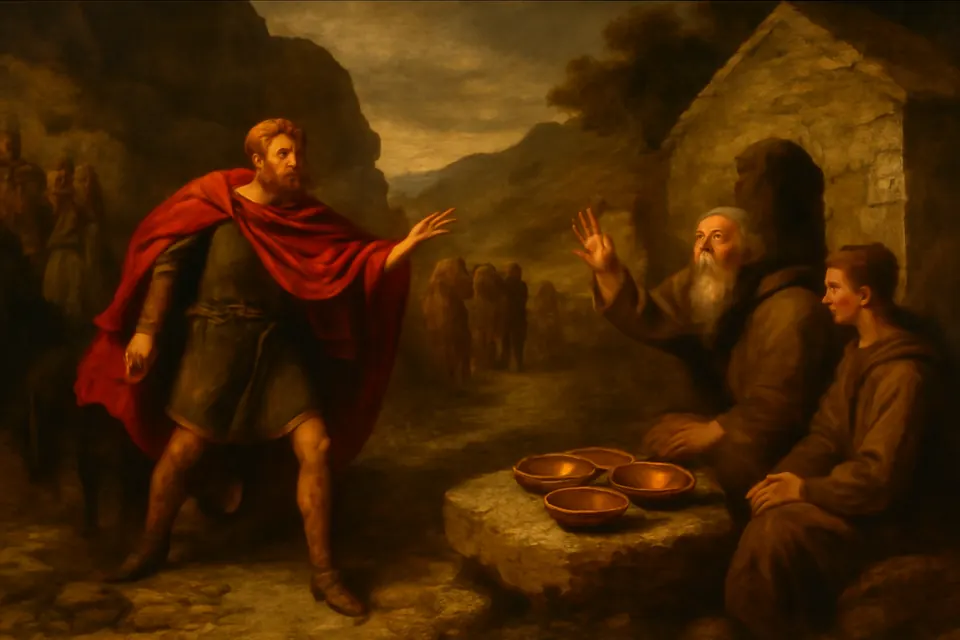
After seven years of hiding, Colman was found by King Guaire himself. Colgan's account, drawn from older Irish writings, says that on Easter Sunday Colman's young disciple grumbled that they had only herbs and a small wild bird to eat, while the king's household feasted. At that same hour, at his fortress near Kinvara, Guaire wished aloud that his banquet could be set before some true servant of God. The dishes rose from his table and were carried off. The king and his riders followed them into the Burren and found them laid before the hermit. The path is still called Bóthar na Mias, the Road of the Dishes. The miracle is traditional.
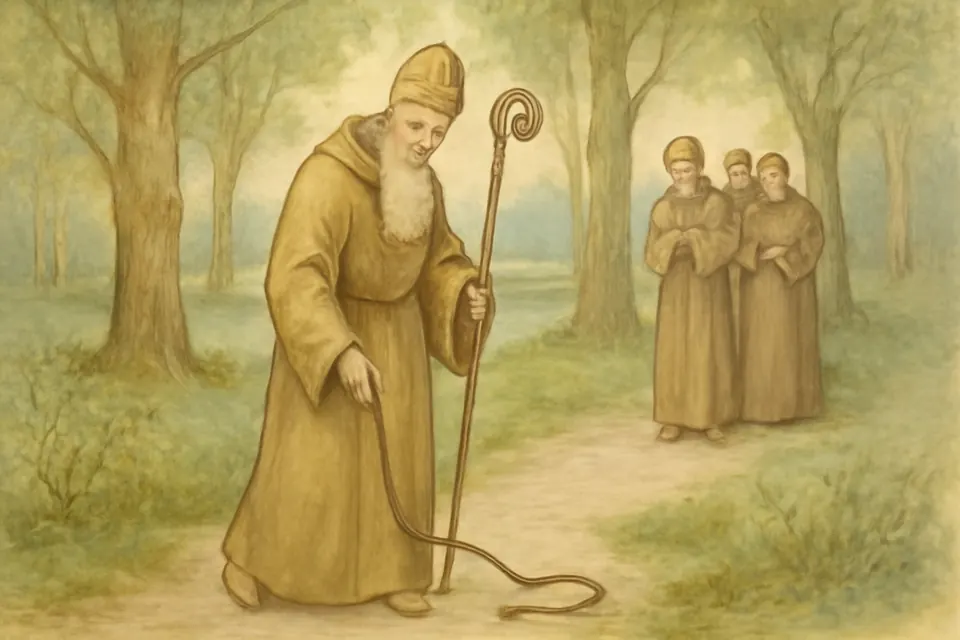
The falling girdle (traditional)
Guaire, his kinsman, begged Colman to become bishop of his people. Colgan writes that Colman was told in prayer that his girdle would fall to the ground at the place God had chosen. "As he journeyed through the forest, his cincture fell on a certain place, not far from his former cell, and there he built his monastery." That was Kilmacduagh, about 610. The O'Shaughnessys, his kin, kept the jeweled girdle for centuries, and it was said to fit only the chaste. This is traditional.
Kilmacduagh and his last years
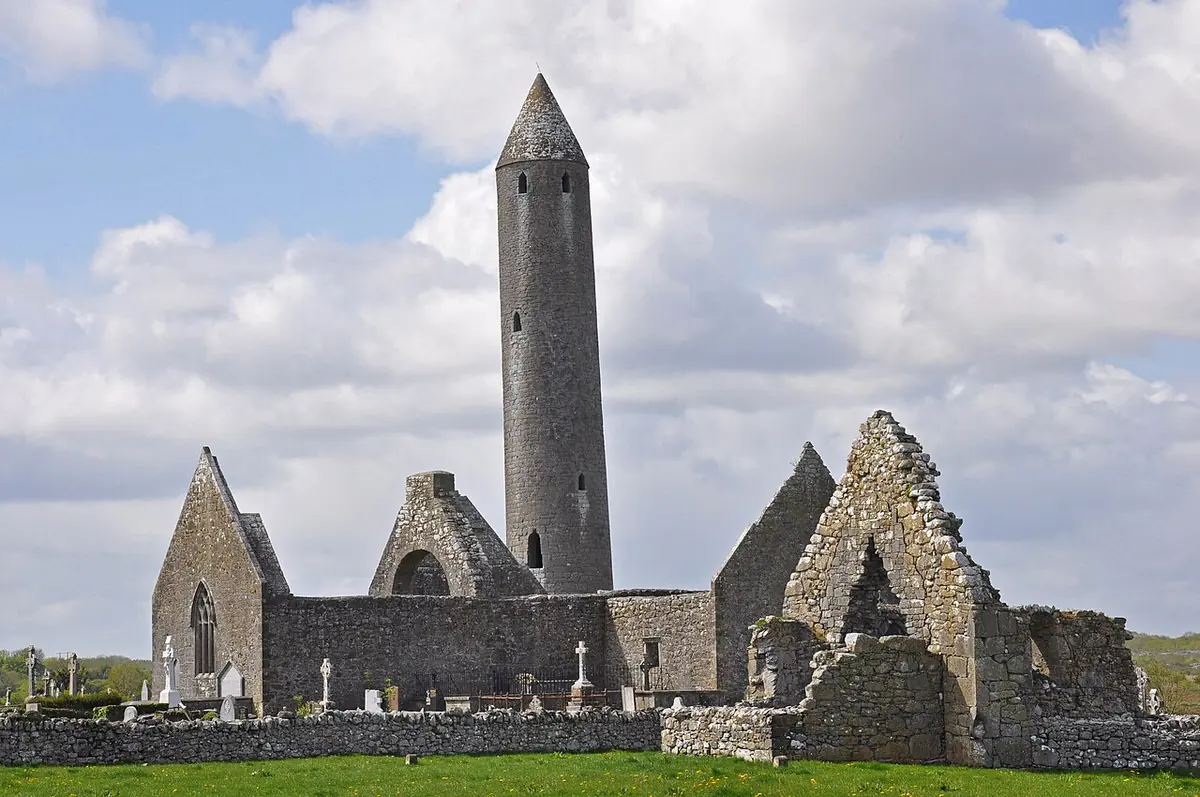
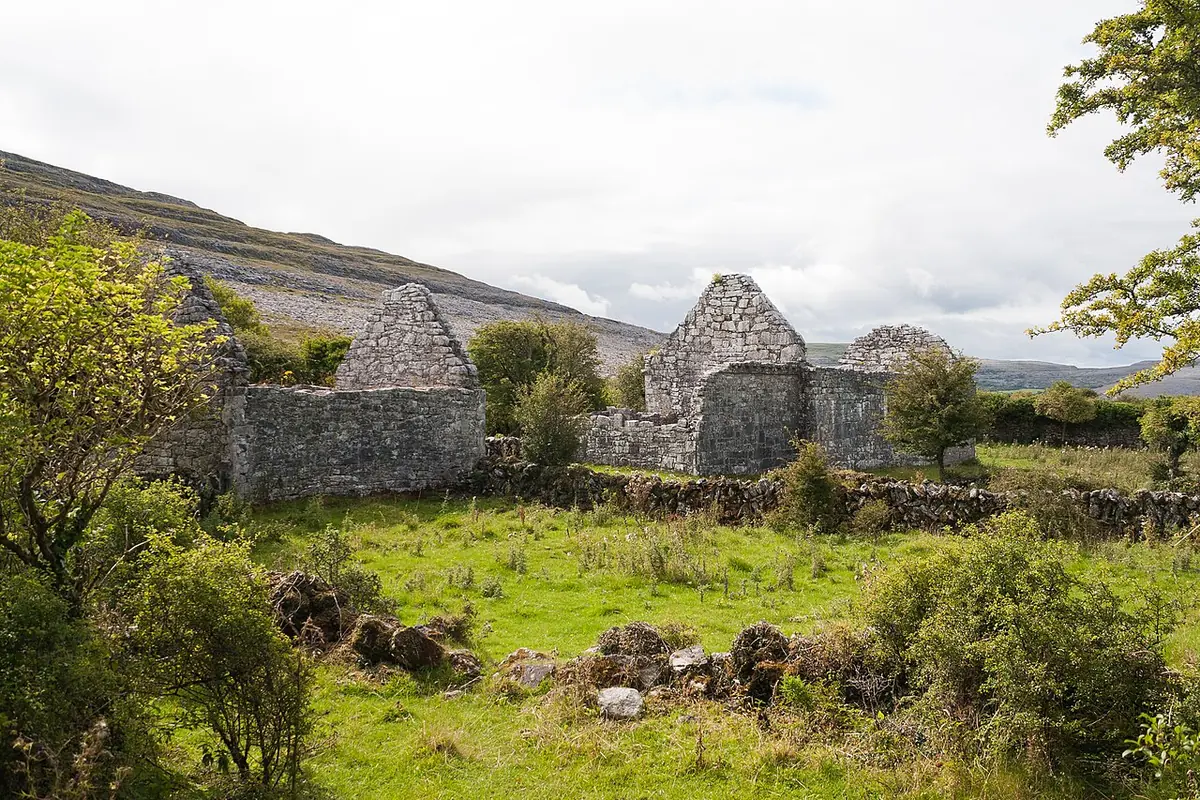
Kilmacduagh became the center of the old diocese of Aidhne, roughly the later Diocese of Kilmacduagh. Its round tower, which leans visibly, is among the best known in Ireland. It was built centuries after Colman, though local tradition credits it to the legendary builder Gobán Saor.
Late in life Colman resigned his see and went back to the Burren, to the hidden valley of Oughtmama, where he built a church and cell beside a spring. He died there, by the traditional reckoning on October 29, 632. He had asked to be buried at Kilmacduagh, and his grave was long shown in the churchyard southwest of the cathedral. Fahey writes that people took earth from it to lay on the sick. A gilt crozier-shaft made about 1110, now in the National Museum of Ireland, carries his name.
Symbols of St. Colman mac Duagh in art
Colman is not often painted, but Irish churches show him with a few clear signs:
- Bishop's crozier: he was the first bishop of Kilmacduagh. The medieval crozier-shaft that bears his name is the oldest object linked to him.
- Rooster, mouse and fly: his three companions in the Burren, the surest way to recognize him.
- Girdle: the cincture that fell to mark the place of his monastery.
- A cell among rocks: the hermitage beneath the Burren cliffs.
Where he does appear, look for a bearded bishop with a crozier, and often the rooster close by.

Feast day and prayer
We keep his feast on October 29, the day the diocese kept "from time immemorial." Pope Benedict XIV fixed it by rescript in 1747, and a proper Office in his honor was published in 1751. The ruins of Kilmacduagh and Oughtmama are open to visitors, and the holy well at Corker still bears his name. See the feast day calendar and the Irish saints.
No traditional prayer to St. Colman mac Duagh has come down to us in English. Let us ask his help in our own words: St. Colman, who left the world to pray in the Burren and gave your life to the people of Aidhne, pray for us, that we may love silence, keep watch in prayer, and trust God to provide.
Frequently asked questions
Who was St. Colman mac Duagh?
An Irish monk of the late sixth and early seventh centuries, a kinsman of King Guaire of Connacht. He lived as a hermit on Aranmore and then in the Burren, and about 610 founded the monastery of Kilmacduagh ("the church of the son of Duagh"), which became the seat of the Diocese of Kilmacduagh. He died in 632.
What is the story of St. Colman's rooster, mouse and fly?
Geoffrey Keating's history of Ireland tells that the hermit had no living creature with him but a cock, a mouse and a fly. The cock woke him for his night prayers, the mouse scratched his ear if he slept more than five hours, and the fly walked along the lines of his book and marked his place when he stopped reading. It is a traditional legend, loved in Ireland, not a historical record.
When is the feast of St. Colman mac Duagh?
October 29. The diocese kept that date from time immemorial, and Pope Benedict XIV fixed it by rescript in 1747.
What is the Road of the Dishes?
A path in the Burren called Bóthar na Mias. By tradition, King Guaire's Easter banquet was carried away by angels to feed the fasting hermit and his disciple, and the king and his riders followed the dishes to the hermitage. Colgan took the story from older Irish sources.
Keep exploring
Sources
- Catholic Encyclopedia (1908): St. Colman of Kilmacduagh. Birth at Kiltartan, the hermitage on Aranmore, the Burren in 592, the monastery in 610, death in 632, the 1747 rescript of Benedict XIV
- Jerome Fahey, The History and Antiquities of the Diocese of Kilmacduagh (Dublin, 1893), chapters 7–12. The baptism legend at Corker, the Burren hermitage, Keating's account of the cock, mouse and fly, Colgan's account of the Road of the Dishes and the girdle, the retirement to Oughtmama, the grave at Kilmacduagh and the feast day