St. Pedro Calungsod: Teenage Filipino Catechist and Martyr of Guam

St. Pedro Calungsod was a teenage catechist from the Visayas who went with Jesuit missionaries to Guam and was killed there on April 2, 1672, rather than abandon the priest he served. He was canonized on October 21, 2012, the second Filipino saint, and is the patron of Filipino youth. In the Philippines his feast is kept on October 21.
Who was St. Pedro Calungsod?
St. Pedro Calungsod was a Filipino teenager, a lay catechist from the Visayas, who sailed with Jesuit missionaries to the Mariana Islands in 1668 and was killed on Guam on April 2, 1672, at about 17 years old. He could have run, and the people who knew him said he was quick enough to escape. He stayed at the side of his priest, Fr. Diego Luis de San Vitores, and died with him.

For three centuries he was almost forgotten, a name in the old Spanish reports on Fr. Diego's death. Pope John Paul II beatified him in 2000, and Pope Benedict XVI canonized him on October 21, 2012, making him the second Filipino saint after St. Lorenzo Ruiz. Today he is the patron of Filipino youth, and his face, a boy in a white shirt holding a palm and a catechism, is everywhere in Philippine parishes.
The life of St. Pedro Calungsod
A boy from the Visayas
We know very little about his early years. His Spanish companions wrote his name as Calonsor, Calongsor or Calansor and simply called him a Visayan, an indio bisaya. The Cebu archdiocese's catechetical primer on his life explains that "Calungsod" comes from the Cebuano word lungsod, "town," and means something like "townmate." No baptismal record survives, so no one knows exactly where he was born. Ginatilan in Cebu, Hinunangan and Hinundayan in southern Leyte, and the Molo district of Iloilo all have Calungsod families and claims to him. All of them belonged then to the old Diocese of Cebu.
In the 1600s the Jesuits in the Visayas trained boys in their boarding schools to be catechists and helpers on the missions. Pedro was most likely one of them. When Fr. Diego Luis de San Vitores, a Spanish Jesuit working in Antipolo, organized a mission to the islands then called the Ladrones, Pedro was among the young catechists chosen to go.
The mission to the Marianas
The missionaries left the port of Cavite on August 7, 1667, on the ship San Diego, sailed first to Acapulco in Mexico for supplies, and reached Guam in mid-June 1668. Pedro was about 14. The missionaries renamed the islands the Marianas, in honor of the Virgin Mary and of the Queen Regent of Spain, Mariana of Austria, who paid for the mission. Their first church, in Hagåtña, was dedicated to the Sweet Name of Mary.
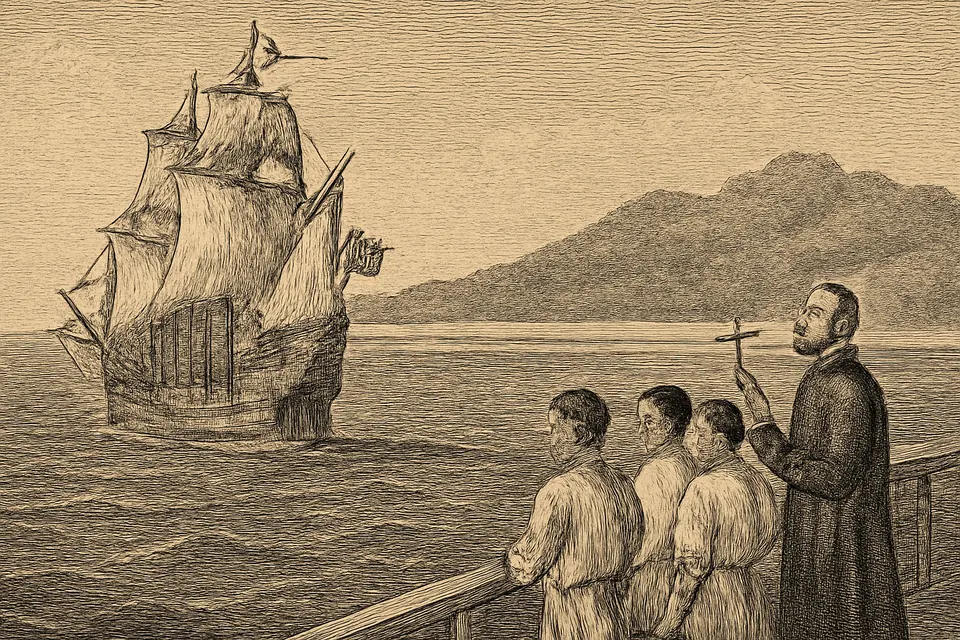
Life there was hard. Supply ships came irregularly, the jungle was thick and the cliffs steep, and typhoons tore across the islands. Pedro taught the catechism, helped at Mass and at baptisms, and went with the priests from village to village. Many Chamorros were baptized. Then opposition grew. According to the missionaries' accounts, a Chinese man named Choco spread the rumor that the baptismal water was poisonous, and since some sickly infants died after baptism, many believed him. Several missionaries and their helpers were killed in the years that followed.
We should also say honestly that for the Chamorro people, the decades after 1668 brought war, epidemics and a terrible loss of life under Spanish rule. Pedro's story is told from the missionaries' side, and Chamorro families remember those years with grief.
The martyrdom of St. Pedro Calungsod
The account below comes from the testimonies of Pedro's fellow missionaries, gathered for Fr. Diego's cause. The first was written by Fr. Francisco Solano only 24 days after the martyrdom.
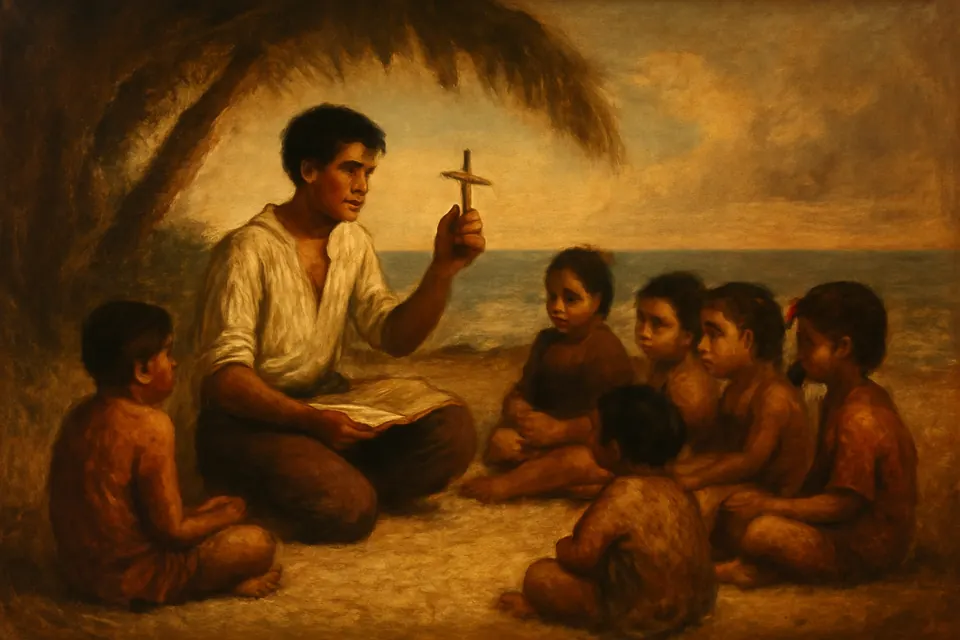
Early on Saturday, April 2, 1672, the day before Passion Sunday, Fr. Diego and Pedro came to the village of Tumon (Tomhom). They heard that a baby girl had just been born and asked her father, Matapang, to bring her to be baptized. Matapang had once been a Christian and a friend of the missionaries but had turned against the faith, and he angrily refused. To give him time to cool down, the priest and the boy gathered the village children and some adults on the beach and began chanting the truths of the faith with them, inviting Matapang to join in.

Matapang went off to find help and persuaded another man, Hirao, who at first refused because of the missionaries' kindness. While Matapang was away, Fr. Diego baptized the baby with the consent of her mother, who was a Christian. When Matapang learned of it he was furious.
He threw his spears first at Pedro. The witnesses said the boy dodged them with remarkable agility and could easily have escaped, but he would not leave Fr. Diego alone. Those who knew him believed he might have beaten off the attackers if he had been armed, but Fr. Diego never allowed his companions to carry weapons. At last a spear struck Pedro in the chest and he fell. Hirao ran to him and killed him with a blow of a cutlass to the head. Fr. Diego raised his crucifix and gave Pedro absolution, and then he too was killed.
The two men stripped the bodies, tied heavy stones to their feet, carried them out on a canoe and threw them into the sea. They were never found.
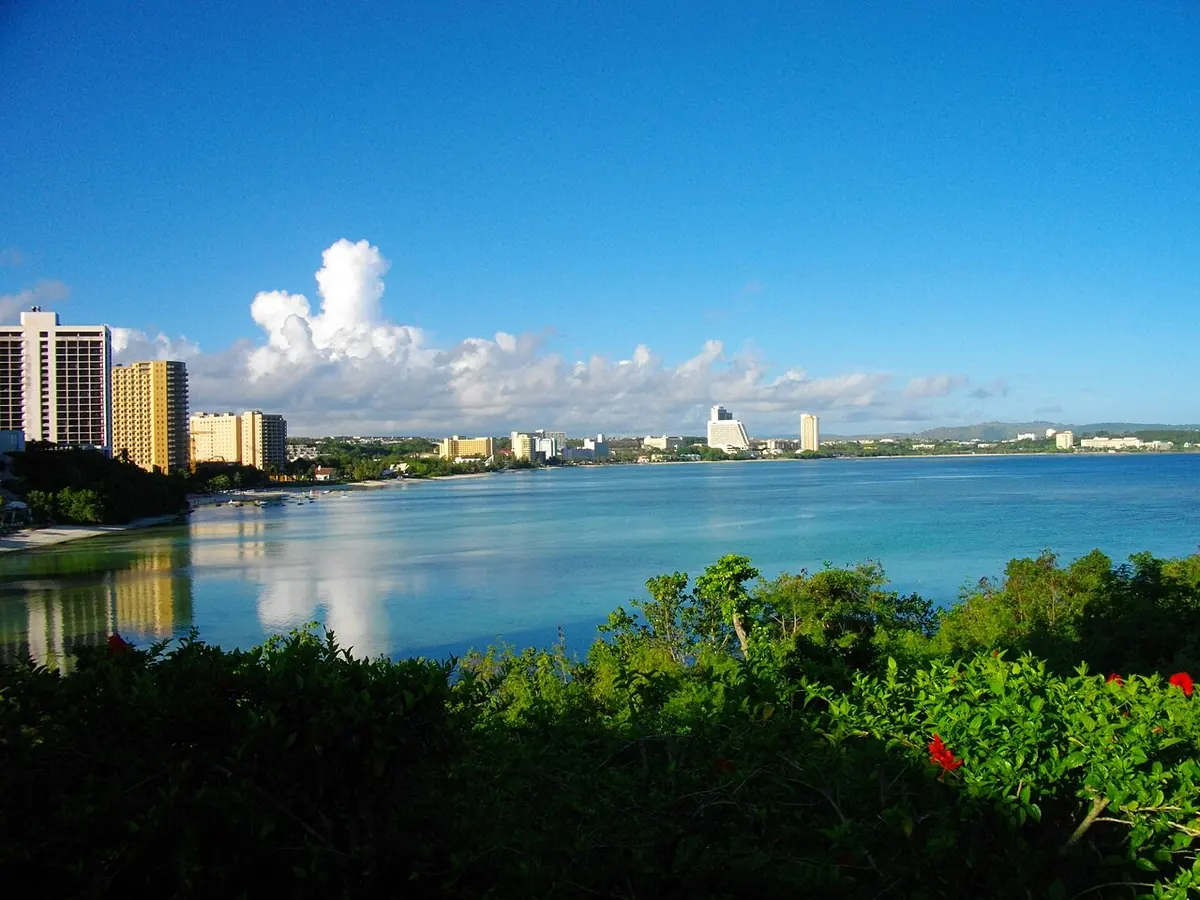
When the other missionaries heard of his death, the primer reports, they cried out: "Fortunate youth! How well rewarded his four years of persevering service to God in the difficult Mission are; he has become the precursor of our superior, Padre Diego, in Heaven!"
From forgotten martyr to saint
The missionaries opened a cause for Fr. Diego's beatification on January 9, 1673, but turmoil in the islands and the later suppression of the Jesuits left it buried in archives. In 1981, as the Church in Guam prepared to mark twenty years as a diocese, the old cause was rediscovered, and Fr. Diego was beatified on October 6, 1985. Because the documents never failed to mention his lone companion, Pedro's memory came back with him.

The Archdiocese of Cebu opened Pedro's own cause in 1994. On January 27, 2000, Pope John Paul II promulgated the decree recognizing his martyrdom, and on March 5, 2000, he beatified him in St. Peter's Square, with 43 others. In his homily the pope said that "in the face of imminent danger, Pedro would not forsake Fr Diego, but as a 'good soldier of Christ' preferred to die at the missionary's side."
A martyr can be beatified without a miracle, but canonization requires one. On March 26, 2003, a woman in a Cebu City hospital fell into a deep coma, rated 3 on the Glasgow Coma Scale (no response to anything), after complications from heart surgery. Her doctors expected that if she survived at all she would be left paralyzed and unable to speak. One of them prayed to Blessed Pedro for help. Within hours she woke and recovered completely. Msgr. Ildebrando Leyson, the vice-postulator, told the Philippine Daily Inquirer that the woman had never even heard of Pedro: when the doctor told her to thank him, she asked, "Who is that?" The investigation also had to show that the doctor had invoked only Pedro. Pope Benedict XVI approved the miracle in December 2011. This is an approved miracle.
Pedro Calungsod was canonized in Rome on October 21, 2012, World Mission Sunday, together with six others, among them St. Kateri Tekakwitha and St. Marianne Cope. Pope Benedict prayed that "the example and courageous witness of Pedro Calungsod inspire the dear people of the Philippines to announce the Kingdom bravely and to win souls for God!"
Why St. Pedro Calungsod is the patron of Filipino youth and catechists
He was a teenager and a lay catechist, and he died doing exactly that work, teaching the faith to children on a beach. So the Philippine Church gave him to its young people and to its catechists, and he is also honored by altar servers, since he served the priests at the altar on the mission. John Paul II spoke directly to the young at his beatification: "Young friends, do not hesitate to follow the example of Pedro."
Pedro left home, family and his own islands to serve the Church on the far side of an ocean, which makes him dear to the many Filipinos who work and live abroad. Like Lorenzo, he has no grave: both martyrs' bodies were lost at sea. You can find him with other patrons on our patron saints page.
Symbols of St. Pedro Calungsod in art
No portrait of Pedro was made in his lifetime, and his companions left no description of his face. His images all date from his beatification on. They show him as a slim Filipino teenager, and the details mean:
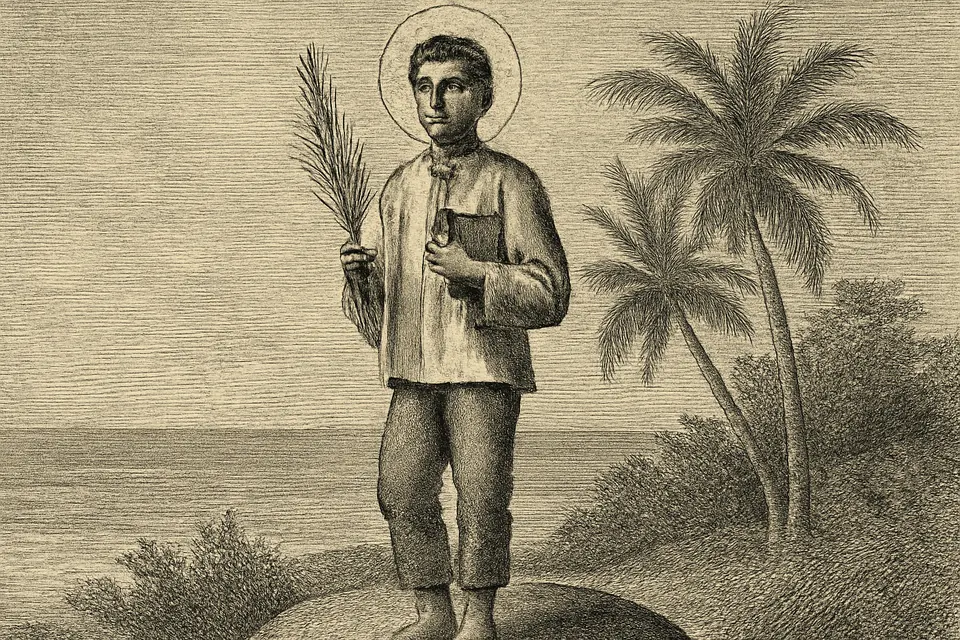
- A white camisa and trousers: the simple dress of a Visayan boy, never clerical robes, because he was a layman.
- A martyr's palm: the victory of his death for Christ.
- A book, often labeled Doctrina Christiana: the catechism he taught.
- A crucifix: the one Fr. Diego raised over him to absolve him. Some statues show Pedro holding it up himself.
- A rosary: the Marian devotion John Paul II praised in him.
In church you will usually see him barefoot or in sandals, standing alone or beside Fr. Diego in his black Jesuit cassock.
Feast day and where he is honored
Pedro's feast was first fixed on April 2, the day of his death, which is how the martyrology lists him with Fr. Diego. Because that date usually falls in Holy Week or the Easter Octave, the national meeting of diocesan liturgy directors in the Philippines moved it to October 21, the day of his canonization, with the rank of a Feast, starting with the liturgical year 2025. Saturdays keep a special place in his devotion: he began his mission on a Saturday in June 1668 and died on a Saturday. See his neighbors on our feast days page.
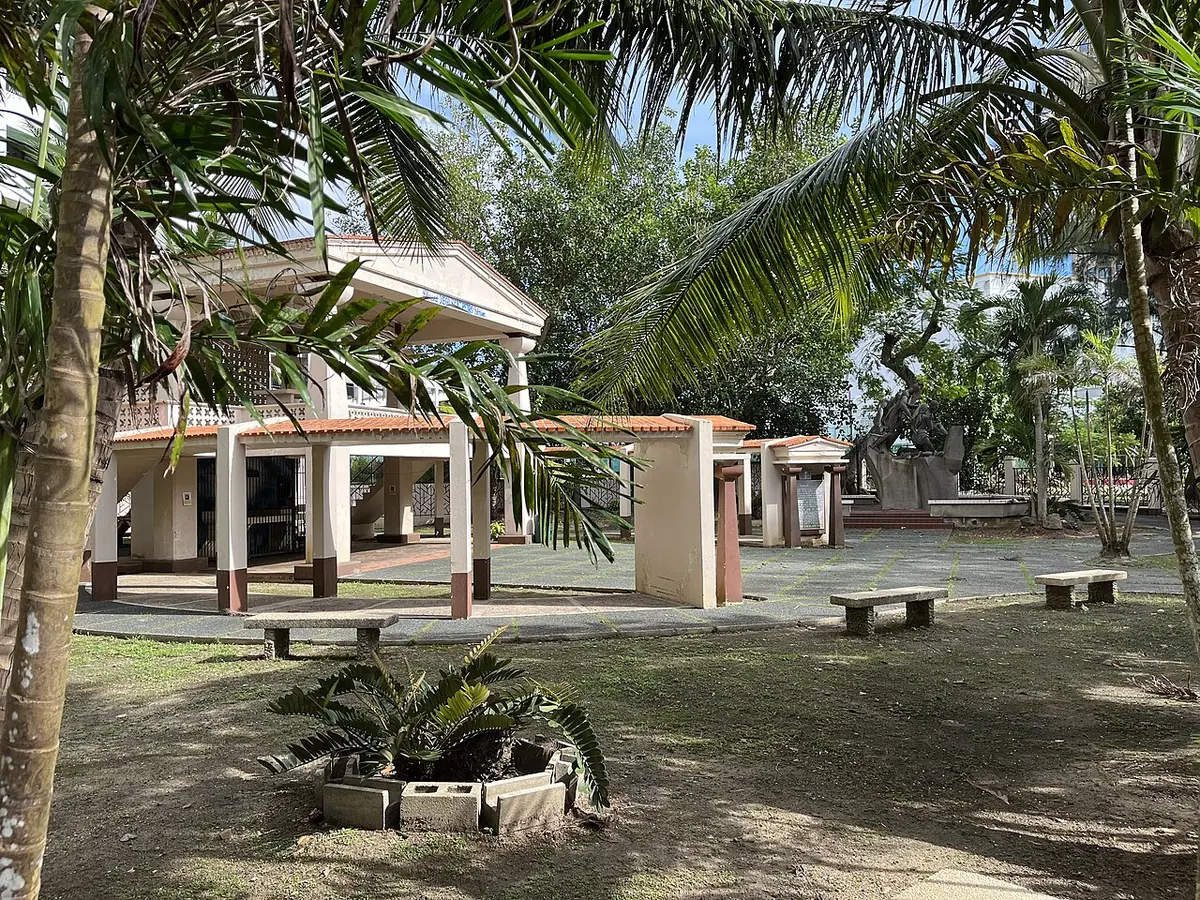
The St. Pedro Calungsod Shrine in Cebu City is the center of his cult, and chapels in his honor have appeared across the country, even in shopping malls. On Guam, a memorial marks the martyrdom site at Tumon.
Prayer to St. Pedro Calungsod
Pedro left no writings, and no prayer comes from him. The Archdiocese of Cebu and Philippine parishes use prayers and novenas composed for his cause, in English and in Cebuano. The words the Church itself spoke over him are those of the popes. At his beatification John Paul II said:

Today Bl. Pedro Calungsod intercedes for the young, in particular those of his native Philippines, and he challenges them. Young friends, do not hesitate to follow the example of Pedro, who "pleased God and was loved by him" (Wis 4: 10) and who, having come to perfection in so short a time, lived a full life (cf. ibid., v. 13).
Let us ask St. Pedro Calungsod to pray for young people, for catechists and for all Filipinos far from home, that we may stand by Christ and his Church as faithfully as he stood by Fr. Diego.
Frequently asked questions
Who was St. Pedro Calungsod?
He was a Filipino lay catechist, born around 1654 somewhere in the Visayas, who joined the Jesuit mission of Fr. Diego Luis de San Vitores to the Mariana Islands in 1668. He taught the faith to the Chamorro people of Guam for nearly four years and was killed with Fr. Diego at Tumon on April 2, 1672. He was about 17.
When is the feast day of St. Pedro Calungsod?
In the Philippines it is October 21, the anniversary of his canonization. The bishops' liturgy directors moved it there from April 2, with the rank of a Feast, starting with the liturgical year 2025, because April 2 so often falls in Holy Week or the Easter Octave. April 2, the day of his death, is the date in the Roman Martyrology. Saturdays are the traditional day of weekly devotion to him.
What miracle made Pedro Calungsod a saint?
On March 26, 2003, a woman fell into a deep coma, rated 3 on the Glasgow Coma Scale, after complications from heart surgery in a Cebu City hospital. One of her doctors prayed to Blessed Pedro Calungsod, and within a few hours she woke up and recovered with no lasting damage. After investigation, Pope Benedict XVI approved the decree recognizing it as a miracle in December 2011. It is an approved miracle.
How did Pedro Calungsod die?
At Tumon on Guam, two men attacked him and Fr. Diego after they baptized a newborn girl with her Christian mother's consent but against the will of her father, Matapang. Witnesses said Pedro dodged the spears and could have fled, but would not leave the priest, who allowed his companions no weapons. A spear struck him in the chest and a cutlass blow to the head killed him. Fr. Diego absolved him before he too was killed, and their bodies were thrown into the sea.
Is Pedro Calungsod the first Filipino saint?
No, he is the second. St. Lorenzo Ruiz of Manila, martyred in Japan in 1637, was canonized in 1987. Pedro Calungsod followed on October 21, 2012.
Keep exploring
Sources
- Pope Benedict XVI, homily for the canonization Mass, October 21, 2012 (vatican.va)
- Pope John Paul II, homily for the beatification of 44 Servants of God, March 5, 2000 (vatican.va)
- Pontifical Academy Cultorum Martyrum: martyrology, April 2 (BB. Diego Luigi de San Vitores e Pietro Calungsod)
- A Catechetical Primer on the Life, Martyrdom and Glorification of Blessed Pedro Calungsod, Part 1 (pedrocalungsod.org, archived)
- Philippine Daily Inquirer: Calungsod miracle bared
- Dominus Est: Updates in the Philippine Liturgical Calendar (September 9, 2024)