St. Gaspar del Bufalo
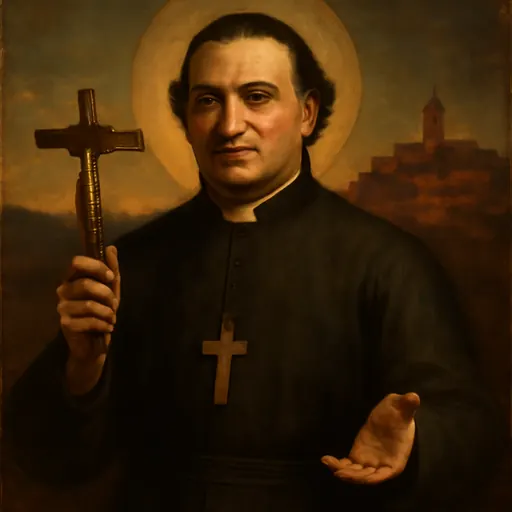
St. Gaspar del Bufalo (1786–1837) was a Roman priest who refused to swear loyalty to Napoleon, spent four years in exile and prison, and then founded the Missionaries of the Precious Blood in 1815. He preached missions all over central Italy, converting brigands and members of secret societies, and is called the Apostle of the Precious Blood. His feast is kept on October 21.
Who was St. Gaspar del Bufalo?
St. Gaspar del Bufalo was a priest of Rome who lived through the Napoleonic occupation of the city, went to prison rather than betray the pope, and then spent the rest of his life preaching missions across central Italy. In 1815 he founded the Missionaries of the Precious Blood, a society of priests whose whole work was to call people back to God through the Blood of Christ. People who heard him called him "Il Santo," the Apostle of Rome, and, for his success with secret societies, the "hammer of the Carbonari."
He was born in Rome on the Epiphany, January 6, 1786, and died there on December 28, 1837, worn out by his last labors among the victims of cholera. Pope Pius X beatified him in 1904, and Pope Pius XII canonized him on June 12, 1954. The Precious Blood family keeps his feast on October 21.
The life of St. Gaspar del Bufalo
The cook's son of Palazzo Altieri
Gaspar's father, Antonio del Bufalo, was chief cook to the princely Altieri family, whose palace faces the Jesuit church of the Gesù. His mother was Annunziata Quartieroni. He was a frail baby, and the Catholic Encyclopedia says his mother had him confirmed at about a year and a half. When an eye disease threatened to leave him blind, the family prayed to St. Francis Xavier, whose arm is kept at the Gesù across the street, and the boy was healed. The cure is a reported one, never formally examined, but Gaspar never forgot it. He chose Francis Xavier as patron of the congregation he later founded.
He entered the Roman College at twelve. As a young cleric he taught catechism with such energy that people called him "the little apostle of Rome." At nineteen he led the catechism school at Santa Maria del Pianto, where he went out to teach the barozzari, the carters who brought hay from the countryside into the old Roman Forum, then a cow pasture called Campo Vaccino. He also revived the charitable Work of St. Galla for the poor.
He was ordained a priest on July 31, 1808, and became a canon of the Basilica of St. Mark in Rome. He worked in the poorest quarters, preached in the markets, and helped Fr. Francesco Albertini found the Archconfraternity of the Most Precious Blood at San Nicola in Carcere.
"I cannot, I ought not, I will not"
In July 1809 French troops arrested Pope Pius VII and carried him into exile. Napoleon then ordered the clergy of Rome to swear an oath of loyalty to the new regime. On June 13, 1810, Gaspar, then twenty-four, was called before the French authorities. The pope had forbidden the oath, and Gaspar answered with words that became famous: "Non posso, non debbo, non voglio," "I cannot, I ought not, I will not."
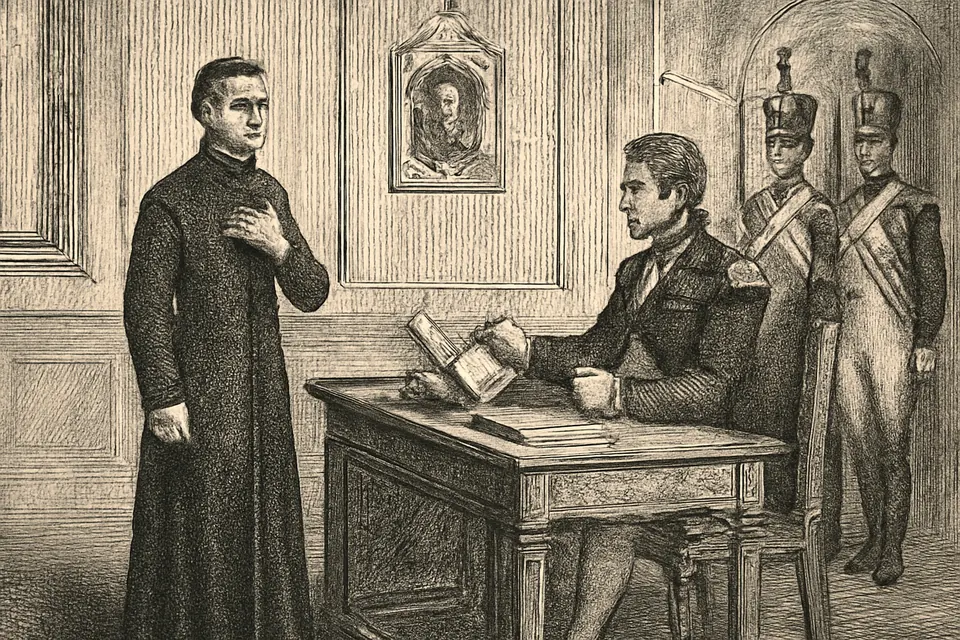
He was exiled, then moved from prison to prison: Piacenza, Bologna, Imola, the fortress at Lugo. Each time he was asked again, he refused again. In December 1813 he was sentenced to deportation to Corsica and was waiting in Florence for the ship when Napoleon's power collapsed. He came home to Rome in 1814, after about four years.
The Missionaries of the Precious Blood
Back in Rome he meant to join the newly restored Jesuits. His director, Fr. Albertini, and Pope Pius VII had other plans. The pope wanted missions preached throughout the Papal States to heal the damage of the war years, and he gave Gaspar and a few companions the old abbey of San Felice at Giano, in Umbria. On August 15, 1815, the feast of the Assumption, the first house of the new congregation opened there with a sung Te Deum.
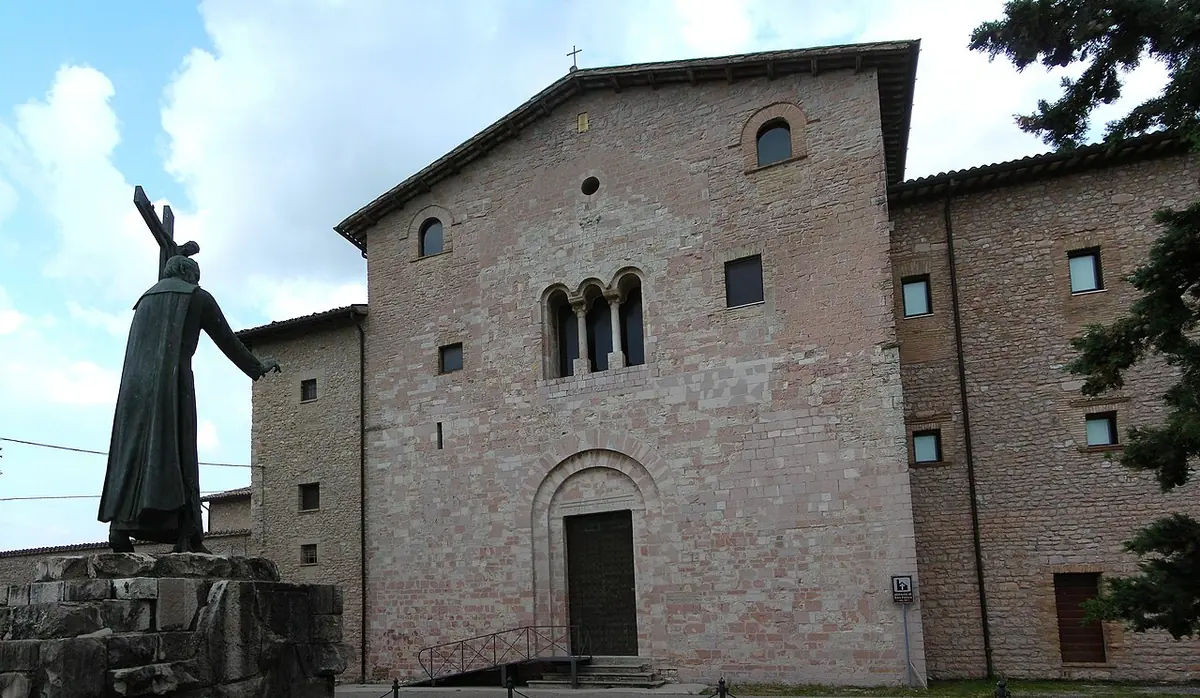
The members were secular priests living in community, bound by charity and a promise rather than by vows. Their work was the parish mission: days of preaching, confessions, processions and reconciliation in a single town, followed by groups that kept the fruit alive. Gaspar wrote a "Method of the Holy Missions" for them, and the Catholic Encyclopedia says he often preached five times a day. At Sanseverino fifty priests were not enough to hear the confessions after his sermons.
The brigands of the southern hills
In the 1820s the border country between Rome and Naples, the provinces then called Marittima and Campagna, was ruled by brigands. In 1819 Pius VII even decreed the destruction of the town of Sonnino as their stronghold. Gaspar asked for a different remedy. In 1821 the pope entrusted him with the moral renewal of the region and ordered six mission houses opened there. A house at Sonnino itself followed in 1826.
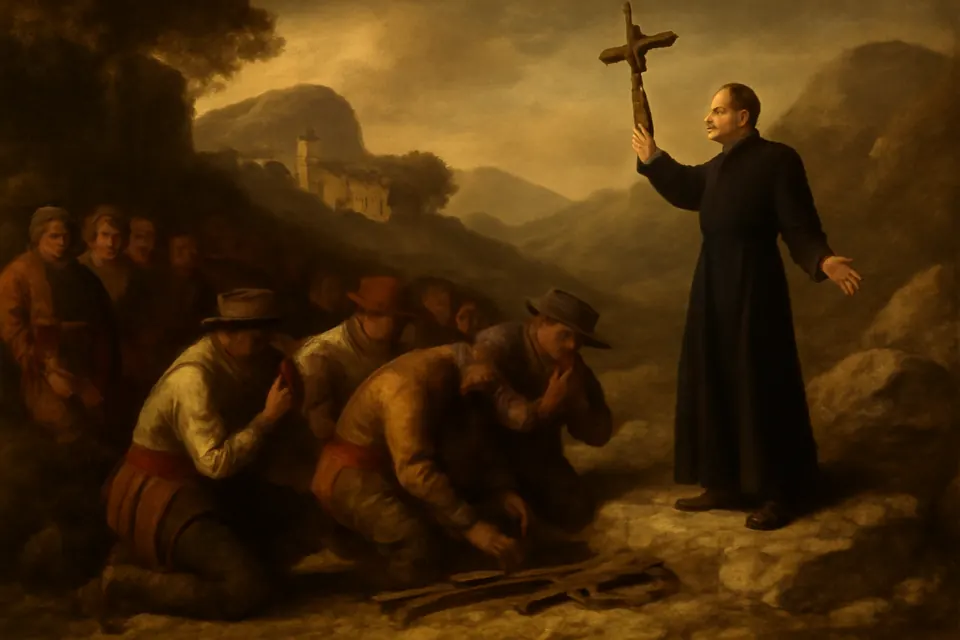
The Catholic Encyclopedia tells what happened next: the brigands "came in crowds and laid their guns at his feet after he had preached to them in their mountain hiding-places." He went to them armed with nothing but a crucifix. The Dicastery for the Causes of Saints says that, little by little, he managed what no one else had: he made the roads safe.
Trials from his own side
Not everyone was pleased. Officials who profited from bribes in the brigand country turned against him, and enemies nearly persuaded Pope Leo XII to suppress his work. Leo even objected to the title "Precious Blood" as a novelty. After meeting Gaspar in person, the pope told his court, "Del Bufalo is an angel." Under Pius VIII, in 1830, Gaspar briefly lost his faculties and his congregation's subsidy was cut. He bore it without bitterness, forgave his accusers, and the storm passed.
In 1834 a woman he had first met during a mission at Vallecorsa in 1822, Maria De Mattias, founded the Adorers of the Blood of Christ at Acuto with his encouragement. She was canonized in 2003. By then the missionaries had about seventeen houses.
Death among the cholera victims
His health began to fail in 1836. In 1837 cholera reached Rome, and although he was already gravely ill, he hurried there to serve the sick. Pius XII recalled that Gaspar had refused every church honor, crying "Paradiso, paradiso!" and wanting to die sul palco, on the preacher's platform. He got his wish. He died in Rome on December 28, 1837, still at work. St. Vincent Pallotti, his confessor and friend, stood by him at the end and later testified to his holiness.
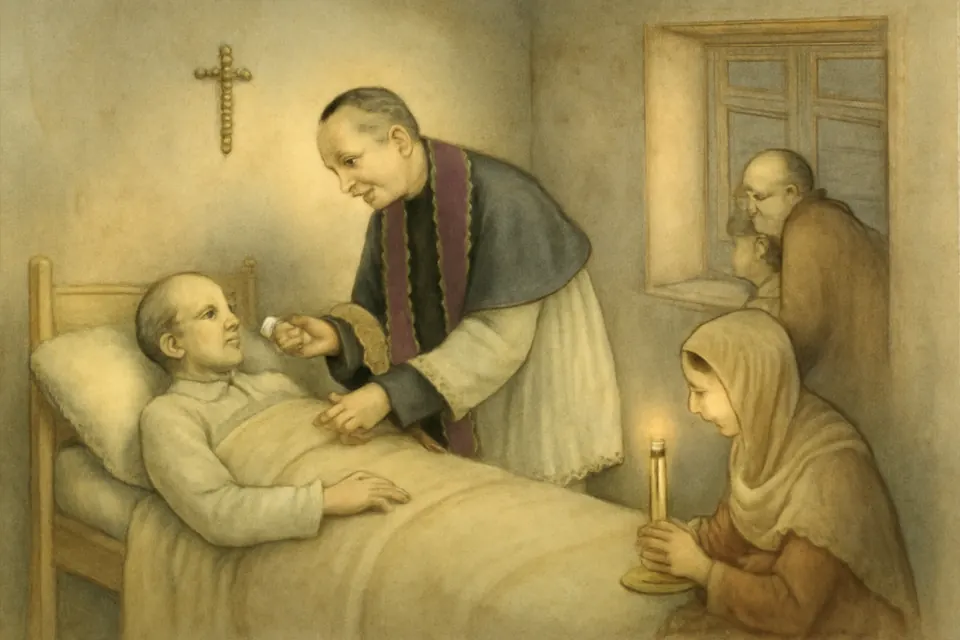
Beatification, canonization and miracles
Pope Pius X beatified Gaspar in 1904. Pope Pius XII canonized him on June 12, 1954, together with Peter Chanel, Joseph Pignatelli, St. Dominic Savio and Maria Crocifissa Di Rosa. As the modern process requires, the Church accepted miracles worked through his intercession for both steps; the published sources we consulted do not describe them, so we do not either.
Two other wonders are told of him:
- The healing of his eyes as a child: reported, through the prayers of St. Francis Xavier.
- The conversion of the brigands: not a miracle in the formal sense, but the Church and his contemporaries saw God's hand in it.
Pope St. John XXIII was devoted to him and went to pray at his tomb on January 4, 1963.
Why St. Gaspar is a patron
St. Gaspar is the patron of the congregation he founded, the Missionaries of the Precious Blood (C.PP.S.), which came to the United States in 1844 at the invitation of Bishop John Purcell of Cincinnati and still serves parishes in Ohio, Indiana and Missouri. The town of Sonnino, in the province of Latina, honors him as its patron because he brought peace to the town in the worst years of the brigands. See the full list on our patron saints page.
Symbols of St. Gaspar del Bufalo in art
St. Gaspar lived in the 19th century and is shown as he looked: a Roman secular priest, not a friar or monk. Look for:
- A black cassock: the plain dress of a Roman priest.
- A large crucifix on a chain over his heart: the missionary crucifix of ebony and brass that every member of his congregation received. It is his most distinctive mark.
- The crucifix raised high: he is often shown preaching, holding it up before a crowd, as he did before the brigands.
- A chalice or drops of blood: for the Precious Blood, the devotion at the center of his life.
Statues in American churches served by his missionaries often show him pointing to heaven with one hand while holding the cross with the other.
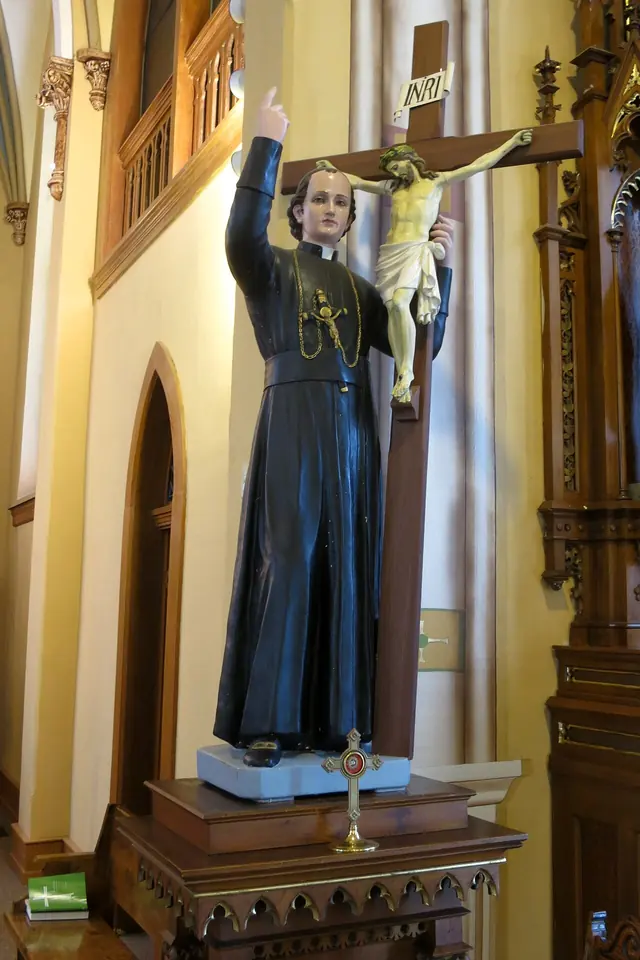
His tomb at Santa Maria in Trivio
Gaspar's body rests in the church of Santa Maria in Trivio, near the Trevi Fountain in Rome. The church and the old convent of the Crociferi beside it became the mother house of his congregation. His relics lie in a glass-fronted shrine beneath a side altar, with a gilded figure of the saint, and an altarpiece above shows him rising to heaven.
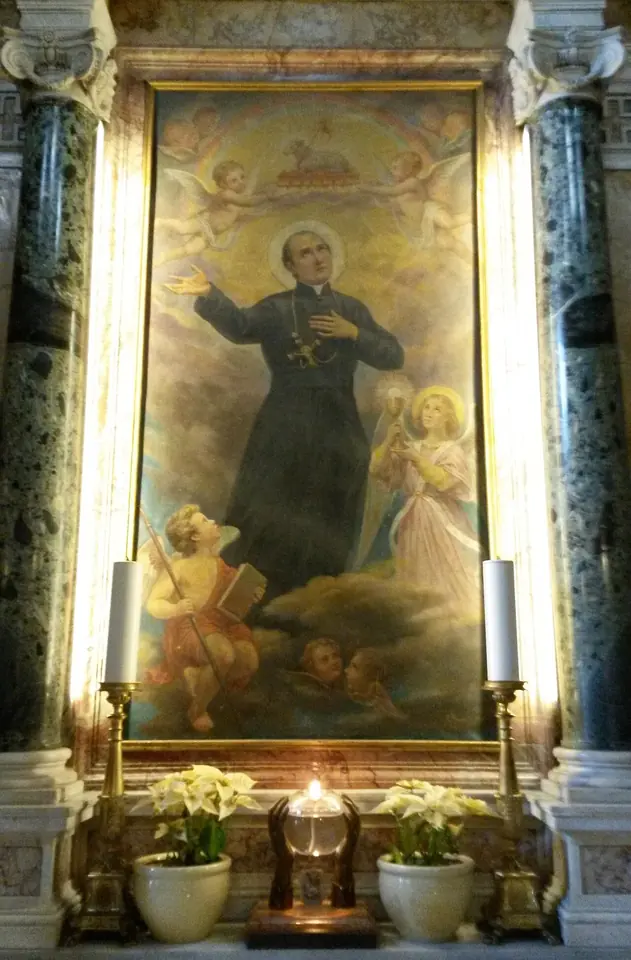
Pilgrims kneel before the shrine below the altar, where the gilded figure lies over his relics. Pope John XXIII prayed here on January 4, 1963, about two weeks before he canonized Gaspar's friend Vincent Pallotti.
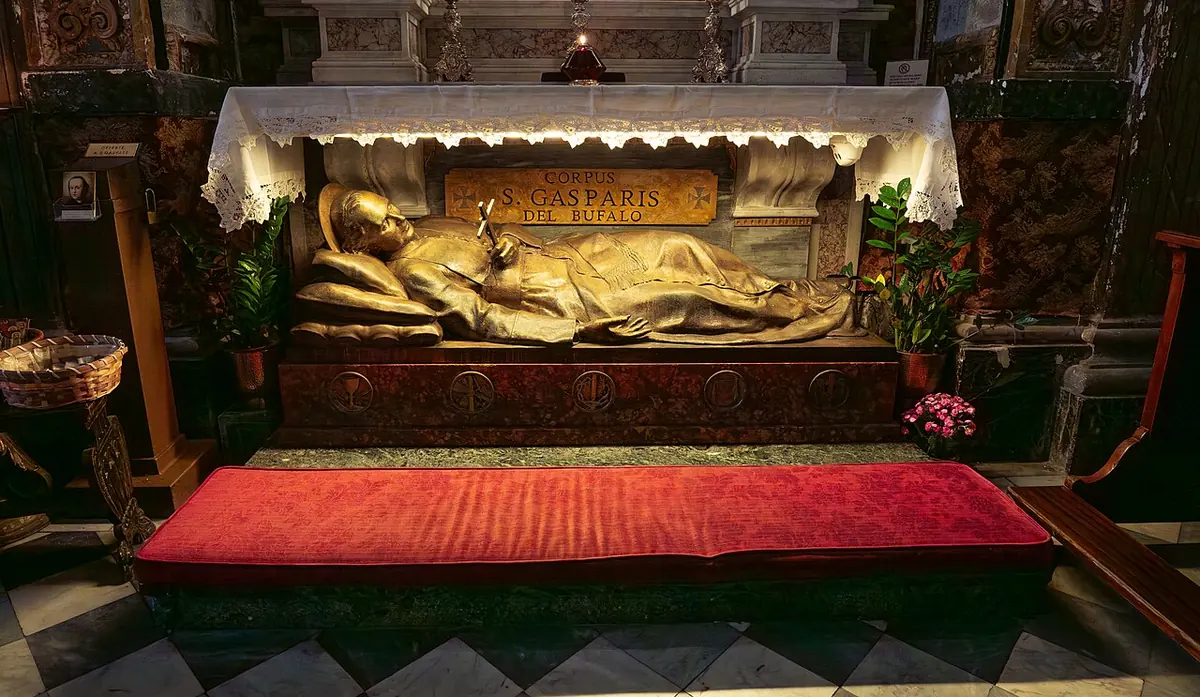
Small relics of St. Gaspar are kept in many churches of his congregation, especially in western Ohio and Indiana.

Prayer of St. Gaspar del Bufalo to the Precious Blood
Gaspar's own words are the best prayer to learn from him. The Dicastery for the Causes of Saints gives this prayer of his to the Blood of Jesus. It begins, in Italian:
O sangue prezioso del mio Signore, che io ti benedica in eterno.
In our English translation:
O precious Blood of my Lord, may I bless you for ever.
O Blood of Jesus Christ, balm of our souls, fountain of mercy, grant that my tongue, reddened with blood in the daily celebration of the Mass, may bless you now and always.
Your wounds, your blood, the thorns, the cross, and above all the divine blood poured out to the last drop, with what eloquent voice they cry out to my poor heart!
Since you suffered agony and died to save me, I will give my life too, if need be, so that I may come to the blessed possession of heaven.
From your opened side, ark of salvation, furnace of charity, came forth blood and water, sign of the sacraments and of the tenderness of your love, O Christ, who have loved us and washed us in your blood!
The Dicastery also records the wish that sums up his life: "I would like to have a thousand tongues to soften every heart toward the most Precious Blood of Jesus."
Let us ask St. Gaspar to pray for priests and missionaries, for those caught up in violence and crime, and for everyone who needs to hear that the Blood of Christ was shed for them. We honor him on October 21; you can find other saints of the season on our feast days calendar.
Frequently asked questions
Who was St. Gaspar del Bufalo?
A priest of Rome, born in 1786, who refused Napoleon's oath of loyalty in 1810 with the words "I cannot, I ought not, I will not," was exiled and imprisoned until 1814, and founded the Missionaries of the Precious Blood in 1815. He spent the rest of his life preaching parish missions and died in Rome in 1837 while serving cholera victims.
When is the feast day of St. Gaspar del Bufalo?
The Missionaries of the Precious Blood and the parishes they serve keep his feast on October 21. He died on December 28, 1837, and for a long time his memorial was kept on January 2. He is not on the General Roman Calendar.
Where is St. Gaspar del Bufalo buried?
His body lies beneath a side altar in the church of Santa Maria in Trivio in Rome, a few steps from the Trevi Fountain. The church was the mother house of his congregation.
What is St. Gaspar del Bufalo the patron saint of?
He is the patron of the congregation he founded, the Missionaries of the Precious Blood, and of the town of Sonnino in Lazio, which honors him for bringing peace in the years when brigands ruled its hills.
Why is he called the Apostle of the Precious Blood?
He made devotion to the Blood of Christ, poured out for our redemption, the heart of all his preaching. He named his congregation for it and said he wished he had "a thousand tongues" to soften every heart toward the Precious Blood of Jesus.
Keep exploring
Sources
- Catholic Encyclopedia (1909): St. Gaspare del Bufalo. His healing through St. Francis Xavier, "Non posso, non debbo, non voglio," the brigands, Leo XII's "Del Bufalo is an angel," and his death
- Dicastery for the Causes of Saints: Gaspare del Bufalo (Italian). The "thousand tongues" saying and his prayer to the Precious Blood (our translations)
- Pius XII, Address for the canonization of Peter Chanel, Gaspar del Bufalo, Joseph Pignatelli, Dominic Savio and Maria Crocifissa Di Rosa (June 12, 1954, Italian). His cry "Paradiso, paradiso!" and his wish to die "sul palco," preaching
- Missionaries of the Precious Blood: Our Founder (timeline after Ven. John Merlini). Dates of his ordination, exile, the first house at San Felice of Giano, Sonnino, Maria De Mattias, his death, and John XXIII's visit to his tomb
- Catholic Encyclopedia (1911): Congregation of the Most Precious Blood. The congregation's growth, the six mission houses for the brigand country, and its arrival in America in 1844