St. Alexander of Bergamo

St. Alexander of Bergamo was a Christian soldier martyred at Bergamo in northern Italy around the year 300. Tradition makes him a centurion of the Theban Legion who escaped its massacre, was imprisoned in Milan, fled to Bergamo and was beheaded there for preaching Christ. He is the patron saint of Bergamo, and we keep his feast on August 26.
Who was St. Alexander of Bergamo?
St. Alexander of Bergamo was a Christian soldier who gave his life for Christ at Bergamo, in Lombardy, around the year 300. The Roman Martyrology remembers him on August 26:
At Bergamo, in Lombardy, St. Alexander, martyr, who was one of the same legion, and endured martyrdom by being beheaded for the constant confession of the name of our Lord Jesus Christ.
"The same legion" is the Theban Legion of St. Maurice, named in the line just before. Bergamo has honored him as its patron for well over a thousand years. Its cathedral bears his name, his golden statue stands on top of its dome, and his relics rest on its high altar.
History and legend
We should be honest about what we know. The written Passio of St. Alexander is late, set down long after his death, and his cult is far older than the text.
The Catholic Encyclopedia of 1907 judged the core of the story "more trustworthy" than most of Bergamo's early legends. Whatever the details, it notes, historians have shown that Galerius and Maximian began purging Christians from the Roman army years before Diocletian's great persecution of 303. Alexander was one of its victims, and the Encyclopedia suggests his martyrdom may have come as early as 287. The Italian hagiographer Maurizio Misinato sums up the likely history plainly: Alexander was probably a Roman soldier, born in or living at Bergamo, who was tortured and killed for refusing to give up his faith.
The story of St. Alexander of Bergamo
The traditional account, as Bergamo tells it, runs like this. Alexander was a centurion of the Theban Legion, Christian soldiers from Egypt brought west to fight in the Alps. At Agaunum, in what is now Switzerland, the legion refused to persecute fellow Christians and was decimated, then massacred. Alexander was among the few who escaped, and he fled into Italy.
At Milan he was recognized and thrown into prison. There, tradition says, he was visited by St. Fidelis and by Bishop Maternus, and Fidelis helped him escape. He was caught again on the road to Como and brought back. Before the emperor Maximian he overturned a pagan altar, and he was condemned to be beheaded. The story says the executioner's arms went stiff and he could not strike.
He escaped a second time and came to Bergamo by way of Fara Gera d'Adda and Capriate. A local lord named Crotacius sheltered him and urged him to hide. Instead Alexander began to preach, and he brought many to Christ, among them Firmus and Rusticus, who were martyred in their turn. He was arrested once more and beheaded publicly on August 26, on the spot where the church of Sant'Alessandro in Colonna now stands.

St. Grata and the lilies
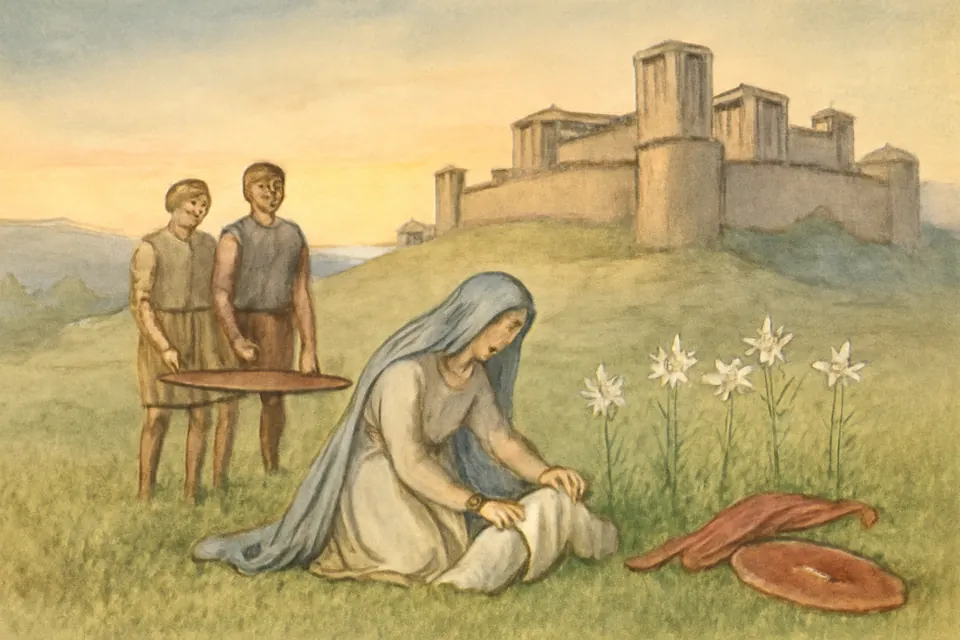
Bergamo's tradition adds a gentle ending. A Christian noblewoman named Grata, honored in the city as a saint, came to gather the martyr's remains. Where his blood had fallen, white lilies had sprung up, and by them she found him. She buried him on her family's land outside the walls, where a great basilica of Sant'Alessandro later rose. The Venetians demolished it in 1561 to build the city walls, and the cathedral took his name.

The miracles of St. Alexander
- Traditional: the executioner's arms that stiffened at Milan, so that he could not behead the saint.
- Traditional: the white lilies that grew where his blood fell, by which St. Grata found his body.
Both come from the late Passio and from Bergamo's tradition. Neither has been examined by the Church.
Why St. Alexander is the patron saint of Bergamo
He is the patron of Bergamo because he died there and the city's Christians have kept his grave and his memory since late antiquity. The Lombard king Grimoald and Charlemagne endowed his first cathedral, the Catholic Encyclopedia records. Other towns honor him too, among them Melfi in the far south, and the villages of Fara Gera d'Adda and Capriate on the road his legend says he took to Bergamo.
Symbols of St. Alexander in art
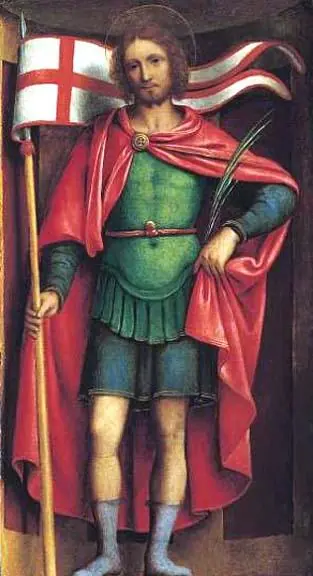
- Roman armor and a red cloak: he is painted as a soldier, often young and beardless, as in Luini's panel.
- The banner with a white lily: the standard of the Theban Legion in Bergamo's tradition, marked with the lily of the legend. Some painters, like Luini, give him a white banner with a red cross instead.
- The martyr's palm and the sword of his beheading.
- A horse: he is sometimes shown mounted, as a knight.
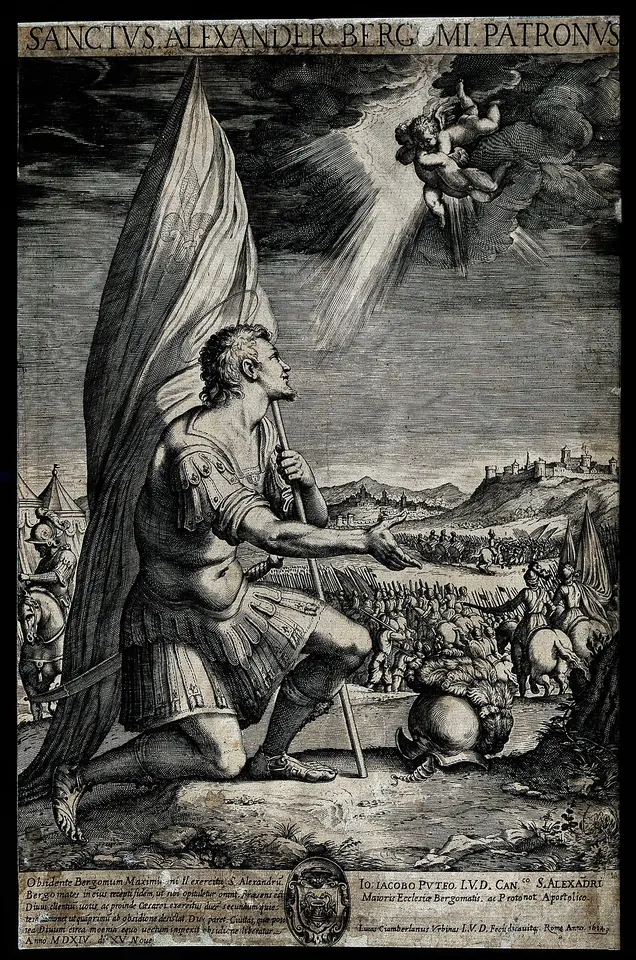
Luca Ciamberlano's engraving of 1614, titled Sanctus Alexander Bergomi Patronus, shows him kneeling on the battlefield with his great banner while angels bring him the crown of martyrdom.
Feast day and where he is honored
We keep his feast on August 26. See the feast day calendar. In Bergamo it is the great feast of the year, with a solemn Mass in the cathedral and a city festival.
His relics rest in a gilded urn on the high altar of Bergamo Cathedral. Pilgrims also visit Sant'Alessandro in Colonna, built on the traditional place of his beheading and named for the column that stands before it, and Sant'Alessandro della Croce in the lower town.

There is no widely used traditional English prayer to St. Alexander of Bergamo. Let us ask him, with the people of Bergamo, to pray for soldiers who must choose between an order and their conscience, and for all who are asked to deny Christ.
Frequently asked questions
Who was St. Alexander of Bergamo?
A martyr of the persecutions under the emperor Maximian, beheaded at Bergamo around 300. The Roman Martyrology calls him a soldier of the Theban Legion who was beheaded "for the constant confession of the name of our Lord Jesus Christ." He is the patron saint of the city and diocese of Bergamo.
When is the feast of St. Alexander of Bergamo?
August 26. Bergamo celebrates it as its patronal feast, with Mass in the cathedral and a festival in the last days of August.
Why is St. Alexander shown with a lily?
Tradition says that where drops of his blood fell, white lilies sprang up, and that the noblewoman St. Grata found his remains by them. His banner in art usually carries a white lily.
Where are his relics?
In Bergamo Cathedral, which is dedicated to him, in a gilded urn on the high altar.
Keep exploring
Sources
- Roman Martyrology, August 26 (1916 English edition). His entry as a soldier of the Theban Legion, beheaded at Bergamo
- Catholic Encyclopedia (1907): Bergamo. The value of his legend, the purge of Christians from the army before 303, the possible date of 287, and the cathedrals dedicated to him
- Santi e Beati: Sant'Alessandro di Bergamo (Maurizio Misinato). The fuller legend (Milan, St. Fidelis, Como, Crotacius, Firmus and Rusticus) and the lily banner in art
- BergamoNews: Sant'Alessandro, una storia di fede lunga 1.600 anni tra leggenda e realtà (August 26, 2017). St. Grata, the basilica destroyed in 1561 and the golden urn on the cathedral's high altar