St. Andrei Rublev, Iconographer of the Holy Trinity
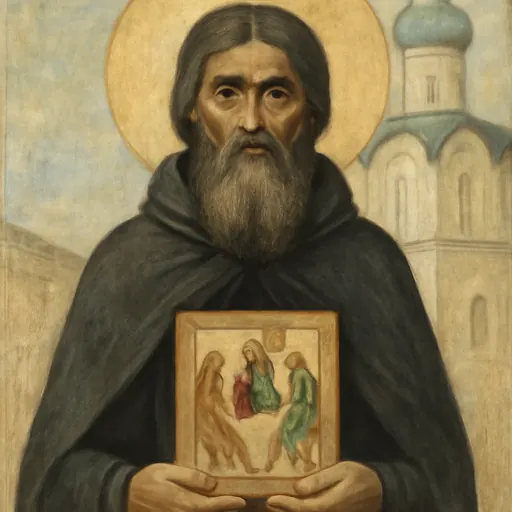
St. Andrei Rublev (about 1360–1430) was a Russian monk, the greatest of Russia's icon painters, whose famous icon of the Holy Trinity honors St. Sergius of Radonezh. He worked on the great churches of Moscow and Vladimir and died at the Andronikov Monastery. The Russian Orthodox Church glorified him in 1988 and keeps his feast on July 4.
Who was St. Andrei Rublev?
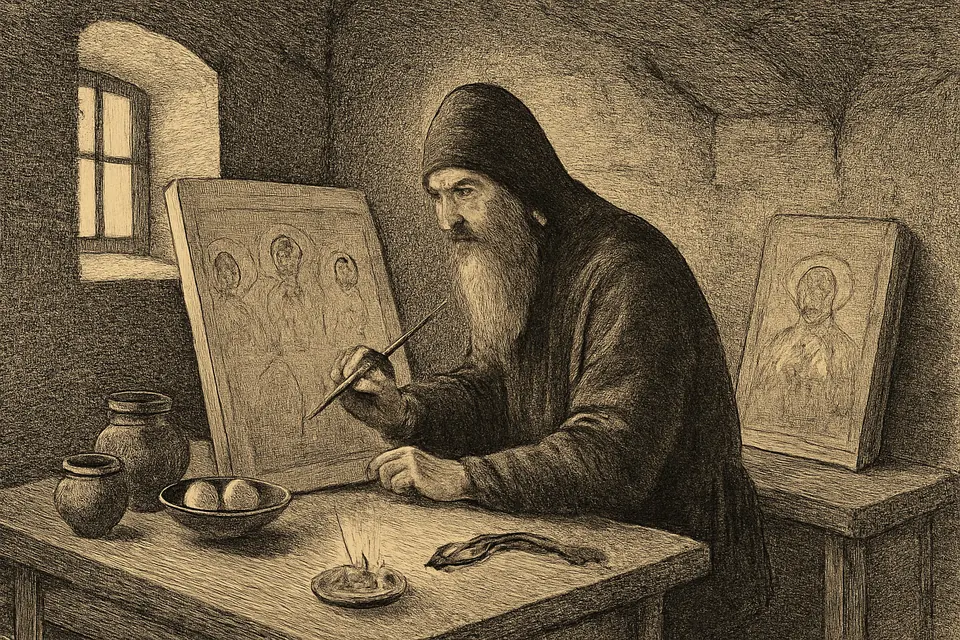
St. Andrei Rublev was a Russian monk who painted icons, and the Orthodox Church honors him as the greatest of all Russia's iconographers. He lived around 1360 to 1430, in the generation after St. Sergius of Radonezh, and his icon of the Holy Trinity is one of the most beloved holy images in the world. The Russian Orthodox Church glorified him as a saint in 1988, at the council held for the thousandth anniversary of the Baptism of Rus. We honor him here as the Orthodox Church keeps him, as "Venerable Andrew the Iconographer."
Very little is written about his life, and almost all of it is about his work. He is one of those saints we know by what he made.
The life of St. Andrei Rublev
A monk of St. Sergius's circle
The Orthodox Church in America's life says he was born near Moscow sometime between 1360 and 1370. As a young man he went to the Holy Trinity Monastery founded by St. Sergius and was deeply moved by him. After Sergius died in 1392, Andrei became a novice there under his successor, St. Nikon. Some time before 1405 he moved, with Nikon's blessing, to the Andronikov Monastery in Moscow, where he received the monastic tonsure. There he learned his craft from Theophanes the Greek and from the monk Daniel, his lifelong friend and fellow ascetic.
The great commissions
The chronicles first name him in 1405, when he, Theophanes and Prokhor of Gorodets painted the Cathedral of the Annunciation in the Moscow Kremlin. In 1408 he and Daniel painted the Dormition Cathedral in Vladimir. When the Tatars had burned St. Sergius's monastery, St. Nikon asked the two friends to paint the new stone church of the Holy Trinity there. In those years Andrei painted the icon that has made his name known everywhere.
Joy in looking
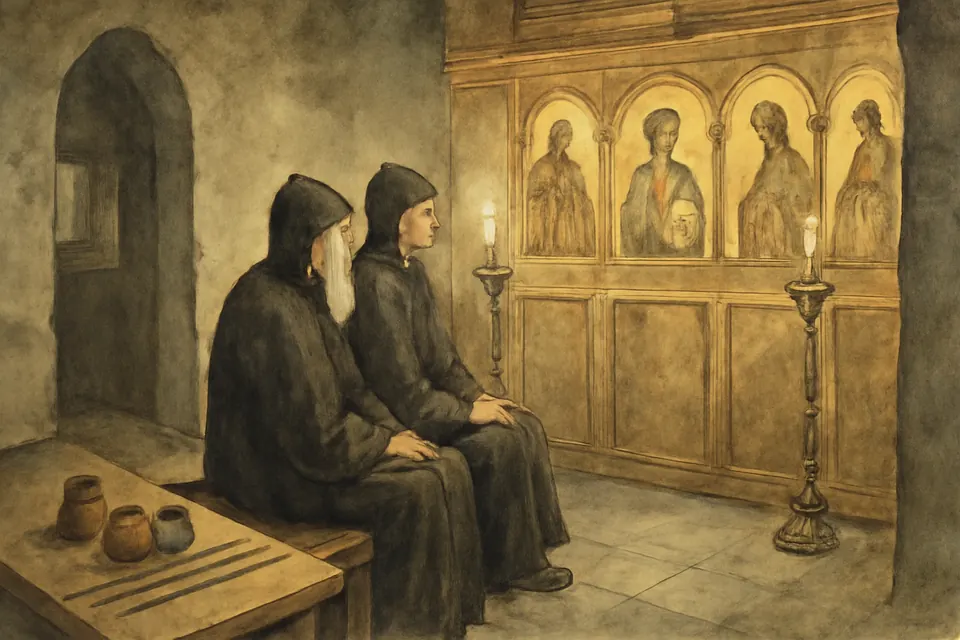
One of the few glimpses we have of his inner life comes from St. Joseph of Volokolamsk, who heard it from an elder of his monastery. On feast days, when work was set aside, Andrei and Daniel would sit before the holy icons and, in Joseph's words, "gazing on them unwaveringly, they were filled with divine joy and light." Joseph adds that through fasting and the monastic life they learned to lift their minds to the immaterial, divine light.
His last work and death
He died at the Andronikov Monastery between 1427 and 1430, at over seventy, after painting its Cathedral of the Savior. The Orthodox Church in America's life records that Daniel, who had died first, appeared to his friend and called him to join him in eternal blessedness.
The Holy Trinity icon
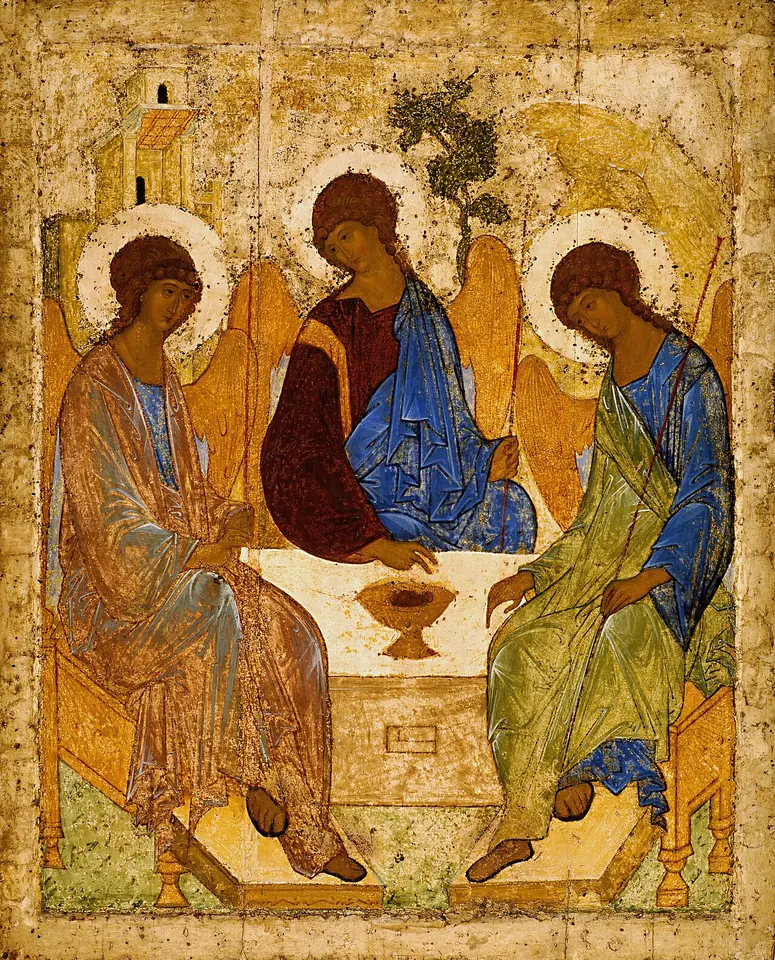
The icon shows the three angels who visited Abraham at the oak of Mamre in Genesis 18. Older icons of the scene show Abraham and Sarah serving the guests. Rublev left them out. Only the three angels remain, seated around a table with a single chalice, their heads bowed toward one another in a circle of quiet love, and the scene becomes an image of the Holy Trinity itself. A 17th-century source says it was painted "in praise of Sergius of Radonezh," for the monastery he founded. In 1551 the Stoglav Council of Moscow named it a model that icon painters should follow. Catholics love it too, and it hangs in countless churches and homes in the West.
Miracles and veneration
- Daniel's appearance before his death (traditional). The Orthodox Church in America's life tells of it.
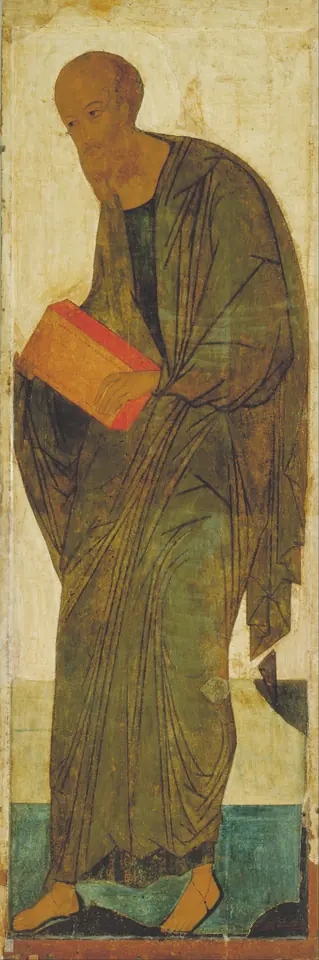
- Wonder-working icons (traditional). The old Russian Tale of the Holy Icon Painters, as the Pravoslavnaya Entsiklopediya notes, says that all of Andrei's icons were held to be wonder-working.
- Honored as a saint long before 1988 (historical). Sixteenth-century illuminated manuscripts of the lives of St. Sergius and St. Nikon already show Andrei with a halo, and a 17th-century calendar lists him among the holy monks of the Andronikov Monastery.
Why St. Andrei Rublev is a patron of icon painters
He is the model iconographer of the Orthodox Church, the painter whose Trinity a council told others to follow. Iconographers ask his prayers as they work, and in 2001 the Holy Synod of the Russian Orthodox Church created an Order of St. Andrei Rublev to honor church artists. He is a patron of icon painters, artists and painters. More patronages are on our patron saints page.
Symbols of St. Andrei Rublev in icons
Icons of St. Andrei are all modern, since he was glorified in 1988. Look for:
- A monk in a dark habit: he was a simple monk, not an abbot or priest.
- The Trinity icon in his hands: his great work, which he holds out to us, as in the wall painting at Podgorica.
- A brush, or a board being painted: less often, the tools of his craft.
- A gold background and an inscription with his name: beside the halo, in Church Slavonic letters.
St. Andrei Rublev's feast day and the Andronikov Monastery
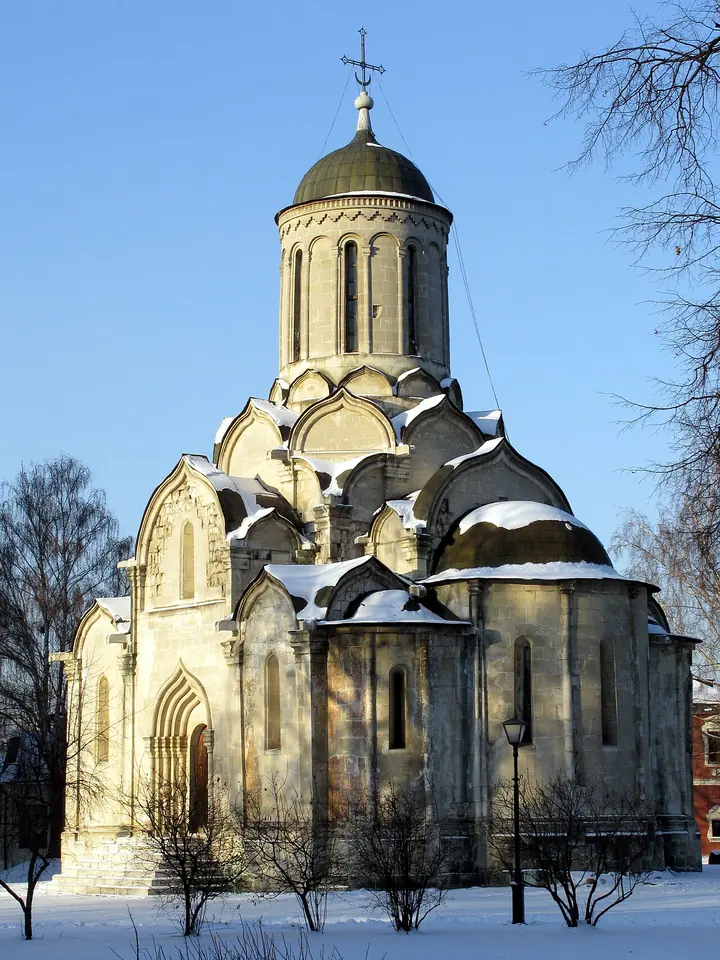
The Orthodox Church keeps his feast on July 4, which falls on July 17 of the civil calendar for churches that follow the Julian calendar. The place of his grave is lost: a 19th-century source says he and Daniel lay under the old bell tower of the Andronikov Monastery, which was torn down and the ground leveled. The monastery's Cathedral of the Savior, whose paintings the Life of St. Sergius calls his last work, still stands, and today the monastery houses the Andrei Rublev Museum of early Russian art. See other July saints on our feast days page.
Troparion of St. Andrei Rublev
On his feast the Orthodox Church sings a troparion (Tone 3) that praises him as a monk who knew Christ and preached the Holy Trinity to the whole world through his icon, and asks him to pray that the uncreated light may illumine our souls. The OCA prints the full text on its website.
Let us ask St. Andrei to pray for all who make holy images, and for us, that we may learn to look at the face of God with the same quiet joy.
Frequently asked questions
Who was St. Andrei Rublev?
A monk of the circle of St. Sergius of Radonezh who became Russia's greatest iconographer. He painted in the Annunciation Cathedral of the Moscow Kremlin in 1405, the Dormition Cathedral in Vladimir in 1408, and the Trinity Cathedral of St. Sergius's monastery, and died at the Andronikov Monastery in Moscow between 1427 and 1430.
What is St. Andrei Rublev's most famous icon?
The Holy Trinity, also called the Old Testament Trinity or the Hospitality of Abraham. It shows the three angels who visited Abraham in Genesis 18, seated around a table with a chalice, as an image of the Holy Trinity. In 1551 the Stoglav Council of Moscow named it a model for icon painters.
When was Andrei Rublev canonized?
In 1988, by the Local Council of the Russian Orthodox Church held for the millennium of the Baptism of Rus. A liturgical service in his honor was composed at the same time.
When is St. Andrei Rublev's feast day?
July 4 (July 17 on the civil calendar for Julian-calendar churches).
Keep exploring
- Patron saint pages
- Artists
- Feast-day calendar
- Saints remembered in JulySaint of the dayWhat saint is my birthday?
- Relics
- Where the relics are kept (map)
- More
- Saints A to ZPatron saints A to ZExplore every section
Sources
- Venerable Andrew Rublev the Iconographer (Orthodox Church in America). His novitiate under St. Nikon; the Andronikov Monastery; the 1405 and 1408 commissions; Daniel appearing to him before his death
- Troparion and Kontakion of Venerable Andrew Rublev (Orthodox Church in America). The text of the troparion
- E. N. Telitsyna and others, Andrei Rublev (Pravoslavnaya Entsiklopediya, in Russian). St. Joseph of Volokolamsk on Andrei and Daniel contemplating icons on feast days; the Stoglav Council of 1551 naming his Trinity a model; burial under the old bell tower of the Andronikov Monastery; glorification by the 1988 Council