St. Cassian of Tangier, Martyr

St. Cassian of Tangier was the court notary at Tangier, in Roman North Africa, who in 298 refused to write down the death sentence passed on the Christian centurion St. Marcellus. He threw down his writing tablets, declared the sentence unjust, confessed himself a Christian and was beheaded about a month later. The Roman Martyrology keeps him on December 3.
Who was St. Cassian of Tangier?
St. Cassian of Tangier was a Roman court clerk, a notary whose job was to take down the proceedings and sentences of the court in the North African city of Tingis, now Tangier in Morocco. In the year 298 he was at his desk when the deputy prefect condemned a Christian officer, the centurion St. Marcellus, to death. Cassian would not write the sentence. That refusal cost him his life, and the Church has honored him ever since as a martyr.
We know him from a single moment. There is no account of his family, his conversion or his earlier years. But that one moment says a great deal: a minor official, with no power to stop an injustice, decided he would at least not put his hand to it.
The trial of St. Marcellus
The story begins with Marcellus. Butler's Lives of the Saints, following the acts of his martyrdom, says that in the summer of 298 the army in Spain was celebrating the birthday of the emperor Maximian with sacrifices to the gods. Marcellus, a centurion, would not take part. He threw down his military belt in front of his company and declared that he was a soldier of Jesus Christ, the eternal King. He also threw down his vine staff, the sign of a centurion's rank.
He was imprisoned and then sent under guard to Aurelius Agricolanus, the deputy of the praetorian prefect, who was then holding court at Tangier. When Marcellus admitted what he had done, Agricolanus sentenced him to death for desertion and impiety. Marcellus was beheaded on October 30. His relics were later carried to León in Spain, where he is honored as the city's patron and his relics rest in the church that bears his name.

The refusal of St. Cassian
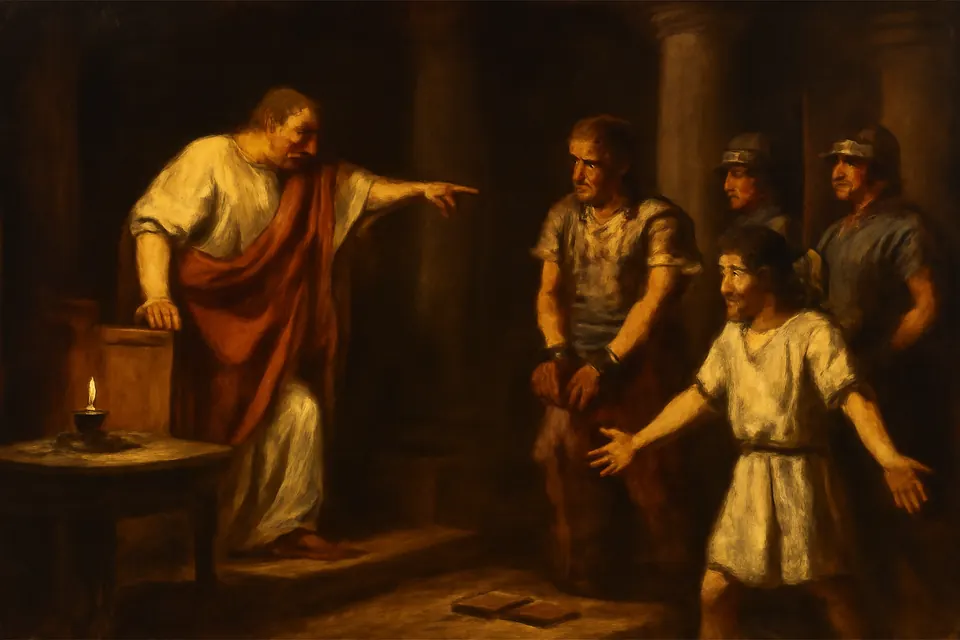
Cassian was the clerk recording the case. Butler tells what happened next:
Cassian, the secretary or notary of the court, refused to write the sentence which the vicar pronounced against the martyr, and threw his pencil and table-book on the ground.
The "pencil and table-book" were a stylus and wax writing tablets, the tools of his trade. Agricolanus rose from his seat in a rage and asked him why he had done it. Cassian answered: "Because the sentence which you have dictated is unjust."
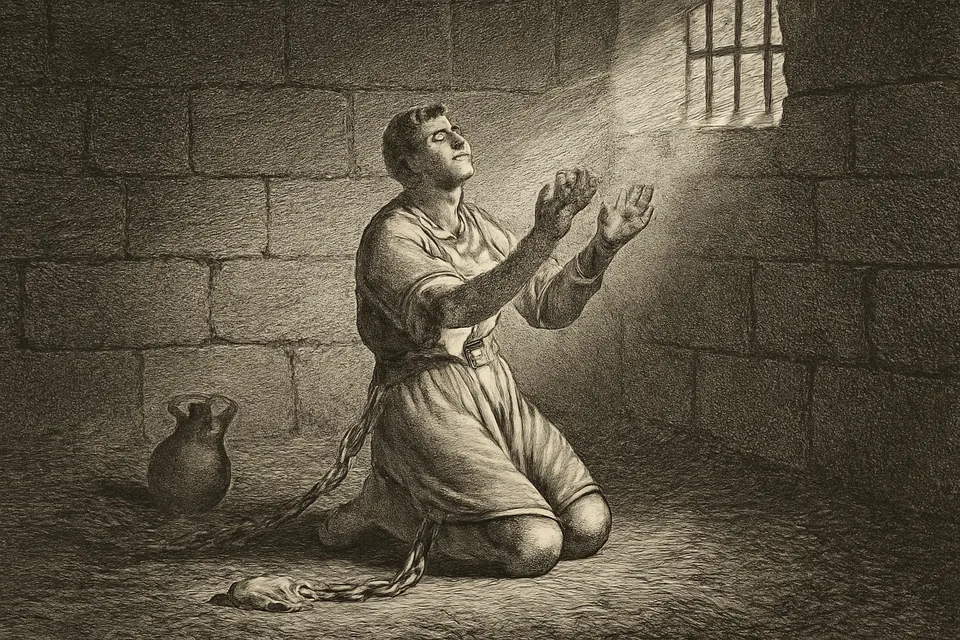
He was taken to prison at once. About a month later he was brought out and questioned again. He held to his answer and confessed that he was a Christian, and he was beheaded on December 3, 298.
The Roman Martyrology sums up his story on his feast:
At Tangier, in Morocco, St. Cassian, martyr. After having been a recorder for a long time, at length, through the inspiration of heaven, he deemed it an execrable thing to contribute to the massacre of the Christians, and therefore abondoned his office, and making profession of Christianity, deserved to obtain the triumph of martyrdom.
History and tradition
The Acts of St. Marcellus are among the more trustworthy early martyr accounts. Butler calls them "authentic," and Thierry Ruinart, the Benedictine scholar who collected the genuine acts of the martyrs in the seventeenth century, printed them together with "the short acts of St. Cassian." What we know of Cassian is that short text and nothing more. The Martyrology adds only that he had been a recorder "for a long time" before heaven moved him to act, so we should not imagine him as a newcomer to the court.
No miracles of St. Cassian are recorded, and no shrine or relics of his are known today.
Why St. Cassian matters
St. Cassian is a saint for ordinary people inside large systems. He was not a soldier like Marcellus, a bishop or a teacher. He was a clerk. He could not overturn the sentence. All he could do was refuse to be the hand that wrote it down, and he did.
Court reporters, notaries, stenographers and secretaries may find a friend in him, though no official patronage has been given to him. So may anyone asked to sign, stamp or record something they know is wrong.
Symbols of St. Cassian in art
Pictures of St. Cassian of Tangier are rare, and he is easily confused with St. Cassian of Imola, the schoolmaster killed by his students' styluses. Look for:
- Writing tablets and a stylus thrown to the ground: the moment of his refusal.
- A martyr's palm: the sign of his death for Christ.
- The plain robe of a court clerk, often beside St. Marcellus in his soldier's dress.
If a Cassian appears surrounded by boys with pens, he is the saint of Imola. If he stands near a Roman soldier or a judge's seat, he is the clerk of Tangier.
Feast day
We keep his memory on December 3, the day of his martyrdom. His companion in the story, St. Marcellus, is remembered on October 30. See our feast days page for other saints of December.
Prayer to St. Cassian of Tangier
No traditional prayer to St. Cassian of Tangier has come down to us. Let us ask him to pray for all who work in courts and offices, that they may have the courage to say, as he did, "the sentence which you have dictated is unjust," and to give up a post rather than give up Christ.
Frequently asked questions
Who was St. Cassian of Tangier?
A court clerk (notary) at Tangier in 298. When the deputy prefect Agricolanus condemned the centurion Marcellus to death for refusing to serve in pagan rites, Cassian refused to record the sentence and was himself executed as a Christian.
When is the feast day of St. Cassian of Tangier?
December 3, the day of his death in 298, in the Roman Martyrology.
Is St. Cassian of Tangier the same as St. Cassian of Imola?
No. St. Cassian of Imola was a schoolmaster in Italy killed by his pupils with their styluses; his feast is August 13. Cassian of Tangier was a court clerk in North Africa.
How do we know about St. Cassian?
From a short account attached to the Acts of St. Marcellus, which Butler's Lives of the Saints calls authentic and which the Benedictine scholar Thierry Ruinart published among his genuine acts of the martyrs. Nothing else is known of his life.
Keep exploring
Sources
- The Roman Martyrology (1916 English translation), on archive.org. December 3 entry, quoted on this page
- Butler, Lives of the Saints, vol. 10, October 30: St. Marcellus the Centurion, Martyr (archive.org). The trial of Marcellus at Tangier before Agricolanus and Cassian's refusal, from Ruinart's edition of the acts