St. Emma of Lesum, Countess and Benefactor of Bremen

St. Emma of Lesum (about 975/980–1038), also called Imma, was a Saxon countess, the widow of Count Liudger, who gave her wealth to the Church of Bremen and to the poor. She is the first woman of Bremen known to us by name, and a beloved legend credits her with giving the city its common pasture, the Bürgerweide. Her feast is December 3.
Who was St. Emma of Lesum?
St. Emma of Lesum, also called Imma or Hemma, was a Saxon countess of the early eleventh century who, after her husband's death, spent her fortune on the Church of Bremen and on the poor. She lived at Lesum, on a bluff above the river of the same name just north of Bremen, and died there on December 3, 1038. She is the first woman of Bremen whose name history has kept. The people of the region honored her as a saint, and we keep her memory on December 3.
Her story comes to us in two layers. A few facts are documented. Around them grew a well-loved Bremen legend that the city itself calls closer to a fairy tale. We will keep the two apart.
The life of St. Emma of Lesum
A countess of the Saxon nobility
Emma was born about 975 or 980. Old sources make her a sister of Bishop Meinwerk of Paderborn, though the historian Paul Derks argued in 1998 that this kinship rests on a later addition to Adam of Bremen's chronicle, and her family remains uncertain. She married Count Liudger, a son of the Saxon margrave Hermann Billung and brother of Duke Bernard I of Saxony. King Otto III gave Liudger the estate of Stiepel, south of the Ruhr, in 1001.
Widow and benefactor
Liudger died in 1011, and Emma withdrew to her estate at Lesum. The Archbishop of Hamburg-Bremen, Unwan, who governed the see from 1013, was her kinsman. She became a great benefactor of the Church of Bremen. The diocese of Münster's saints' calendar says she supported the Church of Bremen with her fortune and cared deeply for her people. Tradition also names her as the founder of the church at Stiepel, which later became a place of pilgrimage. A charter of 1008 once cited for this has been shown to be a forgery, so we cannot be sure of it.

She died at Lesum on December 3, 1038. The BBKL says she was buried in Bremen Cathedral, and that relics of hers were once kept in the abbey church of Werden on the Ruhr. The kirchensite article from the Diocese of Münster says it is unclear whether she was really buried in the cathedral.
The legend of the Bürgerweide
The story everyone in Bremen knows is traditional. It tells that in 1032 Emma was riding through the city with her brother-in-law, Duke Benno of Saxony, when the townspeople complained that they had too little pasture for their cattle. She promised them as much land as a man could walk around in an hour. "Why an hour, why not a whole day?" the duke asked with scorn, worried about his inheritance. Emma at once agreed to a day. Benno then asked to choose the walker, and pointed to a man by the road who had no legs.
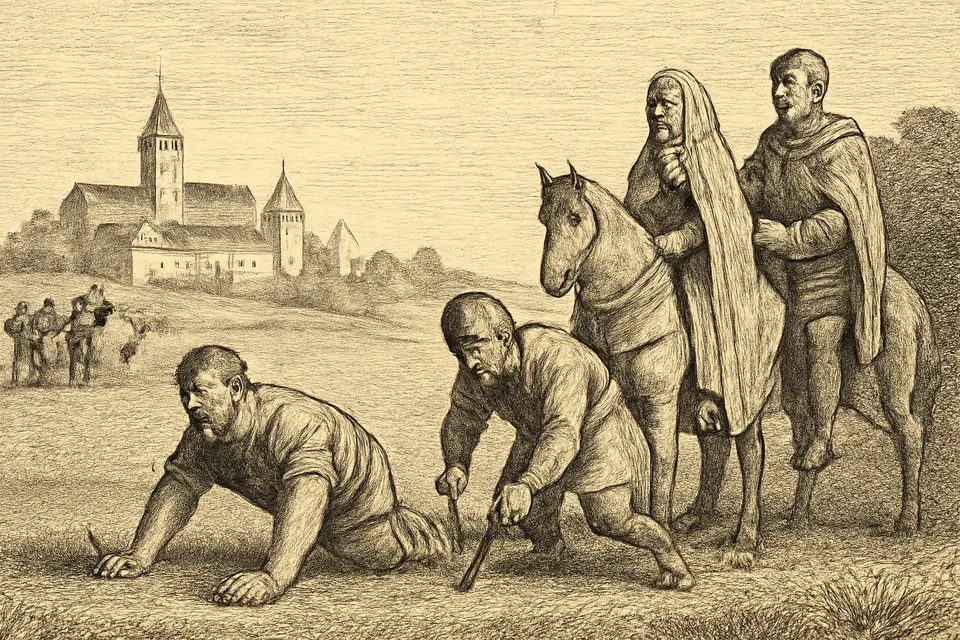
The man set off on his hands, and a servant of the countess followed him, driving in stakes to mark the way. By evening stakes stood as far as the eye could see, and the people cheered. That, says the legend, is how Bremen got its great common pasture, the Bürgerweide.
We should be honest about the history. Bremen's Bürgerpark, which grew out of that meadow, notes that the story was handed down by the storyteller Friedrich Wagenfeld and that Emma's gift cannot be proved. The oldest record of the pasture is a charter of Archbishop Hartwig from 1159, granting grazing rights to all the people of Bremen, "poor and rich." The old account even has a problem of dates, since Liudger's brother Bernard died in 1011, long before 1032. Still, the legend tells us what Bremen remembered about Emma: that she was generous to the people, and that God took the side of the weakest.
Miracles of St. Emma of Lesum
No miracles of Emma were ever formally investigated. The crawling man's long journey is the only wonder told of her, and it belongs to the traditional legend. Her holiness, as the sources describe it, was the plain holiness of a widow who gave away what she had.
Symbols of St. Emma of Lesum in art
Old images of Emma are rare. Modern Bremen has many, and they share a few signs:
- A noblewoman in a long gown and veil, the widowed countess.
- Gifts or loaves in her arms, for her charity to the poor.
- On horseback beside Duke Benno, from the ride in the legend.
- A man crawling on his hands, sometimes linked to the small kneeling figure at the feet of the Roland statue in Bremen's market square, though the Bürgerpark says that figure probably has another meaning.
She also appears in stained glass in the Catholic church of St. Johann in Bremen's Schnoor quarter and in the church at Stiepel.
Where St. Emma of Lesum is honored
Bremen remembers her everywhere: the Emmasee lake in the Bürgerpark, Emma Street in Schwachhausen, and the Emma bench, whose inscription tells her story. At Stiepel in Bochum, schools, ponds and a street carry her name in the form Gräfin Imma.

See our feast days calendar for other saints of December.
Prayer to St. Emma of Lesum
We know of no traditional prayer to St. Emma of Lesum. We may ask her in our own words to pray for widows, for those who share what they have with the poor, and for the people of Bremen. St. Emma of Lesum, pray for us.
Frequently asked questions
When is the feast of St. Emma of Lesum?
December 3, the day she died at Lesum in 1038.
Was St. Emma of Lesum canonized?
No formal beatification or canonization is recorded. She has been honored as a saint locally, around Bremen and at Stiepel, since the Middle Ages.
What is the legend of Countess Emma and the Bürgerweide?
The story says Emma promised the people of Bremen as much pasture as a man could walk around in a day. Her brother-in-law, Duke Benno, chose a man with no legs to make the walk, but he crawled so far by evening that Bremen won a huge meadow. Bremen's Bürgerpark says the story is closer to a fairy tale; the oldest record of the pasture is a charter of Archbishop Hartwig from 1159.
What is St. Emma's connection with Stiepel?
Tradition names her as founder of the church at Stiepel, now part of Bochum, which later became a place of pilgrimage. The charter of 1008 once cited for this is now regarded as a forgery, so the claim is uncertain.
Keep exploring
Sources
- Biographisch-Bibliographisches Kirchenlexikon, vol. XVI (1999): Emma (Imma) von Lesum (Ekkart Sauser). Her death on December 3, 1038, her kinship with Archbishop Unwan, Stiepel, burial in Bremen Cathedral, and relics at Werden
- Diocese of Münster, kirchensite.de: Emma (Imma) von Lesum (Thomas Mollen, 2004). The legend in full, and the uncertainty about her canonization and burial
- Bürgerpark Bremen: Die Anfänge (the legend of Countess Emma). The charter of Archbishop Hartwig in 1159, Friedrich Wagenfeld, and the verdict that the gift cannot be proved