Blessed William Way, Priest and Martyr of Kingston

Blessed William Way (died 1588) was an English seminary priest, ordained in France in 1586, who was arrested in Surrey within months of his return and hanged, drawn and quartered at Kingston upon Thames for being a Catholic priest. Pope Pius XI beatified him in 1929, and we keep his memory on September 23.
Who was Blessed William Way?
Blessed William Way was a young English priest who wanted, more than anything, to give his life for Christ. He was put to death at Kingston upon Thames in the autumn of 1588, the year of the Spanish Armada, when the persecution of Catholic priests in England was at its fiercest. Many people look for him as "St. William Way." He has not yet been canonized; the Church declared him Blessed in 1929.
His crime, in the words of the law, was simply to be in England as a priest ordained abroad. Bishop Challoner, writing in the eighteenth century, found almost nothing else about him. Much more came to light in the early twentieth century, when the Lives of the English Martyrs (1914) gathered the prison lists, the notes of the Crown lawyer who prosecuted him, and the memories of his fellow prisoners. Those witnesses give us a vivid picture of a man of prayer and penance.
The life of William Way
A Devon man at Rheims
Challoner says he was born in Cornwall, but gives no source. A better witness, the priest Benjamin Norton, wrote in 1626: "Mr. William Way I knew at Rheims and I verily think that he was a Devonshire and probably an Exeter man." The Crown's own notes agree: "William Flower. Born in Devonshire." Nothing is known of his childhood.
About 1583 he crossed to France to study for the priesthood at the English College, which Cardinal William Allen had founded at Douai and which was then in exile at Rheims. He was tonsured there on March 31, 1584. In 1586 he received all three major orders at Laon, most probably from its Benedictine bishop, Valentine Douglas: the subdiaconate on March 22, the diaconate on April 5, and the priesthood on September 18. On December 9 he left Rheims alone for England.

Arrest and prison
He was free barely six months. He was arrested in Surrey, at Lambeth, about June 1587, under the name Flower, which he used on the mission. For the next year he lay in the Clink prison in Southwark, where the lists name him "Flower alias Way."
His fellow prisoners remembered him. A contemporary account in Fr. Christopher Grene's collections calls him "a man much mortified by great abstinence and other austerities, lying ever in prison upon the boards and wearing continually a shirt of hair," and says he would "many times cry out, 'Oh, I shall never come to it.'" The Jesuit John Gerard, himself a prisoner for the faith, recalled that when other priests were sent for to their trial and he was not, "he did weep and cry," and was so troubled that he went to confession. "But when he himself was sent for, he had so much joy that he seemed past himself."

The trial and martyrdom of William Way
St. Henry Walpole, the Jesuit who would himself die a martyr at York in 1595, left an account of the trial at the Newgate sessions. Way refused to be tried by a temporal judge in a matter of faith. The Bishop of London was sent for, and the Recorder said that now there was a spiritual judge. Way asked, "Who made him a bishop?" The Recorder answered, "The Queen, who is Supreme Head of the Church." Way replied that she was not Head of the Church, "neither would he acknowledge him for Bishop."
He was condemned under the statute against priests and taken from London to Kingston upon Thames. There he was hanged, drawn and quartered. Walpole says he was "very cruelly martyred." Grene's account says he answered "with great constancy." The chronicler John Stow dates the execution to September 23, 1588; other early lists give October 1.

That autumn of 1588 saw a wave of executions after the defeat of the Armada. St. Margaret Ward had died at Tyburn on August 30 for helping a priest escape.
Beatification
For many years he was honored as Venerable, the title the 1914 Lives of the English Martyrs gives him. On December 15, 1929, Pope Pius XI beatified him with 135 other martyrs of England and Wales. The decree, printed in the Acta Apostolicae Sedis the next year, lists him under his alias as "Gulielmus Flower (Way), sacerdos."
No miracles are recorded of Blessed William Way, and none was needed for his beatification as a martyr. His witness is his death.
Symbols of Blessed William Way in art
No portrait of William Way from his lifetime survives. Modern images give him the signs shared by the English martyrs:
- The martyr's palm, for his death for the faith.
- A priest's stole or cassock, because he died for his priesthood.
- A rope, for the gallows at Kingston.
- A hair shirt, recalling the penance his fellow prisoners described.
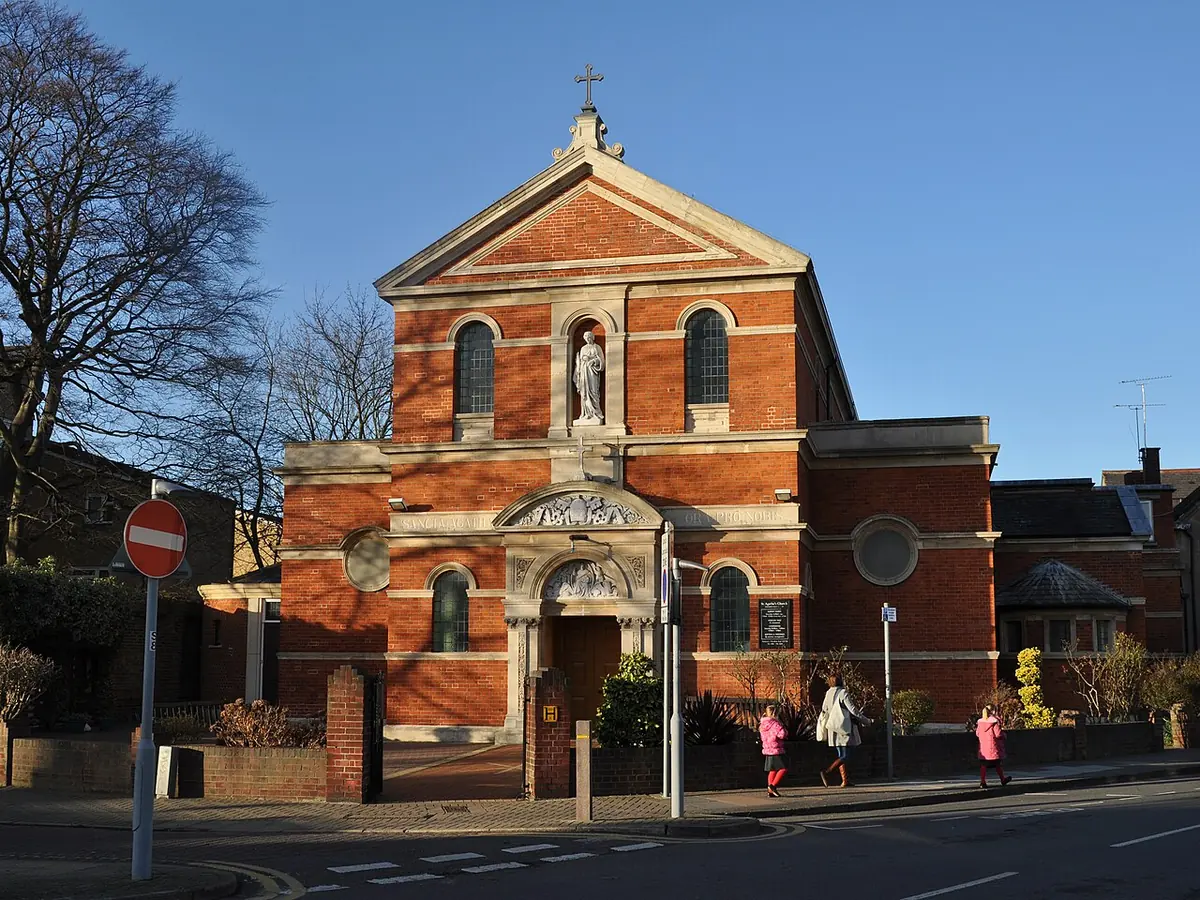
St. Agatha's Catholic Church in Kingston upon Thames keeps a small shrine in his honor with a plaque recalling that he was martyred there for the Catholic faith on September 23, 1588.
Feast day and prayer
We keep Blessed William Way's memory on September 23. In England the beatified martyrs are honored with the canonized martyrs of the Reformation on May 4. You can find other saints and blessed of late September on our feast days page.
There is no traditional prayer to Blessed William Way. The plaque at Kingston ends with a simple invocation, and we can make it ours: "Blessed William Way, pray for us." We pray also for his canonization, and for priests everywhere who face danger to bring the sacraments to their people.
Let us ask Blessed William Way to give us a little of his longing for God, so that we may count nothing too dear to give for Christ.
Frequently asked questions
Who was William Way?
An Elizabethan Catholic priest, born in Devon (probably Exeter), who trained at the English College at Rheims, was ordained at Laon in 1586, and was executed at Kingston upon Thames in 1588 simply for being a priest ordained abroad and working in England.
Is William Way a saint?
Not yet. He was declared Blessed on December 15, 1929, by Pope Pius XI, with 135 other martyrs of England and Wales. People often search for him as St. William Way, but his title is Blessed.
When is the feast of Blessed William Way?
September 23, the date the chronicler John Stow gives for his execution. Some early catalogues give October 1. In England he is also honored with all the martyrs on May 4.
Why is he sometimes called William Flower?
He used the alias Flower in England, and he was arrested and imprisoned under that name. Prison lists call him 'William Flower alias Way.' Older books sometimes wrongly merge him with another priest, William Wigges, who died in Wisbech Castle.
Keep exploring
Sources
- Lives of the English Martyrs, Second Series: The Martyrs Declared Venerable, vol. 1 (London: Longmans, 1914), Venerable William Way, Internet Archive. His Devon birth, the Rheims and Laon dates, his arrest, his trial as told by St. Henry Walpole, the words of Fr. John Gerard and Fr. Grene's Collectanea, and the Flower and Wigges confusion; quoted on this page
- Richard Challoner, Memoirs of Missionary Priests, ed. J. H. Pollen (London: Burns, Oates and Washbourne, 1924), 1588: William Way, Internet Archive. Challoner's short account and Stow's date of September 23
- Acta Apostolicae Sedis 22 (1930): decree of beatification of 136 English martyrs, December 15, 1929. Lists "Gulielmus Flower (Way), sacerdos" among the martyrs beatified by Pius XI
- William Way shrine, St. Agatha's Catholic Church, Kingston upon Thames, Wikimedia Commons. Only source found for the shrine and plaque in St. Agatha's
