The Vietnamese Martyrs

The Vietnamese Martyrs are 117 saints, St. Andrew Dung-Lac and his companions, who died for Christ in Vietnam in the eighteenth and nineteenth centuries: 8 bishops, 50 priests and 59 lay men and women, 96 of them Vietnamese. Pope John Paul II canonized them on June 19, 1988. We keep their feast on November 24, and they are the patron saints of Vietnam.
Who are the Vietnamese Martyrs?
The Vietnamese Martyrs are 117 saints who gave their lives for Christ in Vietnam in the eighteenth and nineteenth centuries. They are honored together under the name of one of them, St. Andrew Dung-Lac, a Vietnamese parish priest beheaded in Hanoi in 1839. Pope John Paul II canonized all 117 in St. Peter's Square on June 19, 1988, and the whole Church keeps their feast on November 24.
In his homily that day the Pope counted them: eight bishops, fifty priests and fifty-nine lay people. Ninety-six were Vietnamese. The rest were missionaries from Spain and France, Dominicans of the Province of the Holy Rosary and priests of the Paris Foreign Missions Society, who had made Vietnam their home. Among the lay people was one woman, Agnes Le Thi Thanh, the mother of six children.
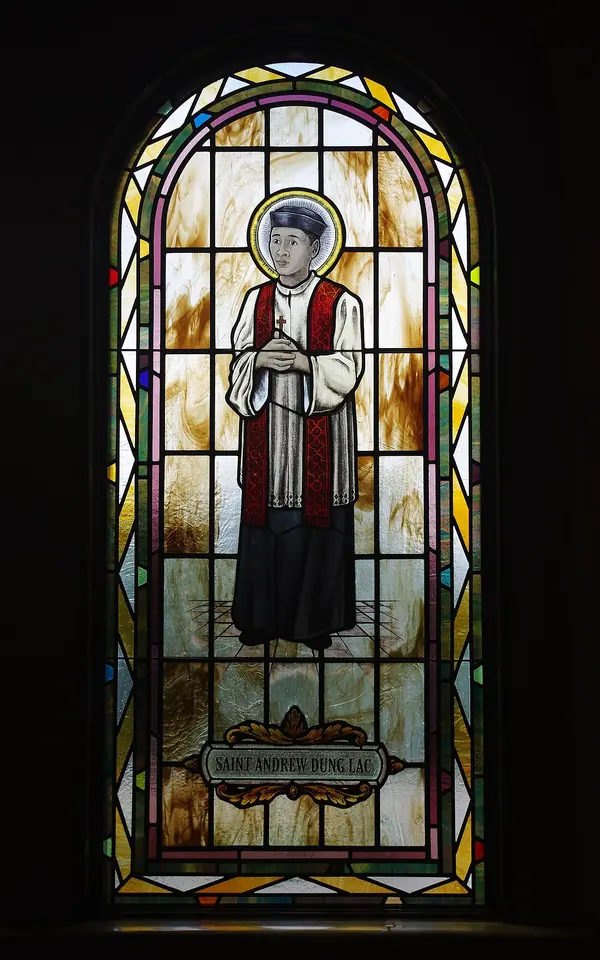
Three centuries of persecution
The Gospel was first preached in Vietnam, John Paul II recalled, in 1533. For three centuries after that, the Church there lived through wave after wave of persecution, with quiet years between. The Pope compared it to the first three centuries of the Church in Rome. Thousands were killed; many more died in exile in mountains, forests and fever-ridden country.
The persecution grew fiercest in the nineteenth century. In 1832, Vatican News recounts, the Emperor Minh Mang banned foreign missionaries and ordered Vietnamese Christians to renounce their faith by trampling on a crucifix. Many would not. Christians had the words tà đạo, "false religion," branded on their faces. Villages were destroyed, families broken up, property seized. The faithful hid their priests in caves and in their own houses, and paid with their lives when they were found.

St. Andrew Dung-Lac
The man whose name the feast carries was born Dung An-Tran about 1795, in a poor family in northern Vietnam that kept the traditional religion of the country. When he was twelve, the family moved to Hanoi to look for work, and the boy was taken in by a Christian catechist who taught him the faith. He was baptized Andrew. In 1823 he was ordained a priest, and his preaching and simple life brought many to baptism.
He was first arrested in 1835, and his parishioners paid a ransom to free him. He changed his name to Lac and moved to another region, but the persecution followed him. John Paul II quoted what Father Andrew said about being bought out of prison again and again:
Those who die for the faith go up to heaven; we, on the other hand, who are always hiding, spend money to escape the persecutors! It would be much better to let ourselves be arrested and die.
In 1839 he was arrested again, this time with another Vietnamese priest, St. Peter Thi, whom he had gone to visit to make his confession. They were ransomed, arrested once more, tortured, and beheaded together in Hanoi on December 21, 1839.

A few of the companions
We can't tell all 117 stories here, but a few names show who they were:
- St. Vincent Liem, a Vietnamese Dominican priest killed in 1773, the first of the ninety-six Vietnamese among the saints, as John Paul II noted.
- St. Agnes Le Thi Thanh, the only woman among them, a mother of six.
- St. Théophane Vénard, a young French priest of the Paris Foreign Missions Society, beheaded near Hanoi in 1861. His cheerful letters home were published after his death, and St. Thérèse of Lisieux loved them.
- Catechists and lay faithful from the villages, whose courage held the Church together when the priests were in hiding.
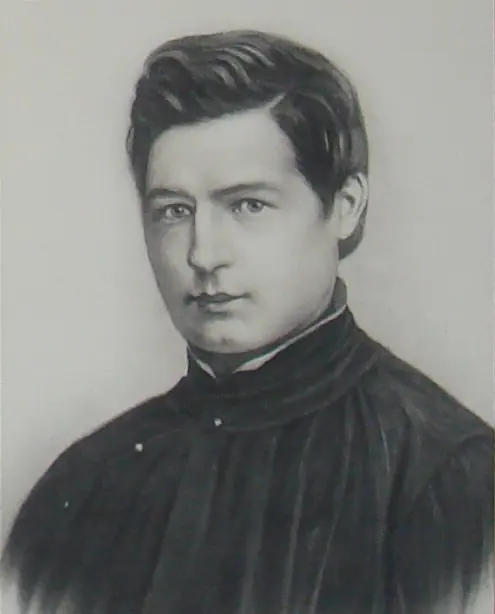
The canonization of 1988
The martyrs had been beatified in several groups during the twentieth century. When John Paul II canonized them together in 1988, Vatican News recalls, the government of Vietnam did not allow a single representative of the country to attend. Instead some 8,000 Vietnamese Catholics from the diaspora filled the square. The 117, the Pope said, stand for a far larger number; Vatican News gives an estimate of 100,000 to 300,000 Vietnamese martyrs in all. Their blood was the seed of a Church that today counts millions of faithful.
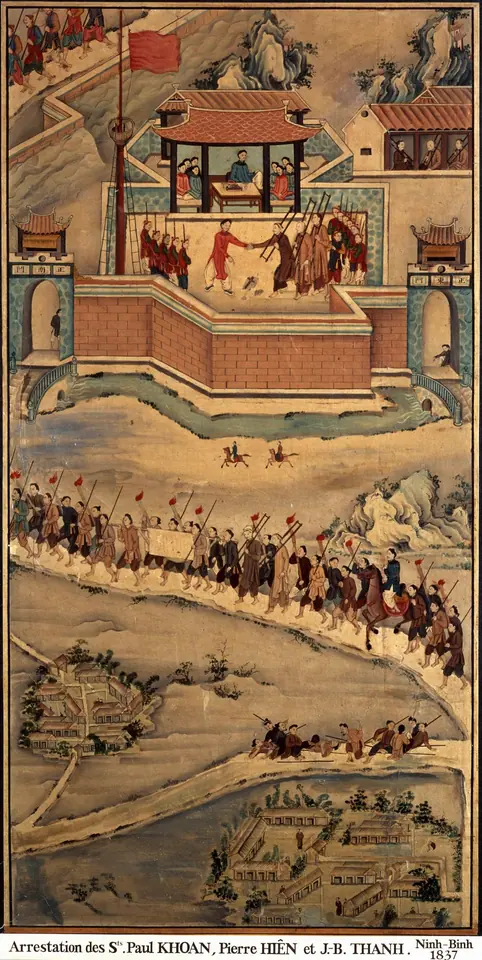
Symbols of the Vietnamese Martyrs in art
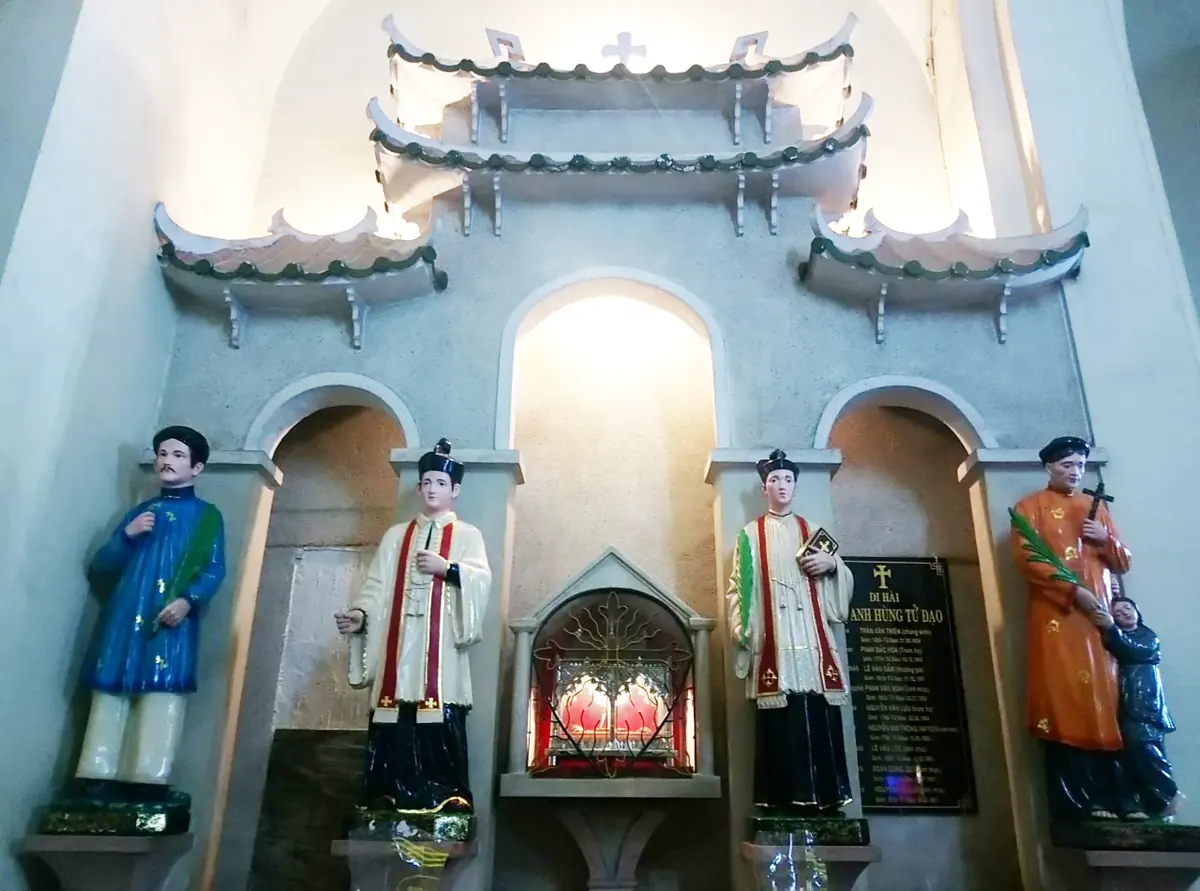
Images of the Vietnamese Martyrs usually show them as a crowd or a representative few, often in traditional Vietnamese dress:
- Martyr's palm: carried by each one, the sign of victory through death.
- Traditional dress: the long tunic and turban or headscarf of nineteenth-century Vietnam, which roots them in their own people.
- Cangue and chains: the heavy wooden collar locked around prisoners' necks, and the chains of the prisons where many spent months or years.
- Priest's vestments: St. Andrew Dung-Lac is usually shown in cassock, surplice and stole, sometimes holding a crucifix.
- Bishops and missionaries: European bishops in simple cassocks with pectoral crosses stand among them, as brothers rather than masters.
Many Vietnamese churches have a chapel of the martyrs with a few representative figures standing for all of them, as in the cathedral of Ho Chi Minh City.
Feast day and prayer
We keep the memorial of St. Andrew Dung-Lac and Companions on November 24, and in Vietnam and in Vietnamese parishes around the world it is one of the great days of the year. See the feast day calendar.
The Church prays for their intercession in the Mass of the day, asking that we, like them, may be faithful to Christ. In our own words, let us ask the holy martyrs of Vietnam to pray for the Church in their homeland, for Vietnamese families scattered across the world, and for every Christian who must still choose between hiding and witness.
Frequently asked questions
Who are the 117 Vietnamese Martyrs?
Eight bishops, fifty priests and fifty-nine lay people, according to Pope John Paul II's canonization homily. Ninety-six were Vietnamese; the other twenty-one were Spanish and French missionaries, mostly Dominicans of the Holy Rosary Province and priests of the Paris Foreign Missions Society. Among them was one woman, Agnes Le Thi Thanh, a mother of six.
Who was St. Andrew Dung-Lac?
A Vietnamese diocesan priest, born about 1795 to a poor non-Christian family, baptized after a catechist took him in, and ordained in 1823. Ransomed from prison more than once by his parishioners, he was beheaded in Hanoi on December 21, 1839, with St. Peter Thi. The feast bears his name on behalf of all 117.
When is the feast of the Vietnamese Martyrs?
November 24, an obligatory memorial throughout the Latin Church.
How many Christians were martyred in Vietnam?
The 117 canonized saints stand for a much larger number. Vatican News gives an estimate of between 100,000 and 300,000 Vietnamese Christians who died for the faith over three centuries.
Sources
- Pope John Paul II, Homily for the canonization of 117 Vietnamese martyrs, June 19, 1988 (Italian, vatican.va). The numbers (8 bishops, 50 priests, 59 laity), Agnes Le Thi Thanh, Vincent Liem, and St. Andrew Dung-Lac's words (our translation)
- Vatican News: Sts. Andrew Dũng Lạc and his companions, martyrs (November 24). The life of St. Andrew Dung-Lac, Minh Mang's edict, the estimate of 100,000 to 300,000 martyrs, and the 1988 canonization