Blessed Margaret of Savoy, Marchioness of Montferrat and Dominican Nun
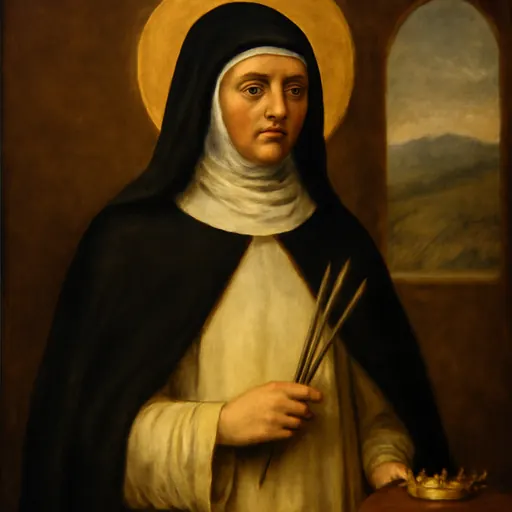
Blessed Margaret of Savoy (about 1390–1464) was a princess who married Theodore II, Marquis of Montferrat. Widowed in 1418, she refused to marry the Duke of Milan and founded at Alba a community that became a monastery of Dominican nuns, where she died on November 23, 1464. She was beatified in 1669 and is shown holding three arrows.
Who was Blessed Margaret of Savoy?
Blessed Margaret of Savoy was a fifteenth-century princess of Piedmont who married into the ruling house of Montferrat and ended her life as a Dominican nun. Widowed at about twenty-eight, she turned down a proposal from the powerful Duke of Milan, gathered a group of women at Alba, and built the monastery of Santa Maria Maddalena, where she died on November 23, 1464. In art she holds three arrows, the sign of the trials she accepted from Christ.
Two kinds of source tell her story. The modern historical one is Luigi Provero's article in the Dizionario Biografico degli Italiani (2008), drawn from treaties, papal bulls and the monastery's records. The devotional one goes back to the Italian lives of the 1600s and is summed up in English in the Dominican Short Lives of the Dominican Saints (1901). We follow the first for dates and the second for the stories, and say which is which.
The life of Blessed Margaret of Savoy
A princess of Savoy-Achaea
Margaret was the daughter of Amedeo of Savoy, Prince of Achaea and Lord of Piedmont, and Catherine of Geneva, and was probably born at Pinerolo about 1390. (The 1910 Catholic Encyclopedia gives 1382 and different parents, following older lives; Provero corrects both.) Her father died in May 1402 with no son, and Margaret and her sister passed into the care of their uncle Louis.
Marchioness of Montferrat
Louis used her to make peace with a troublesome neighbor. By the treaty of Asti of March 29, 1403, Margaret, about thirteen, was promised to Theodore II Palaiologos, Marquis of Montferrat, a widower descended from the Byzantine emperors. They were married in Turin on October 18, 1403. From 1409 to 1413 Theodore governed Genoa, and Margaret lived there with him. The marriage lasted fifteen years and had no children.
The Dominican lives say that the preaching of St. Vincent Ferrer, who spent months in the region, set Margaret on a path of hidden penance and prayer while she was still a marchioness.
Widow at Alba
Theodore died in 1418. Margaret did not return to the marriage market. She refused Filippo Maria Visconti, Duke of Milan, and retired to the marquises' palace at Alba with women of her court, where they lived as Dominican tertiaries. The Short Lives adds that the duke obtained a papal dispensation from her private vow and pressed his suit again, and that she answered she wanted no dispensation.
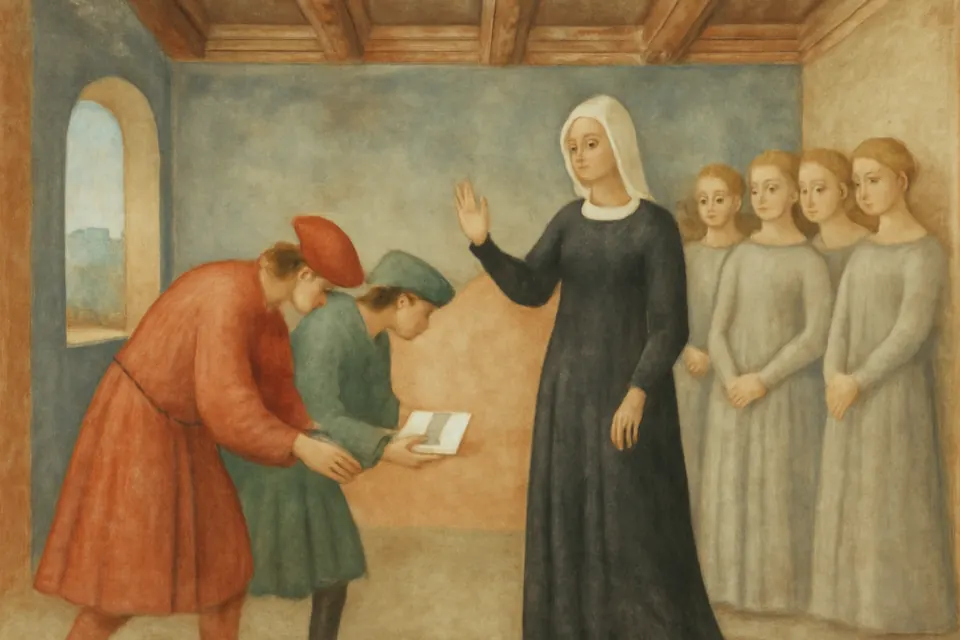
The little community grew slowly into a true monastery. In 1441 Pope Eugene IV gave it the nearby church of Santa Maria Maddalena. In 1446 the sisters made profession as Dominican nuns of the Second Order, and the new monastery was blessed in 1448. Most of the sisters came from Alba and Montferrat.

Death at Alba
Margaret died in her monastery on November 23, 1464. She was buried on December 13 in a simple tomb, and in 1481 the Marquis William of Montferrat paid for a marble sarcophagus inside the monastery.

The miracles and legends of Blessed Margaret
All the wonders told of her are traditional: they come from the lives written in the 1600s and are not judged in any formal process. No miracle was approved for her beatification, which confirmed an old cult.
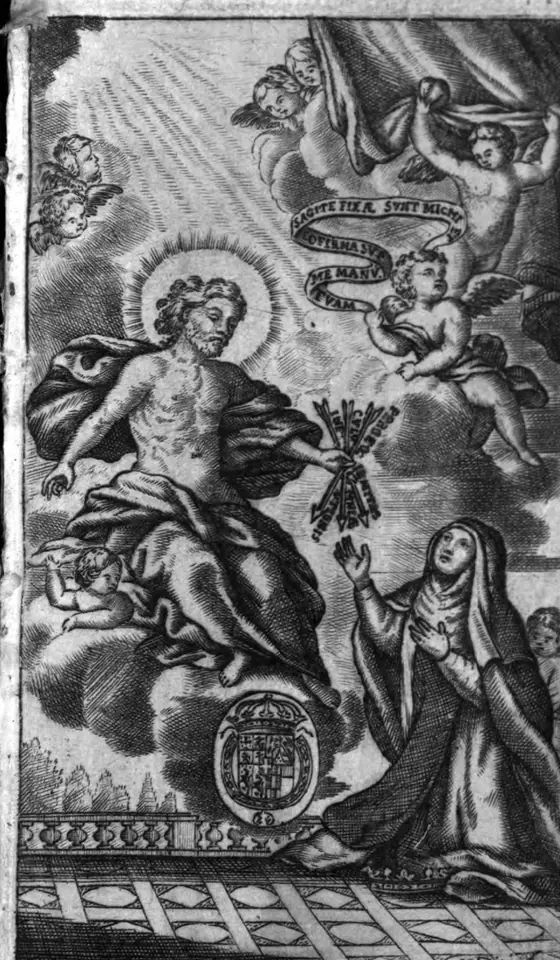
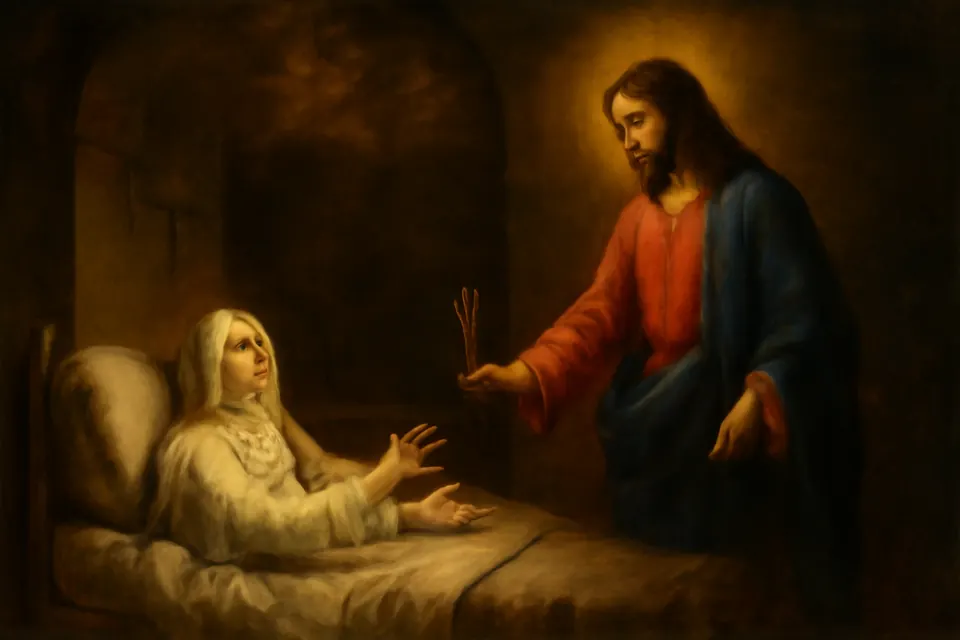
- The three arrows. When she lay sick, the Short Lives says, Christ appeared to her with angels, holding three darts inscribed "Calumny, Sickness, and Persecutions," and bade her choose. She gave herself to His will, and He left her all three. Soon after, the Duke of Milan's court accused her to the pope of favoring the Waldensian heresy.
- The storm over Alba. Her prayers are said to have calmed a violent tempest that threatened the town.
- Her death. The lives tell of heavenly music in her cell, of a religious no one knew who held her up as she received the last sacraments and was taken to be St. Catherine of Siena, and of the convent bell tolling by itself at her passing.
Her cult and beatification
Devotion began in Alba as soon as she died. In 1566 Pope St. Pius V, who had been prior of the Dominicans at Alba, allowed the nuns to keep a yearly commemoration of their foundress. The house of Savoy took up her cause in the next century, visited her tomb and obtained relics, and she was beatified in 1669. Clement X extended her cult to the Dominican Order in 1671, and Clement XIV to all the Savoy lands in 1774.
Symbols of Blessed Margaret of Savoy in art
- Three arrows: her emblem, for the vision in which she accepted calumny, sickness and persecution.
- Dominican habit: white habit and black veil, as in the 1629 painting above.
- Crown: worn over the veil or laid aside at her feet, for the marchioness who gave up rank.
In a church in Piedmont, look for a nun with a crown and a sheaf of arrows.
Feast day and where she is honored
We keep her feast on November 23. She is honored above all at Alba, where her body rests in the church of Santa Maria Maddalena, and among the Dominican nuns. See our feast days calendar.

Prayer to Blessed Margaret of Savoy
This is the collect of her feast as printed in the Dominican Short Lives of 1901:
O God, who didst teach Blessed Margaret to forsake with all her heart the pomps of this world for the humble following of Thy Cross, grant that, by her merits and example, we may learn to tread under foot the perishable delights of the world, and in the embraces of Thy Cross to overcome all adversities. Who livest and reignest world without end. Amen.
Let us ask her to pray for widows, for those who carry illness or false accusation, and for all who are tempted to choose comfort over God. Blessed Margaret of Savoy, pray for us.
Frequently asked questions
Who was Blessed Margaret of Savoy?
A princess of Savoy-Achaea, married in 1403 to Theodore II Palaiologos, Marquis of Montferrat. After his death in 1418 she retired to Alba with a group of women, lived as a Dominican tertiary, refused the Duke of Milan, and founded the Dominican monastery of Santa Maria Maddalena, where she died in 1464.
When is the feast of Blessed Margaret of Savoy?
November 23, the day she died at Alba in 1464. Some older Dominican books keep her on November 27.
What do the three arrows of Blessed Margaret of Savoy mean?
Her old lives tell that Christ appeared to her with three darts marked Calumny, Sickness and Persecution and let her choose. She accepted all three, and trials of each kind followed. The arrows became her emblem in art.
Where is Blessed Margaret of Savoy buried?
In Alba, in the church of the monastery she founded, Santa Maria Maddalena. Her body was moved to a marble tomb there in 1481.
Keep exploring
Sources
- Luigi Provero, "Margherita di Savoia-Acaia, marchesa di Monferrato," Dizionario Biografico degli Italiani 70 (2008), Treccani. Her parents, probable birth in 1390, the treaty of Asti and the wedding of 1403, Genoa, the bulls of 1441 and 1448, profession in 1446, the 1481 translation, Pius V's permission of 1566, beatification in 1669 and the bulls of 1671 and 1774
- Short Lives of the Dominican Saints, ed. John Procter (London, 1901), pp. 334–337. The traditional life: St. Vincent Ferrer, the vision of the three darts, the Waldensian calumny, the miracles at Alba, her death, and the collect of her feast
- Léon Clugnet, "Blessed Margaret of Savoy," Catholic Encyclopedia (1910). The older account, with birth in 1382 and a list of the early Italian lives (Baresiano 1638, Barisano 1692)