St. Innocent of Irkutsk, First Bishop of Irkutsk
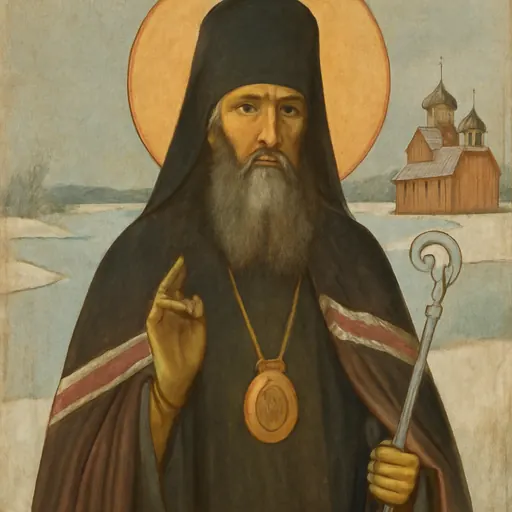
St. Innocent of Irkutsk (about 1680–1731), born John Kulchitsky, was a Russian Orthodox monk and the first bishop of Irkutsk in eastern Siberia. Sent as a missionary bishop to China and refused entry, he served the vast new diocese of Irkutsk in great poverty and founded its first schools. His incorrupt relics rest in Irkutsk, and the Orthodox Church keeps his feast on November 26.
Who was St. Innocent of Irkutsk?
St. Innocent of Irkutsk was the first bishop of Irkutsk, the great diocese of eastern Siberia, and one of the best-loved saints of Siberia. Born John Kulchitsky about 1680, he was a learned monk who was sent to be a bishop in China, was turned back at the border, and spent the rest of his short life caring for a frontier Church in deep poverty. He died on November 27, 1731, at about fifty-one. Thirty-three years later his body was found incorrupt, and the Orthodox Church has honored him as a saint since the early 1800s.
We keep his feast on November 26, the eve of his repose, because November 27 belongs to the icon of the Mother of God of the Sign.
From Kiev to the court of Peter the Great
The Orthodox Church in America tells his life. The Kulchitskys were a noble family from Volhynia who had moved to the Chernigov region in the mid-seventeenth century. John was educated at the Kiev Academy and became a monk in 1710, taking the name Innocent. He taught at the Slavonic-Greek-Latin Academy in Moscow as prefect and professor of theology. In 1719 he moved to the Alexander Nevsky Lavra in St. Petersburg, Peter the Great's new capital, and was made chief chaplain of the navy.
On February 14, 1721, he was consecrated Bishop of Pereyaslavl and named head of the Russian spiritual mission in Peking.
Turned back at the border
He never reached China. The Russian Senate's papers had described him, carelessly, as "a spiritual personage, a great lord," and the Chinese government refused to let such a figure in. For three years Innocent waited at Selenginsk on the frontier, without a clear position, short of everything, and grieved by the disorder of the civil government in Siberia. Diplomatic blunders and intrigue finally gave the China mission to another man, the archimandrite Anthony Platkovsky.
First bishop of Irkutsk
In 1727 the Holy Synod named Innocent bishop of the new diocese of Irkutsk and Nerchinsk. It was enormous, thinly settled, and without roads, and many of its people, Buryats, Mongols and others, had never heard the Gospel. Through what the OCA calls "a strange oversight of the Senate," he received no salary until he died. He lived in real want.
Even so, he opened two schools at the Ascension Monastery in Irkutsk, one Mongol and one Russian, and he worried constantly about teachers, books and clothes for the students. He wrote sermons, pastoral letters and instructions for his clergy, began a stone church at the monastery, and extended the diocese to Yakutsk and Ilimsk.

The drought of 1728
In the spring of 1728 a drought struck the Baikal region, after a poor harvest the year before. With the bishop's blessing, every Liturgy in the churches of Irkutsk included a moleben for rain; on Saturdays the people sang the Akathist to the Mother of God, and on Sundays another moleben. The prayers, Innocent said, "should end on the Feast of Saint Elias," July 20. On that very day, the OCA records, such a storm broke over Irkutsk that water stood knee-deep in the streets. We count this among his reported wonders.

Incorrupt relics and glorification
Innocent died on the morning of November 27, 1731. In 1764, during repairs to the Tikhvin church of the Ascension Monastery, his body was found incorrupt. People across Siberia began to pray to him, and many healings were reported. In 1783 a great fire burned nearly everything at the monastery, but the old wooden church where his body lay was untouched. On February 9, 1805, the Holy Synod decided to uncover his relics and number him among the saints, and in 1831 they were carried in procession into the Ascension Cathedral.
In 1921 the Soviets subjected the relics to a "medical examination" and carried them off to an anti-religious museum, where they were shown as the mummified remains of an unknown man. In 1990 they were found in a utility room of a church in Yaroslavl. They came home to Irkutsk that September and now rest in the Znamensky Monastery.

Where the relics of St. Innocent of Irkutsk are kept: see them on the relics map →
Symbols of St. Innocent of Irkutsk in icons
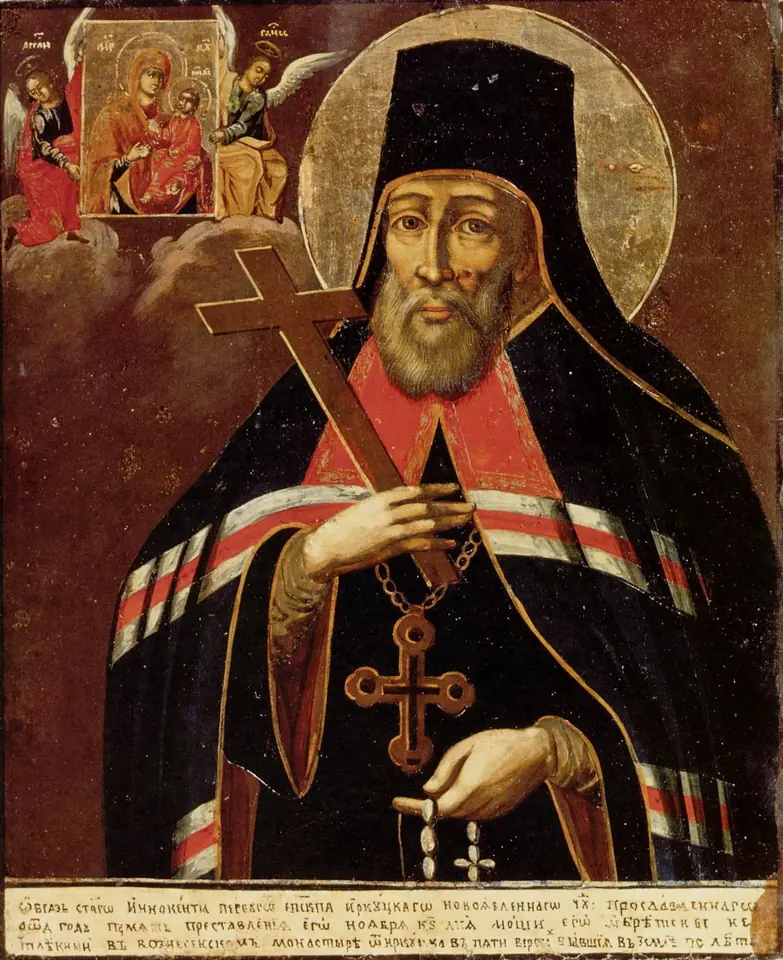
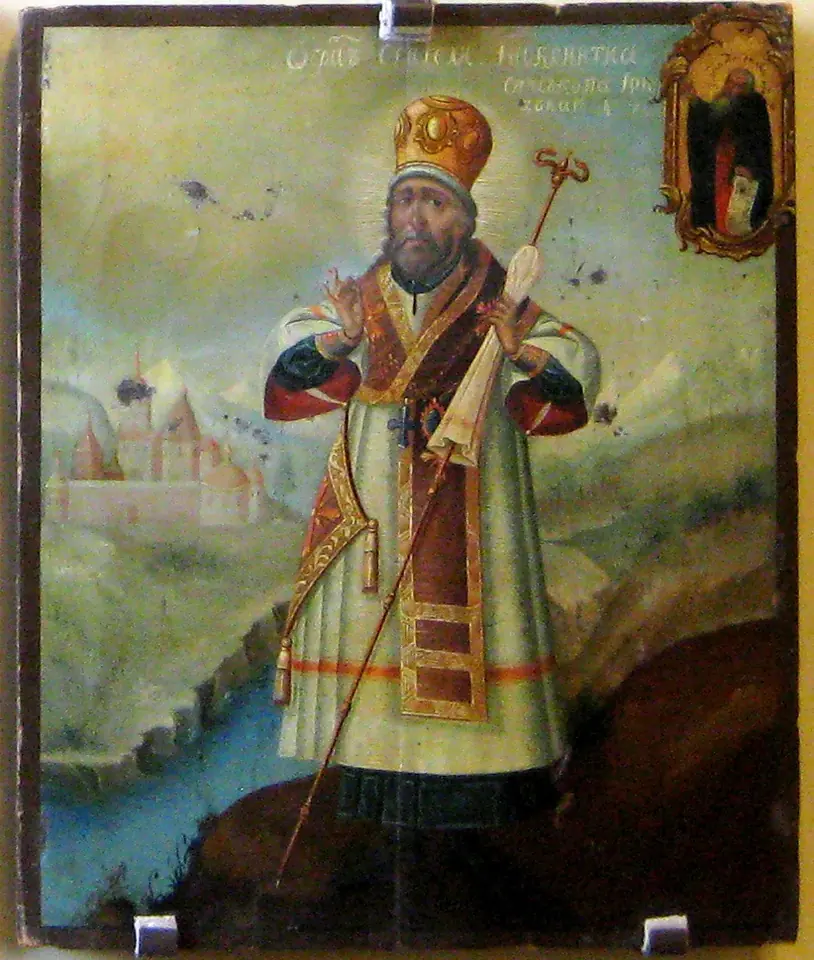
Russian icons show him as a monk-bishop of the early eighteenth century:
- Black klobuk and bishop's mantle: the tall monastic headdress and the striped mantle of a bishop who was first a monk.
- Cross or staff: the cross he carried to a missionary land, or the bishop's staff of his office.
- Hand raised in blessing: his care for his flock.
- The Sign icon of the Mother of God: often shown above him, because his feast is moved for hers.
- Siberian landscape: in some icons he stands by a river before the walls of the Irkutsk monastery.
Feast day and prayer
The Orthodox Church keeps the feast of St. Innocent of Irkutsk on November 26, with further commemorations on February 9 and September 2. See the feast day calendar.
In the Orthodox Church his troparion (Tone 3) praises him as a bright light of the Church in Siberia, a healer of the faithful who came to his shrine, and asks him to keep us from misfortune and sorrow. The OCA prints the full text on its website.
Let us ask St. Innocent to pray for missionaries sent where they are not welcome, for teachers in poor schools, and for the faithful of Siberia.
Frequently asked questions
Who was St. Innocent of Irkutsk?
John Kulchitsky, a monk of a noble Ukrainian family educated at the Kiev Academy, who became a professor in Moscow, chief naval chaplain in St. Petersburg, and in 1721 a bishop for the Russian mission to China. Refused entry by the Chinese, he became the first bishop of Irkutsk in 1727 and died there in 1731.
When is the feast of St. Innocent of Irkutsk?
November 26, the eve of his repose on November 27, 1731. The Orthodox Church also remembers him on February 9 for the uncovering of his relics and on September 2 for their return to Irkutsk in 1990.
Is St. Innocent of Irkutsk the same as St. Innocent of Alaska?
No. St. Innocent of Irkutsk died in 1731. St. Innocent of Alaska, John Veniaminov, was born in the Irkutsk province in 1797 and became the apostle to Alaska and later Metropolitan of Moscow. He took the monastic name Innocent in honor of the first bishop of Irkutsk.
Where are the relics of St. Innocent of Irkutsk?
In the Znamensky (Sign) Monastery in Irkutsk. Found incorrupt in 1764, they were taken by the Soviets in 1921, rediscovered in Yaroslavl, and brought home to Irkutsk in 1990.
Keep exploring
Sources
- Orthodox Church in America: Repose of Saint Innocent, first Bishop of Irkutsk (November 26). His life, the refusal at the Chinese border, his schools, the drought of 1728, the finding of his body in 1764 and the fate of his relics
- Orthodox Church in America: Uncovering of the relics of Saint Innocent, Bishop of Irkutsk (February 9). The fire of 1783, the Synod's decision of February 9, 1805, the transfer of 1831, the rediscovery in Yaroslavl and his other feast days
- Orthodox Church in America: Troparion and Kontakion of St. Innocent of Irkutsk. The troparion in Tone 3